

Highlight Reel: Saturday Football Finals
November 28, 2016
By John Johnson
MHSAA Communications Director
The final day of the MHSAA 11-Player Football Finals at Ford Field in Detroit – powered by the Michigan Army National Guard – produced a first-time gridiron champion and a game-winning play that will be talked about for a long time.
Division 7
Pewamo-Westphalia 28, Detroit Loyola 14
Logan & Lehman Go Long - The Pewamo-Westphalia combo of quarterback Jimmy Lehman and receiver Logan Hengesbach connected for two touchdowns in the Division 7 title game against Detroit Loyola. Here's the second TD in the third quarter, with Hengesbach winning the jump ball to complete a 37-yard scoring play.
Johnson Powers Into the End Zone - Detroit Loyola gets on the board midway through the fourth quarter, when TE Keith Johnson makes a great play to catch a pass from Price Watkins and then power into the end zone to complete the 18-yard score.
Division 1
Detroit Cass Tech 49, Detroit Catholic Central 20
CC Takes the Early Lead - Detroit Catholic Central led 14-7 at the end of the first quarter, taking the lead on this 35-yard pass interception return by Jack Morris.
The Peoples' Choice for Cass Tech - Detroit Cass Tech QB Rodney Hall tied a Finals record with five touchdown passes against Detroit Catholic Central - two going to Donovan Peoples-Jones, including this 49-yarder in the third quarter.
Division 5
Grand Rapids West Catholic 43, Menominee 7
Meyers Off to the Races - Grand Rapids West Catholic scored its first TD against Menominee on a pitch and catch from Gaetano Vallone to Brett Meyers covering 91 yards.
Hass Records a Finals First - Menominee uses special teams to get on the board in the third quarter. Sam Larson blocks the West Catholic field goal attempt, and Hunter Hass returns it 76 yards for a TD – the first time in Finals history a blocked field goal has been returned for a score.
Division 3
Orchard Lake St. Mary’s 29, Muskegon 28
Pimpleton's Second Score - Lined up in the slot, Muskegon's Kalil Pimpleton gets his second 18-yard rushing touchdown of the Division 3 Final against Orchard Lake St. Mary's on the end-around to give his team a 21-20 lead early in the fourth quarter.
A Catch for the Ages - In the closing seconds of the Division 3 Final, Orchard Lake St. Mary's QB Caden Prieskorn hits Ky’ren Cunningham in the end zone with an 18-yard touchdown strike to give the Eaglets the win.
The MHSAA Football Finals are sponsored by the Michigan National Guard.
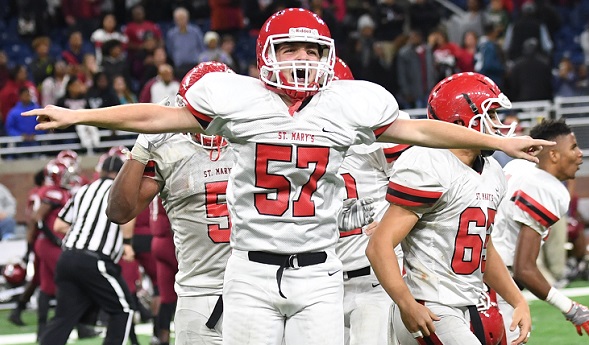
PHOTO: Orchard Lake St. Mary's Chris Bean celebrates during Saturday's Division 3 Final.

Heads and Heat
August 16, 2012
We are engaged in very serious discussions. They’re not only complicated, with unintended negative consequences possible from what are thought to be positive actions; they’re also a matter of life and death.
The topic is football – the high school sport under most scrutiny today and suffering from the most criticism it’s seen since the 1970s when catastrophic neck injuries spiked, liability awards soared, many insurers balked, and most helmet manufacturers abandoned the business altogether.
During recent years we have learned about the devastating long-term effects of repeated blows to the head; and we’re trying to reduce such hits. We’ve learned that 70 percent of concussions in football result from helmet-to-helmet contact, and we’re trying to have coaches teach blocking and tackling differently and have officials penalize “high hits” consistently and rigorously.
During the past several years we’ve learned that serious heat illness and heat-related deaths are 100 percent preventable, yet nationwide there were 35 heat-related deaths in high school football alone from 1995 to 2010; and we’re promoting practices that acclimatize athletes more gradually than “old school” traditionalists might advocate.
As we simultaneously address issues of heads and heat in football, some coaches may think we’re being overbearing, while many in medical fields say we’re out of date, citing higher standards of the American Academy of Pediatrics, National Athletic Trainers Association and National Federation of State High School Associations, as well as many of our counterpart organizations across the country.
As we consider in-season changes to improve athlete acclimatization and reduce blows to the head, we should be open to making out-of-season changes that work toward rather than in opposition to those objectives. There can be no sacred cows. The topic is too serious.
Ultimately, if we err in the outcome of this year’s discussions about heads and heat in football, it must be on the side of safety, on minimizing risks for student participants. They deserve it and, once again, the sport of football needs it.