

Hill's Return Aids Onsted Playoff Climb
November 22, 2019
By Doug Donnelly
Special for Second Half
ONSTED – Travis Hill only played in three games for the Onsted football team last season.
 But it was those three games that helped pave the way for the senior to rush for more than 1,300 yards and help the Wildcats reach this weekend’s Division 6 Semifinals.
Hill broke his collarbone at practice the Wednesday before Onsted’s season opener in 2018.
“They told me I wouldn’t be back that season,” Hill said. “I recovered quick, I guess.”
Hill’s competitive drive put him on the fast track. He was back on the field for the final three games of the season. The Wildcats finished 3-6 on the year, but Hill’s return was important.
“It was pretty difficult (to come back),” Hill said. “But, those three games helped me be mentally prepared. … The first couple of plays, I was hesitant. But ever since then, I’ve felt good and confident in it.”
Last football season wasn’t the first time Hill had to miss time from the court or field. He broke the same collarbone during his sophomore basketball season. He was one of the key players on Brad Maska’s varsity hoops team when he went down with the injury.
“Travis is as competitive as any athlete I’ve ever coached, and I’ve coached a lot of really competitive guys,” said Maska. “He’s one of those rare athletes who could be all-state in baseball, all-state in basketball and all-state in football. He works hard and has a lot of drive.”
A healthy Hill has paid huge dividends for the Wildcats football team. Onsted started this season 2-0, slipped to 2-2 and hasn’t lost since. Two playoff wins avenged the Wildcats’ two regular-season losses – against Blissfield and Lenawee County Athletic Association champion Hillsdale.
“It’s been great and so much fun,” Hill said.
“We had a hot start, and then lost two games in a row. We could have either went up north and played really well, or we could have went south. We decided to get our stuff together and play well as a team. We’ve been playing pretty well since then.”
Hill has been a big reason why.
Through the Regional Final win over Hillsdale, Hill has 186 carries for 1,312 yards on the ground and another 23 receptions for 390 yards receiving. He has rushed for 14 touchdowns, caught four passes for touchdowns and returned a kick for a score.
On defense, he has 52 tackles, four interceptions and a forced fumble. He returned one of those interceptions for a touchdown.
He seldom takes a play off.
“He’s very talented but, more than that, it’s his competitive spirit,” Onsted coach Dan Terryberry said. “He just wants to win so bad. He’s explosive and doesn’t want to be denied.”
The Wildcats will face Monroe St. Mary Catholic Central in their Division 6 Semifinal at 1 p.m. Saturday at Ypsilanti Lincoln High School. For Onsted, this has been the deepest run in the playoffs since Hill’s uncles – including one of the most prolific passers in Lenawee County history John Hutchinson – led the Wildcats to the 1993 Class CC championship game.
Hill isn’t the only 1,000-yard back in the Wildcats’ backfield. Terryberry also leans heavily on Rourke Barth (1,025 yards). Junior quarterback Dylan Terryberry has more than 1,000 yards passing.
Coach Terryberry credits the Wildcats offensive line for much of the success.
“This is the first year that line has played all together, and a couple of them are playing new positions,” said Coach Terryberry. “They have grown a lot this season. They’ve bought in and are playing well.”
Dylan Stevens is one of those linemen. He’s a senior, like Hill, and is glad to have his classmate back for this season.
“It’s made a huge difference,” Stevens said. “Travis is an outstanding athlete on both sides of the ball. Not having him last year hurt us quite a bit.”
Terryberry, in his 16th season as Onsted’s head coach, is from Charlevoix. A former high school quarterback, he walked on at Michigan State. He started teaching and coaching at Tecumseh, where he served as offensive coordinator for the varsity football team and as the junior varsity head coach.
Having Hill play in those three games at the end of the 2018 season, Terryberry said, put any fears about the injury to rest.
“He’s pretty fearless and super competitive,” Terryberry said.
Hill has had numerous big games. He had 190 yards rushing against Dundee, and more than 175 against Blissfield in the first round of the playoffs. The Onsted faithful are hoping for at least one more big game Saturday against the Falcons (10-1), who were the No. 1-ranked team in the final regular-season Associated Press poll.
“It’s been a great experience so far, and we hope we aren’t done yet,” Hill said. “… I think it’s a mindset. We’ve played well. We knew we had the opportunity; if we put the work in, we could just keep going and keep going farther.”
 Doug Donnelly has served as a sports and news reporter and city editor over 25 years, writing for the Daily Chief-Union in Upper Sandusky, Ohio from 1992-1995, the Monroe Evening News from 1995-2012 and the Adrian Daily Telegram since 2013. He's also written a book on high school basketball in Monroe County and compiles record books for various schools in southeast Michigan. E-mail him at [email protected] with story ideas for Jackson, Washtenaw, Hillsdale, Lenawee and Monroe counties.
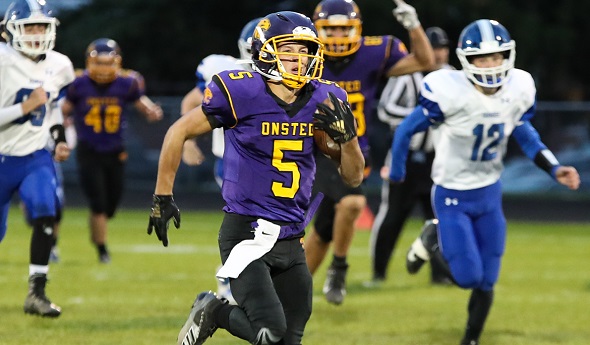
PHOTO: Onsted's Travis Hill (No. 5) rushed for more than 1,300 yards this season, a year after missing six games due to breaking his collarbone. (Photo courtesy of Onsted Athletics/T.J. Olsen.)
1st & Goal: 2025 Playoffs Week 2 Review
By
Geoff Kimmerly
MHSAA.com senior editor
November 11, 2025
Kent City, Hanover-Horton, Springport, St. Clair Shores Lakeview and Allen Park Cabrini hoisted football District championship trophies for the first time.
 Blanchard Montabella brought home its first Regional title and also was among a handful of teams that set school wins records during a highlight-filled second weekend of the MHSAA Football Playoffs.
We checked in with all eight 8-Player Regional Finals below and also glanced at 32 of our 11-Player District championship games as the field was reduced to 72 teams.
11-Player Division 1
HEADLINER Clarkston 44, Grand Blanc 22 Three players scored multiple touchdowns and Clarkston (10-1) held Grand Blanc to well below half of its season average of 48 ppg in dealing the Bobcats (10-1) their only loss. The District title was the Wolves’ third in four years. Click for more from the Oakland Press.
👀Most watched: 🏈District Final – Clarkston beats Grand Blanc 44-22. QB Alex Waszczenko ran for two TDs in the win.
Subscribe & watch all the action on @NFHSNetwork >> https://t.co/MMNs3IcM1v #football #watchnow #nfhsnetwork #MHSAA pic.twitter.com/dH6EnKPou3— MHSAA (@MHSAA) November 10, 2025
District Digest East Kentwood 49, Howell 41 The Falcons claimed their first District championship since 2014 and ended Howell’s season a win shy of what would have been a second straight for the Highlanders (9-2). Hudsonville 42, Rockford 31 The Eagles (11-0) finished a season sweep of the Rams (8-3) for the first time to repeat as District champs. Rochester Adams 43, Rochester Hills Stoney Creek 18 These Highlanders (9-2) won their fourth District title over the last five seasons, pulling away after previously defeating Stoney Creek (7-4) by only six points in Week 6.
11-Player Division 2
HEADLINER Traverse City Central 16, Muskegon 14 The Trojans (7-4) have opened these playoffs with a pair of unforgettable two-point wins, this one to claim their first District title since 2021. The Big Reds closed a solid rebound season also at 7-4 after finishing 3-5 a year ago. Click for more from the Traverse City Record-Eagle.
TRAVERSE CITY CENTRAL BACK ON TOP. The Trojans capture their first District Title since 2021 with a 16-14 win over Muskegon in the Division 2 District Final. Delivered by @hungryhowies pic.twitter.com/4jQuHy1jRd
— STATE CHAMPS! Michigan (@statechampsmich) November 8, 2025
District Digest Orchard Lake St. Mary’s 35, Bloomfield Hills Brother Rice 14 The Eaglets (8-2) saw their three-year winning streak over Rice (6-5) end with a 43-31 loss in Week 8, but they reversed that result to win a third District title over four seasons. Dexter 41, South Lyon 27 The Dreadnaughts (10-1) claimed their second District title over the last four years and delivered South Lyon (10-1) its lone loss by overcoming a defense that had given up only 12 points per game. Portage Central 34, Byron Center 7 After allowing more than eight points in a game (19) last week for the first time all season, Central (11-0) was back to its single-digit success in ending this run for last season’s Division 2 runner-up Bulldogs (7-4).
11-Player Division 3
HEADLINER Zeeland West 48, St. Joseph 24 If reigning Division 3 champion Zeeland West is going to return to Ford Field, the Dux are going to pile up plenty of miles along the way. West (8-3) went on the road for not only the second time this playoffs, but fifth-straight week and defeated St. Joseph (6-5) in a District Final for the second-straight season. West heads to Lowell next. Click for more from the Holland Sentinel.
District Digest Mount Pleasant 42, Gaylord 0 The Oilers (11-0) put up perhaps their most impressive performance against one of their most notable opponents, claiming their third shutout this season in handing Gaylord (10-1) its lone defeat. Lowell 28, Middleville Thornapple Kellogg 21 The Red Arrows (9-2) jumped out to a 21-0 halftime lead and held on for a first District title since 2016, ending MTK’s run at 7-4. Fenton 35, Adrian 7 The Tigers (8-3) also earned their first District championship since 2016, ending Adrian’s winningest season since 2010 at 9-2.
11-Player Division 4
HEADLINER Goodrich 27, Chelsea 7 Make that 24 straight wins and four straight District championships for the reigning Division 4 champion Martians, who this week will pursue a fourth-straight Regional title as well. Goodrich (11-0) stopped a Chelsea offense that hadn’t scored fewer than 28 points in a game. The Bulldogs finished 9-2. Click for more from the Flint Journal.
District Digest Big Rapids 48, Escanaba 18 The Cardinals (10-1) made the trip north and came back with their second District title in three seasons, ending Escanaba’s best run this decade at 9-2. Williamston 42, Haslett 21 The Hornets (11-0) trailed 21-7 at halftime but scored 28 unanswered points during the third quarter to clinch a first District title since 2020 and end Haslett’s season at 8-3. Portland 28, Grand Rapids Christian 0 After surviving a first-round matchup with Grand Rapids South Christian 42-41, Portland locked up its fourth shutout and ninth game giving up seven points or fewer to get past the Eagles (6-5), who were making their first playoff run since 2022.
11-Player Division 5
HEADLINER Grand Rapids West Catholic 21, Grand Rapids Catholic Central 20 (OT) West Catholic (10-1) defeated rival Catholic Central for the first time since 2016, stopping a 2-point conversion try to close it out. Catholic Central (10-1) had ended the Falcons’ last two seasons with playoff losses and won nine straight District titles entering this playoffs. Click for more from the Grand Rapids Press.
WEST CATHOLIC STANDS TALL. Jacob Timmer came up with the clutch stop on Grand Rapids Catholic Central’s 2-point try in OT as the Falcons win 21-20 to claim the Division 5 @MHSAA District Crown. pic.twitter.com/r4uZ4OxpIW
— STATE CHAMPS! Michigan (@statechampsmich) November 8, 2025
District Digest Michigan Center 35, Ann Arbor Father Gabriel Richard 18 This made nearly as big a wave as West Catholic’s win, as Michigan Center (10-1) won its first District title since 2021 by handing FGR (10-1) its only defeat. Ogemaw Heights 41, Kingsford 6 Ogemaw Heights (10-1) also came back from surviving a one-point playoff-opening win, claiming its first District title since 2012 in ending the Flivvers’ season at 7-4. Kalamazoo United 21, Berrien Springs 6 The Titans (9-2) won this matchup of league champions to repeat as a District title winner after these two met for last year’s as well. Berrien Springs finished 6-3 after making the playoffs this season for the 12th straight.
11-Player Division 6
HEADLINER Kingsley 57, Traverse City St. Francis 6 Kingsley (9-2) hasn’t lost since falling to St. Francis by a point in Week 5, and with this victory avenged that defeat to lock up its second District title in three seasons. The Stags earned another rematch and will face Reed City for the Regional title after defeating the Coyotes in their season opener. Click for more from the Traverse City Record-Eagle.
District Digest Kent City 24, Belding 16 The Eagles (11-0) claimed their first District title while playing their third-straight road game and set a program record for wins while ending Belding’s season at 9-2. Detroit Edison 48, Warren Michigan Collegiate 14 Edison (9-2) managed to still win its league this season despite losing to Michigan Collegiate (6-5) in Week 2 and added a second District title over three seasons by avenging that loss. Ida 28, Ecorse 6 The Bluestreaks (9-2) won their first District title since 2016 with their best defensive showing since September, ending Ecorse’s run at 8-3.
11-Player Division 7
HEADLINER Clinton 22, Monroe St. Mary Catholic Central 14 More than two months after falling to St. Mary 42-6 in its season opener, Clinton (9-2) also avenged last year’s District Final loss to the Falcons (8-3). The win gave the Redwolves their fifth District title over the last six seasons, and with St. Mary coming off finishing Division 7 runner-up last fall. Click for more from the Adrian Daily Telegram.
District Digest Hanover-Horton 20, Bronson 12 The Comets (9-2) have won eight straight and now their first District championship as part of that streak, ending Bronson’s best season since 2009 at 8-3. Ithaca 22, Elkton-Pigeon-Bay Port Laker 21 The Yellowjackets (8-3) came back from multiple touchdowns down to win a third District title this decade and end Laker’s run at 8-3 as well. Menominee 49, McBain 6 Menominee’s third-straight District title clincher saw the Maroons (11-0) tie their season-low points allowed while handing McBain (8-3) its first defeat since mid-September.
11-Player Division 8
HEADLINER Bark River-Harris 41, Iron Mountain 20 After entering this season having never defeated Iron Mountain, Bark River-Harris (9-1) downed the Mountaineers for the third time this fall to win a first District title since 2003. Iron Mountain (7-4) had won five District titles over the last six seasons entering the weekend. Click for more from the Escanaba Daily Press.
Gionni McDonough to the house 91 yards as the Bark River-Harris Broncos raced to a 24-0 lead and beat Iron Mountain 41-20. pic.twitter.com/1gD1C6ymKx
— Jack Hall (@JackHall600) November 8, 2025
District Digest Springport 35, New Lothrop 13 The Spartans (11-0) added a first District championship to what continues to be their most successful season all-time, doing so in part by holding New Lothrop (7-4) to its fewest points scored this fall. Madison Heights Madison 22, Clarkston Everest Collegiate 17 Madison’s first playoff run this decade has turned into its longest since 2018 as the Eagles (10-1) ended Everest’s season at 6-5. Allen Park Cabrini 52, Riverview Gabriel Richard 0 Cabrini (10-1) also claimed its first District title and scored its most points in a game this season while ending the run for RGR (5-6), last year’s Division 8 runner-up.
8-Player Division 1
HEADLINER Blanchard Montabella 26, Merrill 0 A Week 9 loss to Portland St. Patrick is proving to be just a detour for Montabella as the Mustangs (10-1) may have missed out on a perfect regular season but have now won their first Regional championship. Montabella had taken its Week 8 matchup with Merrill 36-26, but this time claimed its third shutout this season. Click for more from the Greenville Daily News.
Regional Roundup Norway 58, Pickford 12 The Knights have reached 11 wins for the first time since 1979, according to Michigan-Football.com, and will play in their first Semifinal since 2006 after ending this run for last year’s Division 1 runner-up Pickford at 8-2. Martin 36, Climax-Scotts 20 The Clippers (11-0) clinched their fifth Regional title over the last six seasons in part by holding Climax-Scotts (8-3) to a tie for its fewest points scored over the last two years. Kingston 32, Capac 8 After opening the playoffs by avenging a regular-season loss, Capac (8-3) fell short in doing so a second time as Kingston (10-1) added to its 42-0 win from Week 2 to claim a second Regional title over the last three seasons.
8-Player Division 2
HEADLINER Portland St. Patrick 51, Mendon 22 The Shamrocks won their first Regional championship since 2020 by holding Mendon to its fewest points in two years. Both teams were undefeated entering the weekend, and Mendon (10-1) scored first before Brady Leonard scored four of his five touchdowns to help St. Patrick (11-) build a 36-8 lead early in the third quarter. Click for more from the Sturgis Journal.
Regional Roundup Felch North Dickinson 32, Lake Linden-Hubbell 12 The Nordics (11-0) added to their 38-34 Week 1 win over the Lakes (8-3) to claim their first Regional title since 2001 – and, as started previously this season, just two years after not having a varsity team. Onekama 46, Gaylord St. Mary 6 The Portagers (11-0) have won two straight Regional titles and with this one also set a program record for wins while ending the Snowbirds’ season at 8-3. Deckerville 28, Britton Deerfield 8 The Eagles (10-1) are one more win from a return trip to Superior Dome and advanced this time by handing Britton Deerfield (9-2) its first loss since Week 2.
MHSAA.com's weekly “1st & Goal” previews and reviews are powered by MI Student Aid, a division within the Department of Lifelong Education, Advancement, and Potential (MiLEAP). MI Student Aid encourages students to pursue postsecondary education by providing access to student financial resources and information. MI Student Aid administers the state’s scholarship and grant programs that help make college Accessible, Affordable and Attainable for you. Click to connect with MI Student Aid and find more information on Facebook and Twitter @mistudentaid.
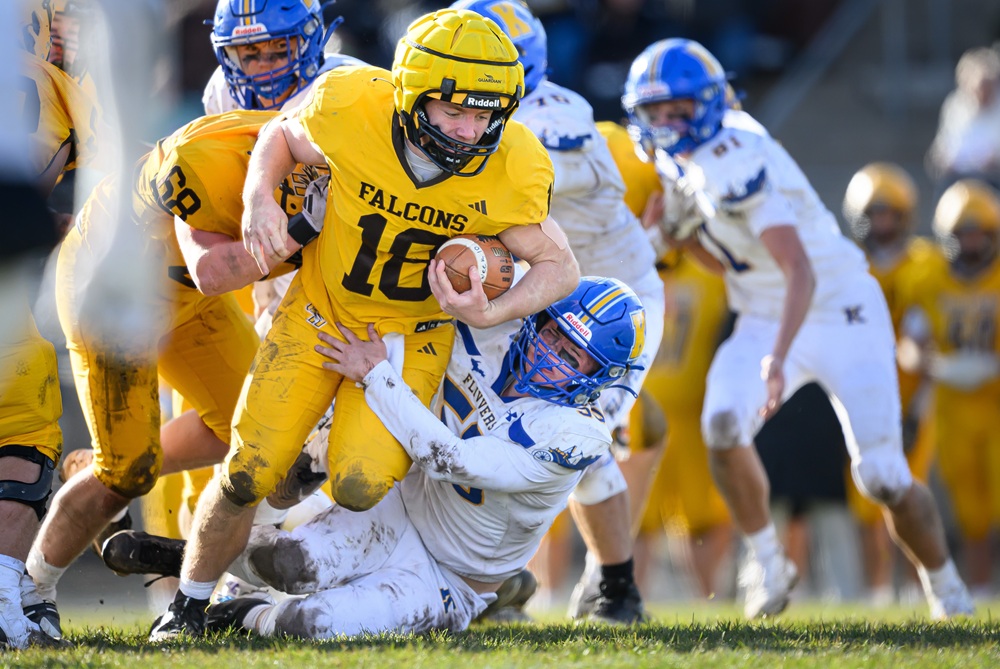
PHOTO Ogemaw Heights senior quarterback Eion Jones runs for a first down during his team’s Division 5 District Final win over Kingsford on Saturday. (Photo by Kolleth Photo.)