

History-Making Huskies Reverse Course
October 12, 2016
By Geoff Kimmerly
Second Half editor
Breckenridge football coach Kris Robinson is doing his best to remain guarded despite his team’s history-making run to begin this season.
 But the signs something special is playing out in his community are impossible to miss.
Like the multiple TV crews that came to practice Tuesday, one from WJRT, a local channel that still is based more than 60 miles away in Flint. The second crew, from Fox Sports Detroit, was putting together a feature for its statewide audience.
And they are just the latest to take note of the undefeated Huskies, who are 7-0 and clinched their first league championship Friday since 1946 after finishing 0-9 last season.
“The atmosphere here Friday night against Merrill was ridiculous. Our student section, the outpouring has been pretty awesome,” Robinson said. “I was always told – our AD Ryan Sklener played basketball here in the (19)80s and he said when our team was good, they would line up four deep around the basketball court. He said that would happen (for football). I was waiting for it. It didn’t happen when we went 5-4, so I’ve been anxious to see it happen. And it sure has.”
The Breckenridge football team is the first Applebee’s statewide Team of the Month for the 2016-17 school year.
The Huskies have the opportunity to become the first Michigan team in the playoff era (beginning in 1975) to follow an 0-9 finish with a 9-0 regular season – not counting Bellaire, which went 0-9 in 11-player in 2010 but then 9-0 in 8-player the following fall. Even if Breckenridge falls short on that goal, it has guaranteed it will become just the eighth team since 1975 to come back from a winless season to make the playoffs the following year.
A “perfect storm” is how Robinson describes how his team has gone undefeated heading into this week’s matchup with Vestaburg. But truly, a number of pieces have fallen into place to help the Huskies make history – with more opportunities to do so on the way.
Robinson is in his fourth year as coach, having taken over a program in 2013 that went 1-8 the year before and hadn’t made the playoffs since 1993 before qualifying this season with a 38-0 win over Carson City-Crystal on Sept. 30.
His first team finished 2-7, and the Huskies improved to 5-4 in 2014. But they felt all the way back to square one last fall with only three seniors on the team and freshmen at quarterback and running back. Breckenridge scored 68 points over nine games and lost all of them by at least 21.
But things were about to change – and quickly.
“They were ticked off, especially that (current) sophomore group,” said Robinson, who previously coached wrestling at the school and as a football assistant at Farwell and Roscommon. “They’ve won at every level, and for them to come out last year and not win a game, there were some moments last year that were really tough on them.”
 First, Breckenridge – a Class C school with 235 students – is enjoying a roster of 28 players after finishing last fall with only 12. With that jump in numbers has come the opportunity to fit players at their best-possible positions, and at least half on both sides of the ball are playing only one way. Although this team will graduate 14 seniors, another solid group is waiting that is 4-1 at the junior varsity level with only a two-point loss to Fowler. Of 110 boys in the school, 50 are playing football.
Many also put in the time during the offseason. Robinson credits commitment to the weight room for a lot of this team’s turnaround as well, pointing to players like sophomore Lukas Ebright, who was a good JV player last season but added 25 pounds and increased his vertical jump to 32 inches during the offseason to line up this fall as a 5-foot-5, 155-pound cornerback.
It's also helped greatly that those freshmen playmakers from a year ago have become leading sophomores. Quarterback Carter Staley had run for 773 yards and 10 touchdowns and completed 62 percent of his passes for 711 yards and 12 scores heading into last week’s Merrill game. Including that 12-0 win over the Vandals, Hunter Collins has run for 762 yards and seven touchdowns, averaging more than nine yards per carry. (Click to watch the replay of Breckenridge vs. Merrill on MHSAA.tv.)
In front of them is an offensive line that averages 240 pounds, sizable for sure relative to the size of their school. It’s also been brought up that Breckenridge moved to a league this fall – the Mid-State Activities Conference – that is a better fit, as the Huskies have the third highest enrollment among eight schools in the league compared to when they were the third-smallest of eight schools in the Tri-Valley Conference West in 2015. But that doesn't mean the MSAC is some easy run; Breckenridge included, five of eight teams are 4-3 or better, and four teams are tied for second place in the league at 4-2 in conference games.
The Huskies can clinch the title outright Friday, which would represent another accomplishment – Breckenridge hasn’t won an outright conference championship since 1941.
Trophies celebrating those long-ago league championship seasons are among five total owned by the school – with two others a cup from 1917 and a 1931 trophy with a player kicking a football, except all that’s left is the foot. But that will change shortly, as well.
“We broke the season scoring record in Week 6, and they knew we broke the season scoring record and actually asked me that night if we’ve broken the record for breaking the most records yet,” Robinson said. “So they get it.
“But I don’t think they understand the gravity of the situation. This is older than their grandparents.”
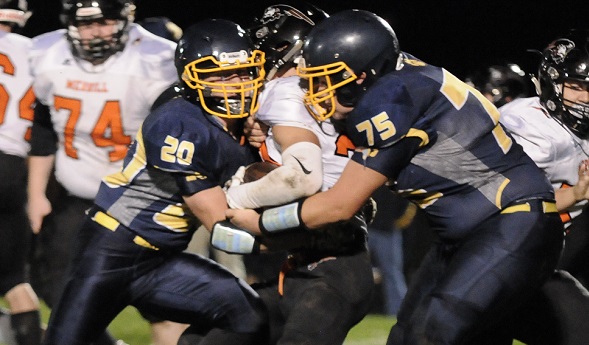
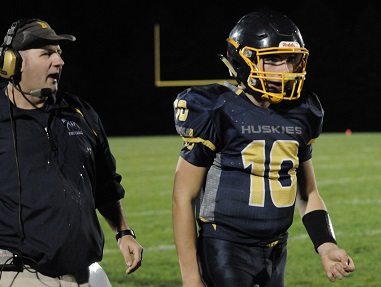
PHOTOS: (Top) A pair of Breckenridge defenders wrap up a Merrill ball carrier during Friday’s 12-0 league title-clinching win. (Middle) Huskies coach Kris Robinson (left) speaks with quarterback Carter Staley. (Click to see more from HighSchoolSportsScene.com.)
Drive for Detroit: Week 5 in Review
September 29, 2014
By Geoff Kimmerly
Second Half editor
No set up is needed to explain the significance of many of the games played across Michigan during Week 5 of the MHSAA football season.
The scores speak for themselves.
Read on for some of the details behind a wide array of results that wowed many over this weekend.
In addition, Ishpeming (5-0) became the first playoff qualifier for 2014, and Battle Creek St. Philip put up one of the most incredible point totals in MHSAA history – 89 points after trailing early in its 8-player win.
Total, seven games this weekend saw teams combine to score more than 100 points – while six games saw both teams score in single digits, including one of the matchups highlighted below.
Bay and Thumb
Goodrich 41, Montrose 39
The game of the season in the Genesee Area Conference Red was shaping up as Montrose vs. Flint Beecher on Oct. 17 – until Goodrich changed things up substantially by ending the Rams’ 22-game league winning streak. That Beecher/Montrose matchup might still decide part of the league title – but Goodrich is back in play as a contender. Click for more from the Flint Journal.
Also noted:
Almont 23, Richmond 6 – The Raiders (5-0) remained perfect while ending a 12-game Blue Water Area Conference winning streak for Richmond (4-1).
Lapeer 63, Mount Pleasant 0 – This is the most impressive win of an early run by the first-year Lightning (5-0), which looks like the Saginaw Valley Association Red favorite after dominating the Oilers (3-2).
Burton Atherton 34, Flint Hamady 22 – Atherton (4-1) still trails in the Genesee Area Conference Blue by a win, but knocked Hamady (4-1) out of a tie for first.
Millington 30, North Branch 29 – Only a week after a huge win over rival Frankenmuth, Millington (5-0) just survived against the Broncos (1-4) to remain atop the Tri-Valley Conference East.
Southwest and Border
Battle Creek Lakeview 27, Stevensville Lakeshore 0
Lakeview has had plenty of success the last few seasons and is 19-3 over its last 22 games, two playoff losses included. But this might be the most impressive win of the run – although Lakeshore plays in the Southwest Michigan Athletic Conference East and Lakeview in the West, the Spartans (3-1) still should celebrate their first win (and in impressive fashion) over the Lancers (4-1) since 2001. Click for more from the Battle Creek Enquirer.
Also noted:
Battle Creek Central 21, St. Joseph 10 – The Bearcats (3-2) already have their most wins since 2008 and now an upset of one of the best teams annually from the southwest in St. Joseph (3-2).
Plainwell 31, Vicksburg 21 – The Wolverine B Conference East title may have been decided Friday, with Plainwell (4-1) bouncing back from a Week 4 loss to slow the upstart Bulldogs (4-1).
Paw Paw 62, Edwardsburg 57 – The favorites in the Wolverine B West also met and combined for more than 100 points for the second straight season as Paw Paw (3-2) took a 2-1 advantage on Edwardsburg (4-1) in their recent series.
South Haven 34, Dowagiac 28 – South Haven (2-3) hadn’t beaten Dowagiac since 2007 – or scored a point on the Chieftains (2-3) since 2011.
Lower Up North
Boyne City 28, Traverse City St. Francis 27 (OT)
This victory will become "legendary" if it ends up deciding the first Northern Michigan Football Conference Legends title. Boyne City (5-0) held on to first place after choosing to go for a 2-point conversion instead of an extra point that would’ve instead sent the game into a second overtime. Both losses for St. Francis (3-2) this season have come in OT. Click for more from the Petoskey News.
Also noted:
Traverse City Central 18, Gaylord 7 – The Big North Conference race is getting whittled down, with Central (4-1) putting much improved Gaylord (4-1) a game back of the leaders.
Suttons Bay 48, Charlevoix 19 – The Norsemen (4-1) with a win over East Jordan this week can clinch a share of the NMFC Legacy title; Charlevoix (2-3) must win out to guarantee a playoff berth.
Manistee 30, McBain 20 – The Chippewas (4-1) broke a four-game losing streak to McBain (2-3) to surpass last season’s win total with four more games to play.
Whittemore-Prescott 34, Lincoln Alcona 0 – The Cardinals (5-0) clinched a share of the North Star League’s Huron Shores title, although Alcona (3-2) can still gain a share with some Week 7 help from Rogers City.
Greater Detroit
Clarkston 42, Oxford 14
Clarkston (5-0) left no doubt which is the top team again in the Oakland Activities Association Red, downing Oxford (4-1) to go with previous wins over Rochester Hills Stoney Creek and surprise contender West Bloomfield. The Wolves, defending MHSAA Division 1 champions, broke open the game at the end of the first half and pulled away during the second. Click for more from the Detroit Free Press.
Also noted:
West Bloomfield 39, Lake Orion 0 – The Lakers (4-1) are off to their best start since 2000 with their only loss to Clarkston; Lake Orion (2-3) finds itself needing to win out to avoid missing the playoffs for the first time since 2000.
Farmington Hills Harrison 34, Southfield 27 (3 OT) – Harrison (4-1) kept its hopes alive for a share of the OAA White title, but now needs help from Southfield (3-2) against league leader Oak Park in Week 8.
Waterford Mott 20, Walled Lake Western 17 – Mott (4-1) equaled its highest win totals of the last six seasons and kept a share of the top spot in the Kensington Lakes Activities Association North by upending reigning champion Western (4-1).
Warren Woods-Tower 16, Madison Heights Madison 14 – Madison (4-1) had won 20 straight regular-season games, although Woods-Tower (5-0) nearly broke the streak in 2013 after becoming the first to fall in 2012.
West Michigan
Caledonia 42, Rockford 0
Caledonia opened this season with two impressive wins and looked like a team to watch until then falling to 2-2 (although those losses were to talented teams as well). Put the Fighting Scots (3-2) back on the watch list; over the last decade, only powerhouse Muskegon has managed to put this kind of loss on Rockford (4-1). Click for more from the Grand Rapids Press.
Also noted:
Grand Rapids Christian 35, Hudsonville 34 – Only the shock of the above result kept this from being the area’s most intriguing game of the weekend; Christian (4-1) scored the go-ahead points during the final minutes, delivering Hudsonville (3-2) its second one-point loss in successive weeks.
Grandville Calvin Christian 29, Wyoming Godwin Heights 28 – The Squires (2-3) trail by a win in the O-K Silver standings but still have hope for the playoffs after giving Godwin Heights (4-1) its first loss.
Grand Rapids South Christian 41, Grand Rapids Catholic Central 14 – Just when it looked like the Sailors (3-2) might struggle after opening with two losses (albeit against strong teams), they’re looking good to win out in the O-K Gold; GRCC (2-3) must do the same to guarantee a seventh straight playoff berth.
Muskegon Oakridge 36, Ravenna 20 – Oakridge (4-1) still owns supremacy in the West Michigan Conference although Ravenna (4-1) is poised to take a share of the league title if the Eagles fall over the next three weeks.
Mid-Michigan
Manchester 18, Hanover-Horton 16
The Flying Dutchmen dissolved a little of the thrill of Hanover-Horton’s turnaround season with a goalline stand that set up this week’s likely Cascades Conference championship game against Grass Lake. Both are undefeated in conference play – Manchester (4-1 overall) has played one more game – while Hanover-Horton sits tied for third but still 4-1 overall and with a strong shot at its first playoff berth since 2008. Click for more from the Jackson Citizen-Patriot.
Also noted:
Charlotte 42, Parma Western 35 – The Orioles (2-3) delivered another heart-breaker to Western (2-3) which has three losses by seven points or fewer.
Fowler 27, Dansville 6 – The Eagles (5-0) are setting up a Week 8 championship game against Pewamo-Westphalia after the two more or less eliminated Dansville (3-2) from Central Michigan Athletic Conference contention over the last two weeks.
Eaton Rapids 9, Portland 7 – This was another sign Eaton Rapids (3-2) has turned a corner as a program; after falling badly to Williamston in Week 4, the Greyhounds hung in a nail-biter against improving Portland (3-2).
Homer 40, Jonesville 16 – The Big 8 Conference looks to be a two-team race after Homer (5-0) dropped Jonesville (3-2) into third behind the Trojans and also-undefeated Union City.
Upper Peninsula
Bark River-Harris 22, Felch North Dickinson 18
Bark River-Harris (4-1) hasn’t won more than two games in a season since 2009 – and its four wins this fall equal the total of the last four seasons combined. The Broncos have won all four after losing on opening night to Crystal Falls Forest Park, but beating North Dickinson was by far the most impressive as the Nordics (3-2) are playoff regulars and went 8-3 a year ago. Click for more from the Escanaba Daily Press.
Also noted:
Iron Mountain 13, Ishpeming Westwood 8 – The Mountaineers (3-2) are shaping up as second-best in the Mid-Peninsula Athletic Conference, with Westwood (3-2) falling after two straight losses.
Marquette 21, Gladstone 13 – The Great Northern U.P. Conference race is again looking like Marquette (4-1) vs. Menominee, with Gladstone (3-2) falling to both in successive weeks.
St. Ignace 28, Johannesburg-Lewiston 0 – The Saints (5-0) are alone atop the Ski Valley Conference with the Cardinals (4-1) now in a tie for second place.
Hurley, Wis., 32, Bessemer 26 – Hurley (5-1) clinched a share of the Great Western Conference title while Bessemer (3-2) fell to third place despite a strong effort.
8-Player
Waldron 66, Webberville 46
When these two have met the last two seasons, it's been busy for the scoreboard operator. Waldron (4-1) scored its most points since Week 6 in 2012, and also scored its season-high points in 2013 in a 56-54 win over the Spartans (3-2). Click for more from the Hillsdale Daily News.
Also noted:
Kingston 26, Dryden 24 – The Cardinals (3-2) surpassed last season’s win total and kept a foot in the North Central Thumb 8-Man League race while handing Dryden (3-2) its second straight loss.
Big Rapids Crossroads Academy 26, Burton Madison 24 – The Cougars (1-4) earned their first win in 8 or 11-player since 2010.
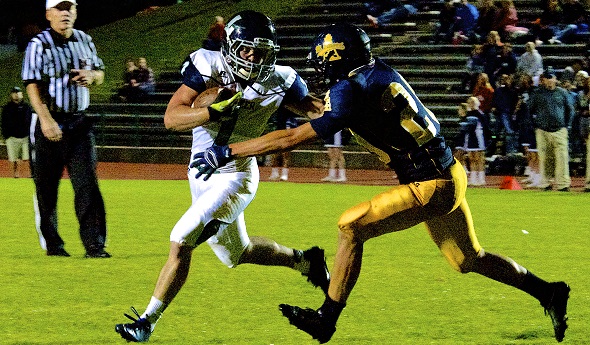
PHOTO: Lapeer, in its first season after former schools West and East combined this summer, is off to a 5-0 start. (Click to see more from HighSchoolSportsScene.com).