

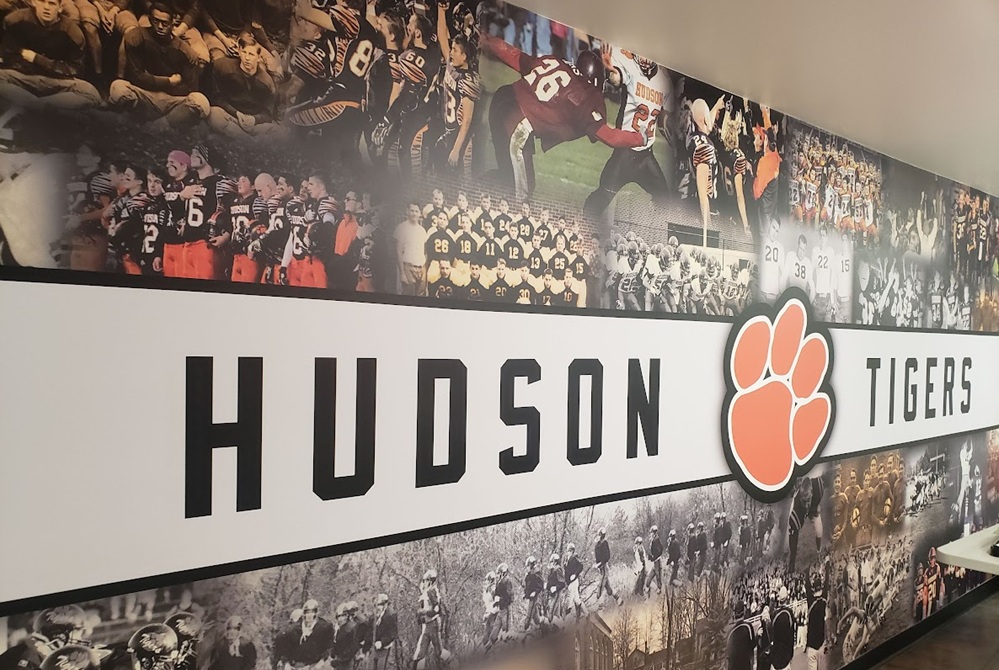
Hudson Paying 50-Year Tribute to Winning Streak Record-Setters, Supporters
By
Doug Donnelly
Special for MHSAA.com
October 14, 2025
It’s a little over two hours’ drive from Mount Pleasant to Hudson. But the November 1975 bus ride seemed to take forever.
The Hudson football team had just lost in the Class C state championship game to Ishpeming, ending a national record 72-game winning streak, and was on the way home.
“It was a really long ride,” said Ray Curran, an assistant coach for the Tigers. “A quiet ride.”
After the game, Hudson head coach Tom Saylor let his players know they had played hard and he was proud of them, but there were plenty of tears.
“We tried to tell them it wasn’t the end of the world,” Curran said.
For nearly everyone except maybe a few coaches, it was the first, and probably last, time they rode the bus home after a loss.
Hudson’s streak still stands today as the record for consecutive wins by a varsity football team in Michigan. From Week 2 of the 1968 season until the Class C Final in 1975, the Tigers never tasted defeat.
 As disappointing as it was to lose, what happened on that bus ride home had a huge impact on the program for years to come.
“When we got close to town, we started to see fire trucks and cars lining the streets,” Curran said. “We lost, but the fans still showed up for us. We had tremendous community support from parents and families and community members. I think that made a lot of the players feel like everything was going to be okay.”
Everything was okay. In fact, Hudson went 9-0 the next season, although the Tigers failed to qualify for the MHSAA Playoffs (which had a field of only four teams in each classification, 16 teams total, at the time).
To mark the end of that incredible 72-game win streak, Hudson is inviting back everyone who had a part in those undefeated teams during the 1960s and 1970s – players, coaches, cheerleaders, band and members of the flag corps are all expected to take part in the ceremony before Friday’s final home game of the regular season at Thompson Field in Hudson.
Bill Mullaly, who played for Hudson during that streak and has become a historian for the Tigers, said this celebration will be the last one.
“This is it,” Mullaly said. “It’s been 50 years, and this is the last one we are planning.”
Curran went to see Saylor a few weeks before he died, at the family’s request. Saylor had been in declining health and had dementia. Curran said when they got together, they talked football.
“We were talking about some of the games, some of the players,” he said. “He definitely remembered. It was a good visit.”
Hudson’s football team this season is undefeated, ranked No. 1 in Division 8 and gearing up for what the Tigers hope is another historic playoff run. Head coach Dan Rogers said the record streak remains an important piece of the community’s history, and the celebration Friday and recent passing of Saylor have brought it all back to the forefront.
“It’s definitely a big part of the community,” Rogers said. “I grew up here, and I’ve heard stories about it. You don’t live it, but you are part of it. I think it has helped mold our community, and it has been a way to identify the community. The streak is definitely alive and well.”
To commemorate this season, current Hudson players will be wearing a throwback uniform Friday – black and white jerseys with orange pants and the same design of socks the players in the 1970s wore. The helmet sticker will be the same one used during the streak.
“It’s all been very positive, all season,” Rogers said. “Some of the kids have grandpas that played in the streak, which is great. They weren’t around, but I think it’s my job to pass all of that along to a new generation. We have embraced it.”
Rogers said he’s gone back and talked to former players and coaches, and Hudson plans to pattern much of its pregame routine on the Tigers’ during Saylor’s regime.
 “We have people coming back who haven’t been to a Hudson football game since they played here,” Rogers said. “They had a lot of cool traditions back then. We want them to be proud.”
One of the current assistant coaches is Chris Luma, who played on that 1975 team. Luma was Hudson’s head coach before Rogers took over six years ago. He and Saylor were close. Luma will speak at Saylor’s memorial service later this month.
“It just seemed like with Tom you were learning life lessons along with how to win football games,” he said. “He installed discipline in all of us. What he had us go through was the things you needed to know to go through life.”
Mullaly also played for Saylor.
“He didn’t put Hudson on the map, but he took it to another level,” he said. “He was a great coach and a great man. His legacy is with Hudson football.”
Rogers said after Saylor died, more RSVPs started coming in for Friday’s event.
“It’s brought it to another level,” he said. “There are people flying in from all over the country to be a part of it. This is the final one. After this, it’s only the stories.”
 Doug Donnelly has served as a news and sports reporter at the Adrian Daily Telegram and the Monroe News for 30 years, including 10 years as city editor in Monroe. He's written a book on high school basketball in Monroe County and compiles record books for various schools in southeast Michigan. He is now publisher and editor of The Blissfield Advance, a weekly newspaper. E-mail him at [email protected] with story ideas for Jackson, Washtenaw, Hillsdale, Lenawee and Monroe counties.
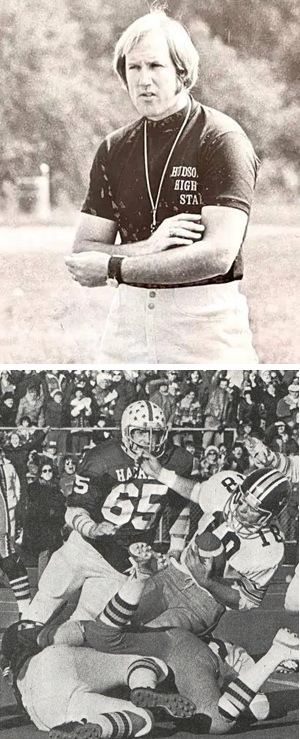
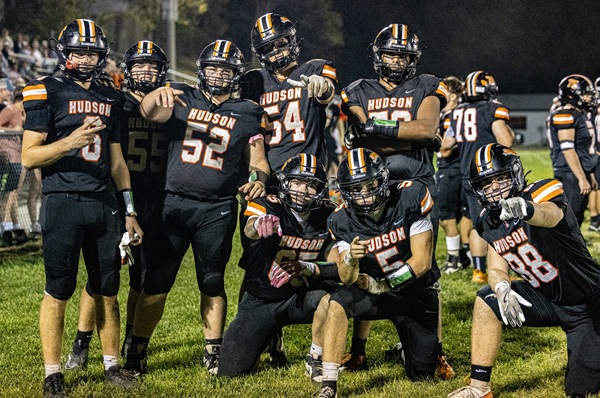
PHOTOS (Top) A wall in the Hudson press box tells of the football program’s rich history. (Middle) Tom Saylor, top, was the longtime coach of the Tigers dynasty, while Tim Decker (18) was among standouts during the streak. (Below) Hudson players come together for a quick photo on a game night this fall. (Wall photo by Doug Donnelly. Saylor photo courtesy of Todd Saylor; Decker photo courtesy of Jackson Citizen Patriot/Hudson Historical Museum. Current team photo by Rachel Stiverson.).
Drive for Detroit: Week 9 in Review
October 25, 2016
By Geoff Kimmerly
Second Half editor
The MHSAA football playoffs are upon us. From 617 teams that began this season, we’re down to watching our final 272.
But before we get too far ahead, there’s plenty to review from the final week of the regular season – including a number of upsets that altered the playoff field and brackets created Sunday.
Bay & Thumb
Fenton 28, Linden 21
The Tigers (7-2) scored with three minutes to play to move past Linden (6-3) for good and claim an outright Flint Metro League championship; a Linden win would’ve created a three-way tie for the title with these two and Ortonville Brandon. Fenton has won 29 straight league games and opened this season with two nonleague losses. Click for more from the Flint Journal.
Also noted:
Lapeer 24, Flint Carman-Ainsworth 14 – Carman-Ainsworth (6-3) won the Saginaw Valley League Blue and Lapeer was only second in the Red, but the Lightning (7-2) did remain undefeated in their three-year series with the Cavaliers.
Freeland 7, Frankenmuth 3 – The Tri-Valley Conference Central champion Falcons (9-0) made it three wins in two years over TVC East winner Frankenmuth (8-1), with a chance they could meet again in a Division 5 District Final.
Pinconning 20, Whittemore-Prescott 6 – The Spartans (6-3) claimed their first playoff berth since 2009, which also was their last season with a winning record; Whittemore-Prescott (5-4) did still make the postseason with an at-large bid.
Saginaw Michigan Lutheran Seminary 24, New Lothrop 20 – The Cardinals (7-2) got a major boost heading into the playoffs, handing New Lothrop (8-1) its first regular-season loss since 2009.
Greater Detroit
Detroit Catholic Central 17, Orchard Lake St. Mary’s 14
The last 11-player game of Michigan’s high school regular season had drama right until the end. The undefeated Shamrocks (9-0) were less than a minute from falling to St. Mary’s (5-4) in a Prep Bowl A-B Final rematch of the Detroit Catholic League Central first and second-place teams this fall. DCC scored with 21 seconds remaining for its second win over the Eaglets in three weeks after losses to them the last two seasons. Click for more from the Detroit News.
Also noted:
Bloomfield Hills 21, Lake Orion 0 – The 4-year-old Black Hawks (9-0) bounced back from 1-8 last season to win the Oakland Activities Association Blue title and make the playoffs for the first time; Lake Orion (5-4) did earn an at-large bid with four losses to teams that are a combined 27-9.
Detroit Cass Tech 41, Detroit Martin Luther King 20 – The Technicians (9-0) finished off another tremendous regular season with a second win over Martin Luther King (7-2), this time in the Public School League I final at Ford Field; Cass Tech has beaten all opponents by at least 13 points.
Detroit Denby 8, Detroit Mumford 0 – The Tars (8-1) guaranteed their best record since 2006 and claimed a PSL I/II championship by handing Mumford (7-2) its first loss since opening night.
Dearborn Divine Child 35, Detroit Loyola 24 – The Falcons (7-2) had lost seven times to Loyola (7-2) over the last five seasons including 34-24 in Week 5, but came back to break the streak in the Catholic League Prep Bowl.
Mid-Michigan
Williamston 38, Lake Fenton 35
Williamston needed to win its final regular-season game and some help to earn an at-large bid to the playoffs – but really helped itself by upsetting previously-undefeated Lake Fenton (8-1). A late defensive stand kept the Hornets (5-4) in the playoff mix, and they were selected to the field after missing at 4-5 a year ago. Lake Fenton, meanwhile still finished two wins better than 2015. Click for more from the Tri-City Times.
Also noted:
Holt 30, Grand Ledge 20 – The Rams (5-4) missed the playoffs by one spot among at-large teams from Class A, but the rebounding program can go into the offseason having handed Grand Ledge (6-1) the latter’s only loss in the Capital Area Activities Conference Blue.
Ionia 35, Lake Odessa Lakewood 30 – The Bulldogs (4-5) mostly struggled in league play, but started this season with two wins and ended with two straight including this upset of longtime rival and Greater Lansing Activities Conference champion Lakewood (8-1)
Lansing Catholic 42, Monroe St. Mary Catholic Central 20 – The Cougars (8-1) won their fifth straight, good momentum for this week’s matchup with reigning Division 5 champion Grand Rapids West Catholic, and also might have eliminated SMCC (4-5).
Fowler 27, Merrill 14 – The Eagles (6-3) continued their string of eight straight playoff berths by holding Merrill (6-3) to its second-fewest points this season.
Northern Lower Peninsula
Traverse City St. Francis 22, Boyne City 0
St. Francis (9-0) repeated as Northern Michigan Football Conference Legends champion with a second straight shutout and by ending a six-game winning streak by runner-up Boyne City (6-3). It was the second straight season this matchup determined the league title winner. The Gladiators have won 22 straight regular-season games. Click for more from the Traverse City Record-Eagle.
Also noted:
Frankfort 46, Onekama 20 – The Portagers (9-0) completed their first perfect regular season since 2004 and an outright title in the NMFC Leaders by avoiding a spoiler attempt by Onekama (6-3).
Traverse City Central 49, Cadillac 6 – Central (8-1) bounced back from a Week 8 triple-overtime loss to Birmingham Brother Rice to finish a Big North Conference championship run against third-place Cadillac (6-3).
Grayling 34, Kalkaska 27 – The Vikings (6-3) clinched a seventh playoff berth in eight seasons but only after edging the playoff-bound Blazers (6-3), who are in for the first time since 2013.
Hillman 32, Indian River Inland Lakes 29 – By the slimmest of margins, Hillman (5-4) was able to extend its playoff streak to 11 seasons, earning an at-large bid with five wins over the last six games.
Southeast & Border
Saline 38, Birmingham Groves 3
The Hornets further strengthened their status as a Division 1 championship contender, winning big in a matchup of undefeated teams. Saline (9-0) completed its second straight perfect regular season with its second-best defensive performance this fall, holding Groves (8-1) to the latter's fewest points in a game since 2013. Click for more from the Ann Arbor News.
Also noted:
Grass Lake 43, Springport 27 – The Warriors (8-1) got clipped by Michigan Center in Week 8, but came back to down Springport (7-2) in the Big 8/Cascades Conference championship game.
Ottawa Lake Whiteford 38, Clinton 12 – The Bobcats (9-0) completed their first perfect regular season since 1965 and an outright Tri-County Conference title by sending fourth-place Clinton to 6-3.
Napoleon 25, Concord 20 – The Pirates (7-2) have won seven straight to guarantee their best finish since 2002, first winning season since 2006 and first playoff berth since 2005; Concord also finished the regular season 7-2.
Morenci 42, Adrian Madison 7 – The Bulldogs (6-3) have three losses by a combined eight points, but are back in the playoffs for the third straight season after ending any chance for Madison (4-5).
Southwest Corridor
Portage Central 24, St. Joseph 14
Portage Central (8-1) secured the Southwestern Michigan Athletic Conference West championship outright after these teams shared the title in 2015. The Mustangs took a 14-0 lead late into the third quarter and extended it to 17 in the fourth before St. Joseph (6-3) added a late score. Portage Central hasn’t lost more than once during a regular season since 2012, building a record of 35-6 over the last four years.
Also noted:
Benton Harbor 54, Muskegon Heights Academy 6 – This is worth mention because it gave the Tigers (9-0) their first undefeated regular season since going 7-0-2 in 1962.
Three Rivers 14, Vicksburg 13 – The Wildcats (7-2) added to their comeback from 3-6 a year ago by just edging Vicksburg (7-2) to tie the Bulldogs for second in the Wolverine Conference.
Coldwater 31, Traverse City West 14 – The Cardinals (7-2) continued a nice run after their one-point loss in Week 6, sending West (6-3) home with a defeat.
Battle Creek Pennfield 22, Olivet 19 – Pennfield (5-4) got the needed boost from beating Olivet (5-4) to earn an at-large playoff berth after seasons of 2-7 in 2014 and 3-6 in 2015.
Upper Peninsula
St. Ignace 62, Newberry 20
The Saints (8-1) made another argument as the top 11-player title contender from the Upper Peninsula with a dominating performance against Mid-Eastern Conference runner-up Newberry (7-2). St. Ignace won the NMFC Legacy title this fall, and its only loss was to reigning Division 8 champion Muskegon Catholic Central, 21-6. Those two could meet again in a Semifinal next month. Click for more from 9&10 News.
Also noted:
Gwinn 38, Ishpeming 6 – With its first winning record since 2000, Gwinn (6-3) clinched its first playoff berth since 1999 while guaranteeing Ishpeming (3-5) wouldn’t be in the playoffs for the first time since 2001.
Escanaba 49, Kingsford 42 – The Eskymos (7-2) secured their best record since 2011 despite losing by a point in Week 8 and ended up locking up a home playoff game by getting past also playoff-bound Kingsford (6-3).
Felch North Dickinson 56, Bark River-Harris 24 – This is reportedly the last season of 11-player for the Nordics (6-3), but they’re going out on a high note after earning their first playoff berth since 2013 with four wins over their last five games.
Iron Mountain 28, Norway 7 – Four of six Mid-Peninsula Athletic Conference teams made the playoffs, including these two both at 7-2 for the regular season.
West Michigan
Hudsonville 14, Rockford 7
The Eagles (8-1) bounced back after a Week 4 loss to Grandville to win four straight in commanding fashion and earn the opportunity to take a share of the Ottawa-Kent Conference Red title in Week 9. Hudsonville finished the run with a late score on Rockford that created a three-way share of the championship with the Rams (6-3) and Grandville – and the Eagles also cemented home-field advantage through a District that includes both, with Rockford up again this week. Click for more from the Grand Rapids Press.
Also noted:
Allendale 30, Grand Rapids West Catholic 27 – Allendale’s first win over West Catholic since 2008 created a three-way championship in the O-K Blue between those two (both 7-2 overall) and Grand Rapids Catholic Central (8-1).
Byron Center 40, Hudsonville Unity Christian 19 – The Bulldogs (8-1) finished their O-K Green title by sending Unity Christian (7-2) into a tie for second in a league that will send five of seven teams to the playoffs.
Grand Rapids Forest Hills Northern 27, Greenville 16 – Scheduling tough does matter; Forest Hills Northern (5-4) was 0-4 against teams with winning records heading into Week 9 but earned an at-large bid thanks in part to this victory over also playoff-bound Greenville (5-4).
Whitehall 37, Battle Creek Harper Creek 30 – The Vikings (6-3) came back from two straight one-point losses Weeks 6 and 7 to get into the playoffs for the third season in a row; Harper Creek (7-2) is headed back after going 3-6 last season.
8-Player
Powers North Central 68, Stephenson 32
The reigning MHSAA champ Jets (9-0) finished their Western Eight Conference run and moved into the top seed in 8-player with a solid boost from beating third-place Stephenson (7-2). North Central is only a little behind the pace of its incredible numbers from a year ago – the Jets are outscoring opponents on average 69-17, and Stephenson was the first to score more than 18 since Week 3. Click for more from the Marinette EagleHerald.
Also noted:
Lawrence 22, Battle Creek St. Philip 14 – The final game to finish in 8-player over the weekend saw Lawrence (8-1) come back from two losses last season to St. Philip (5-4) to knock the reigning MHSAA runner-up out of the playoff mix.
Camden-Frontier 44, Waldron 18 – The Redskins (6-1) played their way into the playoffs after two straight 0-9 finishes by getting a key win over Waldron (4-5).
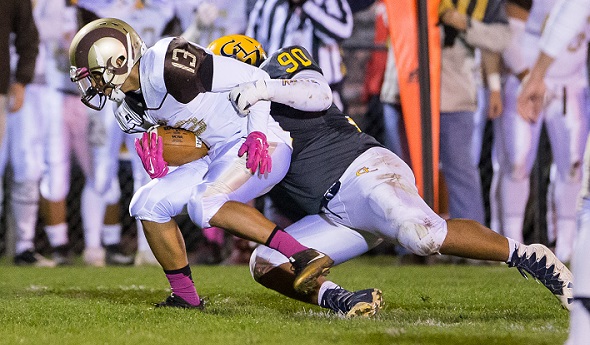
PHOTO: Holt over Grand Ledge was one of a number of upsets during Week 9 of the football regular season. (Click to see more from HighSchoolSportsScene.com.)