

At Hudson, Winning Starts with the 'Ride'
November 2, 2017
By Doug Donnelly
Special for Second Half
HUDSON – It was a couple hours before kickoff for the Hudson Tigers, and head coach Tom Saylor didn’t think his team was focused enough.
 “It was early on in our winning streak,” said Saylor. “Everybody was kind of laughing and just not thinking about the game. I told them to get on the bus and we drove right out of town, past the cemetery and I think we drove clear to Clayton (a town about six miles away). The players were thinking, ‘What is this guy doing?’”
The home game for Hudson turned into a road game – complete with a bus ride. A tradition was born.
“I thought we played better on road games,” said Saylor, who coached the Tigers through their record-setting 72-game win streak during the 1970s. “There weren’t so many distractions.”
Friday night, Hudson’s players will board the bus once more this season and take the trip from the high school locker room into downtown Hudson to Thompson Field, where the Tigers play their home games. Hudson will take on Monroe St. Mary Catholic Central in a Division 7 District championship game.
The head coach now is Chris Luma, who was a quarterback for Hudson during part of that win streak. He said the bus ride is a little shorter these days, but remains a surreal moment for all Tigers players and coaches.
“Coach Saylor liked to only make right turns,” Luma said. “That was his thing. We’d go out of the school and only make right turns to get to the field. Now, we just come out of the school, go down Maple, go right past my house and turn and go to the stadium. It’s about a five-minute ride.”
And it takes place in total silence.
“I don’t even know how to explain it,” said Tigers running back Malik Ray, who has more than 1,500 yards rushing. “It’s a really different experience. It’s legit. We get on the bus and some kids pray and others just think about the game. We don’t have time to mess around. Once we hit the seats, it’s go time. There’s no joking around. No way.”
Luma said every so often a young player will board the bus and talk or say something and a captain will quickly let him know the bus ride is done in silence.
“I’ll get on the bus, count them up and make sure we have everybody and give them the look,” he said. “It’s all quiet. We drive to the stadium, pull up and the players get out and go to the shed. Everyone has their own routine.”
Hudson has been home to a lot of big games on Friday nights over the years. The Tigers’ tradition is well known. Hudson held the national high school football winning streak record of 72 games for 22 years. Thompson Field has been the site of a lot of those Hudson wins and impactful games.
“The place has held more huge games than any other venue in Lenawee County over the past 60 plus years,” said Hudson sports historian Bill Mullaly. “Thompson Field has been around since 1955, and there have been many exciting, thrilling and very meaningful games played there with upwards of 5,000-plus people watching, especially back in the winning streak days.”
Before 1955, Hudson’s field was located in a low area right next to the current stadium, which sits on a hill in town and was moved because the old field was prone to flooding. The stadium is not on campus, somewhat atypical at the high school level.
 Saylor used to live right next to the stadium, on the hill.
“I would wake up and see the stadium every morning,” he said.
Luma said the bus ride is different to the ‘home’ game than it is for an actual road game.
“When I was a player, I’d sit right next to Coach Saylor,” he said. “For road games, we’d go over my assignments, what he expected out of me. We’d talk about situations and what I should say or do in the huddle. I think those times sitting on the bus with him is one of the reasons I went into coaching.
“Riding to a home game, though, there was no talking. It’s still that way.”
Luma has had a remarkable coaching career at Hudson, winning 175 games, including a Division 7 championship in 2010. Friday will be Hudson’s second game ever against St. Mary, a traditional power from Monroe County with a couple of MHSAA championships to boast about – including its most recent in 2014, a Division 6 championship. The Falcons are competing for the first time in the Division 7 playoffs.
Ironically, both teams run the ‘T’ offense and both teams have strong rushing attacks. Hudson (9-1) was the Lenawee County Athletic Association champion while SMCC (6-4) got into the playoffs at 5-4 after navigating a difficult Huron League schedule.
No matter the weather, Thompson Field figures to be a packed house.
When it’s game time, Ray will board the bus, make the silent ride, get to the stadium and play catch for a few minutes with Hudson quarterback Andrew Valdez. When the team is ready to take the field, they’ll leave the shed and take turns with the rest of the team touching a sign above the door that says “The Team, The Team, The Team.”
Then – and only then – will it be game time.
“On the bus ride to the game, you’ll see people on the streets and they are waving at you and they are excited,” Ray said. “You can see joy in their eyes.
“Anytime you play in a playoff game, it’s a truly great experience. Playing one more game with these guys … its more than I can say.”
 Doug Donnelly has served as a sports and news reporter and city editor over 25 years, writing for the Daily Chief-Union in Upper Sandusky, Ohio from 1992-1995, the Monroe Evening News from 1995-2012 and the Adrian Daily Telegram since 2013. He's also written a book on high school basketball in Monroe County and compiles record books for various schools in southeast Michigan. E-mail him at [email protected] with story ideas for Lenawee and Monroe counties.
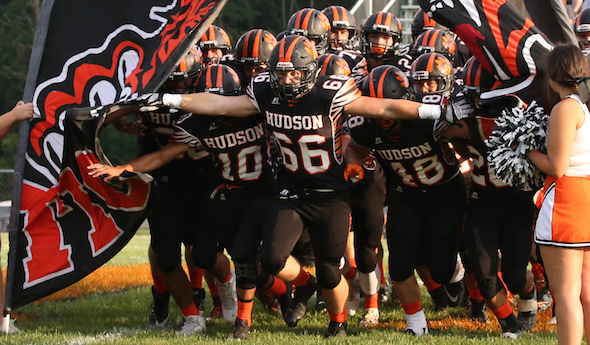
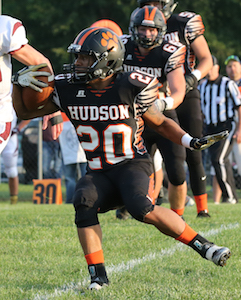
PHOTOS: (Top) Hudson’s players enter Thompson Field at the start of a game this season. (Middle) Malik Ray works to elude a Morenci defender during a Week 2 win. (Photos by Mike Dickie.)
Drive for Detroit: Week 2 Preview
August 29, 2018
By Geoff Kimmerly
Second Half editor
Opening week of this high school football season predictably fulfilled anticipation and expectation.
 The encore should be pretty good, too.
Up this week is a rematch of last season’s Division 1 championship game, which also is among a number of league openers matching conference title favorites all over Michigan. Reigning Division 3 champ Muskegon won’t be starting league play for a few more weeks, but again might be hosting the most intriguing game statewide as another Detroit-area powerhouse comes to town.
Nearly all of this week’s games will be played Thursday night in advance of the Labor Day holiday. Check out the MHSAA Score Center for the full schedule and results as games are completed, and if you’re not watching in person check out one of eight games live on MHSAA.tv.
“Drive for Detroit” previews are powered by MI Student Aid. Games below are Thursday unless noted.
Bay & Thumb
Frankenmuth (1-0) at Saginaw Swan Valley (1-0)
Big-time rivals during the 1980s (when they shared a league), Swan Valley and Frankenmuth will meet again for the first time since 2010 and this time as statewide contenders. Swan Valley is the reigning Division 5 runner-up and Frankenmuth was a Division 5 semifinalist a year ago as both fell to champion Grand Rapids West Catholic during the playoff’s final rounds. Both are coming off big wins over bigger competition last week; the Vikings downed Cedar Springs by nine, and the Eagles defeated Bay City Central by 23.
Others that caught my eye: THURSDAY Elkton-Pigeon-Bay Port Laker (1-0) at Reese (1-0), Goodrich (1-0) at Ortonville Brandon (1-0), Flint Carman-Ainsworth (1-0) vs. Midland (0-1) at Northwood, St. Clair Shores South Lake (1-0) at Marine City (1-0).
Greater Detroit
West Bloomfield (1-0) at Clarkston (1-0), Friday
This is a rematch of last season’s Division 1 championship game, when these two combined for the second-lowest scoring Final in MHSAA football history – Clarkston winning 3-2. Not telling by the score, West Bloomfield’s offense was loaded with future Division I college players – but the retooled Lakers scored 39 in a win last week over Birmingham Groves, while Clarkston’s defense looked stingy again in downing Grandville 12-9. And don’t forget: These two also both play in the Oakland Activities Association Red, and West Bloomfield won that matchup last season 37-16.
Others that caught my eye: THURSDAY Waterford Our Lady (1-0) at Sterling Heights Parkway Christian (1-0), Oak Park (1-0) at Birmingham Groves (0-1), Livonia Churchill (1-0) at Belleville (1-0), Warren Fitzgerald (1-0) at Auburn Hills Avondale (1-0).
Mid-Michigan
Haslett (1-0) at Lansing Sexton (0-1)
In finishing 8-3 a year ago, Haslett posted its best record since 2006. The Vikings picked up on the same foot last week, opening with a 28-7 win over Coldwater – and they’ll now try to make it two in a row over 2017 playoff teams. Sexton just missed giving new coach Johnel Davis his first win, falling to Gaylord by 23-19. But the Big Reds would love to pick up some steam heading into a new league, the Capital Area Activities Conference White, and it’s already possible to forecast this as a key game if Sexton is to qualify for the playoffs in two months.
Others that caught my eye: THURSDAY Lincoln Alcona (0-1) at Breckenridge (1-0), Brooklyn Columbia Central (1-0) at Leslie (1-0), Walled Lake Northern (0-1) at DeWitt (1-0), Ann Arbor Huron (0-1) at Williamston (1-0).
Northern Lower Peninsula
Traverse City St. Francis (1-0) at Maple City Glen Lake (0-1)
St. Francis had a lot to enjoy about a 42-3 opening-night win over Marquette last week, while Glen Lake ran into a regular-season superpower in falling to New Lothrop. But a win over the Gladiators would certainly heal the grief of that 32-point defeat. These teams have met in both the regular season and playoffs two of the last three seasons, with St. Francis claiming last year’s regular-season meeting 35-9 – but then the District Final rematch only 13-0.
Others that caught my eye: THURSDAY Tawas (1-0) at Rogers City (1-0), Lakeview (1-0) at Lake City (1-0), Gladstone (1-0) at Gaylord (1-0), Marquette (0-1) at Traverse City Central (1-0).
Southeast & Border
Napoleon (0-1) at Addison (1-0)
Last season’s Cascades Conference race saw Addison beat Napoleon by two, Napoleon beat Michigan Center by three and Michigan Center beat Addison by 12 – and all three share the league title. It wouldn’t be shocking if this matchup played a big part in the chase again. Addison opened last week with a big win over Dearborn Heights Star International and Napoleon fell to Brooklyn Columbia Central – both repeats of 2017 results and not necessarily telling of what to expect.
Others that caught my eye: THURSDAY Jackson Lumen Christi (1-0) at Parma Western (1-0), Hudson (0-1) at Morenci (0-1), Lake Fenton (1-0) at Ida (1-0) FRIDAY Grand Rapids Catholic Central (1-0) at Saline (0-1).
Southwest Corridor
Saugatuck (1-0) at Watervliet (1-0)
Both saw their 2017 seasons end against eventual MHSAA champions, Watervliet in a Division 6 Regional Final to Jackson Lumen Christi and Saugatuck at Ford Field where it fell to Pewamo-Westphalia in the Division 7 Final. Watervliet scored at least 50 points in its first seven games last season, and opened this one with another 50-pointer last week against Lawton. Saugatuck actually was more of a defensive force a year ago – but started this one with a 55-pointer that’s been the expectation most other seasons this decade.
Others that caught my eye: THURSDAY Dowagiac (1-0) at Three Rivers (1-0), Portage Northern (1-0) at Stevensville Lakeshore (0-1), St. Joseph (0-1) at Niles (1-0), Kalamazoo United (1-0) at Lawton (0-1).
Upper Peninsula
Iron Mountain (1-0) at Ishpeming Westwood (1-0), Friday
Iron Mountain’s one-win finish in 2017 was quite a rarity – the Mountaineers had made the playoffs 16 of the previous 18 years and not had a one-win season on the field since 1990. So it made sense that they equaled last fall’s win total last week with a 12-9 victory over Negaunee. Westwood, meanwhile, is coming off its winningest season ever at 9-2 – and started its campaign last week to show that wasn’t a one-hit wonder with a 42-0 shutout of Houghton.
Others that caught my eye: THURSDAY Negaunee (0-1) at Calumet (1-0) FRIDAY Lake Linden-Hubbell (0-1) at Ishpeming (1-0), Petoskey (0-1) at Escanaba (0-1), Iron River West Iron County (1-0) at Bark River-Harris (0-1).
West Michigan
Detroit Martin Luther King (1-0) at Muskegon (1-0), Friday
When Muskegon opens with back-to-back home games against Warren DeLaSalle and now Martin Luther King, it’s hard to not tout them as the biggest games of many exciting matchups from the west side of the Lower Peninsula. Quarterback Cameron Martinez showed what he’s capable of in last week’s 36-21 win over the reigning Division 2 champion, and expectations will only continue to grow. But King – which fell to DeLaSalle by a point in their Division 2 Semifinal in November – could be an even tougher test coming off a 52-38 win over Illinois powerhouse East St. Louis.
Others that caught my eye: THURSDAY Rockford (0-1) at Lowell (0-1), Lansing Catholic (1-0) at Grand Rapids West Catholic (0-1), Benton Harbor (1-0) at Grand Rapids South Christian (1-0), Holland West Ottawa (1-0) at Grand Rapids Forest Hills Central (1-0).
8-Player
Eben Junction Superior Central (1-0) at Cedarville (0-1)
Superior Central stunned the 8-player community with a 46-24 win over reigning Division 2 champion Crystal Falls Forest Park last week, and the Cougars can start 2-0 for the first time since 2012 by following up against another perennial power. But Cedarville surely is eager to get back on the field as well after putting up 40 in a six-point loss to Stephenson. Don’t be surprised if this turns into an offensive display.
Others that caught my eye: THURSDAY Central Lake (0-1) at Onekama (1-0), Engadine (1-0) at Pickford (1-0), Powers North Central (0-1) at Rapid River (1-0), Bellaire (1-0) at Suttons Bay (1-0).
Second Half’s weekly “Drive for Detroit” previews and reviews are powered by MI Student Aid, a part of the Student Financial Services Bureau located within the Michigan Department of Treasury. MI Student Aid encourages students to pursue postsecondary education by providing access to student financial resources and information, including various student financial assistance programs to help make college more affordable for Michigan students. MI Student Aid administers the state’s 529 savings programs (MET/MESP) and eight additional aid programs within its Student Scholarships and Grants division. Click for more information and connect with MI Student Aid on Facebook and Twitter @mistudentaid.
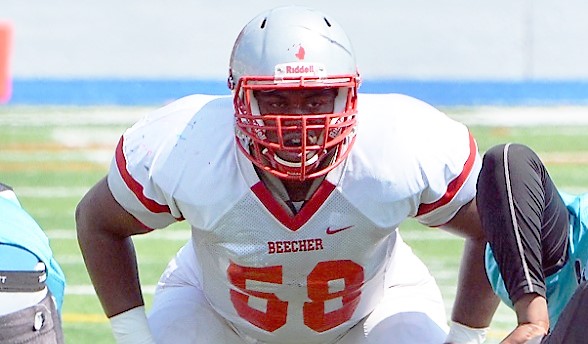
PHOTO: A Flint Beecher linebacker readies for the snap during last week’s win over Flint Southwestern at Atwood Stadium. (Photo by John Johnson.)