

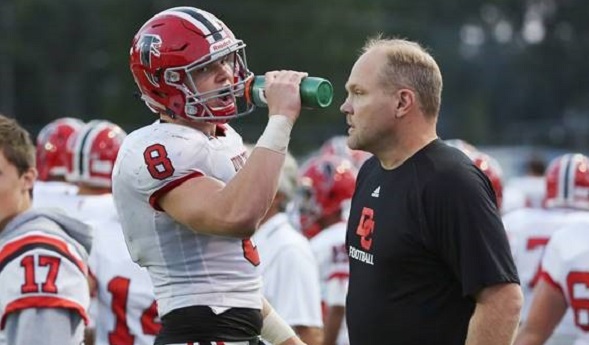
Hutchinson Makes Name at Divine Child
By
Tom Markowski
Special for Second Half
September 13, 2017
DEARBORN – Often, a child of a successful athlete has difficulty living up to that standard.
 To this point, that’s not the case with Aidan Hutchinson.
He plays a similar position as did his father Chris, an All-America defensive lineman at University of Michigan in 1992. But there are differences as well between father and son – although like his dad, Aidan also will head to Ann Arbor after he graduates from Dearborn Divine Child.
All Falcons fourth-year coach John Filiatraut knows is that he hit the lottery when the Hutchinsons decided Aidan would attend Divine Child – not that he didn’t see it coming, given Aidan’s mother, Melissa Hutchinson, and his two older sisters, Mia and Aria, all attended the Catholic school.
“They’re great people,” said Filiatraut, a 1986 Divine Child graduate. “It’s a treat. Coaches can complain and whine with the best of them. But we’re lucky to have Aidan.
“And Chris is not very intrusive. I was worried about that at the beginning. With his background, it would be easy to step in. We as coaches are trying to do things right here. (Chris) is committed to Aidan and for him to do this on his own, and not cast a shadow on Aidan.”
Coming off its winningest season (10-3) since 1985 and a Division 3 Semifinals berth in 2016, Divine Child is off to a 3-0 start this fall.
As for those differences between father and son, size is one. The elder Hutchinson was 6-foot-2 and weighed 221 pounds when he graduated from high school. His playing weight at U-M was 250. His son is 6-6 and weighs 255 pounds, and is considered one of the top prospects in the class of 2018. Aidan plays defensive end and tight end. His father was a defensive tackle.
Chris Hutchinson grew up in Houston and played football at Cypress Creek High before going on to University of Michigan, where he played four seasons and was named first team All-America as a senior defensive lineman in 1992. Chris Hutchinson said private school education was all new to him, but he couldn’t be more pleased with the educational – and now with his son – athletic experiences his family has enjoyed.
Not surprisingly, Aidan has accepted a scholarship offer to attend U-M. He did make unofficial visits to Notre Dame and Wisconsin, in addition to his interest in attending Penn State, but eventually U-M won out.
 And so far his senior season has unfolded as planned.
“We’re 3-0. It’s great,” he said. “Michigan is undefeated. We’re undefeated. It’s all great.”
Chris Hutchinson didn’t allow Aidan to play tackle football until he was in the seventh grade. Aidan did play flag football, and other sports like soccer, but his father held him out of the physical contact until he thought Aidan was ready.
“It was a big change for me,” Aidan said of playing tackle football. “I had to learn a lot because most of the other kids had been playing two or three years. It wasn’t too bad a transition. I just had to learn quickly.”
Despite his size, and his weight as an infant (11 pounds, one ounce), Aidan wasn’t a large child growing up. He weighed 135 pounds when he was in the eighth grade, then 160 as a freshman playing on the line on Divine Child’s junior varsity team. Over the next two years, he grew seven inches and added 70 pounds.
“I’ve been (growing) all through high school,” he said. “Am I done growing? I don’t think so, but I’m hoping I am.”
The answer is likely the former. Aidan just turned 17 last month (Aug. 9).
Though his size is a plus once he gets to college, there are times when it can work against him at the high school level.
“It’s different when you’re 6-6 going against a 6-foot kid,” Chris Hutchinson said. “You have to keep your head down, and stay low.”
Chris Hutchinson, who’s a doctor in the emergency room at Beaumont Hospital in Royal Oak, understands it’s not his place to coach his son from the sideline, even though, as the team physician, it’s his job to be on the sideline. He keeps a safe distance and allows Filiatraut and his staff do their jobs.
At home, it’s a different story. The two view film constantly to determine where improvements can be made.
“Thank God for Hudl,” Chris said. “I only focus on technique. When Aidan tells me they’re using a double team, I ask what type? There are different ways you can use a double team.
 “It’s important not to be that dad who coaches. There are way too many dads who do the coaching thing. The hardest thing for me is not to say something, and have him come to me. When they do ask, then you can go forward.”
Aidan is quick for his size, and he attributes much of that quickness and his ability to react quickly to the other sport he plays, lacrosse. He started playing lacrosse the same year he began playing tackle football, and to him they go hand in hand.
“It’s a ton of fun (playing lacrosse),” he said. “My whole group of friends play. All six of us started (on varsity) as freshmen, so we should be pretty good this year. There’s no question it helps me in football. One hundred percent. It helps with my hip movement, and in lacrosse it forces you to back pedal.”
Filiatraut said Hutchinson is a special part of a special team at Divine Child. Its quarterback, Theo Day, is one of the state’s best. Day led the Falcons to the Division 3 Semifinals last season and has committed to sing with Michigan State.
“Aidan gives great effort all of the time,” Filiatraut said. “Honestly, he’s on the shy side. He’s trying to figure it all out. He’s doing his best to be a vocal leader, but it’s not in his nature.
“He’s got a ton of want-to. He wants to be good, and to get better.”
 Tom Markowski is a columnist and directs website coverage for the State Champs! Sports Network. He previously covered primarily high school sports for the The Detroit News from 1984-2014, focusing on the Detroit area and contributing to statewide coverage of football and basketball. Contact him at [email protected] with story ideas for Oakland, Macomb and Wayne counties.
PHOTOS: (Top) Deaborn Divine Child’s Aidan Hutchinson grabs a water break while dad and team physician Chris Hutchinson keeps an eye on the field. (Middle) Hutchinson blocks against Benton Harbor during his team’s Week 1 win. (Below) Aidan, Chris, mom Melissa and U-M coach Jim Harbaugh take a photo after Aidan commits to sign with the Wolverines. (Photos courtesy of the Hutchinson family.)

Byron Brother & Sister Teaming Up Once More
By
Paul Costanzo
Special for MHSAA.com
October 23, 2018
When it was announced Sunday night that Byron was included in the Division 6 playoff bracket, it wasn’t a surprise for the 5-4 Eagles – but it did provide new opportunities.
 An opportunity to play another game. An opportunity to avenge a Week 1 defeat against Flint Hamady. An opportunity to stay together for at least one more week as a team.
In the Marvin household, it provided one other unique opportunity: a chance for senior TJ and his younger sister Sarah, a sophomore, to be teammates on the Eagles’ offensive and defensive lines. Sarah Marvin was a captain on the Eagles’ junior varsity team this year, and is among a group of players moving up to the varsity for the postseason.
“That’s awesome to be able to play football with your sister,” TJ Marvin said. “But to play the same positions and not have to go easy, it’s good, because I can still get a good look.”
It’s the second straight year the Marvins have had this opportunity, and in 2017 they actually were able to line up next to each other late in the Eagles’ loss to Ithaca.
When it comes to practice, being on the same field is nothing new as Byron’s varsity and JV teams often practice together. That means brother and sister – who both play defensive end and offensive tackle -- not only share a field, but also get to square off throughout the season.
“It’s fun,” TJ Marvin said. “It’s cool to be up against your sibling. Caliber of player wise, she lines up just like all the other guys, so I’m still getting a good look. It’s not much different.”
The Marvins get to spend plenty of time together athletically, as both are also throwers on the track & field team, along with Sarah’s twin sister, Becky. Sarah and Becky also get to play basketball for their mother, Theresa, who is the Byron girls varsity basketball coach.
“Everyone in my family knows about throwing,” Sarah said. “All of the sports – you can go home and talk about it, and everyone in your family understands.”
Football is also a family thing, but it’s something special TJ and Sarah share. They started playing while she was in first grade and he was in third, and often times found themselves not only as teammates, but also lined up next to each other on the offensive line.
Starting in the male-dominated sport was something Sarah didn’t think twice about.
“I don’t know if it was something that so much drew me to it. It was just that all of my boy cousins always played,” Sarah Marvin said. “I have (two younger cousins, two younger brothers), an older brother and an older cousin, and we would always rough house.”
Theresa Marvin said her daughter has always loved the game -- whether it be watching or playing -- and became a student of it. TJ agreed.
 “Sometimes I’ll give her tips and stuff, but she is very athletically smart,” TJ Marvin said. “She knows the game, watches a lot of football and she’s very good at big picture plays and seeing what’s going on. Any sport, really, but especially football where there is so much going on, she really analyzes the game.”
While they started playing at the same time, TJ does have plenty of experience he can pass onto his younger sister. Injuries kept him off the field for the majority of his freshman and sophomore seasons, but the 6-foot-3, 235-pound two-way starter was an all-conference selection as a junior. He also is a varsity captain this season.
Sarah Marvin already has established herself as an all-state athlete, finishing third this spring at the Lower Peninsula Division 3 track & field championships in the discus and shot put. She was also an honorable mention all-state selection in basketball during her freshman year.
Throwing appears to be her future as an athlete, and continuing to play football is something they’re taking year by year.
“All through my freshman year I was dead set on it, that I’m going to play all four years,” Sarah Marvin said. “I think that’s changed a little bit. I had a kind of close call where a kid went to make a tackle and I was behind our running back, and he fell right into my knee. So that’s the main thing, is not getting hurt.”
Worrying about getting injured, however, has nothing to do with Sarah’s gender.
“Sometimes I worry about it, but I don’t worry about her anymore than I would other guys on the field,” TJ Marvin said. “I worry about it a little bit with her coming up on varsity where there are much bigger players and it’s a little more intense, but I know what she can do physicality wise and the kind of athlete she is. I worry about her getting hurt, but I worry about every one of my teammates getting hurt.”
Sarah is simply a member of the team, and she says that’s something that resonates through the program.
“Within my grade level and even the grade older, since I’ve played since the first grade, I think they’re just used to it -- we’re definitely just regular teammates,” she said. “They don’t treat me any different than the other kids; they’re just out there to play football. I’d probably be annoyed if they didn’t hit me as hard as they hit everyone else.”
Despite that, the Marvin siblings realize their situation is unique, and they feel fortunate to be able to experience playing together for at least one more week.
“(Getting on the field together) would be a really cool thing to do,” Sarah Marvin said. “Especially in his senior year.”
 Paul Costanzo served as a sportswriter at The Port Huron Times Herald from 2006-15, including three years as lead sportswriter, and prior to that as sports editor at the Hillsdale Daily News from 2005-06. He can be reached at [email protected] with story ideas for Genesee, Lapeer, St. Clair, Sanilac, Huron, Tuscola, Saginaw, Bay, Arenac, Midland and Gladwin counties.
PHOTOS: (Top) TJ, left, and Sarah Marvin take the field for Byron’s varsity and junior varsity teams, respectively, this season. (Middle) TJ and Sarah first teamed up nine years ago when TJ was in 3rd grade and Sarah in 1st. (Photos courtesy of the Marvin family.)