

Ice Man: Skyline's Copp sets football records, leaves legacy
October 27, 2011
Eventually, Andrew Copp may be best-known as a hockey star. His spot on the USA under-18 national team development program squad marks him as one of the top players his age in the country.
But he’ll be remembered as one of Ann Arbor Skyline’s first standout athletes for another sport he simply couldn’t give up.
Bittersweet and heart-breaking are how Copp described the end of this football season. The MHSAA playoffs begin this weekend, and he hoped to be a part -- a possibility that was likely closer than Skyline’s 3-6 record might imply, given four of those losses were by four or fewer points. And that’s not the worst part. Even if Skyline had earned a berth, Copp would’ve been forced to watch after breaking his right collarbone in multiple spots three weeks ago.
Still, there will be plenty to remember fondly for the first quarterback in his school’s four-year history. Two MHSAA records and his school’s first varsity football wins will top the list, even as the combination of football and the injury will force Copp the miss the first half of his USA team’s season.
“It means a lot, starting something new and trying to put your stamp on it,” Copp said. “As the quarterback, it’s a lot of weight on your shoulders to start something that 10, 20 years down the road people are going look at.
“Last year, when I got offered to play (USA) but had to quit football after the first game, I couldn’t do it. I just couldn’t quit on the team.”
That kind of leadership was “worth its weight in gold” for a school and program only just getting started, Skyline athletic director John Young said.
Copp likely would’ve attended Ann Arbor Pioneer -- like both of his parents had -- had Skyline not opened in fall 2008.
The Eagles’ football program started that first fall, but didn’t field a varsity team until 2010. Copp was the quarterback all four years until his he was injured on a run during the first quarter of his team’s Week 7 game against Temperance Bedford.
Two weeks earlier, against Ann Arbor Pioneer, Copp had thrown for an MHSAA record 557 yards and record-tying seven touchdowns. In six games this fall plus a few minutes of that seventh, Copp completed 96 of 156 passes for 1,732 yards and 27 touchdowns. Those season touchdown passes also qualify for an MHSAA record book listing, as do the 31 completions that led to his record-setting numbers against Pioneer.
“Obviously, I can’t throw for 557 yards without my line doing a great job, my receivers catching balls and making plays. And probably the most unsung heroes on our team are the running backs, who were blocking for me,” Copp said. “I just remember everything going our way, almost like a recess football game.”
But it took some flexibility from USA hockey and a tough decision by Copp to make it possible. Usually, USA players aren’t allowed to play other sports, Copp said, but he was granted that exception. He joined USA hockey after his junior football season, and this summer started that team’s workouts at 8 a.m. before then moving on to workouts and film study for football. This fall, after his five classes at Skyline to start the day, he’d work out for hockey from 1:30-4 p.m. every week Monday through Wednesday, then start football practice at 4:30. All while remaining a strong student and adhering to a hockey-imposed 9 p.m. curfew.
Ironically, the 6-foot, 185-pound Copp joined the football team to become more physical for hockey on the advice of his father Andy, a successful youth hockey coach. Andrew has seen some similarities between the two sports -- as a hockey center he also controls play. Hockey helped Copp be ready for a fast pace of play and developed the quick decision-making necessary to thrive at quarterback.
His football mind helped him help the Eagles when he could no longer lead them on the field. “He had surgery on Tuesday, missed Wednesday, and was back at practice the next day,” Skyline coach Rodrek Jones said. “That was the same day my offensive coordinator was not able to come to practice, and (Copp) called the entire practice for me. He stayed very focused.”
Copp still can’t carry his backpack around school, but hopes to play hockey by January. He is almost assured of an outstanding college hockey opportunity, and Jones thinks he has the ability to play college football as well. Young said Copp, along with receiver Jordan Woods (committed to Purdue) and volleyball player Maggie Halloran (committed to Michigan State), has put Skyline on the map. Despite the tough end this fall, it’s a legacy Copp is glad to leave for those who come after him.
“He’s one of the most popular kids in school, on the Homecoming king court ... a typical All-American kid,” Young said. “I’m extremely happy for him. I was disappointed he broke his collarbone, because he was on track for a more spectacular year. But he helped, along with other players, to elevate their play this year.”
PHOTO
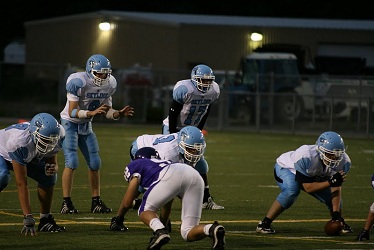
Skyline quarterback Andrew Copp (9) takes a snap against Ann Arbor Pioneer on Sept. 23. Copp threw for an MHSAA-record 557 yards and a record-tying seven touchdowns in a 52-49 loss. (Photo courtesy of Jeff Lepley. Head shot by Pete Draugalis.)
Drive for Detroit: Week 3 in Review
September 14, 2015
By Geoff Kimmerly
Second Half editor
Admittedly, last week's statewide slate of varsity football games didn't appear that intriguing on first glance.
Of course, that means we ended up with more noteworthy results than we expected – and some hard decisions picking which had the biggest impacts as we completed the first third of this season.
See below for five of the most significant finishes from every region of the state, plus links to coverage from those that stuck out most.
Bay & Thumb
Marlette 27, Reese 26
The Red Raiders are 3-0 for the fourth time in five seasons, but living a little on the edge after also beating Bad Axe by a point in Week 2. Reese (0-3) opened with 20 straight points, and took back the lead after Marlette’s first go-ahead score made it 21-20 during the second quarter. The Red Raiders took the lead back for good with a final score with just more than six minutes to play. Click for more from the Port Huron Times-Herald.
Also noted:
Pinconning 28, Whittemore-Prescott 6 – The Spartans (2-1) ended a five-game losing streak to the Cardinals (1-2), a 10-win team last season, with Pinconning’s start its best since its last playoff season of 2009.
Algonac 50, Imlay City 0 – The Muskrats’ story keeps getting better, with its 3-0 start equaling its best season finish since 2007 and its best start since 1972.
Lake Fenton 49, Montrose 21 – The Blue Devils (2-1) no doubt were happy to equal last season’s win total by contributing to the rival Rams’ first 1-2 start since 2009.
Saginaw Swan Valley 26, Alma 21 – The Vikings are finding their way post-Alex Grace, and moved to 2-1 by handing the Panthers (2-1) their first loss
Greater Detroit
Warren Mott 32, Macomb Dakota 27
After surging to a 26-0 lead, Mott held on against what was one of the state’s most impressive teams of the first two weeks. Dakota opened this fall by ending two-time reigning Division 1 champion Clarkston’s 27-game winning streak, then beat rival Clinton Township Chippewa Valley in Week 2. But Mott moved to 3-0 and in doing so gained nice footing in a Macomb Area Conference Red race that could be one of the most competitive in the state. Click for more from the Macomb Daily.
Also noted:
Clinton Township Chippewa Valley 32, Sterling Heights Stevenson 28 – Quarterback Patrick Briningstool’s two touchdown passes during the final five minutes finished a late comeback for the Big Reds (2-1), who avenged last season’s loss to the Titans (2-1).
Detroit Martin Luther King 20, Detroit East English 15 – The Crusaders (3-0) withstood their first tough challenge of the Detroit Public School League schedule and earned their second win by five or fewer points while handing East English (2-1) its first loss.
Sterling Heights 13, St. Clair 10 – The Stallions won two games combined over the last two seasons but are 3-0 for the first time since 1987 after dropping St. Clair to 0-3.
West Bloomfield 35, Clarkston 21 – The Lakers moved to 3-0 for the first time since 1989 thanks in part to four TD runs by Trishton Jackson, while the tough early go continued for the Wolves (1-2).
Mid-Michigan
Grand Ledge 34, Lansing Sexton 32
Grand Ledge had to outlast a previously inexperienced but quickly improving Sexton team to reach 3-0 for the first time since 2011. After just one game of league play, the Comets look like strong favorites in the Capital Area Activities Conference Blue, with Jackson the only other team in the league with fewer than two losses overall. Sexton (0-3) hadn’t lost a league game since Week 8 of 2012. Click for more from the Lansing State Journal.
Also noted:
East Lansing 28, Jackson 21 – Before handing Jackson (2-1) its first loss, the Trojans (1-2) had fallen by only 13 and seven points, respectively, to teams a combined 5-1.
Dansville 40, Fulton 27 – The Aggies have solidified themselves as a top-four team in the Central Michigan Athletic Conference the last few seasons, and for the second year in a row will take on powers Pewamo-Westphalia and Fowler in back-to-back weeks off a 3-0 start.
St. Johns 49, Mason 28 – Seemingly forgotten again in a league with usual favorites DeWitt and Mason (2-1), St. Johns (2-1) looks every bit the contender in the CAAC Red.
Eaton Rapids 34, Ionia 26 (2 OT) – These teams are in similar position in the CAAC White, both facing tough opponents ahead and Eaton Rapids (2-1) thankful for a slight upper hand as Ionia (1-2) must continue to build after a second loss by six or fewer points.
Northern Lower Peninsula
Traverse City Central 32, Traverse City West 26 (OT)
This season’s Patriot Game again went to Traverse City Central, which also celebrated the 600th win in program history and sits fifth all-time among Michigan high schools for varsity football victories. The Trojans (3-0) have beaten rival West (0-3) three of the last four seasons in the annual game at Thirlby Field. Click for more from the Traverse City Record-Eagle.
Also noted:
Hillman 35, AuGres-Sims 20 – The Tigers (2-1) bounced back from a Week 2 loss to continue a recent winning streak over the North Star rival Wolverines (0-3).
Petoskey 38, Cadillac 13 – The Northmen (2-1) also bounced back from a Week 2 loss to down reigning Big North Conference champion Cadillac (0-3) for the first time since 2011.
Gaylord 17, Escanaba 7 – The Blue Devils (3-0) won this matchup of previous unbeatens, although Escanaba’s start remains its best since 2011.
Grayling 30, Maple City Glen Lake 15 – The Vikings (2-1) got back on the right foot quickly after a big Week 2 loss to rival Gaylord by handing league foe Glen Lake (2-1) its first loss this fall.
Southeast & Border
Morenci 22, Petersburg-Summerfield 8
Morenci’s success of a year ago wasn’t a one-time surge – the Bulldogs have now beaten three 2014 playoff teams to open this fall. Morenci has given up only single-digit points in nine its last 12 regular-season games, although the Tri-County Conference challenges should be tougher this time with Sand Creek rejuvenated and Clinton and Ottawa Lake-Whiteford both undefeated as well so far. Click for more from the Adrian Daily Telegram.
Also noted:
Brooklyn Columbia Central 26, Hillsdale 22 – The Eagles (3-0) won two games last season and hadn’t beaten Hillsdale (1-2) since 2011, including a 41-3 loss to the Hornets a year ago.
Homer 32, Concord 30 – The Trojans (2-1) took the momentum away from Concord (2-1), which had celebrated the week before a solid win over reigning Big Eight Conference champion Union City.
Jackson Lumen Christi 20, Battle Creek Harper Creek 17 – The Titans (3-0) remained undefeated with their second win this season by three points or fewer, and this one much closer than last year’s 34-14 win over Harper Creek (1-2).
Vandercook Lake 41, Addison 7 – The Jayhawks (3-0) early are outscoring opponents on average 36-7 during their best start since 2008.
Southwest Corridor
Portage Central 7, Stevensville Lakeshore 6
This was the second time in four seasons these teams played to within a point of each other – the other two games were decided by three and 10 – and Portage Central avenged last season’s 20-17 loss in part by blocking Lakeshore’s extra-point try with just under 10 minutes to play. The Southwest Michigan Athletic Conference West rivals have split their last four meetings – with the winner of this game going on to win the league title the last three seasons. Click for more from the St. Joseph Herald-Palladium.
Also noted:
Battle Creek Central 35, Battle Creek Lakeview 27 – Central (1-2) broke a four-game losing streak against Lakeview (1-2) after scoring only seven points against the Spartans during those previous four matchups.
Delton Kellogg 21, Constantine 18 – The Panthers (2-1) had dropped all six meetings with Constantine (1-2) when the two were in the former Kalamazoo Valley Association, but are 1-0 against the Falcons now that they are in the Southwestern Athletic Conference.
Kalamazoo Central 18, Kalamazoo Loy Norrix 6 – This gives the Maroon Giants (1-2) a 4-3 advantage over the recent history of this rivalry after Loy Norrix (1-2) won last season 20-19.
Coldwater 35, Battle Creek Pennfield 8 – The undefeated Cardinals (3-0) have yet to give up more than eight points in a game this fall and haven’t given up double digits in the regular season since Week 7 of 2014.
Upper Peninsula
Bark River-Harris 56, Newberry 34
Every week the wins are getting more impressive for Bark River-Harris, which moved to 3-0 for the first time since 2009 while handing Newberry (2-1) its first loss. The Broncos literally have doubled their offensive output every week this season, from 14 points in a one-point win over Crystal Falls Forest Park on opening night, to 28 against Gogebic last week and 56 on Friday. Click for more from the Escanaba Daily Press.
Also noted:
Ishpeming Westwood 20, L’Anse 12 – The Patriots (2-1) won this first matchup between these two since the early 1990s, with L’Anse dropping its first game after two league wins.
Munising 12, Felch North Dickinson 8 – Make that 11 straight regular-season wins for the Mustangs (3-0), although the Nordics (1-2) gave them the toughest test during that run.
Iron Mountain 26, Iron River West Iron County 0 – The Mountaineers (2-0) avenged a 24-0 shutout from a year ago at the hands of the rival Wykons (0-3).
Sault Ste. Marie 35, Marquette 21 – The Blue Devils (2-1) broke a five-game losing streak to Marquette (0-3) to move to 2-1 for the first time since 2008.
West Michigan
Muskegon 39, Grandville 12
Friday turned into a flood of historical references and national headlines from Michigan's west coast after Muskegon became the state's first high school football program to earn 800 varsity wins – which also puts the Big Reds tied for ninth in national high school history. They are 2-1 this season and 800-274-43 dating to 1895 (and watch for more on this on Second Half soon from MHSAA historian Ron Pesch, a Muskegon resident and the expert on the subject). Grandville fell to 2-1. Click for more from the Muskegon Chronicle.
Also noted:
East Grand Rapids 35, Caledonia 28 – With plenty of tough competition ahead, this was huge for the Pioneers (3-0) as Caledonia (2-1) also has been one of this area’s most impressive teams early.
Zealand East 39, Hudsonville 33 – Last season’s uncharacteristic 2-7 finish for East (3-0) included a 40-0 loss to Hudsonville (2-1), making this a pretty significant turnaround to say the least.
Ada Forest Hills Eastern 48, Grand Rapids West Catholic 15 – This is a signature win for the still-emerging coach Eddie Ostipow era at Forest Hills Eastern (3-0); the Hawks had dropped all three of their recent meetings with the two-time reigning Division 5 champion.
Muskgon Mona Shores 31, Rockford 10 – Last season’s three-point loss to Rockford (1-2) was Mona Shores’ only defeat of the regular season; the Sailors (3-0) might be even stronger this fall and will have more opportunities to prove it.
8-Player
Rapid River 28, Cedarville 14 – As explained last week, Cedarville’s only regular-season losses of the last three years have come, now three times, to the Rockets (3-0). But for the first time since both moved to 8-player football, they aren’t in the same league – which means a possible rematch in the playoffs for the second straight year would mean infinitely more than this appetizer.
Also noted:
Peck 28, Kinde-North Huron 22 – The generally-powerful Pirates came back from a significant Week 2 loss to Morrice by taking an early upper hand in the North Central Thumb 8-Man League.
Powers North Central 76, Bellaire 14 – Circle Week 8 against Rapid River on the North Central schedule; the Jets (3-0), in their first season of 8-player, are looking that dangerous after winning big over another of the annual powers in Bellaire (2-1).
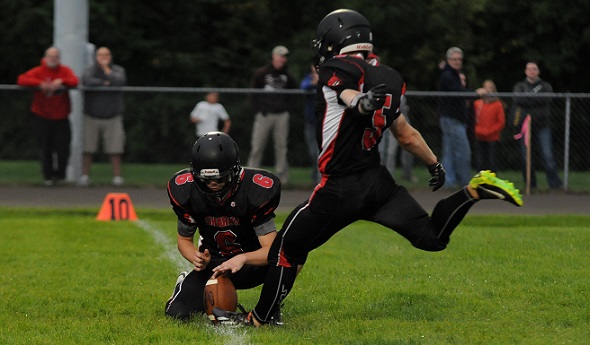
PHOTO: St. Louis, here adding a few more points in last week's 38-6 win over Breckenridge, is 3-0 for the first time since 1978. (Click for more from HighSchoolSportsScene.com.)