

Inside Selection Sunday: Mapnalysis '14
October 26, 2014
By Geoff Kimmerly
Second Half editor
The pictures we drew Sunday morning at the MHSAA office won’t be found hanging on anyone’s walls.
But we worked toward something suitable for framing, designing this season’s football playoff brackets while considering the months and years of work put in by our schools and their teams, parents and fans to earn an opportunity to continue their seasons this weekend.
The work completed today to draw up the 2014 MHSAA Football Playoffs began long before opening night in August. Our football tournament is like none other sponsored by the MHSAA – it’s the only team tournament in which every team doesn’t qualify – and we began talking about this tournament not long after last season’s champions were decided.
Then came April and May and tracking down schedules for 613 MHSAA varsity football teams, plus 45 out-of-state opponents our Michigan schools were set to play including 14 from Ontario and one from Minnesota.
The fun part was monitoring the scores and standings for all of these teams over the nine weeks of the regular season, each Friday night a stream of chatter from kickoff into our weekly highlights show on Fox Sports Detroit.
And then came Sunday – and navigating the most difficult maps to draw in my four seasons assisting in the process.
We often have versions “a” and “b” and on occasion “c” when considering which best accomplishes our goal – to create the correct geographical picture for each of eight 11-player divisions and our 8-player bracket.
Sunday morning, we saw a version “e” for the first time I can remember and some shapes that didn’t make much sense without explanation.
Some of those explanations are below – the stories behind how we made some of the toughest decisions. I start with a quick history lesson you can skip if you’re familiar with this annual report or our playoff selection process in general, then move into some of the specifics many will be discussing this week as they begin focusing on their Pre-District opponents. (Click for the full schedule.)
The process
Our past: The MHSAA playoff structure – with 256 teams in eight divisions, and six wins equaling an automatic berth (or five wins for teams playing eight or fewer games) – debuted in 1999. An 8-player tournament was added in 2011, resulting in nine champions total each season.
The first playoffs were conducted in 1975 with four champions. Four more football classes were added in 1990 for a total of eight champions each fall. Through 1998, only 128 teams made the postseason, based on their playoff point averages within regions (four for each class) that were drawn before the beginning of the season. The drawing of Districts and Regions after the end of the regular season did not begin until the most recent playoff expansion.
In early years of the current process, lines were drawn by hand. Dots representing qualifying schools were pasted on maps, one map for each division, and those maps were then covered by plastic sheets. Districts and Regionals literally were drawn with dry-erase markers.
Our present: After a late Saturday night tracking scores, we file in as the sun rises Sunday morning for a final round of gathering results we may still need (which can include making a few early a.m. calls to athletic directors). Re-checking and triple-checking of enrollments, what schools played in co-ops and opted to play as a higher class start a week in advance, and more numbers are crunched Sunday morning as the fields are set.
This season, there were 229 automatic qualifiers by win total – with the final 27 at-large then selected, by playoff-point average, one from each class in order (A, B, C, D) until the field is filled.
Those 256 11-player teams are then split into eight equal divisions based on enrollment, and their locations are marked on digital maps that are projected on wall-size screens and then discussed by nearly half of the MHSAA staff plus a representative from the Michigan High School Football Coaches Association. Only the locations themselves are marked (by yellow dots) – not records, playoff point averages or names of the schools or towns. In fact, mentions of those are strictly prohibited. Records and playoff points are not part of the criteria. Matchups, rivalries, previous playoff pairings, etc. also DO NOT come into play.
The same process is followed for organizing the 8-player bracket, with the difference that the 16 teams are selected purely on playoff-point average.
Geography rules: This long has been rule number one for drawing MHSAA brackets in any sport, and is a repeat as well for those who have read this report the last three Octobers. Travel distance and ease DO come into play. Jumping on a major highway clearly is easier than driving across county-wide back roads, and that’s taken into consideration. Also, remember there’s only one Mackinac Bridge and hence only one way to cross between peninsulas – and boats are not considered a possible form of transportation. When opponents from both peninsulas will be in the same District, distance to the bridge is far more important than as the bird flies.
Tradition doesn’t reign: Every group of 32 dots is a new group – these 32 teams have not been placed in a bracket together before. That said, how maps have been drawn in the past isn’t considered – it’s hard to say a division has been drawn in a certain way traditionally when this set of 32 teams is making up a division for the first time.
Observations and answers: 2014
Class A ripple: A total of 80 Class A teams qualified for the playoffs in 2013 after three seasons of 79 each. But 89 Class A teams are part of the 2014 field, and that increase in turn shifted a number of smaller schools into different divisions – including some annual favorites. Muskegon, Division 2 runner-up the last two seasons, is in Division 3. Marine City, last season’s Division 4 champion, will play in Division 5. Five-time Division 5 champ Jackson Lumen Christi moved into Division 6, where it could be the toughest obstacle as Ithaca attempts to win that division for the fifth straight season.
Stranger on paper: Yes, Division 1’s District 2 stretches from Grandville to Hartland. This isn’t a desirable outcome, but was necessary with this field. Six districts are filled with teams all east of U.S. 23, and a seventh is completely north and west of Grand Rapids. That left the four teams in the middle – Grandville, East Kentwood, Grand Ledge and Hartland.
Something similar came down in the 8-player bracket – why would we break up four teams in the Thumb to include three with Big Rapids Crossroads Academy all the way west of U.S. 127? It had to do with creating the appropriate semifinal matchup for whichever team emerges from the Rapid River/Cedarville/Engadine/Bellaire regional; keeping the Thumb teams together might’ve meant Lawrence or Waldron from near the Indiana border going all the way to Rapid River instead of Thumb teams that are still far away but closer to the convenient highways.
Line falls through Warren: Division 2 presented a few challenges. There are five districts made up of schools predominantly in the Greater Detroit and Port Huron areas, so one was going to end up potentially matching up farther from home. At first we drew a region across the bottom of the Lower Peninsula that connected teams from the Kalamazoo/Battle Creek area with a district from Ypsilanti and south of Detroit. But rearranging districts to draw a line between Warren DeLaSalle and Warren Counsino, although they’re nearly neighbors, helped make the rest of the map much cleaner – and eliminated that I-94 Regional we didn’t prefer.
Deconstructing D3: This was another toughie given the locations of teams involved. Three districts are all east of U.S. 23 and south of Pontiac, and four more are all west and/or north of Greater Lansing. Usually the Lansing area has a large share of Division 3 qualifiers – but not this season. So that left five schools somewhat without a sure home – St. Johns, DeWitt, Mason, Tecumseh and Linden. DeWitt is much closer to Mason and even Tecumseh, with the differences between St. Johns and DeWitt to Linden and St. Johns and DeWitt to Grand Rapids small enough to cancel out in the big picture.
Stretching Division 6: In the end, this map looks good – but there was a lot of conversation. The tough part was finding the fairest possible situation for whichever district champ might end up playing Negaunee – Bad Axe in the Thumb, Madison Heights Madison or Warren Michigan Collegiate as possibilities coming out of northern Detroit, or even Fennville near Lake Michigan south of Holland. Proximity to I-75 helped make this decision.
Crisscrossing Division 8: Figuring out this bracket started out easy enough with eight teams in the Upper Peninsula or just south of Mackinac Bridge and with the southwest and southeast Lower Peninsula set. But a group of 10 across the top of the Lower Peninsula – including neighbors Mount Pleasant Sacred Heart, Beal City and Coleman – made this interesting. A rule of thumb is we don’t want a team passing through a different district or regional to reach its opponent – and with three teams so closely bunched, that was a challenge in drawing this one out.
At the end of the day ...
What you see is what our committee decided upon after multiple discussions among multiple groups that broke down every sensible possibility we could muster. There are certainly points open to argument – and we likely made those arguments as well.
In the end, we present a group of dots on a map – as stated above, we don’t identify the schools until after the groupings are drawn. Part of the fun is then finding out what first-round matchups we’ve created: Muskegon Mona Shores vs. Caledonia and Detroit Martin Luther King vs. Southfield should be incredible, as well as the Ishpeming/Westwood and Iron Mountain/West Iron County rivalry games in the Upper Peninsula.
And no doubt, those who play for and support Burton Atherton, Ypsilanti Community, first-year Lapeer High School, Big Rapids Crossroads and New Haven Merritt Academy are ready to enjoy the playoff ride for the first time.
We’re excited to watch them all – and see which end up in Detroit with us to finish the fall over Thanksgiving weekend. We hope to see you there as well.
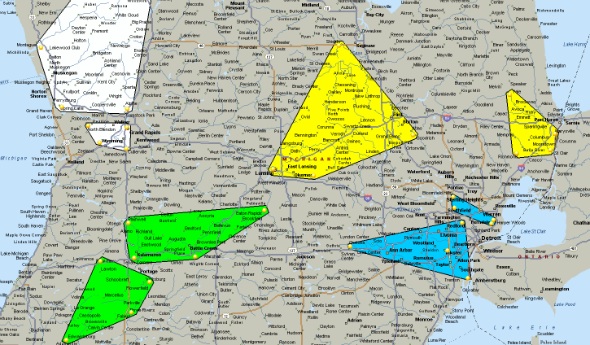
PHOTO: The Division 4 map for 11-player football has each region shaded; champion of the white plays green in a semifinal with yellow facing blue in the other.
King Completes Perfect Run on Final Play
November 27, 2015
By Bill Khan
Special for Second Half
DETROIT — Armani Posey was supposed to be a two-week stopgap at quarterback for Detroit Martin Luther King.
 Two weeks turned into 11 weeks, building toward a championship finish for the ages.
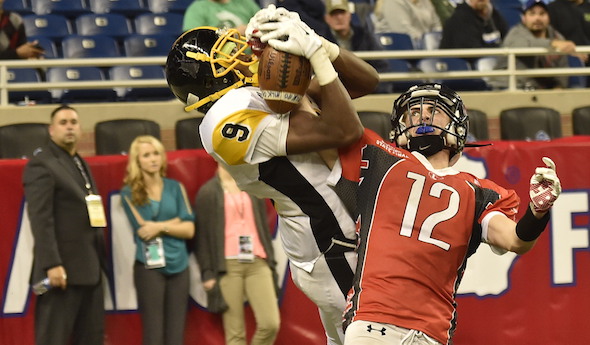
In a moment that was “The Catch” and “The Drive” all rolled into one, Posey heaved a 40-yard touchdown pass to senior receiver Donnie Corley on the final play of the game to give King a 40-38 victory over Lowell in the Division 2 title game Friday at Ford Field.
Lowell led 31-13 in the third quarter before Posey responded by throwing four of his record-tying five touchdown passes in the final 15:41 of the game. The final drive began with 37 seconds remaining at King's 3-yard line after a punt out of bounds and a penalty.
It was a scenario tailor-made for John Elway — or Armani Posey.
"What happened today is a memory forever," Posey said. "I dreamed about that and went out there and did it today. I couldn't imagine that type of performance, but we got the job done. Shout-out to the O-line."
When the starter was suspended for two weeks, King coach Dale Harvel was in search of a quarterback for the Week 4 game against Detroit Denby and the week 5 game against eventual Division 1 finalist Detroit Cass Tech. Harvel wanted a mature senior to, at the very least, manage an offense that is loaded with Division I college prospects. Posey turned into much more than a game manager.
"What we found out was he settled down everybody in the offense, because the first week we struggled a little bit against (Warren) DeLaSalle and struggled against East (English) Village," Harvel said. "We were able to win because we were playing good defense. He's been a settling effect on our offense and we couldn't go away from him, because we were in a rhythm with our offense. So, we stuck with him all year."
Posey's first position was quarterback, but that was way back in his elementary school days playing in the Detroit Police Athletic League for the East Side Tigers. One of his teammates back in the day happened to be the young man with whom his legacy will forever be linked.
"He played quarterback when I played for the Tigers," Corley said. "He's always been a good quarterback. I didn't know he was going to play this well. He had five touchdowns for 300 yards today? That's amazing."
After starting the game with three three-and-outs and his team falling behind 17-0, Posey finished 19 for 27 for 383 yards, five touchdowns and no interceptions. He broke the MHSAA Finals record of 335 yards set by Olivet's Jay Cousineau in the 2010 Division 5 Final. He matched the record of five touchdown passes shared by Macomb Dakota's Mitch Lovett (2007, Division 1) and Cass Tech's Jayru Campbell (2011, Division 1). Posey also ran seven times for 20 yards and a touchdown.
It took a rare defensive stop by King to put Posey and Corley in a position to produce a moment that will be talked about for decades.
Lowell drove from its own 35 to King's 39 before its only negative play of the game, a 2-yard loss on a run by quarterback Ryan Stevens, forced only the second punt of the game for the Red Arrows. Stevens nailed the punt out of bounds at the 5 with 37 seconds left. An illegal procedure penalty on King before the first snap moved it back inside the 3.
"They battled, right down to where we punted the ball down to the 5 with (37) seconds on the clock," Lowell coach Noel Dean said. "I thought that would be a pretty good spot to be in. Credit them — they made the plays at the end."
 King made several plays on its way to the end zone.
A 22-yard pass to Lavert Hill, a 10-yard pass to Corley and a 25-yard pass to Dontre Boyd got the ball to the Lowell 40 with 10 seconds left. Boyd had to watch the final play from the sidelines, having injured his shoulder after his catch on a tackle by Alex Anschutz. Boyd had 126 yards on five catches.
"He could've easily dropped the football," Harvel said. "He focused on that football and knew he was going to get hit — a good legal hit. He caught the football and made the play for a first down for us and made the opportunity to throw that pass to Donnie. All of his teammates understand what he sacrificed for his football team out there today."
"To me, that was the biggest play of the game," said Corley, who was about to make the most memorable play of the 2015 season.
King had two shots at the end zone in the final 10 seconds. On the first play, Posey overthrew Ambry Thomas down the left side. Two seconds remained on the clock for a play that would make one team's dreams come true and crush another's.
As King lined up for the final play, Corley was in single coverage on the left side. This was an inviting prospect for the Crusaders, considering Corley is being recruited by Michigan, Michigan State, Notre Dame and Ohio State.
Corley said the Lowell cornerback called for safety help over the top, but that the safety didn't hear in the instructions.
"When we didn't see the safety move over, I was repeating, 'Throw it to Donnie, throw it to Donnie,'" Harvel said. "Nobody could hear me, but it was comforting to me to say that, even though nobody could hear me."
As Corley ran toward the left side of the end zone, Posey had time to heave the ball to his star receiver. Corley, who has a 37-inch vertical leap, won a jump ball against the corner who appeared to get a hand on the ball, then fell to the ground safely inbounds.
"It was a beautiful ball," said Corley, who caught six passes for 108 yards and two touchdowns. "It couldn't have been any better. He threw it just inbounds and in the back of the end zone. I knew where I was on the field. I couldn't believe it — I'm not gonna lie. We fought back from 17-0 and we won."
It's only the second time that the winning score in an MHSAA championship game took place on the final play. Steve Mann caught a 17-yard touchdown pass from Charlie Johnson to give Detroit Country Day an 18-14 victory over Muskegon Catholic Central in the 1986 Class C title game.
For most of the afternoon, this wasn't a championship game that appeared to be destined for a dramatic finish.
Max Dean's third touchdown run of the game, a 4-yarder with 8:24 left in the third quarter, gave Lowell a 31-13 lead. The Red Arrows had leads of 17-0 and 24-7 in the first half.
A 25-yard touchdown pass from Posey to Corley with 3:41 left in the third quarter and a 41-yard pass from Posey to Thomas got King back in the game, down only 31-26 with 11:44 remaining.
Lowell responded with a 10-play, 73-yard drive that culminated with a 2-yard touchdown run by Stevens with 7:10 remaining.
Aided by a personal foul for facemasking, King crept to within 38-34 on a 2-yard pass from Posey to Hill and a 2-point pass from Posey to Martell Pettaway with 4:42 to go.
Lowell got two first downs on its next possession, forcing the Crusaders to use their remaining timeouts. They were able to manage the clock well on the final drive, particularly when Hill gave up the opportunity for a few more yards to get out of bounds with 28 seconds left on the first play. The clock stopped temporarily when Corley's 10-yard catch got a first down. Boyd was on the field for a couple of minutes after being injured making his 25-yard catch, allowing King to discuss its options and be ready at the line when the clock started running as play resumed.
Corley's catch gave King its second MHSAA championship, matching the achievement of the 2007 team. It was King's fourth victory of three points or fewer in a 14-0 season.
Lowell scored on its first four possessions before taking a knee to end the first half during its fifth, leading 17-0 before King even registered a first down.
After getting first-and-goal at the King 5, Lowell settled for a 21-yard field goal by George Gonzales to open the scoring with 4:52 left in the first quarter.
A 36-yard pass to senior Gabe Steed was the key play on a 10-play, 70-yard scoring drive that ended with a 1-yard run by Dean with 11:03 left in the second quarter.
A 62-yard pass to a wide-open David Kruse on Lowell's third drive set up a 4-yard touchdown run by Stevens with 7:02 left in the first half. At this point, Lowell had a 173-9 advantage in total offense and a 17-0 lead.
It appeared King would suffer its fourth straight three-and-out to start the game when an intentional grounding penalty left the Crusaders facing third-and-20 from their own 25. That's when King's explosive offense finally showed life, as Boyd had a 73-yard catch and run down to the Lowell 2. Two plays later, Posey scored on a 3-yard bootleg to the right, cutting Lowell's lead to 17-7 with 4:21 left in the first half.
Lowell responded immediately, using a 66-yard pass to Sawyer Olesko to set up a 3-yard touchdown run by Dean with 1:53 to go in the first half, making it a 24-7 game.
King tightened the margin before the break, as Hill made an acrobatic 41-yard catch at the Lowell 12, then grabbed a 12-yard touchdown pass from Posey on the next play to cut Lowell's lead to 24-13 with 25 seconds left in the half. The extra point attempt failed.
Lowell (12-2) used some trickery to build its lead to 31-13, with Nathan Stephens taking a short direct snap on a fourth-and-one punt and running 38 yards to the King 5. Two plays later, Dean scored his third touchdown from four yards out with 8:24 left in the third quarter.
Dean finished with 99 yards rushing and three touchdowns on 22 carries. Stevens was 6 for 9 for 186 yards, running 22 times for 66 yards and two touchdowns.
The MHSAA Football Finals are sponsored by the Michigan National Guard.
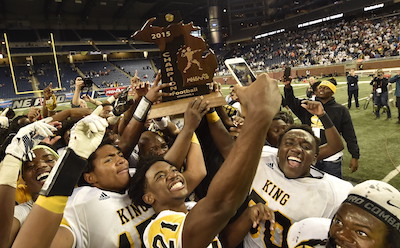
PHOTOS: (Top) Detroit Martin Luther King’s Donnie Corley pulls down a touchdown pass on the final play of the game to give the Crusaders the lead and win. (Middle) King players celebrate their second MHSAA championship.