

Inside Selection Sunday: Mapnalysis '15
October 26, 2015
By Geoff Kimmerly
Second Half editor
Consider that one hour Sunday night was the product of nine weeks of games on top of two more weeks of practice, hours of lifting weights, conditioning and camps and a total of six months of work at the MHSAA office, in addition to hours upon hours put in by athletic directors scheduling years in advance.
The anticipation for the release of another year's MHSAA Football Playoff pairings is matched by a giant exhale only after the results are broadcast on Fox Sports Detroit, streamed online and posted on locker room doors and Facebook walls all over our state.
 And then the fun begins again.
But the Selection Sunday Show is the favorite hour of the season for many fans across our state. And that’s why, for the fifth year, we’ll explain our most difficult decisions in this Mapnalysis 2015 breakdown of how we paired 272 teams that will play next month for championships across nine divisions.
For those familiar with our playoff selection process, or who have read this report in the past and don’t want a refresher on how we do what we do, skip the next section and go directly to the “Observations & Answers: 2015.” For the rest, what follows is an explanation of how we selected the playoff pairings during the morning hours Sunday, followed by how we made some of the toughest decisions and a few thoughts on the breakdown of the field.
Ground Rules
Our past: The MHSAA 11-player playoff structure – with 256 teams in eight divisions, and six wins equaling an automatic berth (or five wins for teams playing eight or fewer games) – debuted in 1999. An 8-player tournament was added in 2011, resulting in nine champions total each season.
The first playoffs were conducted in 1975 with four champions. Four more football classes were added in 1990 for a total of eight champions each fall. Through 1998, only 128 teams made the postseason, based on their playoff point averages within regions (four for each class) that were drawn before the beginning of the season. The drawing of Districts and Regionals after the end of the regular season did not begin until the most recent playoff expansion.
In early years of the current process, lines were drawn by hand. Dots representing qualifying schools were pasted on maps, one map for each division, and those maps were then covered by plastic sheets. Districts and Regionals literally were drawn with dry-erase markers.
Our present: After a late Saturday night tracking scores, we file in as the sun rises Sunday morning for a final round of gathering results we may still need (which can include making a few early a.m. calls to athletic directors). Re-checking and triple-checking of enrollments, what schools played in co-ops and opted to play as a higher class start a week in advance, and more numbers are crunched Sunday morning as the fields are set.
This season, there were a record-low 216 automatic qualifiers by win total – with the final 40 at-large then selected, by playoff-point average, one from each class in order (A, B, C, D) until the field was filled. There were only four Class D additional qualifiers with 5-4 or 4-4 (playing eight games) records from which we could choose – so after those four we added 12 teams each from Class A, Class B and Class C.
Those 256 11-player teams are then split into eight equal divisions based on enrollment, and their locations are marked on digital maps that are projected on wall-size screens and then discussed by nearly half of the MHSAA staff plus a representative from the Michigan High School Football Coaches Association. Only the locations themselves are marked (by yellow dots) – not records, playoff point averages or names of the schools or towns. In fact, mentions of those are strictly prohibited. Records and playoff points are not part of the criteria. Matchups, rivalries, previous playoff pairings, etc. also DO NOT come into play.
The same process is followed for organizing the 8-player bracket, with the difference that the 16 teams are selected purely on playoff-point average.
Geography rules: This long has been rule number one for drawing MHSAA brackets in any sport. Travel distance and ease DO come into play. Jumping on a major highway clearly is easier than driving across county-wide back roads, and that’s taken into consideration. Also, remember there’s only one Mackinac Bridge and hence only one way to cross between peninsulas – and boats are not considered a possible form of transportation. When opponents from both peninsulas will be in the same District, distance to the bridge is far more important than as the bird flies.
Tradition doesn’t reign: Every group of 32 dots is a new group – these 32 teams have not been placed in a bracket together before. How maps have been drawn in the past isn’t considered – it’s hard to say a division has been drawn in a certain way traditionally when this set of 32 teams is making up a division for the first time.
Observations & Answers: 2015
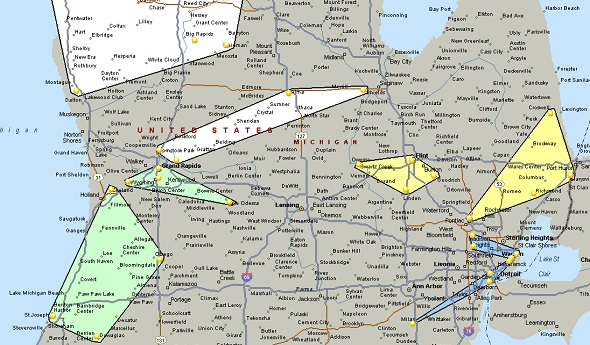
Go north with ease: For the most part, most Regional pairings were easier to draw than in past years. For the most part. Divisions 2 and 4 were not easy, specifically when it came to deciding which teams would be paired with an Upper Peninsula qualifier or a team from the Traverse City area. Keep in mind, distance on these maps isn’t based on how the bird flies, but how a bus would drive. In Division 2, that meant putting Muskegon, Muskegon Mona Shores and Grand Rapids Forest Hills Northern – near U.S. 31 and U.S. 131 – with Traverse City Central instead of sending Midland and Midland Dow west, up I-75 and then east-to-west again on more non-highway roads. In Division 4, we considered pairing Alma and Saginaw Swan Valley with Escanaba instead of Big Rapids and Remus Chippewa Hills. That decision came down to Big Rapids being about 14 miles closer to Escanaba than Swan Valley (Whitehall would go with Big Rapids and Chippewa Hills regardless.).
Four counties wide: Yes, on first glance it looks a little odd that Bay City John Glenn and Orchard Lake St. Mary’s would be in the same Division 3 District – but look at the map as a whole. Eight Division 3 teams are located south and mostly east of St. Mary’s, and John Glenn is the only team that could be considered in the northeastern quarter of the Lower Peninsula (Mount Pleasant and Gaylord are right down the middle and naturals to go with Sault Ste. Marie and Petoskey.). With the thumb playoff qualifiers of near-similar size in Division 4, there were no other options than to create this four-county trip between the Eaglets and Bobcats.
Semifinal selection: When all the Regional lines are drawn for a division, we also must figure out which Regionals will meet for Semifinals. This annually provides some challenges. Do we match east vs. west or north vs. south? If something seems iffy in four weeks when those games are played, again, keep in mind the entire map and entire Regionals that are matched up.
Scheduled strong: Because we’re looking only at dots on a map, we don’t see the matchups until everything is drawn – and in that way, we’re like everyone else. It wasn’t lost on us that two 9-0 teams will have road games this week or three 5-4 at-large qualifiers will be at home. For those 9-0 teams, it’s true: there’s nothing more they could’ve done on the field. But here’s why they will travel.
- Clinton, in Division 6, hasn’t lost a regular-season game since 2011, and in fact plays in a strong Tri-County Conference made up of Class C schools and one Class D. Four of eight from the league made the playoffs, and the competition was so strong that Morenci and Petersburg-Summerfield will host games in Division 8. But Clinton’s opponent, Monroe St. Mary Catholic Central, while it did have one loss, fell to one-loss Class B Lansing Catholic – and the Falcons played eight Class B and one Class A school this season. Beating a Class B team is worth 16 points more than beating a Class C and 32 more than beating a Class D (with those points then divided over the number of games a team plays that season) – and all of that made the difference in St. Mary’s final eight-point playoff average edge over Clinton.
- Saugatuck in Division 7 is a similar story. The Indians are one of three undefeated teams in their District, and did play a pair of Class B opponents. But by no fault of their own, especially in league play where the schedule is set, Saugatuck didn’t face a team this season that won more than five games. Hesperia played three Class B opponents including one that finished 6-3 – enough for the slim 1.8 points more in playoff average that earned the Panthers homefield advantage. Pewamo-Westphalia has the highest average in the District and didn’t play a Class B – the Pirates actually played three Class D teams. But they also beat four teams that made the playoffs including two that finished 8-1 – giving them a 2.7-point edge on Hesperia and 4.5 edge on Saugatuck.
- The 5-4 teams that will host – Redford Thurston in Division 3 and Escanaba and Benton Harbor in Division 4, all earned their spots. Escanaba faced six playoff teams and beat three, Class B Benton Harbor played eight Class A teams, and Thurston played five playoff teams and a sixth that just missed an at-large bid.
At the end of the day ...
What you see is what our committee decided upon after multiple discussions among multiple groups that broke down every sensible possibility we could muster. There are certainly points open to argument – and we likely made those arguments as well.
Those who would like to see the playoff selection process changed are in favor of a larger strength-of-schedule component, and it’s interesting to see how strength of schedule inadvertently made a larger impact this season than in the recent past – especially given the examples above of undefeated teams going on the road and at-large teams hosting.
Why were there fewer automatic qualifiers than ever before? Here's one theory. There were 11 fewer teams in 11-player football this season than in 2014 (most moved to 8-player). An argument can be made that there were fewer wins to be gained against teams that last season might have struggled to field 11-player teams, shifting the balance to fewer automatic qualifiers and more parity with stronger teams facing each other to fill their schedules.
Meanwhile, the 8-player field grew by nine teams this fall and has its strongest ever, with seven teams that finished 5-4 missing the postseason after a team with a sub-.500 record got in just a year ago.
Given how some matchups shook out this fall, the next argument by those seeking change likely will center on seeding entire Regionals instead of just Districts. But keep this in mind as well: if Regionals were seeded with this year's groupings, it would create possibilities of first-week trips like Battle Creek to Traverse City and Cedar Springs to Sault Ste. Marie. We're fairly sure most coaches and players would dread such journeys for a first-round game.
It's a lot to digest, and the scrutinizing will surely continue long after these playoffs are done as we all work to conduct the best tournament possible.
But at the end of the day – and the end of these next five weeks – to be the best, teams will need to beat the best no matter the matchups. And we’ve got plenty to look forward to starting this weekend and all the way through the 11-player Division 3 Final on Nov. 28 at Ford Field.
The MHSAA Football Playoffs are sponsored by the Michigan National Guard.
PHOTO: The Division 4 map was among the most difficult to draw during this year's selection process.

2016 Week 9 Football Playoff Listing
October 18, 2016
By Geoff Kimmerly
Second Half editor
Here is a list of Michigan High School Athletic Association football playing schools, displaying their win-loss records and playoff averages through the eighth week of the season.
Schools on this list are in enrollment order for 11-player teams, with 8-player teams ordered by playoff average. An asterisk (*) beside a record indicates a team has eight or fewer games scheduled. A caret (^) beside a school’s name indicates a team is one win away from playoff qualification.
Those schools with 11-player teams with six or more wins playing nine-game schedules, or five or more wins playing eight games or fewer, will qualify for the MHSAA Football Playoffs beginning Oct. 28.
Schools with 5-4, 4-3 or 4-4 records may qualify if the number of potential qualifiers by win total does not reach the 256 mark. Schools with six or more wins playing nine-game schedules or five or more wins playing eight games or fewer may be subtracted from the field based on playoff average if the number of potential qualifiers exceeds the 256 mark.
Once the 256 qualifying schools are determined, they will be divided by enrollment groups into eight equal divisions of 32 schools, and then drawn into regions of eight teams each and districts of four teams each. Those schools with 8-player teams will be ranked by playoff average at season’s end, and the top 16 programs will be drawn into regions of eight teams each for the playoff in that division, which also begins Oct. 28.
To review a list of all football playoff schools, individual school playoff point details and to report errors, visit the Football page of the MHSAA Website.
The announcement of the qualifiers and first-round pairings for both the 11 and 8-player playoffs will take place at 7 p.m. on Oct. 23 on the Selection Sunday Show on FOX Sports Detroit. In addition to the cable television broadcast, the show will be available via a live video stream on the FoxSportsDetroit.com website, and for mobile users on FOX Sports GO! The playoff qualifiers and pairings will be posted to the MHSAA Website following the Selection Sunday Show.
11-Player Playoff Listing
1. Macomb Dakota ^, 2976, 5-3, 65.000
2. Utica Eisenhower, 2700, 8-0, 113.000
3. Clarkston, 2683, 6-2, 82.125
4. Grand Blanc, 2628, 4-4, 57.000
5. East Kentwood, 2596, 4-4, 55.500
6. Southfield Arts & Technology ^, 2581, 5-3, 68.125
7. Rockford, 2563, 6-2, 83.750
8. Clinton Township Chippewa Valley ^, 2518, 5-3, 73.000
9. Howell ^, 2499, 5-3, 65.875
10. Dearborn Fordson, 2487, 7-1, 94.750
11. Lake Orion ^, 2418, 5-3, 64.500
12. Detroit Cass Tech, 2368, 8-0, 93.000
13. Northville, 2325, 7-1, 100.750
14. Salem, 2172, 4-4, 51.125
15. Brighton, 2142, 7-1, 94.750
16. Detroit Catholic Central, 2128, 8-0, 110.000
17. Novi, 2050, 4-4, 51.875
18. Oxford, 2042, 4-4, 51.000
19. Canton, 2035, 6-2, 79.500
20. New Baltimore Anchor Bay ^, 1987, 5-3, 57.500
21. Macomb L'Anse Creuse North, 1986, 6-2, 76.500
22. Dearborn, 1978, 7-1, 97.750
23. Lapeer, 1932, 6-2, 72.500
24. Saline, 1923, 8-0, 108.714
25. West Bloomfield, 1905, 4-4, 53.375
26. Holt, 1881, 4-4, 48.500
27. Livonia Stevenson, 1839, 4-4, 57.125
28. Bloomfield Hills, 1831, 8-0, 107.000
29. White Lake Lakeland, 1822, 4-4, 48.875
30. Grandville, 1810, 7-1, 93.625
31. Hudsonville, 1797, 7-1, 93.750
32. Warren Mott, 1768, 6-2, 78.375
33. Ann Arbor Skyline, 1732, 4-4, 49.536
34. Grand Ledge, 1694, 7-1, 91.750
35. Belleville, 1668, 6-2, 77.500
36. Davison, 1668, 8-0, 101.000
37. Rochester Adams, 1666, 6-2, 75.500
38. Romeo ^, 1641, 5-3, 75.750
39. Waterford Mott, 1638, 4-4, 56.000
40. Rochester ^, 1632, 5-3, 63.750
41. Walled Lake Northern, 1631, 6-2, 76.125
42. Kalamazoo Central, 1615, 4-4, 52.089
43. Grosse Pointe South, 1600, 6-2, 83.125
44. Temperance Bedford, 1597, 7-1, 85.875
45. Detroit Western International, 1584, 4-4, 42.750
46. Brownstown Woodhaven, 1579, 6-2, 75.375
47. Detroit East English, 1579, 4-4, 49.125
48. Livonia Churchill ^, 1578, 5-3, 64.625
49. Traverse City West, 1552, 6-2, 77.625
50. Flint Carman-Ainsworth, 1522, 6-2, 78.250
51. Livonia Franklin, 1507, 6-2, 80.000
52. Warren Cousino, 1496, 7-1, 89.500
53. Detroit Martin Luther King, 1487, 7-1, 86.875
54. Detroit U-D Jesuit *, 1482, 5-2, 76.746
55. Jenison ^, 1481, 5-3, 60.125
56. Oak Park, 1409, 6-2, 81.750
57. St. Clair Shores Lakeview ^, 1409, 5-3, 55.875
58. Ypsilanti Lincoln, 1404, 4-4, 47.161
59. Traverse City Central, 1394, 7-1, 92.500
60. Port Huron, 1392, 4-4, 47.875
61. Midland, 1388, 4-4, 46.625
62. Portage Central, 1388, 7-1, 95.464
63. Portage Northern ^, 1378, 5-3, 65.946
64. Walled Lake Western, 1370, 7-1, 103.125
65. Grosse Pointe North, 1367, 6-2, 76.250
66. Battle Creek Lakeview *, 1353, 5-2, 70.268
67. Hamtramck ^, 1352, 5-3, 51.804
68. Dearborn Edsel Ford, 1346, 4-4, 47.875
69. Berkley ^, 1319, 5-3, 65.750
70. Grand Rapids Forest Hills Central, 1316, 6-2, 76.375
71. Wyandotte Roosevelt, 1311, 7-1, 89.875
72. Dearborn Heights Crestwood, 1294, 4-4, 45.125
73. Port Huron Northern, 1288, 6-2, 67.875
74. Wyoming ^, 1288, 5-3, 59.875
75. Pinckney, 1276, 6-2, 78.375
76. Midland Dow, 1254, 7-1, 86.625
77. Birmingham Brother Rice ^, 1250, 5-3, 69.042
78. Birmingham Groves, 1248, 8-0, 109.000
79. Jackson, 1243, 4-4, 51.250
80. Muskegon Mona Shores, 1240, 4-4, 52.375
81. South Lyon, 1234, 4-4, 53.250
82. Muskegon Reeths-Puffer, 1198, 4-4, 45.625
83. Lowell, 1165, 8-0, 113.000
84. Holly ^, 1164, 5-3, 59.750
85. Farmington Hills Harrison, 1161, 4-4, 50.500
86. Bay City Central ^, 1158, 5-3, 58.875
87. Greenville ^, 1142, 5-3, 64.625
88. Fenton, 1138, 6-2, 79.000
89. Gibraltar Carlson, 1136, 4-4, 51.500
90. East Lansing ^, 1117, 5-3, 62.500
91. Ferndale, 1117, 6-2, 65.375
92. Grand Rapids Forest Hills Northern, 1100, 4-4, 50.875
93. Allen Park, 1094, 8-0, 111.000
94. Byron Center, 1070, 7-1, 89.750
95. Mount Pleasant, 1065, 4-4, 43.625
96. Muskegon, 1052, 7-1, 91.750
97. Orchard Lake St. Mary's ^, 1040, 5-3, 70.978
98. Ortonville-Brandon, 1034, 7-1, 80.625
99. Detroit Cody ^, 1015, 5-3, 59.125
100. St. Johns, 1015, 4-4, 47.750
101. Mason, 1009, 7-1, 81.750
102. Zeeland East, 1007, 6-2, 73.250
103. DeWitt, 1002, 7-1, 95.750
104. St. Joseph, 989, 6-2, 77.071
105. East Grand Rapids, 979, 6-2, 78.625
106. Trenton ^, 969, 5-3, 68.000
107. Linden, 940, 6-2, 70.500
108. Coldwater, 929, 6-2, 72.000
109. Romulus, 929, 7-1, 84.750
110. Grand Rapids Christian, 912, 7-1, 88.958
111. Warren Fitzgerald, 891, 7-1, 85.500
112. New Boston Huron ^, 886, 5-3, 57.750
113. Battle Creek Harper Creek, 880, 7-1, 78.625
114. Chelsea, 867, 8-0, 101.486
115. Redford Union, 865, 6-2, 62.375
116. Stevensville Lakeshore ^, 865, 5-3, 65.750
117. Vicksburg, 861, 7-1, 77.875
118. Dearborn Divine Child, 859, 6-2, 66.000
119. Zeeland West, 857, 6-2, 78.500
120. Edwardsburg, 855, 8-0, 93.000
121. Marshall, 849, 4-4, 48.375
122. Bay City John Glenn, 838, 6-2, 63.375
123. Sparta, 834, 4-4, 38.375
124. Fowlerville, 833, 6-2, 69.625
125. Cadillac, 817, 6-2, 68.250
126. Hamilton ^, 810, 5-3, 59.125
127. Bloomfield Hills Cranbrook Kingswood, 797, 6-2, 65.536
128. Marysville, 794, 8-0, 99.000
129. Adrian ^, 792, 5-3, 59.161
130. Detroit Osborn, 786, 4-4, 45.750
131. St. Clair, 784, 4-4, 51.375
132. Milan, 775, 7-1, 87.375
133. Pontiac Notre Dame Prep, 749, 4-4, 48.000
134. River Rouge, 741, 7-1, 75.875
135. Allendale, 735, 6-2, 67.500
136. Three Rivers, 730, 6-2, 67.125
137. Escanaba, 722, 6-2, 69.306
138. Detroit Mumford, 714, 7-1, 85.571
139. Harper Woods Chandler Park Academy *, 708, 5-3, 57.911
140. Detroit Cesar Chavez Academy, 697, 4-4, 26.250
141. Ludington, 695, 6-2, 50.375
142. Detroit Country Day, 692, 8-0, 93.714
143. Monroe Jefferson, 687, 4-4, 44.750
144. Warren Lincoln, 686, 4-4, 39.750
145. Yale, 683, 4-4, 42.125
146. Alma, 674, 7-1, 77.875
147. Paw Paw, 672, 4-4, 41.500
148. Battle Creek Pennfield, 669, 4-4, 45.375
149. Wyoming Kelloggsville, 660, 7-1, 80.071
150. Croswell-Lexington ^, 659, 5-3, 53.875
151. Lake Fenton, 654, 8-0, 88.000
152. Grosse Ile, 653, 7-1, 81.750
153. Whitehall ^, 653, 5-3, 51.000
154. Flint Powers Catholic ^, 647, 5-3, 57.625
155. Wyoming Godwin Heights, 645, 4-4, 45.196
156. Grand Rapids Catholic Central, 644, 7-1, 85.750
157. Benton Harbor, 643, 8-0, 93.000
158. Williamston, 643, 4-4, 43.750
159. Corunna, 639, 6-2, 62.500
160. Hudsonville Unity Christian, 629, 7-1, 86.625
161. Grand Rapids South Christian ^, 621, 5-3, 58.250
162. St. Clair Shores South Lake, 617, 6-2, 72.125
163. Lake Odessa Lakewood, 614, 8-0, 86.000
164. Dowagiac ^, 610, 5-3, 54.250
165. Lansing Sexton ^, 610, 5-3, 67.000
166. Hancock, 608, 4-4, 35.514
167. Saginaw Swan Valley ^, 607, 5-3, 55.250
168. Detroit Denby, 593, 7-1, 74.375
169. Muskegon Oakridge, 590, 7-1, 73.875
170. Southfield Bradford, 587, 6-2, 58.536
171. Belding ^, 585, 5-3, 53.125
172. Portland, 579, 8-0, 100.000
173. Remus Chippewa Hills, 577, 7-1, 75.875
174. North Muskegon, 565, 4-4, 38.750
175. Richmond, 562, 7-1, 80.875
176. Freeland, 561, 8-0, 95.000
177. Macomb Lutheran North, 557, 4-4, 41.250
178. Essexville Garber, 550, 6-2, 60.625
179. Algonac, 547, 7-1, 77.750
180. Ida, 546, 7-1, 76.750
181. Carrollton, 543, 4-4, 38.625
182. Kingsford, 543, 6-2, 71.306
183. Olivet ^, 541, 5-3, 54.625
184. Harper Woods, 540, 4-4, 38.425
185. Frankenmuth, 533, 8-0, 88.000
186. Lansing Catholic, 532, 7-1, 83.875
187. Grandville Calvin Christian ^, 531, 5-3, 54.946
188. Marine City, 526, 4-4, 49.000
189. Grant, 520, 6-2, 57.625
190. Kalkaska, 517, 6-2, 56.500
191. Perry, 504, 4-4, 35.250
192. Almont ^, 497, 5-3, 51.000
193. Shepherd ^, 497, 5-3, 51.125
194. Manistee, 496, 4-4, 39.500
195. Reed City, 496, 8-0, 91.000
196. Grayling ^, 492, 5-3, 46.250
197. Berrien Springs *, 482, 5-2, 66.306
198. Stockbridge, 482, 4-4, 41.500
199. Buchanan *^, 476, 4-3, 51.411
200. Grand Rapids West Catholic, 475, 7-1, 75.625
201. Ovid-Elsie, 475, 4-4, 38.750
202. Durand ^, 463, 5-3, 44.125
203. Parchment ^, 448, 5-3, 48.375
204. Clinton Township Clintondale, 447, 4-4, 40.750
205. Brooklyn Columbia Central, 442, 6-2, 58.500
206. Menominee, 439, 7-1, 84.194
207. Hillsdale, 432, 4-4, 39.250
208. Ithaca, 426, 8-0, 83.000
209. Clare, 419, 7-1, 73.875
210. Pinconning ^, 417, 5-3, 44.875
211. Montague, 414, 6-2, 58.125
212. Tawas *, 412, 5-2, 45.714
213. Hemlock, 411, 4-4, 37.875
214. Harrison ^, 410, 5-3, 46.750
215. Calumet, 406, 7-1, 67.764
216. Michigan Center ^, 406, 5-3, 45.000
217. Morley Stanwood ^, 404, 5-3, 48.875
218. Lakeview ^, 402, 5-3, 54.625
219. Delton Kellogg, 401, 4-4, 42.625
220. Negaunee, 400, 8-0, 86.429
221. Warren Michigan Collegiate, 398, 7-1, 76.036
222. Adrian Madison, 397, 4-4, 36.750
223. Boyne City, 396, 6-2, 62.875
224. Charlevoix, 393, 6-2, 56.500
225. Millington, 393, 7-1, 73.875
226. Beaverton ^, 387, 5-3, 48.000
227. Constantine ^, 386, 5-3, 55.000
228. Montrose ^, 386, 5-3, 52.125
229. Byron, 385, 6-2, 57.500
230. Quincy ^, 381, 5-3, 39.125
231. Jackson Lumen Christi, 380, 6-2, 71.500
232. Napoleon, 380, 6-2, 53.375
233. Watervliet, 380, 6-2, 61.375
234. Maple City Glen Lake, 379, 6-2, 56.750
235. Manchester ^, 378, 5-3, 43.000
236. Detroit Edison Public School Academy *^, 374, 4-3, 41.304
237. Houghton Lake ^, 374, 5-3, 49.125
238. Laingsburg, 374, 7-1, 63.875
239. Blissfield, 367, 4-4, 41.875
240. Roscommon, 367, 7-1, 68.750
241. Grass Lake, 363, 7-1, 65.500
242. Kent City, 362, 6-2, 56.125
243. New Haven, 362, 4-4, 41.250
244. Schoolcraft, 358, 8-0, 83.000
245. Monroe St. Mary Catholic Central, 355, 4-4, 49.500
246. Oscoda, 352, 4-4, 30.125
247. Ravenna, 350, 6-2, 60.375
248. Leroy Pine River, 347, 6-2, 61.125
249. Detroit Central Collegiate, 346, 4-4, 40.250
250. Ecorse, 345, 4-4, 40.375
251. Madison Heights Madison ^, 343, 5-3, 67.625
252. Traverse City St. Francis, 341, 8-0, 85.000
253. Bath, 336, 4-4, 32.625
254. Lawton, 333, 7-1, 62.875
255. Clinton, 331, 6-2, 56.250
256. Flint Hamady, 329, 6-2, 58.375
257. Reese ^, 328, 5-3, 43.000
258. Detroit Delta Prep ^, 327, 5-3, 46.375
259. Flint Beecher, 327, 4-4, 38.250
260. McBain, 326, 4-4, 42.625
261. Burton Atherton, 316, 4-4, 30.625
262. Homer, 313, 6-2, 55.250
263. Bridgman ^, 312, 5-3, 39.946
264. Galesburg-Augusta ^, 312, 5-3, 38.250
265. Iron Mountain, 302, 6-2, 53.929
266. Brown City, 298, 4-4, 32.875
267. New Lothrop, 298, 8-0, 80.000
268. Gobles, 289, 6-2, 57.625
269. Saugatuck, 289, 8-0, 71.000
270. Cass City ^, 288, 5-3, 50.375
271. Pewamo-Westphalia, 288, 8-0, 74.000
272. Gwinn ^, 287, 5-3, 46.250
273. Harbor Springs, 284, 4-4, 34.571
274. Cassopolis, 278, 7-1, 65.143
275. Grosse Pointe Woods University Liggett, 277, 8-0, 74.429
276. Rochester Hills Lutheran Northwest ^, 275, 5-3, 42.607
277. Elkton-Pigeon-Bay Port Laker, 274, 7-1, 60.750
278. Carson City-Crystal, 268, 4-4, 30.125
279. Sand Creek, 268, 7-1, 60.161
280. Hudson, 267, 7-1, 74.375
281. Unionville-Sebewaing, 267, 7-1, 65.875
282. Detroit Loyola, 266, 7-1, 80.500
283. Hesperia, 265, 4-4, 37.375
284. East Jordan, 261, 4-4, 27.125
285. Ubly, 260, 8-0, 73.000
286. Dansville ^, 259, 5-3, 41.125
287. Springport, 259, 7-1, 61.625
288. Concord, 258, 7-1, 60.750
289. Onekama, 254, 6-2, 42.250
290. Whittemore-Prescott ^, 251, 5-3, 41.589
291. Royal Oak Shrine Catholic, 249, 6-2, 59.000
292. Saginaw Nouvel ^, 248, 5-3, 57.798
293. Petersburg-Summerfield ^, 247, 5-3, 40.000
294. Lincoln Alcona, 245, 7-1, 59.571
295. Decatur, 243, 4-4, 31.250
296. Evart ^, 242, 5-3, 44.625
297. Ottawa Lake Whiteford, 242, 8-0, 74.000
298. Iron River West Iron County ^, 241, 5-3, 47.708
299. Beal City, 239, 6-2, 58.375
300. Breckenridge, 235, 8-0, 68.000
301. Johannesburg-Lewiston, 233, 4-4, 32.375
302. St. Joseph Lake Michigan Catholic, 232, 7-1, 57.500
303. Harbor Beach, 231, 4-4, 30.250
304. Melvindale Academy for Business & Tech, 224, 4-4, 35.571
305. St. Ignace, 219, 7-1, 62.304
306. Norway, 214, 7-1, 62.637
307. Newberry, 212, 7-1, 54.875
308. Pittsford ^, 206, 5-3, 38.286
309. Mendon, 203, 6-2, 54.179
310. Morenci ^, 201, 5-3, 47.375
311. Saginaw Michigan Lutheran Seminary, 200, 6-2, 59.375
312. Vestaburg ^, 195, 5-3, 41.000
313. Merrill, 191, 6-2, 46.375
314. Adrian Lenawee Christian, 186, 4-4, 34.018
315. Fowler ^, 185, 5-3, 42.000
316. Martin, 178, 4-4, 29.000
317. Sterling Heights Parkway Christian, 173, 4-4, 39.304
318. Frankfort, 171, 8-0, 69.000
319. Gaylord St. Mary, 170, 6-2, 40.125
320. Climax-Scotts, 169, 8-0, 61.286
321. Muskegon Catholic Central, 163, 8-0, 87.000
322. Lake Linden-Hubbell, 157, 8-0, 75.444
323. Colon ^, 156, 5-3, 33.786
324. AuGres-Sims, 149, 7-1, 55.750
325. Hillman, 146, 4-4, 30.625
326. Mt. Pleasant Sacred Heart ^, 146, 5-3, 39.875
327. Waterford Our Lady, 134, 6-2, 59.786
328. Clarkston Everest Collegiate, 115, 6-2, 52.250
329. Felch North Dickinson ^, 95, 5-3, 37.153
8-Player Playoff Listing
1. Deckerville *, 177, 8-0, 64.429
2. Wyoming Tri-unity Christian, 168, 8-0, 60.000
3. Portland St. Patrick, 92, 8-0, 59.143
4. Engadine, 91, 8-0, 59.000
5. Powers North Central, 115, 8-0, 58.476
6. New Haven Merritt Academy, 165, 8-0, 57.000
7. Lawrence, 186, 7-1, 50.685
8. Crystal Falls Forest Park, 159, 7-1, 50.018
9. Owendale-Gagetown, 48, 7-1, 47.875
10. Pickford, 149, 7-1, 47.875
11. Stephenson, 177, 7-1, 47.337
12. Webberville, 178, 6-2, 44.375
13. Cedarville, 156, 6-2, 42.625
14. Flint International Academy, 185, 6-2, 39.625
15. Fife Lake Forest Area, 162, 6-2, 38.893
16. Camden-Frontier *, 159, 5-1, 37.845
17. Battle Creek St. Philip, 143, 5-3, 37.595
18. Peck, 143, 5-3, 37.107
19. Rapid River, 116, 5-3, 36.518
20. Tekonsha, 135, 5-3, 35.000
21. Morrice, 168, 4-4, 32.536
22. Marion, 132, 4-4, 26.500
23. Posen, 94, 4-4, 25.679
24. Hale, 129, 4-4, 25.250
25. Waldron, 83, 4-4, 24.500
26. Onaway, 190, 4-4, 23.750
27. Mayville, 196, 3-5, 22.000
28. Eben Junction Superior Central, 125, 3-5, 20.696
29. Ontonagon, 126, 3-5, 20.431
30. Burton Madison Academy, 198, 3-5, 19.250
31. Burr Oak, 72, 3-5, 18.893
32. Flint Michigan School for the Deaf *, 47, 3-4, 18.506
33. St. Joseph Michigan Lutheran, 97, 3-5, 17.161
34. Manistee Catholic Central, 189, 3-5, 16.875
35. Bellaire, 133, 3-5, 16.125
36. Brethren, 152, 2-6, 13.875
37. Caseville, 98, 2-6, 13.625
38. Kinde-North Huron, 157, 1-7, 12.411
39. Akron-Fairgrove, 105, 1-7, 11.000
40. Baraga, 150, 1-7, 9.143
41. Carsonville-Port Sanilac, 118, 1-7, 8.875
42. Carney-Nadeau *, 140, 1-6, 8.696
43. Ewen-Trout Creek, 115, 1-7, 8.625
44. Covert *, 95, 1-6, 8.571
45. St. Helen Charlton Heston Academy, 137, 1-7, 7.750
46. Pellston, 169, 0-8, 4.417
47. Litchfield, 85, 0-8, 3.750
48. Big Rapids Crossroads Academy, 193, 0-8, 3.036