

Inside Selection Sunday: Mapnalysis '15
October 26, 2015
By Geoff Kimmerly
Second Half editor
Consider that one hour Sunday night was the product of nine weeks of games on top of two more weeks of practice, hours of lifting weights, conditioning and camps and a total of six months of work at the MHSAA office, in addition to hours upon hours put in by athletic directors scheduling years in advance.
The anticipation for the release of another year's MHSAA Football Playoff pairings is matched by a giant exhale only after the results are broadcast on Fox Sports Detroit, streamed online and posted on locker room doors and Facebook walls all over our state.
 And then the fun begins again.
But the Selection Sunday Show is the favorite hour of the season for many fans across our state. And that’s why, for the fifth year, we’ll explain our most difficult decisions in this Mapnalysis 2015 breakdown of how we paired 272 teams that will play next month for championships across nine divisions.
For those familiar with our playoff selection process, or who have read this report in the past and don’t want a refresher on how we do what we do, skip the next section and go directly to the “Observations & Answers: 2015.” For the rest, what follows is an explanation of how we selected the playoff pairings during the morning hours Sunday, followed by how we made some of the toughest decisions and a few thoughts on the breakdown of the field.
Ground Rules
Our past: The MHSAA 11-player playoff structure – with 256 teams in eight divisions, and six wins equaling an automatic berth (or five wins for teams playing eight or fewer games) – debuted in 1999. An 8-player tournament was added in 2011, resulting in nine champions total each season.
The first playoffs were conducted in 1975 with four champions. Four more football classes were added in 1990 for a total of eight champions each fall. Through 1998, only 128 teams made the postseason, based on their playoff point averages within regions (four for each class) that were drawn before the beginning of the season. The drawing of Districts and Regionals after the end of the regular season did not begin until the most recent playoff expansion.
In early years of the current process, lines were drawn by hand. Dots representing qualifying schools were pasted on maps, one map for each division, and those maps were then covered by plastic sheets. Districts and Regionals literally were drawn with dry-erase markers.
Our present: After a late Saturday night tracking scores, we file in as the sun rises Sunday morning for a final round of gathering results we may still need (which can include making a few early a.m. calls to athletic directors). Re-checking and triple-checking of enrollments, what schools played in co-ops and opted to play as a higher class start a week in advance, and more numbers are crunched Sunday morning as the fields are set.
This season, there were a record-low 216 automatic qualifiers by win total – with the final 40 at-large then selected, by playoff-point average, one from each class in order (A, B, C, D) until the field was filled. There were only four Class D additional qualifiers with 5-4 or 4-4 (playing eight games) records from which we could choose – so after those four we added 12 teams each from Class A, Class B and Class C.
Those 256 11-player teams are then split into eight equal divisions based on enrollment, and their locations are marked on digital maps that are projected on wall-size screens and then discussed by nearly half of the MHSAA staff plus a representative from the Michigan High School Football Coaches Association. Only the locations themselves are marked (by yellow dots) – not records, playoff point averages or names of the schools or towns. In fact, mentions of those are strictly prohibited. Records and playoff points are not part of the criteria. Matchups, rivalries, previous playoff pairings, etc. also DO NOT come into play.
The same process is followed for organizing the 8-player bracket, with the difference that the 16 teams are selected purely on playoff-point average.
Geography rules: This long has been rule number one for drawing MHSAA brackets in any sport. Travel distance and ease DO come into play. Jumping on a major highway clearly is easier than driving across county-wide back roads, and that’s taken into consideration. Also, remember there’s only one Mackinac Bridge and hence only one way to cross between peninsulas – and boats are not considered a possible form of transportation. When opponents from both peninsulas will be in the same District, distance to the bridge is far more important than as the bird flies.
Tradition doesn’t reign: Every group of 32 dots is a new group – these 32 teams have not been placed in a bracket together before. How maps have been drawn in the past isn’t considered – it’s hard to say a division has been drawn in a certain way traditionally when this set of 32 teams is making up a division for the first time.
Observations & Answers: 2015
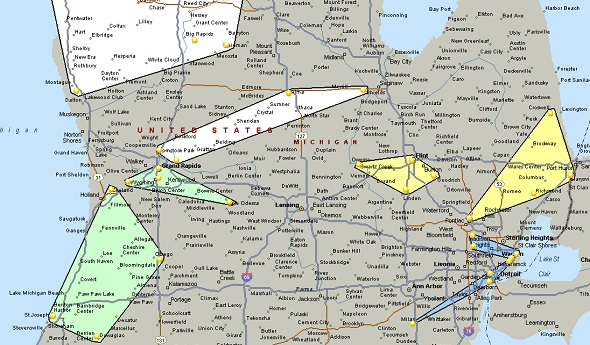
Go north with ease: For the most part, most Regional pairings were easier to draw than in past years. For the most part. Divisions 2 and 4 were not easy, specifically when it came to deciding which teams would be paired with an Upper Peninsula qualifier or a team from the Traverse City area. Keep in mind, distance on these maps isn’t based on how the bird flies, but how a bus would drive. In Division 2, that meant putting Muskegon, Muskegon Mona Shores and Grand Rapids Forest Hills Northern – near U.S. 31 and U.S. 131 – with Traverse City Central instead of sending Midland and Midland Dow west, up I-75 and then east-to-west again on more non-highway roads. In Division 4, we considered pairing Alma and Saginaw Swan Valley with Escanaba instead of Big Rapids and Remus Chippewa Hills. That decision came down to Big Rapids being about 14 miles closer to Escanaba than Swan Valley (Whitehall would go with Big Rapids and Chippewa Hills regardless.).
Four counties wide: Yes, on first glance it looks a little odd that Bay City John Glenn and Orchard Lake St. Mary’s would be in the same Division 3 District – but look at the map as a whole. Eight Division 3 teams are located south and mostly east of St. Mary’s, and John Glenn is the only team that could be considered in the northeastern quarter of the Lower Peninsula (Mount Pleasant and Gaylord are right down the middle and naturals to go with Sault Ste. Marie and Petoskey.). With the thumb playoff qualifiers of near-similar size in Division 4, there were no other options than to create this four-county trip between the Eaglets and Bobcats.
Semifinal selection: When all the Regional lines are drawn for a division, we also must figure out which Regionals will meet for Semifinals. This annually provides some challenges. Do we match east vs. west or north vs. south? If something seems iffy in four weeks when those games are played, again, keep in mind the entire map and entire Regionals that are matched up.
Scheduled strong: Because we’re looking only at dots on a map, we don’t see the matchups until everything is drawn – and in that way, we’re like everyone else. It wasn’t lost on us that two 9-0 teams will have road games this week or three 5-4 at-large qualifiers will be at home. For those 9-0 teams, it’s true: there’s nothing more they could’ve done on the field. But here’s why they will travel.
- Clinton, in Division 6, hasn’t lost a regular-season game since 2011, and in fact plays in a strong Tri-County Conference made up of Class C schools and one Class D. Four of eight from the league made the playoffs, and the competition was so strong that Morenci and Petersburg-Summerfield will host games in Division 8. But Clinton’s opponent, Monroe St. Mary Catholic Central, while it did have one loss, fell to one-loss Class B Lansing Catholic – and the Falcons played eight Class B and one Class A school this season. Beating a Class B team is worth 16 points more than beating a Class C and 32 more than beating a Class D (with those points then divided over the number of games a team plays that season) – and all of that made the difference in St. Mary’s final eight-point playoff average edge over Clinton.
- Saugatuck in Division 7 is a similar story. The Indians are one of three undefeated teams in their District, and did play a pair of Class B opponents. But by no fault of their own, especially in league play where the schedule is set, Saugatuck didn’t face a team this season that won more than five games. Hesperia played three Class B opponents including one that finished 6-3 – enough for the slim 1.8 points more in playoff average that earned the Panthers homefield advantage. Pewamo-Westphalia has the highest average in the District and didn’t play a Class B – the Pirates actually played three Class D teams. But they also beat four teams that made the playoffs including two that finished 8-1 – giving them a 2.7-point edge on Hesperia and 4.5 edge on Saugatuck.
- The 5-4 teams that will host – Redford Thurston in Division 3 and Escanaba and Benton Harbor in Division 4, all earned their spots. Escanaba faced six playoff teams and beat three, Class B Benton Harbor played eight Class A teams, and Thurston played five playoff teams and a sixth that just missed an at-large bid.
At the end of the day ...
What you see is what our committee decided upon after multiple discussions among multiple groups that broke down every sensible possibility we could muster. There are certainly points open to argument – and we likely made those arguments as well.
Those who would like to see the playoff selection process changed are in favor of a larger strength-of-schedule component, and it’s interesting to see how strength of schedule inadvertently made a larger impact this season than in the recent past – especially given the examples above of undefeated teams going on the road and at-large teams hosting.
Why were there fewer automatic qualifiers than ever before? Here's one theory. There were 11 fewer teams in 11-player football this season than in 2014 (most moved to 8-player). An argument can be made that there were fewer wins to be gained against teams that last season might have struggled to field 11-player teams, shifting the balance to fewer automatic qualifiers and more parity with stronger teams facing each other to fill their schedules.
Meanwhile, the 8-player field grew by nine teams this fall and has its strongest ever, with seven teams that finished 5-4 missing the postseason after a team with a sub-.500 record got in just a year ago.
Given how some matchups shook out this fall, the next argument by those seeking change likely will center on seeding entire Regionals instead of just Districts. But keep this in mind as well: if Regionals were seeded with this year's groupings, it would create possibilities of first-week trips like Battle Creek to Traverse City and Cedar Springs to Sault Ste. Marie. We're fairly sure most coaches and players would dread such journeys for a first-round game.
It's a lot to digest, and the scrutinizing will surely continue long after these playoffs are done as we all work to conduct the best tournament possible.
But at the end of the day – and the end of these next five weeks – to be the best, teams will need to beat the best no matter the matchups. And we’ve got plenty to look forward to starting this weekend and all the way through the 11-player Division 3 Final on Nov. 28 at Ford Field.
The MHSAA Football Playoffs are sponsored by the Michigan National Guard.
PHOTO: The Division 4 map was among the most difficult to draw during this year's selection process.
Search Begins Again for 'Greatest Game'
By
Ron Pesch
MHSAA historian
August 27, 2016
There really is no place I’d rather be than in the stands of a high school football stadium on a Friday night. As summer fades to autumn, and leaves begin to fall, the smile on my face grows. It’s football weather. The days shorten and the hue of the evening sky deepens; the air turns crisp; hoodies come out; hot dogs and popcorn bring more joy than a finely catered meal. As the season progresses, hot chocolate becomes a drink to be cherished and appreciated.
As I’ve aged, my interest in the professional game has faded. My fascination with the college game continues to dwindle in direct relation to the increasing prices for a ticket to a game, the marketing hype generated by the changing of brands for overpriced athletic apparel and the escalating dollars involved in signing a coach.
The prep season presents the chance to step outside to enjoy my favorite part of the calendar. I’ll sit beneath lights, watching high school kids struggle with, then grasp, the components of the game. On some nights, I’ll again witness pure athleticism shred the defense of an unprepared squad. On others, I’ll watch a finely schooled team dismantle superior size and speed.
From those prep stands, I’ll continue to see moments where the underdog defeats the favorite; where the ordinary achieves the extraordinary; where tension and excitement erupts into a roar. I’ll stand and cheer as the high school band, enjoying its share of the spotlight, takes the field to play the national anthem and showcase its skills at halftime.
And again this season, I’ll settle in with hopes of finding the game I can call the greatest in state high school history.
My criteria is stringent, perhaps more stringent than the conditions held by others.
1) The margin should be close, ideally through most of the 48 minutes that comprise a contest. I’m really no fan of overtime.
2) The stakes should be high. Hence, this may favor late-season contests, where playoff implications and/or league championships are involved.
3) There should be history, where past battles between the schools have helped to establish a palatable dislike for the other, when the teams line up for a contest. Cross-town rivalries, where bragging rights and perhaps a trophy, are involved, enhance the value in my eyes. At the same time, playoff rivalries, where defeat is balanced between each, or where dominance by a single school is suddenly shattered, augment the importance of such a contest.
4) Weather conditions and controversy should not be a factor.
Over the years, I’ve watched or read about amazing comebacks, decisive thrashings, contests played under vicious weather conditions and marathon overtime battles. Each, some might argue, are challengers to the crown.
But I have yet to find a replacement for the current title-holder – a game played before my birth.
The reigning champ was christened as such by an authority. I’ve seen a small segment of that 1945 season-ending battle between Muskegon High School and Muskegon Heights High School, as captured by a home movie camera. In addition, I’ve viewed a series of amazing still photographs that portray the drama.
I’ll let the legendary Hal Schram set the stage.
“Seldom has one city dominated Michigan high school football as completely as Muskegon does this week,” stated the Detroit Free Press writer later known as “The Swami” for his tongue-in-cheek “all-knowing” ways when it came to predicting high school sports outcomes.
Schram’s Tuesday, November 6 column in the Free Press included his Class A Top Ten rankings. The Top Ten, used to identify the state’s best team based on enrollment classification, win-loss record and strength of schedule, was a relatively new approach to identifying the state’s best. The approach is still in use today.
“One month ago, Muskegon High occupied second place in the Top Ten while Muskegon Heights ranked sixth,” said Schram. “Today, Coach Leo Redmond’s Big Reds with a 16-game winning streak, and the Heights, with the best defensive record in state Class A football, rate first and second respectively.”
A week later, Schram’s ranking in the Free Press reflected the same result in Class A, heading into the season’s final week.
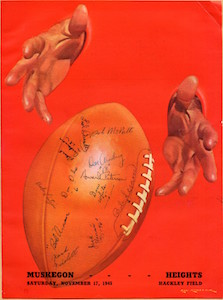 “Twenty-thousand Muskegon fans will watch their high school giants – Muskegon and Muskegon Heights – battle for a mythical Michigan championship Saturday. Only the limited seating capacity of the city’s Hackley Stadium prevents the attendance from reaching 30,000. Reserve seat tickets have been completely sold out for three weeks.
“Muskegon, with its 17-game winning streak, clings to its No. 1 rating among Michigan high schools for the third straight week, but the difference between the Big Reds and the Heights is infinitesimal.
“The Big Reds have scored 191 points to 38 for eight opponents while Muskegon Heights has rolled up 185 points to 37. Both have played almost exactly the same opponents and under identical conditions …
“The Heights will be gunning for its first triumph since 1943 over Muskegon, when the Tigers won, 7-0. The victor will also lay claim to the Southwestern Conference championship.”
It would take 30 years before the MHSAA created a playoff system to determine football state champions. Until that time, state titles were dispensed by the media, and hence were referred to as mythical, since they weren’t settled in a series of head-to-head contests played between contenders.
A total of 18 Big Reds and 23 Tigers would appear in their interscholastic football uniform for the final time. Eight seniors and three juniors would start the game for each team.
While the overall series dating back to 1922 favored Muskegon, in games played since 1930, the two teams were exactly even with each team having six victories and two ties over those previous 14 games. Coach Redmond had led the Big Reds since 1925. Oscar E. “Okie” Johnson took charge of the Heights in 1927 and would guide the Tigers until retirement following the 1963 season. The two coaches had been football teammates at Western State Normal School (today, Western Michigan University). Each coach had led their team to mythical state crowns in years past.
Statewide coverage of the pending heavy-weight battle enticed many from around the state to attend the game. A crowd of 13,500 – still the largest ever to visit Hackley – packed nearly every square inch of the stadium, bleachers and field. Countless others tuned in to the radio broadcast.
Servicemen, recently returned from World War II, helped hoist the flag during pregame ceremonies. The combined marching bands from each school opened the 2 p.m. program with the national anthem, and each entertained the crowd at halftime.
Muskegon won the toss and kicked off. The Heights unleashed their power early. Behind the running of Ed Petrongelli and backfield mate Paul Hulka, the Tigers rolled across mid-field, before a Petrongelli pass was picked off by Bob Clark on the Muskegon 15. The Big Reds were held on downs, and were forced to kick. Muskegon’s Bob Sikkenga, who averaged 30 yards on five punts during the day, gained a mere nine yards on his first kick of the afternoon, allowing the Heights to take control at the Muskegon 27. Petrongelli pounded ahead for four yards to the 23 before Jim Howell skirted the left side on the end around for the first score of the contest. Dorr Grover's placement was accurate, and Okie Johnson's Tigers led 7-0.
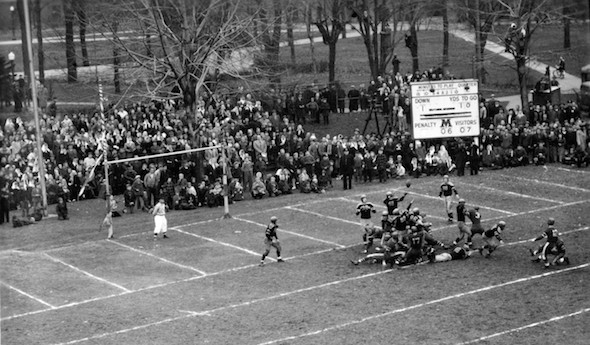
Muskegon bounced back, scoring midway through the second quarter of play. Starting at their own 35-yard line, Coach Redmond's backfield of Percy Moore, Bob McNitt and Howard Peterson alternated carries, pushing the ball to the Heights 31-yard line. Facing a 3rd-and-1 situation, Don Ohs replaced McNitt, and broke through off right guard for a first down on the Tiger 14. A Heights penalty advanced the ball to the 9. A pair of plays eked out only a yard, then McNitt was nailed behind the line on third down for a six-yard loss. Facing a 4th-and-goal, Peterson shot a pass toward McNitt at the goal line. Nearly intercepted by Ray McLean of the Tigers, the ball bounced into the waiting hands of the Muskegon back, and the Big Reds were a point away from a tie. But Tom Carr's kick went wide and low, and the Tigers clung to a one-point lead when the teams broke for the halftime intermission.
Much of the third quarter was played in Muskegon territory, with the Heights dominating. Still, neither team scored. As the teams entered the final quarter, a single point still separated victory from defeat.
Midway through the fourth, opportunity knocked for the Tigers as Jim Dotson recovered a Muskegon fumble on the Big Red 43. The Heights fans roared in approval as the Tiger offense lined up for action. But the momentum changed quickly as the Big Reds' Bob Anderson pounced on a Heights' fumble at the Tiger 48 on the first play from scrimmage.
 Redmond's squad went to the air. An incomplete pass was followed by a six-yard gain by Ted Barrett around left end. Another incomplete pass brought fourth down before Peterson found Bob Lintjer at the 30 yard line and he raced to the Heights 9, securing the first down.
The Big Reds were hit for a five-yard penalty on a substitution, so the squad lined up for a 1st-and-goal from the 14. Barrett quickly made up for the penalty, battling to the 4 yard line. On 2nd and goal, Muskegon again went to Barrett, who picked up three yards. Injured on the play, the halfback exited the game with the ball resting on the 1 yard line.
"On (the) last two plays rode the hopes of 13,500 fans, for or against the success of the attacking Big Reds," wrote Muskegon Chronicle sports editor, James F. Henderson. "On those two plays rode both State and Southwestern titles."
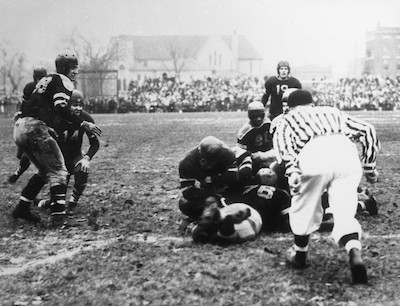
McNitt charged the center of the line on third down, but was stopped three inches from the end zone. Redmond's squad huddled to discuss its final play.
“We decided to go with a quarterback sneak on fourth," recalled Peterson years later. "I decided to use a long, variable, cadence count, in hopes of drawing them offside, in case we needed another shot. To their credit … neither line moved."
"When Jim Dotson, Everett Grandelius, Dick Ghezzi and Gene Hilliard stopped the forward motion of Howard Peterson, the air went dark with the applause of the Heights fans, and the groans of Muskegon's," wrote Henderson. "The ball, three inches from the goal line when play started, still was an inch from the line when it was set down."
“For the second straight year the mythical state high school football title belongs to greater Muskegon, penned Schram following the game. “No longer does the bunting fly over Muskegon High, but it is on display only a few miles away, at Muskegon Heights High. The Tigers laid claim to the title after conquering Muskegon 7 to 6”
As was tradition, following the game the Heights band marched back to its school, leading a victory parade of students celebrating a great day for football.
Seven players from the teams received all-state honors according to The Associated Press. Petrongelli and Dotson from the Heights, and Clark from Muskegon were all named to the first-team squad. Tigers Ghezzi and Howell and Big Reds Barrett and Anderson each earned mention on AP’s second or third all-state teams.
This July, after a long, distinguished career and blessed retirement, Tom Carr, the kicker for the Big Reds, passed away.
As a college student, I had the privilege to meet Carr. Signed to play baseball by the Chicago White Sox out of high school, Carr later earned his Master’s degree at Western Michigan University. Following graduation, he ascended to associate vice president of operations for the University. On the day of our meeting, he smiled, shook my hand, and greeted me with the words, “Hi, I’m Tom Carr – the guy who missed the extra point.”
Long ago, a friend stated that the main difference between male and female athletes is that the boys will carry the agony of defeat into manhood, and it will stay with them until the day they die. While it might have taken years to accept, the game would ultimately become a point of pride for all involved.
Among the crowd of spectators that day was Dick Kishpaugh, who served the MHSAA as high school historian for 50 years. Kishpaugh had come up from Southwest Michigan to attend the game. It was, in the opinion of my mentor, the greatest high school football game ever played in Michigan.
While I wasn’t in attendance, I still share his opinion.
Since that time, 70 years ago, I’d estimate more than 200,000 high school football games have been played in Michigan.
As we kick off another season of high school athletics, I’d love to hear your thoughts on the subject, as well as your candidates for honor of greatest game.
 Ron Pesch has taken an active role in researching the history of MHSAA events since 1985 and began writing for MHSAA Finals programs in 1986, adding additional features and "flashbacks" in 1992. He inherited the title of MHSAA historian from the late Dick Kishpaugh following the 1993-94 school year, and resides in Muskegon. Contact him at [email protected] with ideas for historical articles.
PHOTOS: (Top) Muskegon's Tommy Carr attempts an extra point against Muskegon Heights during their history-making matchup. (Middle) The game program from 1945. (Below) Heights stops Muskegon during its final goal line stand; Big Reds quarterback Howard Peterson is number 19. (Photos provided by Ron Pesch.)