

Inside Selection Sunday: Mapnalysis '16
October 24, 2016
By Geoff Kimmerly
Second Half editor
There was a wheel and something that looked like a magic wand. Another started out looking like the head of a caterpillar.
 A number of Michigan football teams realized their sky-high dreams with Sunday’s playoff selection announcement on Fox Sports Detroit.
But earlier that day, as is the case at the end of each fall, shaping this season’s tournament at times looked a little like finding pictures in the clouds.
Beginning last night and into this morning, MHSAA staff have been busily gathering game days and times for this weekend’s opening round. We’re assigning officials for those contests. Schools are preparing for what likely will be one of their biggest crowds of the season. And, of course, teams are preparing for what surely will be one of their most memorable games.
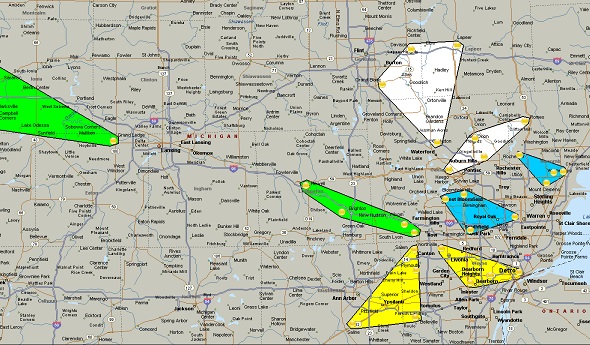
But before all of that could begin, we met Sunday morning with nine maps of Michigan and 272 dots that needed to be organized to set another playoffs in motion.
As we’ve done the past five seasons, we’ll explain our most difficult decisions in this Mapnalysis 2016 breakdown of how we paired 272 teams that will play next month for championships across nine divisions. For those familiar with our playoff selection process, or who have read this report in the past and don’t want a refresher on how we do what we do, skip the next section and go directly to the “Observations & Answers: 2016.” For the rest, what follows is an explanation of how we selected the playoff pairings during the morning hours Sunday, followed by how we made some of the toughest decisions and a few thoughts on the breakdown of the field.
Ground Rules
Our past: The MHSAA 11-player playoff structure – with 256 teams in eight divisions, and six wins equaling an automatic berth (or five wins for teams playing eight or fewer games) – debuted in 1999. An 8-player tournament was added in 2011, resulting in nine champions total each season.
The first playoffs were conducted in 1975 with four champions. Four more football classes were added in 1990 for a total of eight champions each fall. Through 1998, only 128 teams made the postseason, based on their playoff point averages within regions (four for each class) that were drawn before the beginning of the season. The drawing of Districts and Regionals after the end of the regular season did not begin until the most recent playoff expansion.
In early years of the current process, lines were drawn by hand. Dots representing qualifying schools were pasted on maps, one map for each division, and those maps were then covered by plastic sheets. Districts and Regionals literally were drawn with dry-erase markers.
Our present: After a late Saturday night tracking scores, we file in as the sun rises Sunday morning for a final round of gathering results we may still need (which can include making a few early a.m. calls to athletic directors). Re-checking and triple-checking of enrollments, what schools played in co-ops and opted to play as a higher class start a week in advance, and more numbers are crunched Sunday morning as the fields are set.
This season, there were 218 automatic qualifiers by win total – only two more than the record low set a year ago – with the final 38 at-large qualifiers then selected, by playoff-point average, one from each class in order (A, B, C, D) until the field was filled. For the second consecutive season there were only four Class D additional qualifiers with 5-4 or 4-4 (playing eight games) records from which we could choose – so after those four we added 12 teams from Class A and 11 each from Class B and Class C.
Those 256 11-player teams are then split into eight equal divisions based on enrollment, and their locations are marked on digital maps that are projected on wall-size screens and then discussed by nearly half of the MHSAA staff plus a representative from the Michigan High School Football Coaches Association. Only the locations themselves are marked (by yellow dots) – not records, playoff point averages or names of the schools or towns. In fact, mentions of those are strictly prohibited. Records and playoff points are not part of the criteria. Matchups, rivalries, previous playoff pairings, etc. also DO NOT come into play.
The same process is followed for organizing the 8-player bracket, with the difference that the 16 teams are selected purely on playoff-point average.
Geography rules: This long has been rule number one for drawing MHSAA brackets in any sport. Travel distance and ease DO come into play. Jumping on a major highway clearly is easier than driving across county-wide back roads, and that’s taken into consideration. Also, remember there’s only one Mackinac Bridge and hence only one way to cross between peninsulas – and boats are not considered a possible form of transportation. When opponents from both peninsulas will be in the same District, distance to the bridge is far more important than as the bird flies.
Tradition doesn’t reign: Every group of 32 dots is a new group – these 32 teams have not been placed in a bracket together before. How maps have been drawn in the past isn’t considered – it’s hard to say a division has been drawn in a certain way traditionally when this set of 32 teams is making up a division for the first time.
Observations & Answers: 2016
First things, first: Congratulations to five first-time playoff qualifiers – Bloomfield Hills, Detroit Delta Prep, Southfield Arts & Technology, Southfield Bradford and Wyoming Tri-unity Christian. Bloomfield Hills (Lahser and Andover) and Southfield Arts & Technology (Southfield and Southfield-Lathrup) were created by mergers of previous schools. Southfield A&T and Detroit Delta Prep are eligible for tournament play this season for the first time. Bradford and Tri-unity Christian both started programs during the latter half of the 2000s; Tri-unity qualified in 8-player after moving back to that format from 11-player this fall. Of 617 varsity football programs that played games this season (including five not eligible for the playoffs as either a first-year program or with an enrollment too high for 8-player), all but 18 have made the playoffs at least once going back to the first series in 1975.
Tie it up: We had a few ties in a few ways this season. In two situations, we had multiple teams with the same enrollment at a line between divisions. In those cases, the teams with the higher playoff point averages go to the larger divisions – so Ferndale went to Division 2 and East Lansing to Division 3 to settle one tie, and Lansing Sexton went to Division 4 and Dowagiac to Division 5 to settle the other. The additional tie came in 8-player football, with Portland St. Patrick and Wyoming Tri-unity Christian both having the same playoff point average, the same opponents’ winning percentage and drawn into the same District. A coin flip was used to determine St. Patrick as the top seed and home team both this week and next if it advances and plays the Defenders.
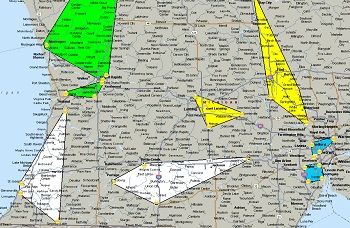 Local really is the rule: Division 3 provided us with a fine example to help show that we work to draw maps locally and beginning with the earliest rounds. There were at least three ways to separate the schools in Region 3 District 1: East Lansing, DeWitt, Fowlerville and Mason. DeWitt, as the westernmost of the group, could’ve been drawn southwest with R2D2’s Vicksburg, Battle Creek Harper Creek and Coldwater, replacing Chelsea. Doing so would’ve literally split the state’s regions down the middle along U.S. 127, which is a favorable picture. But protocol is to favor local matchups at the earliest rounds, and it just didn’t make sense to take DeWitt away from three schools mere minutes away when subbing it in for Chelsea would’ve created a wash in terms of travel for the other three teams in R2D2.
Sometimes, there’s no choice: But keeping a group of four local teams together often is impossible. Remember, 32 dots usually are spread out at least all over the Lower Peninsula. In Division 4, we had Grand Rapids Catholic Central, Wyoming Godwin Heights, Wyoming Kelloggsville and Grand Rapids South Christian stacked nicely along U.S. 131 – but had to send southernmost South Christian down with Benton Harbor, Three Rivers and Hudsonville Unity Christian because there was no other grouping for Allendale, which is about 20 miles west of Grand Rapids. Another incident of splitting up near-neighbors happened in Division 2; we had Lowell and Grand Rapids Forest Hills Central next door to each other, but no other Grand Rapids area teams qualify. By only a few miles, Forest Hills Central is south of Lowell – so although the Rangers had shorter drives than Lowell to possible opponents both north and south, they went into a group with Portage Northern, Portage Central and Battle Creek Lakeview, and Lowell went north to join Greenville, Traverse City West and Traverse City Central.
Why coast to coast: It wasn’t lost on the committee that teams waking up looking at Lake Huron traveling to play on Lake Michigan isn’t the greatest scenario. But it was the best of the options, and we stayed consistent by setting up a possible two District trips across the Lower Peninsula. Tawas will journey to Maple City Glen Lake in Division 6 this week. With wins this week, Lincoln Alcona could end up heading to Frankfort for a Division 8 District Final. Those trips aren’t ideal, but they did allow us to keep northern Lower Peninsula teams together – and in reality, aren’t too different than when teams from the Lower Peninsula and Upper Peninsula match up the first week, as will be the case in Division 4 (Whitehall to Escanaba), Division 5 (Kalkaska to Menominee and Grayling to Kingsford), Division 6 (Charlevoix to Negaunee and Boyne City to Calumet) and Division 8 (Gaylord St. Mary to Newberry).
It’s just the math: The one unexpected oddity of this week’s matchups is Canton going back to Northville for the second week in a row, and after beating Northville 42-27 last week. But math does rule, and Northville does have a higher playoff point average despite that Week 9 loss; the Mustangs beat five teams that finished with winning records, while Canton beat three – which of course is no fault of the Chiefs. It's just the way – rarely – things work out.
At the end of the day …
In six years of being part of these discussions, this weekend’s at least seemed to be the most extensive. We had two and three versions of multiple divisions before deciding which we believed to be the best.
Only one division map – 8-player – was an absolute slam dunk. The rest received plenty of scrutiny from a committee that now includes veterans going back to the beginning but also has had some new eyes join in over the last couple of years. That variety of viewpoints certainly pays off.
And wow, did we fall into some incredible first-week matchups:
• Rockford and Hudsonville in a rematch of the Ottawa-Kent Conference Red-deciding game of Week 9 (a Hudsonville 14-7 win).
• Traverse City West vs. Traverse City Central for the first time in playoff history (Central won 10-8 in Week 3).
• Bloomfield Hills Cranbrook Kingswood at Detroit Country Day in a homecoming for longtime Yellowjackets coach Joe D’Angelo.
• Constantine at Schoolcraft in a matchup of longtime southwestern rivals (Schoolcraft won 20-10 in Week 8).
• Cedarville at Engadine in arguably the most intriguing of three all-U.P. 8-player matchups (Engadine won 52-42 in Week 7).
Truly, at the end of November, the best teams will have to beat the rest to finish as champions – regardless of maps, matchups, weather and anything else that won’t really factor into what eventually is settled on the field.
For many high school sports fans, it’s the favorite time of year. Join us now as we prepare for kickoff.
The MHSAA Football Playoffs are sponsored by the Michigan National Guard.
PHOTOS: (Top) The Division 1 bracket mapped out on the Lower Peninsula. (Middle) The Division 3 map keeps four mid-Michigan teams together.
1st & Goal: 2025 11-Player Semifinals Preview
By
Geoff Kimmerly
MHSAA.com senior editor
November 20, 2025
One more win.
 For all 32 teams playing in 11-Player Semifinals on Saturday, that's all it will take to reach the final weekend of this season and an opportunity to play their last game of 2025 at Ford Field.
But it means so much more as well. For 11 teams, its means continuing an undefeated season. For five teams, it means a chance to repeat as a champion.
For six teams, it means continuing the longest playoff run in school history – and for one more, in guarantees that team will accomplish the same when it steps on the field for an MHSAA Final for the first time.
Here's a glance at all 16 games and some of the standouts who could make the difference. All games kick off at 1 p.m. unless noted below, and all can be watched on the NFHS Network at the links provided.
Division 1
East Kentwood (10-2) vs. Detroit Catholic Central (12-0) at Jackson WATCH
East Kentwood’s first Semifinal run since 2014 has been partly on the shoulders of senior quarterback Kayd Coffman, who has thrown for 2,599 yards and 34 touchdowns and also run for a team-high 686 yards and eight scores. Detroit Catholic Central is making a repeat trip to the Semifinals with a big-armed quarterback directing as well. Junior Duke Banta has thrown for 2,091 yards and 26 scores.
Detroit Cass Tech (12-0) vs. Rochester Adams (10-2) at Troy Athens WATCH
Reigning Division 1 champion Cass Tech relies on some especially notable familiar faces, among them senior Corey Sadler Jr., who is averaging 27.5 yards per catch with 1,406 yards and 19 touchdowns receiving total. Adams also is a repeat semifinalist and led by dual-threat senior quarterback Ryland Watters. He’s thrown for 1,348 yards and 13 touchdowns and run for a team-high 14 scores.
Division 2
Orchard Lake St. Mary’s (9-2) vs. Portage Central (12-0) at Haslett, 12:30 p.m. WATCH
Portage Central is giving up only 5.3 points per game this season, but will receive potentially its greatest challenge from St. Mary’s and junior quarterback Jabin Gonzales – he’s thrown for 1,677 yards and 18 touchdowns and run for seven scores. The Mustangs will counter in part with sophomore running back Cam Noe, who’s totaled 1,563 yards and 19 touchdowns to pace a rushing attack that’s stacked nearly 3,500 yards.
Birmingham Groves (9-3) vs. Dexter (11-1) at Ypsilanti Lincoln WATCH
Groves is playing in its third Semifinal over the last four seasons and seeking to reach the championship round for the first time. Junior running back Jeremiah Whitley has carried much of the offensive load, running for 1,402 yards and 17 touchdowns. Dexter also is seeking its first Finals appearance after just missing with a close 2022 Semifinals loss. Senior quarterback Cooper Arnedt is just the fourth 11-player quarterback to throw for 4,000 yards, totaling 4,022 and 48 touchdowns through the air this fall. Those 48 TD passes are tied for third-most all-time.
Division 3
Lowell (10-2) vs. Mount Pleasant (12-0) at Greenville WATCH
Senior quarterback Logan Dawson has helped bring Lowell within a win of reaching the Finals for the first time since 2015. He’s run for 1,756 yards and 33 touchdowns and thrown for 923 yards and 14 scores. The Oilers are seeking their first trip to Ford Field since 2011, and follow a dual-threat quarterback as well. Junior Xavier Creguer has thrown for 1,548 yards and 20 touchdowns and run for 927 yards and eight scores.
Warren De La Salle Collegiate (6-6) vs. DeWitt (12-0) at Grand Blanc WATCH
Playing in Semifinals is plenty familiar to both of these programs, but this will be their first time facing off in the playoffs. Senior quarterback Trav Moore is one of two 1,000-yard rushers pacing the Panthers, and he’s run for 1,768 yards and 25 touchdowns and thrown for 12 more scores. Sophomore Grayson Thurston has taken over directing the Pilots this season and thrown for 1,788 yards and 17 touchdowns, and run for seven more TDs.
Division 4
Vicksburg (8-4) vs. Hudsonville Unity Christian (11-1) at Caledonia WATCH
Vicksburg is playing in its first Semifinal after a one-point win over previously-undefeated Portland, and the Bulldogs showed again they’re capable of lighting up the scoreboard led by junior quarterback Easton Moughton (2,748 yards/32 TDs passing). Unity is seeking to return to the Finals for the first time since 2021 and is closing in on 4,000 yards rushing as a team, led by senior quarterback Justin Febus (979 yards/16 TDs rushing, 1,014 yards/18 TDs passing).
Dearborn Divine Child (11-1) vs. Goodrich (12-0) at Rochester Hills Stoney Creek WATCH
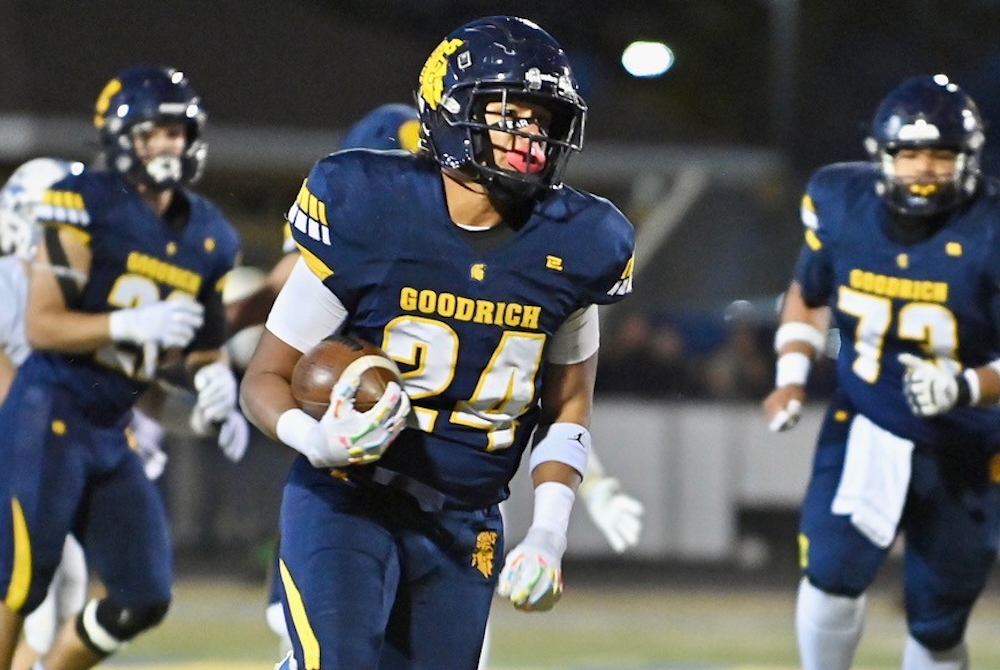
Reigning champion Goodrich has won 25 straight games and remains physically tough to take down with senior running back Jakoby Lagat (1,973 yards/27 TDs) one of two 1,000-yard rushers this fall. Divine Child has held four of its last five opponents to single digits and opened this fall with five shutouts over its first six games. Senior safety/running back Marcello Vitti is among leaders on both sides of the ball.
Division 5
Ogemaw Heights (11-1) vs. Grand Rapids West Catholic (11-1) at Clare WATCH
West Catholic’s first run to the Semifinals since winning the 2022 Division 6 title has been keyed in part by a pair of 1,000-yard runners and senior quarterback Grady Augustyn, who has thrown for 2,015 yards and 19 touchdowns. Ogemaw Heights is playing in its first Semifinal since 2009, with senior running back Calvin Marshall helping set the pace with 1,140 yards and 21 scores on the ground.
Monroe Jefferson (11-1) vs. Pontiac Notre Dame Prep (10-2) at Westland John Glenn WATCH
Reigning champion Pontiac Notre Dame Prep has been led on offense by a familiar standout this fall, as senior quarterback Sam Stowe has completed 70 percent of his passes for 2,498 yards and 38 touchdowns. Jefferson has dominated in the run game – the Bears have rushed for nearly 4,000 yards – but led by a talented quarterback as well, with junior Luke Beaudrie running for a team-high 1,974 yards and 31 touchdowns and throwing for 1,130 yards and 13 more scores.
Division 6
Kingsley (10-2) vs. Kent City (12-0) at Cadillac, Noon WATCH
Kent City’s best season keeps getting better, as the Eagles will play in their first Semifinal and coming off one of their highest-scoring games of the season. Senior Logan Thompson leads a talented set of rushers with 1,121 yards and 13 touchdowns on the ground. Kingsley’s defense should be a good matchup; the Stags have allowed just 24 touchdowns – an average of two per game – with nine interceptions and 12 fumble recoveries.
Almont (12-0) vs. Jackson Lumen Christi (9-3) WATCH
Reigning champion Jackson Lumen Christi has allowed a combined 21 points over the last four games and can wear down opponents with a rushing attack led by senior running back Paul Sattler (1,153 yards/14 touchdowns). Almont succeeds similarly, with Brody Corneau (1,129 yards/17 touchdowns rushing) helping to set the pace on offense and a defense that has given up just 20 points over three playoff games.
Division 7
Pewamo-Westphalia (11-0) vs. Menominee (12-0) at Gaylord, 2 p.m. WATCH
These undefeated contenders also are no strangers to this late stage of the playoffs, as both have played at Ford Field this decade. Menominee has allowed just 23 points during the playoffs and scored 43 or more in every game, and quarterback Tanner Theuerkauf has done his share of the damage all season with 1,379 yards and 22 TDs passing. P-W also can pile up points, and senior quarterback Ty Thelen has been the catalyst throwing for 1,113 yards and 30 touchdowns and running for 1,163 yards and 23 scores.
Schoolcraft (10-2) vs. Clinton (10-2) at Coldwater WATCH
Schoolcraft is seeking its first trip to the Finals since 2001 and has a penchant for making big plays, with junior quarterback Jack DeVries throwing for 2,105 yards and 27 touchdowns – and averaging more than 20 yards per completion. Over the last two weeks, Clinton has defeated both teams that played for last year’s championship – reigning Division 7 title winner Millington and runner-up Monroe St. Mary – and sophomore quarterback Gradyn Whelan averages 19 yards per completion and is among his team’s leading rushers as well.
Division 8
Bark River-Harris (10-1) vs. Harbor Beach (12-0) at Alpena WATCH
Bark River-Harris is playing in its first Semifinal since 2003, with its only loss this season to Pewamo-Westphalia. Juniors Gionni McDonough (1,353 yards/22 TDs rushing) and Andrew Johnson (1,022/13) pace the offense, and the Broncos are holding opponents to just 88 yards per game running the ball. Harbor Beach is averaging nearly 277 yards rushing per game, with senior quarterback Caden Bucholtz running for 20 touchdowns as one of three Pirates who have scored at least 10 on the ground.
Allen Park Cabrini (11-1) vs. Hudson (12-0) at Adrian College WATCH
Hudson is defeating its opponents by an average of 40 points per game, with Grayson Bills (1,601 yards/21 TDs rushing) leading an offense that has topped 4,800 yards on the ground this fall. Cabrini has held opponents to single-digit scoring eight times during this first run to the Semifinals and lost only to Division 5 Ann Arbor Father Gabriel Richard. The Monarchs also can turn to junior quarterback Evan Bergdoll, who has thrown for 2,175 yards and 36 touchdowns.
MHSAA.com's weekly “1st & Goal” previews and reviews are powered by MI Student Aid, a division within the Department of Lifelong Education, Advancement, and Potential (MiLEAP). MI Student Aid encourages students to pursue postsecondary education by providing access to student financial resources and information. MI Student Aid administers the state’s scholarship and grant programs that help make college Accessible, Affordable and Attainable for you. Click to connect with MI Student Aid and find more information on Facebook and Twitter @mistudentaid.
PHOTO Goodrich's Jakoby Lagat charges upfield during his team's 63-42 Week 9 win over Gladwin. (Photo by Terry Lyons.)