

Inside Selection Sunday: Mapnalysis 2012
October 24, 2012
By Geoff Kimmerly
Second Half editor
Between double checking data for more than a third of our 626 football teams, and creating 136 first-round games for our most popular tournament, the morning of MHSAA football "Selection Sunday" is both one of the most exciting and nerve-wracking of the school year.
So for those scratching their heads the last few days over how we picked the brackets this season, I offer one question and one warning:
How would you have done so differently?
And before you answer, remember that moving the position of one school affects at least seven more – if not all 32 in that division.
This was the second year I was involved in the football selection process, which while appearing simple on its face actually is layered with hours of discussions, calculations, checking and re-checking, and anything else we at the MHSAA can do to make sure we’ve created the best tournament possible.
Simply put, it’s more than just drawing circles and calling them good.
Below are a brief description of what we do, the history behind the process, and some challenges we face each time we draw these brackets – including some examples of our toughest this time around.
The process
Our past: The MHSAA playoff structure – with 256 teams in eight divisions, and six wins equaling an automatic berth – debuted in 1999. An 8-player tournament was added in 2011, resulting in nine champions total when November is done.
That’s a long way from our start. The first playoffs were conducted in 1975 with four champions. Four more football classes were added in 1990 for a total of eight champions each fall. Through 1998, only 128 teams made the postseason, based on their playoff point averages within regions (four for each class) that were drawn before the beginning of the season. The drawing of Districts and Regions after the end of the regular season did not begin until the most recent playoff expansion.
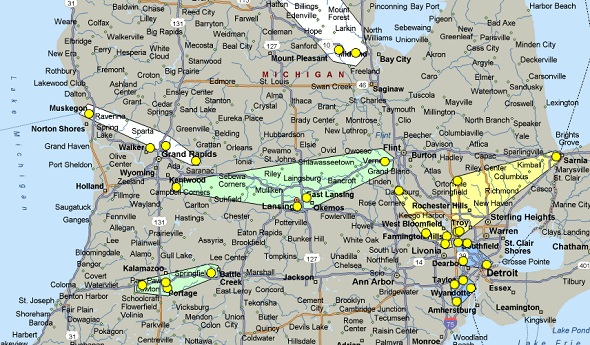
In early years of the current process (or until the middle of the last decade), lines were drawn by hand. Dots representing qualifying schools were pasted on maps, one map for each division, and those maps were then covered by plastic sheets. Districts and Regionals literally were drawn with dry-erase markers.
Our present: After a late Saturday night tracking scores, we file in as the sun rises Sunday morning for a final round of gathering results we may still need (which can include making a few early a.m. calls to athletic directors). Then comes re-checking and triple-checking of enrollments, co-ops, some records and more before the numbers are crunched and the field of 256 is set.
Those teams are then split into eight equal divisions based on enrollment, and their locations are marked on digital maps that are projected on wall-size screens and then discussed by nearly half of the MHSAA staff plus a representative from the Michigan High School Football Coaches Association. Only the locations themselves are marked (by yellow dots) – not records, playoff points averages or names of the schools or towns. In fact, mentions of those are strictly prohibited. Records and playoff points are not part of the criteria. Matchups, rivalries, previous playoff pairings, etc. also DO NOT come into play.
Geography rules: Drawing Districts and Regionals is all about location. Travel distance and ease DO come into play. Yes, ease is important. Schools near the same major highway might be further from each other in mileage than other options but have a better trip. A good example this year is in Division 6, which has seven teams in the U.P. and the northern Lower Peninsula. That meant Shelby needed to be included with those teams to make eight, and left Montague to a District that includes Hemlock – more than halfway across the Lower Peninsula. But at least, in this case, much of that trip will be on one roadway, M-46.
There is certainly conversation about every possible option. The staff splits into two groups, each handling four divisions (plus one of the groups handles 8-player too), and then the entire committee comes together to view all nine maps. There wasn’t one division where the group as a whole said, “That looks great, what’s next?”
Observations and answers
A different ballgame: I was asked whatever happened to Districts, meaning teams opening with opponents nearby. Remember that with eight divisions and 32 teams in each, the difference between maximum and minimum enrollments for each division is smaller than it used to be with just four classes, and the probability of finding two schools in the same division next door to each other is lower. This is especially true for our smaller schools, and those pairings are more spread out. Division 7 provides an excellent example. Opponents Dansville and Ottawa Lake Whiteford are 84 miles apart. But in another option considered, Dansville would’ve played Gobles – and those two are separated by 114 miles.
Points still matter: And that means strength of schedule is a big factor. After Districts are drawn, playoff point average determines the home team for those two games and Regionals as well. There are five Districts in which the team with the best or second-best record did not get home games because those teams’ playoff point averages ranked third among the four teams in those brackets. A number of other Districts have 8-1 teams playing at other 8-1 teams. It’s true: there are times a school can’t help the opponents it plays, because of league affiliation perhaps, and they have no control over how an opponent does the rest of the season. But a Class B team playing in a league with Class D schools can’t expect to compare averages well against teams in their division who face similarly-sized opponents during the regular season.
No boating: This didn’t come up last season, but did twice Sunday. We had to decide if it was a better trip for teams in the thumb to go around Saginaw Bay to play northern opponents, or instead send teams a little bit south of the thumb but with a straight shots north. As the bird flies, the thumb teams were closer in some cases. But I’ve never heard of a team hopping into a boat to get to a playoff game.
The fifth wheels: The toughest lines to draw are around areas with five schools in the same division. Remember, Districts come in fours, and one dot affects the rest. The Grand Rapids area gave us tough calls because of five teams in Divisions 2 and 4. The same was true in the southwest corner in Division 7 and the southeast corner in Division 6. No matter how we circled it, one of those teams got stuck with a longer trip. This time, that group included Caledonia, Grand Rapids South Christian, Blissfield and Gobles.
It’s easy to say certain areas of these maps should’ve been drawn differently. But again, keep in mind a statewide view.
Some of our pairings could create gigantic matchups earlier in the playoffs than those teams might like. But again, who is to decide which teams are the best and which matchups most “gigantic” before they prove it on the field? At least three teams touted during this fall as potentially the best in the state this season didn’t even win their conference titles.
And as I said in this analysis last year, determining the playoff schedule is just one step in many. Nine MHSAA champions must survive until the end, regardless of which opponents they face along the way.
Their journeys begin Friday.
1st & Goal: 2025 Week 2 Preview
By
Geoff Kimmerly
MHSAA.com senior editor
September 4, 2025
When Ishpeming travels to Crystal Falls Forest Park tonight, it will be the first time the Upper Peninsula powers have met since 2022 – and a matchup of two of the first MHSAA Finals champions, as Forest Park won the first Class D title in 1975 and Ishpeming claimed the first championship in Class C that fall.
 Meanwhile, much farther south, we’ll look to our first meeting this season of 2024 champions as Jackson Lumen Christi hosts Pontiac Notre Dame Prep.
Those are just a pair of Week 2 matchups that pop off the page, but there are plenty of note as we start another September. Nearly 75 percent of those mentioned below will be broadcast on the NFHS Network, along with several more, and scores for every game across the state will be posted on the MHSAA Scores page as they conclude.
Bay & Thumb
Ottawa Lake Whiteford (1-0) vs. Harbor Beach (1-0), Saturday at Davison WATCH
This Saturday showdown pits a pair of playoff teams from a year ago that were both expected to face tough matchups in Week 1 – and won their games 56 and 34 points. Harbor Beach has strung together 15 straight regular-season victories and downed Cass City 42-8 after the defeating the Red Hawks by just two points in 2024. Whiteford opened with a 56-0 shutout of a Blissfield team it edged by just seven last season.
Keep an eye on these FRIDAY Warren De La Salle Collegiate (1-0) at Davison (1-0), Saginaw Swan Valley (1-0) at Frankenmuth (0-1) WATCH, Goodrich (1-0) at Lapeer (0-1), Midland Dow (1-0) at Saginaw Heritage (0-1) WATCH.
Greater Detroit
Detroit Catholic Central (1-0) at Toledo Central Catholic (0-1)
This matchup ended up deciding the Catholic High School League Central championship last year as DCC won their Week 2 meeting 21-7 and carried the league lead through the rest of the regular season. The Shamrocks received some of the greatest attention of any team statewide this preseason and justified it with a 41-7 win over Clinton Township Chippewa Valley last week. Central Catholic, an eventual Ohio state runner-up last fall, took reigning MHSAA Division 1 champ Detroit Cass Tech to the end last week while losing 28-27.
Keep an eye on these FRIDAY Harper Woods (1-0) at Clarkston (1-0) WATCH, Oxford (1-0) at Birmingham Groves (1-0) WATCH, Grandville (1-0) at Detroit Cass Tech (1-0) WATCH, Port Huron Northern (1-0) at Madison Heights Lamphere (1-0) WATCH.
Mid-Michigan
Williamston (1-0) at Hastings (1-0)
Williamston made some noise starting the season with a 46-14 win over Lansing Catholic, which finished Division 6 runner-up last fall. Hastings will provide a second opportunity for the Hornets to avenge a 2024 loss, as they fell to the Saxons 16-12 a year ago during a 1-5 start that still turned into a playoff berth. Hastings – a District finalist the last four seasons – won its opener last week 31-29 over Middleville Thornapple Kellogg with a field goal as time expired.
Keep an eye on these FRIDAY Reed City (0-1) at Belding (1-0), Mason (1-0) at DeWitt (1-0) WATCH, New Lothrop (1-0) at Durand (1-0) WATCH, Portland (1-0) at Lansing Sexton (0-1) WATCH.
Northern Lower Peninsula
Traverse City St. Francis (1-0) at Ogemaw Heights (1-0) WATCH
We knew Ogemaw Heights was leveling up with its 2023 win over St. Francis, and although the teams didn’t play each other last year the Falcons are a combined 19-4 over the last three, including a pair of District Final losses. They opened with a big win last week over Flint Hamady, while St. Francis set the tone with a 30-6 victory over Maple City Glen Lake, which like the Gladiators was a league champion last season.
Keep an eye on these FRIDAY Gaylord (1-0) at Kingsley (1-0) WATCH, Harbor Springs (1-0) at Mancelona (1-0) WATCH, Frankfort (1-0) at Maple City Glen Lake (0-1) WATCH, Kalkaska (1-0) at Oscoda (1-0) WATCH.
Southeast & Border
Pontiac Notre Dame Prep (1-0) at Jackson Lumen Christi (0-1) WATCH
After two games last week across the state featured teams that finished at Ford Field last year, here’s the first between reigning champions as Division 5 Notre Dame Prep looks to add to last season’s 28-24 win over eventual Division 6 title winner Lumen Christi. That proved to be the Titans’ only loss of 2024, and although they opened this season falling 20-16 at Lombard Montini Catholic of Illinois, they’ll surely be amped to attempt to avenge last year’s defeat.
Keep an eye on these FRIDAY Clinton (0-1) at Adrian Madison (1-0) WATCH, Ypsilanti Lincoln (1-0) at Ypsilanti Community (1-0), Hudson (1-0) at Ida (1-0) WATCH, Traverse City Central (1-0) at Parma Western (1-0).
Southwest Corridor
Hudsonville Unity Christian (1-0) at Schoolcraft (1-0) WATCH
Schoolcraft reached the Division 7 Semifinals last season and has loaded its nonleague schedule with Unity joined by annual matchups against Centreville and Constantine and a Week 9 meeting with Kalamazoo Hackett Catholic Prep. Three of those four opponents won at least eight games last season, and Unity began building on last year’s 10-1 run with a 55-14 win over Whitehall last week.
Keep an eye on these FRIDAY Plainwell (1-0) at Galesburg-Augusta (1-0), White Pigeon (1-0) at Hartford (1-0), Ithaca (1-0) at Lawton (1-0) WATCH, Edwardsburg (1-0) at St. Joseph (0-1) WATCH.
Upper Peninsula
Bark River-Harris (1-0) at Iron Mountain (1-0) WATCH
As one of the smallest among the best, Bark River-Harris doesn’t always make the conversation when we talk about contenders from the Upper Peninsula – but it should. The Broncos have reached the playoffs eight of the last 11 seasons and last week already avenged a loss from 2024. But Iron Mountain has been a nemesis. The Mountaineers have won all 10 meetings since the teams began playing each other annually in 2018, with a couple of playoff matchups in there as well.
Keep an eye on these FRIDAY Cadillac (0-1) at Escanaba (1-0) WATCH, Ishpeming Westwood (0-1) at Calumet (1-0) WATCH, Kingsford (0-1) at Houghton (0-1) WATCH, Negaunee (1-0) at Gladstone (0-1) WATCH.
West Michigan
Rockford (0-1) at Muskegon (0-1)
The last time these two both started the season 0-1 was 2015, and this matchup could tell mean a lot moving forward this fall. Granted, a second loss won’t end anyone’s season – but a win will really help. Muskegon has Byron Center, Mona Shores and Cincinnati Moeller among others left on the schedule, and Rockford will see three 2024 playoff teams during league play plus a fourth that upset the Rams last year. Rockford downed the Big Reds in last season’s meeting 28-21 and 27-7 in 2023.
Keep an eye on these FRIDAY Byron Center (0-1) at East Kentwood (1-0) WATCH, Portage Central (1-0) at Grand Rapids Forest Hills Central (1-0) WATCH, Vicksburg (1-0) at Grand Rapids Northview (1-0) WATCH, Coopersville (0-1) at Grand Rapids West Catholic (0-1).
8-Player
Portland St. Patrick (1-0) at Morrice (1-0)
Morrice’s only loss last season on the way to the Division 2 championship game came in Week 4 against St. Patrick, and the Orioles avenged that 17-point defeat with a 28-22 Regional Semifinal win over the Shamrocks. The rivals are 2-2 against each other since becoming league foes again in 2022, and as usual both are coming off big opening-night wins – Morrice 49-0 over St. Charles and St. Patrick 62-12 over Merrill.
Keep an eye on these THURSDAY Mendon (1-0) at Britton Deerfield (1-0) WATCH. FRIDAY Ishpeming (0-1) at Crystal Falls Forest Park (0-1) WATCH, Newberry (1-0) at Ontonagon (1-0) WATCH, Norway (1-0) at Powers North Central (1-0) WATCH.
MHSAA.com's weekly “1st & Goal” previews and reviews are powered by MI Student Aid, a division within the Department of Lifelong Education, Advancement, and Potential (MiLEAP). MI Student Aid encourages students to pursue postsecondary education by providing access to student financial resources and information. MI Student Aid administers the state’s scholarship and grant programs that help make college Accessible, Affordable and Attainable for you. Click to connect with MI Student Aid and find more information on Facebook and Twitter @mistudentaid.
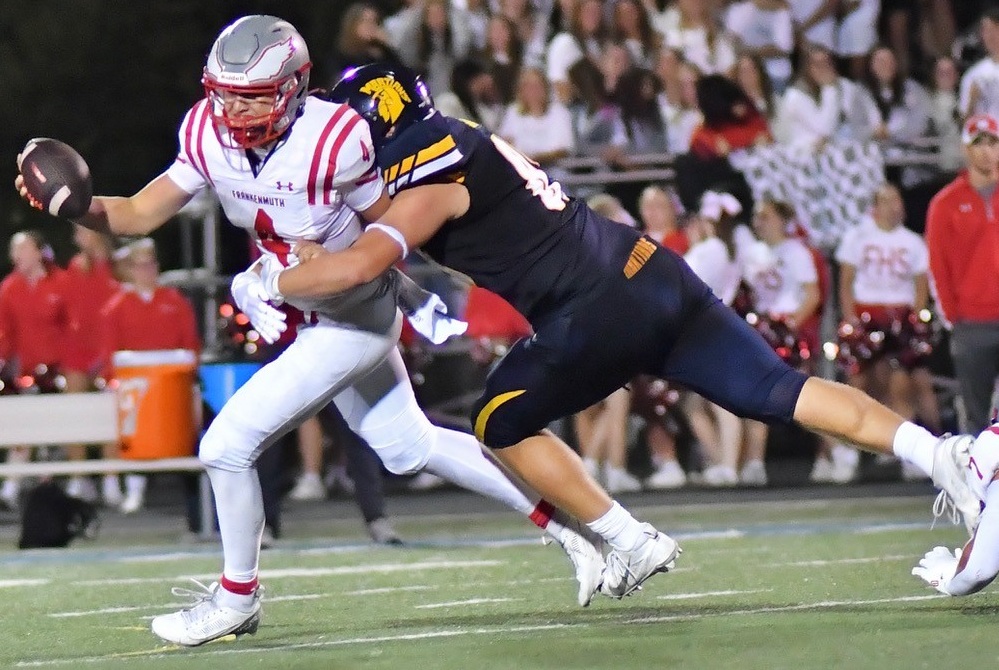
PHOTO A Goodrich defender chases down Frankenmuth's quarterback during the Martians' Week 1 win. (Photo by Terry Lyons.)