

Inside Selection Sunday: Mapnalysis 2012
October 24, 2012
By Geoff Kimmerly
Second Half editor
Between double checking data for more than a third of our 626 football teams, and creating 136 first-round games for our most popular tournament, the morning of MHSAA football "Selection Sunday" is both one of the most exciting and nerve-wracking of the school year.
So for those scratching their heads the last few days over how we picked the brackets this season, I offer one question and one warning:
How would you have done so differently?
And before you answer, remember that moving the position of one school affects at least seven more – if not all 32 in that division.
This was the second year I was involved in the football selection process, which while appearing simple on its face actually is layered with hours of discussions, calculations, checking and re-checking, and anything else we at the MHSAA can do to make sure we’ve created the best tournament possible.
Simply put, it’s more than just drawing circles and calling them good.
Below are a brief description of what we do, the history behind the process, and some challenges we face each time we draw these brackets – including some examples of our toughest this time around.
The process
Our past: The MHSAA playoff structure – with 256 teams in eight divisions, and six wins equaling an automatic berth – debuted in 1999. An 8-player tournament was added in 2011, resulting in nine champions total when November is done.
That’s a long way from our start. The first playoffs were conducted in 1975 with four champions. Four more football classes were added in 1990 for a total of eight champions each fall. Through 1998, only 128 teams made the postseason, based on their playoff point averages within regions (four for each class) that were drawn before the beginning of the season. The drawing of Districts and Regions after the end of the regular season did not begin until the most recent playoff expansion.
In early years of the current process (or until the middle of the last decade), lines were drawn by hand. Dots representing qualifying schools were pasted on maps, one map for each division, and those maps were then covered by plastic sheets. Districts and Regionals literally were drawn with dry-erase markers.
Our present: After a late Saturday night tracking scores, we file in as the sun rises Sunday morning for a final round of gathering results we may still need (which can include making a few early a.m. calls to athletic directors). Then comes re-checking and triple-checking of enrollments, co-ops, some records and more before the numbers are crunched and the field of 256 is set.
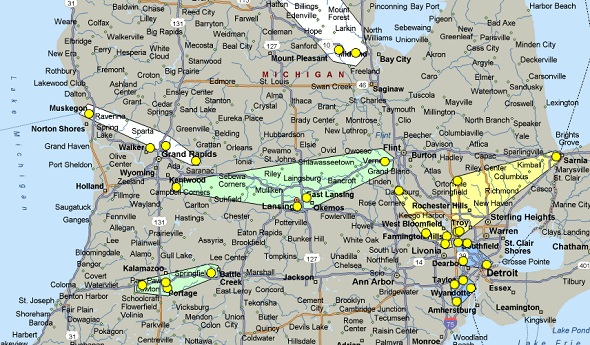
Those teams are then split into eight equal divisions based on enrollment, and their locations are marked on digital maps that are projected on wall-size screens and then discussed by nearly half of the MHSAA staff plus a representative from the Michigan High School Football Coaches Association. Only the locations themselves are marked (by yellow dots) – not records, playoff points averages or names of the schools or towns. In fact, mentions of those are strictly prohibited. Records and playoff points are not part of the criteria. Matchups, rivalries, previous playoff pairings, etc. also DO NOT come into play.
Geography rules: Drawing Districts and Regionals is all about location. Travel distance and ease DO come into play. Yes, ease is important. Schools near the same major highway might be further from each other in mileage than other options but have a better trip. A good example this year is in Division 6, which has seven teams in the U.P. and the northern Lower Peninsula. That meant Shelby needed to be included with those teams to make eight, and left Montague to a District that includes Hemlock – more than halfway across the Lower Peninsula. But at least, in this case, much of that trip will be on one roadway, M-46.
There is certainly conversation about every possible option. The staff splits into two groups, each handling four divisions (plus one of the groups handles 8-player too), and then the entire committee comes together to view all nine maps. There wasn’t one division where the group as a whole said, “That looks great, what’s next?”
Observations and answers
A different ballgame: I was asked whatever happened to Districts, meaning teams opening with opponents nearby. Remember that with eight divisions and 32 teams in each, the difference between maximum and minimum enrollments for each division is smaller than it used to be with just four classes, and the probability of finding two schools in the same division next door to each other is lower. This is especially true for our smaller schools, and those pairings are more spread out. Division 7 provides an excellent example. Opponents Dansville and Ottawa Lake Whiteford are 84 miles apart. But in another option considered, Dansville would’ve played Gobles – and those two are separated by 114 miles.
Points still matter: And that means strength of schedule is a big factor. After Districts are drawn, playoff point average determines the home team for those two games and Regionals as well. There are five Districts in which the team with the best or second-best record did not get home games because those teams’ playoff point averages ranked third among the four teams in those brackets. A number of other Districts have 8-1 teams playing at other 8-1 teams. It’s true: there are times a school can’t help the opponents it plays, because of league affiliation perhaps, and they have no control over how an opponent does the rest of the season. But a Class B team playing in a league with Class D schools can’t expect to compare averages well against teams in their division who face similarly-sized opponents during the regular season.
No boating: This didn’t come up last season, but did twice Sunday. We had to decide if it was a better trip for teams in the thumb to go around Saginaw Bay to play northern opponents, or instead send teams a little bit south of the thumb but with a straight shots north. As the bird flies, the thumb teams were closer in some cases. But I’ve never heard of a team hopping into a boat to get to a playoff game.
The fifth wheels: The toughest lines to draw are around areas with five schools in the same division. Remember, Districts come in fours, and one dot affects the rest. The Grand Rapids area gave us tough calls because of five teams in Divisions 2 and 4. The same was true in the southwest corner in Division 7 and the southeast corner in Division 6. No matter how we circled it, one of those teams got stuck with a longer trip. This time, that group included Caledonia, Grand Rapids South Christian, Blissfield and Gobles.
It’s easy to say certain areas of these maps should’ve been drawn differently. But again, keep in mind a statewide view.
Some of our pairings could create gigantic matchups earlier in the playoffs than those teams might like. But again, who is to decide which teams are the best and which matchups most “gigantic” before they prove it on the field? At least three teams touted during this fall as potentially the best in the state this season didn’t even win their conference titles.
And as I said in this analysis last year, determining the playoff schedule is just one step in many. Nine MHSAA champions must survive until the end, regardless of which opponents they face along the way.
Their journeys begin Friday.
1st & Goal: 2023 Week 7 Review
By
Geoff Kimmerly
MHSAA.com senior editor
October 9, 2023
Fall showed up in a roar for Week 7, drenching fields almost everywhere as 300 games played on.
 But the rain couldn’t put a damper on several league title celebrations all over the state.
Of 88 varsity football conferences in Michigan, 60 have at least one guaranteed champion with two more weeks of regular-season games to play – and those historic victories make up most of the highlights below.
Bay & Thumb
HEADLINER Frankenmuth 38, Freeland 13 Frankenmuth (6-1) secured a share of a 12th-consecutive league championship, clinching in the Tri-Valley Conference Red in this meeting of co-leaders heading into the evening. The Eagles have won 59 straight league games dating to 2014, and all five against the Falcons (6-1) since they began playing in the same division. Click for more from the Saginaw News.
Watch list Cass City 26, Elton-Pigeon-Bay Port Laker 12 With the Greater Thumb Conference set to merge with the North Central Thumb League next school year, Cass City (6-1) earned the final championship in the GTC West as Laker (4-3) also was tied for first entering the evening. (Ubly defeated Sandusky 39-8 to finish a perfect run through the GTC East.)
On the move Chesaning 29, Durand 12 Chesaning (6-1) clinched a share of the Mid-Michigan Activities Conference title, defeating the 2022 champ and with seventh-place Otisville-LakeVille left on the league schedule. Ithaca 26, Saginaw Michigan Lutheran Seminary 7 The Yellowjackets (7-0) also clinched the outright championship in the TVC White by claiming this winner-takes-all meeting with MLS (5-2). Fenton 27, Flushing 8 Fenton (6-1) finished an outright championship in the Flint Metro League Stripes, its fifth-straight league title and first outright since 2020.
Greater Detroit
HEADLINER Lake Orion 42, Clarkston 21 With its first win over Clarkston since 2019, Lake Orion clinched its first league title since those two teams shared the Oakland Activities Association Red championship in 2011. They entered this league finale tied for first, so the Dragons’ also won this time outright and improved to 7-0 while holding down the No. 3 spot in Division 1 playoff-points average. Clarkston is 4-3 but No. 15 on the list in part because of its difficult schedule playing in one of the state’s most competitive leagues. Click for more from the Oakland Press.
Check out these highlights from Lake Orion's recent win against Clarkston on October 6th, 2023 Senior running back Billy Roberson had an impressive game with 3 rushing touchdowns, leading the team to a 42-21 victory! Delivered by @hungryhowies pic.twitter.com/WuJNaTOX2n
— STATE CHAMPS! Michigan (@statechampsmich) October 7, 2023
Watch list Clinton Township Chippewa Valley 45, Romeo 12; Utica Eisenhower 31, Macomb Dakota 0 There’s no way to split these up; Chippewa Valley (5-2) and Eisenhower (6-1) clinched a shared Macomb Area Conference Red championship by winning on a night when all four contenders entered tied for first place.
On the move Walled Lake Western 28, Milford 20 Western (7-0) claimed a share of a second-straight Lakes Valley Conference title, with Milford (5-2) and Waterford Mott one game behind and the Warriors needing to defeat seventh-place Walled Lake Central in two weeks to clinch it outright. Grosse Pointe South 27, St. Clair Shores Lakeview 0 Another winner-take-all in the MAC White went to GPS (6-1), which has won all 10 of its games in this division since making the switch a year ago and handed Lakeview (5-2) its first shutout since 2021. Birmingham Seaholm 20, Auburn Hills Avondale 0 Seaholm (6-1) owns a share of the OAA Blue title and dealt this first loss to Avondale (6-1), which has clinched a share in the OAA Gold. Pontiac Notre Dame Prep 56, Gladwin 21 This was one of few meetings left of undefeated teams this fall, and Notre Dame Prep (6-0) continued its surge by posting 56 points for the third time this season and against a defense that had given up only 90 total during Gladwin’s 6-0 start.
Mid-Michigan
HEADLINER Hastings 20, Parma Western 19 There are still two weeks of Interstate 8 Athletic Conference games to play, but Hastings (5-2) is a major step closer to a fourth-straight championship. The Saxons stopped Western (6-1) on a late two-point try to win and moved into first place alone with a chance to clinch this week against Jackson Northwest. See below for more from FOX 17.
Parma Western and Hastings were both undefeated coming into tonight but it was the Saxons who came out on top! Final score 20-19.https://t.co/meVMKQVCa2 pic.twitter.com/uO6tiaKs2F
— FOX 17 Blitz (@FOX17Blitz) October 7, 2023
Watch list Perry 14, Stockbridge 13 Perry is drawing close to making history. The Ramblers (5-2) are seeking their first playoff berth (not counting 2020, when almost all teams qualified because of COVID-related adjustments) and are tied for No. 15 in Division 7 playoff-point average with a matchup against Division 5 Lake Odessa Lakewood this week.
On the move Fowler 54, Frankfort 0 Fowler (6-1) sits No. 10 in Division 8 playoff-points average after handing Frankfort (6-1) its first defeat. Portland 35, Charlotte 8 Portland (7-0) will play Lansing Sexton this week for the Capital Area Activities Conference White title after turning back this challenge from the third-place Orioles (5-2). Williamston 20, Haslett 7 Williamston (5-2) sits No. 7 in Division 5 playoff-points average with its only losses to Division 3 teams and this win over the Vikings (4-3) among five over opponents from Divisions 3 or 4.
Northern Lower Peninsula
HEADLINER Ogemaw Heights 35, Kingsley 12 For the first time since 2009, Ogemaw Heights (6-1) is a league champion after claiming a winner-takes-all matchup for the Northern Michigan Football League Legends title. Kingsley (5-2) had averaged 50 points per game entering the weekend, but the Falcons’ defense continued a run of success that’s seen them allow only 38 points total over the last five games. Click for more from MI Sports Now.
Watch list Benzie Central 46, Oscoda 14 Benzie remains on the rise, and by moving to 4-3 equaled its win total from a year ago – when it qualified for the playoffs at 3-6 – while holding nicely at No. 21 in Division 7 playoff-points average. Oscoda fell to 3-4 but has some opportunities to climb over the final two regular-season games.
On the move Grayling 46, Kalkaska 6 Grayling (4-3) kept its playoff hopes alive and sits No. 24 on the Division 6 playoff-points list after sending Kalkaska to 3-4 and No. 42. Maple City Glen Lake 47, Johannesburg-Lewiston 8 The Lakers (4-3) added to their playoff candidacy and sit No. 22 in Division 8 playoff-points average while Johannesburg-Lewiston (2-4) is No. 45. Cadillac 28, Richland Gull Lake 7 Cadillac (4-3) bounced back from two straight losses to get a needed boost up to No. 29 on the Division 3 playoff-points list, while Gull Lake (4-3) sits just outside the field at No. 33.
Southeast & Border
HEADLINER Napoleon 44, Michigan Center 34 Despite receiving one of its toughest challenges this fall – and trailing at halftime – Napoleon (7-0) emerged with a share of the Cascades Conference East championship and an opportunity to clinch it outright this week against sixth-place East Jackson. The Pirates have won 20 of their last 21 games and scored the most points Michigan Center (5-2) had allowed since Week 1 of 2022. Click for more from the Jackson Citizen Patriot.
Watch list Chelsea 21, Jackson 14 Chelsea (6-1) withstood its closest Southeastern Conference East matchup to finish an outright title run with Jackson (4-3) pushing for a shared championship.
On the move Monroe St. Mary Catholic Central 27, Flat Rock 18 St. Mary (3-4) was able to jump from No. 22 to No. 9 in Division 7 playoff-point average with this win, and also juggled the Huron League title race a bit by dropping Flat Rock (5-2) out of a tie for first. Addison 42, Hanover-Horton 8 Addison (7-0) completed its Cascades Conference West schedule with an outright championship, the Panthers’ fourth league title in five seasons. Saline 31, Ypsilanti Lincoln 0 Saline (7-0) is another long-running league champion back on top, clinching a share in the SEC Red after missing out a year ago.
Southwest Corridor
HEADLINER Portage Central 32, Portage Northern 22 Central took back the upper hand in this annual rivalry game after losing by three points a year ago, and also took over first place alone in the Southwestern Michigan Athletic Conference. Both teams are 6-1 overall, and Northern will be rooting hard for Kalamazoo Central this week and Stevensville Lakeshore next as the Huskies hope for some help to still claim a league title share. Click for more from the Kalamazoo Gazette.
Check out the highlights as Portage Central outshines rival Portage Northern with a 32-22 victory on October 6th, 2023! 🏈 Gavin Grueter's touchdown reception and incredible end zone interception stole the show! @PCMustangFB | @MHSAA pic.twitter.com/lL6vcaCc5A
— STATE CHAMPS! Michigan (@statechampsmich) October 7, 2023
Watch list Lawton 29, Schoolcraft 22 Lawton (6-1) set itself up to face undefeated Saugatuck this week for the Southwestern Athletic Conference Valley title with Schoolcraft (5-2) hanging on to hope for a shared championship with Saugatuck on its schedule for Week 9.
On the move Constantine 27, Kalamazoo United 7 Constantine (6-1) also will play for a league title this week, against South Haven, in the SAC Lakeshore and with Kalamazoo United (4-3) hoping for similar maneuvering as Schoolcraft as it gets South Haven in Week 9. Parchment 32, Allegan 14 The Panthers (4-3) just missed the playoffs last season at 5-4 but kept their hopes sparked this fall by ending a three-game losing streak and jumping from No. 35 to 28 in the Division 6 playoff-points list while sending Allegan (4-3) down to a tie for No. 32 in Division 5. St. Joseph 35, Stevensville Lakeshore 0 St. Joseph (4-3) vaulted to No. 19 in Division 3 playoff-points average in breaking a two-game losing streak, and also knocked Lakeshore (5-2) out of a tie for first in the SMAC.
Upper Peninsula
HEADLINER Negaunee 47, Menominee 20 The reigning champion in the Western Peninsula Athletic Conference Copper is back in the title hunt. After starting out a step behind with a loss to Gladstone in a Week 2 league opener, Negaunee (6-1) has made it all the way back and can clinch a share of the Copper championship this week against Houghton – while Menominee (6-1) and Kingsford also will play for a guaranteed share of the title. Click for more from Upper Michigan’s Source.
Watch list Marquette 21, Petoskey 20 Marquette (4-2) opened this season 1-2, then didn’t have a Week 4 game, but is 3-0 since with a chance at a share of the Big North Conference title (if Sault Ste. Marie defeats leader Gaylord in Week 9) and the No. 24 spot on the Division 3 playoff-points average list – while Petoskey (4-3) is holding on at No. 32.
On the move Gladstone 31, Houghton 8 Gladstone (5-2) is officially out of the Copper title hunt, but steady at No. 9 on the Division 6 playoff-points average list with opportunities to climb. Sault Ste. Marie 21, Alpena 6 After missing the playoffs last season at 6-3, Sault Ste. Marie (5-2) is sitting at No. 26 on the Division 4 playoff-points list and with two substantial chances to move up. Manistique 19, Lakeview 8 Manistique (4-3) moved up from No. 38 to 36 on the Division 7 playoff-points list but will work to reach the top 32 with two more playoff hopefuls on the schedule to finish the regular season.
West Michigan
HEADLINER Big Rapids 35, Howard City Tri County 6 After forcing a three-team shared championship in the Central State Activities Association last season, Big Rapids (6-1) will reign alone this fall thanks to this win that secured an outright title. The Cardinals won their six league games this season by an average of 24 ppg. Tri County is 6-1 and still can equal last season’s win total with one more. Click for more from the Big Rapids Pioneer.
WATCH: The Big Rapids Cardinals are CSAA Gold champions after a dominating second half tonight. They beat Tri County 35-6, as the defending national champion Ferris State Bulldogs watched from the stands!@brcardinals @TCHSATHLETICS @VennixRiley @FerrisFootball pic.twitter.com/UparPP4qCM
— Matt Gard (@mgard_wzzm13) October 7, 2023
Watch list Grandville 38, Caledonia 34 Grandville (6-1) will play Rockford this week for a share of the Ottawa-Kent Conference Red title after quarterback Cash Ruff put the Bulldogs on his shoulders (and legs) during the fourth quarter. He ran for the winning points during the final seconds as Grandville avenged two losses last season to the Fighting Scots (5-2).
On the move Grand Rapids Forest Hills Northern 23, Lowell 20 In an O-K White filled with contenders, FHN (5-2) quietly has joined them and with this win guaranteed its best record since 2018 with a chance to break up the title race even more after taking the Red Arrows (5-2) out of a four-way tie for first. Muskegon 22, Zeeland West 16 The O-K Green is down to just one leader at the top as the Big Reds (5-2) have a game on West (6-1) and Muskegon Mona Shores and only sixth-place Grand Rapids Union and seventh-place Wyoming left on the schedule. Grand Rapids West Catholic 56, Allendale 6 West Catholic (7-0) claimed a share of the O-K Blue title with two games to play as Allendale (5-2), Coopersville and Spring Lake all are tied for second at 3-2 in league play.
8-Player
HEADLINER Climax-Scotts 58, Mendon 28 After two runner-up league finishes over the last four seasons, including last fall, Climax-Scotts is a champion with this win clinching a share of the Southern Central Athletic Association West title. Mendon (5-2) led by as many as 12 points into the final minute of the first half, but the Panthers (7-0) scored the final six touchdowns to come back and pull away. Click for more from the Kalamazoo Gazette.
Climax-Scotts score 42 unanswered points in the second half to beat Mendon. The Panthers also move to 7-0 this season! https://t.co/meVMKQVCa2 pic.twitter.com/IVL8K9TSC1
— FOX 17 Blitz (@FOX17Blitz) October 7, 2023
Watch list Morrice 44, Mount Pleasant Sacred Heart 13 With one league game left for six of its seven teams, the Mid-State Activities Conference Red has three in first place – Morrice (5-2) creating the jam by handing Sacred Heart (6-1) this defeat. The Orioles, Irish and Portland St. Patrick all are 4-1 in the division, and all play teams in the bottom three of the standings this week.
On the move Alcona 42, Au Gres-Sims 12 Alcona (6-1) plays Rogers City this week for the North Star League Big Dipper title and should have plenty of momentum after handing a first loss to Little Dipper leader Au Gres (6-1). Marcellus 52, Grandville Calvin Christian 0 Marcellus (6-1) dominated the Southwest Michigan 8-Man Football League Red, opening with a 51-18 win over Lawrence, getting a forfeit from Bloomingdale and then defeating second-place Bangor and third-place Calvin Christian (4-3) by a combined 99-0 over the last two weeks. Carson City-Crystal 26, Blanchard Montabella 22 In its first year as part of an 8-player league, Carson City-Crystal (7-0) is a champion with this clinching a share of the MSAC Blue title as Montabella (4-3) moved into a tie for third.
Second Half’s weekly “1st & Goal” previews and reviews are powered by MI Student Aid, a part of the Office of Postsecondary Financial Planning located within the Michigan Department of Treasury. MI Student Aid encourages students to pursue postsecondary education by providing access to student financial resources and information. MI Student Aid administers the state’s 529 college savings programs (MET/MESP), as well as scholarship and grant programs that help make college Accessible, Affordable and Attainable for you. Connect with MI Student Aid at www.michigan.gov/mistudentaid and find more information on Facebook and X (Twitter) @mistudentaid.
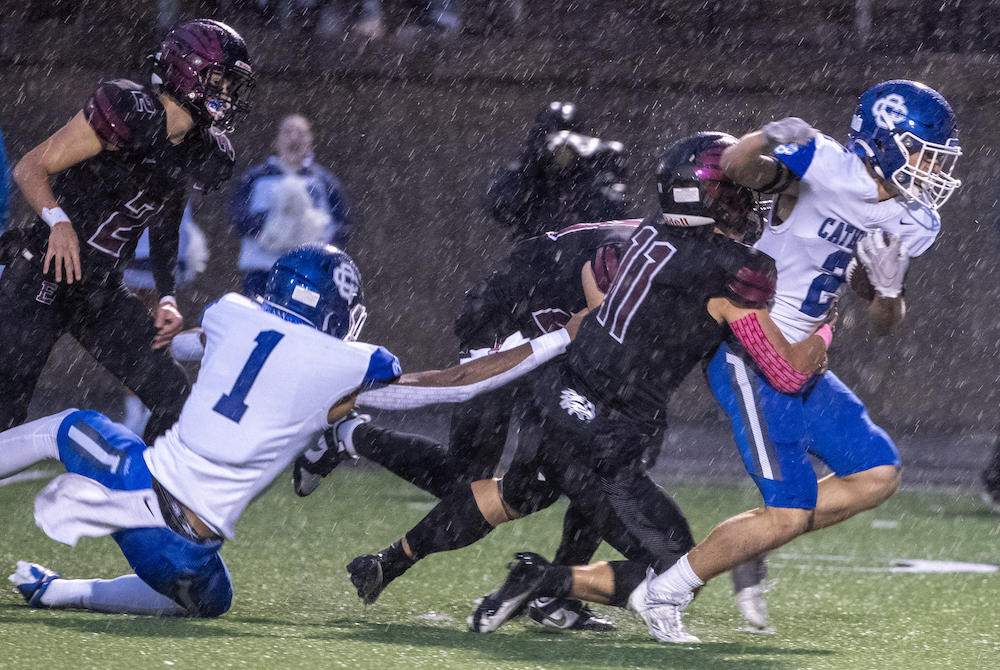
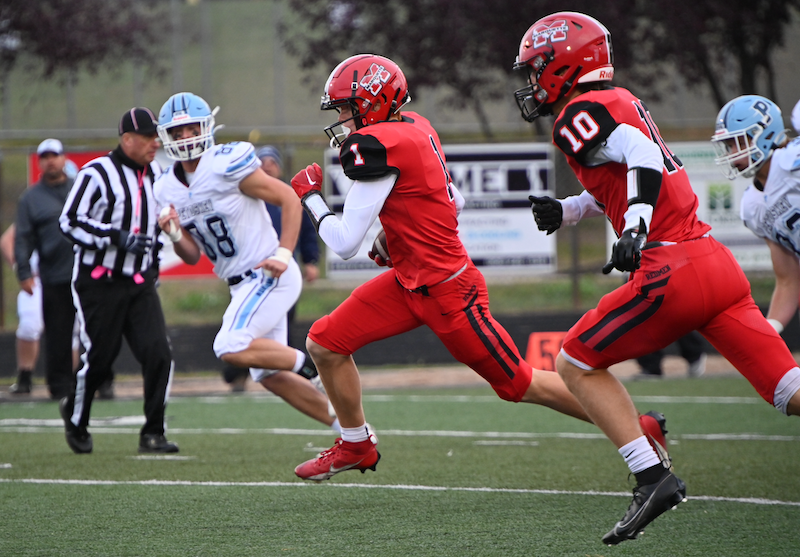
PHOTOS (Top) Grand Rapids Catholic Central breaks away for a 49-14 win over Ada Forest Hills Eastern. (Middle) Marquette's Jacob MacPhee (1) catches a pass from quarterback Jaxon Jurmu. (Top photo by Michigan Sports Photo. Middle photo by Cara Kamps.)