

Inside Selection Sunday: Mapnalysis 2012
October 24, 2012
By Geoff Kimmerly
Second Half editor
Between double checking data for more than a third of our 626 football teams, and creating 136 first-round games for our most popular tournament, the morning of MHSAA football "Selection Sunday" is both one of the most exciting and nerve-wracking of the school year.
So for those scratching their heads the last few days over how we picked the brackets this season, I offer one question and one warning:
How would you have done so differently?
And before you answer, remember that moving the position of one school affects at least seven more – if not all 32 in that division.
This was the second year I was involved in the football selection process, which while appearing simple on its face actually is layered with hours of discussions, calculations, checking and re-checking, and anything else we at the MHSAA can do to make sure we’ve created the best tournament possible.
Simply put, it’s more than just drawing circles and calling them good.
Below are a brief description of what we do, the history behind the process, and some challenges we face each time we draw these brackets – including some examples of our toughest this time around.
The process
Our past: The MHSAA playoff structure – with 256 teams in eight divisions, and six wins equaling an automatic berth – debuted in 1999. An 8-player tournament was added in 2011, resulting in nine champions total when November is done.
That’s a long way from our start. The first playoffs were conducted in 1975 with four champions. Four more football classes were added in 1990 for a total of eight champions each fall. Through 1998, only 128 teams made the postseason, based on their playoff point averages within regions (four for each class) that were drawn before the beginning of the season. The drawing of Districts and Regions after the end of the regular season did not begin until the most recent playoff expansion.
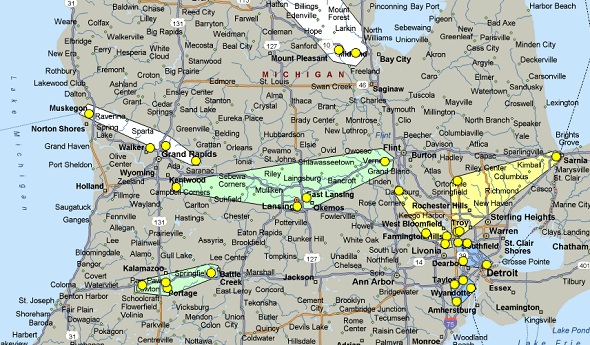
In early years of the current process (or until the middle of the last decade), lines were drawn by hand. Dots representing qualifying schools were pasted on maps, one map for each division, and those maps were then covered by plastic sheets. Districts and Regionals literally were drawn with dry-erase markers.
Our present: After a late Saturday night tracking scores, we file in as the sun rises Sunday morning for a final round of gathering results we may still need (which can include making a few early a.m. calls to athletic directors). Then comes re-checking and triple-checking of enrollments, co-ops, some records and more before the numbers are crunched and the field of 256 is set.
Those teams are then split into eight equal divisions based on enrollment, and their locations are marked on digital maps that are projected on wall-size screens and then discussed by nearly half of the MHSAA staff plus a representative from the Michigan High School Football Coaches Association. Only the locations themselves are marked (by yellow dots) – not records, playoff points averages or names of the schools or towns. In fact, mentions of those are strictly prohibited. Records and playoff points are not part of the criteria. Matchups, rivalries, previous playoff pairings, etc. also DO NOT come into play.
Geography rules: Drawing Districts and Regionals is all about location. Travel distance and ease DO come into play. Yes, ease is important. Schools near the same major highway might be further from each other in mileage than other options but have a better trip. A good example this year is in Division 6, which has seven teams in the U.P. and the northern Lower Peninsula. That meant Shelby needed to be included with those teams to make eight, and left Montague to a District that includes Hemlock – more than halfway across the Lower Peninsula. But at least, in this case, much of that trip will be on one roadway, M-46.
There is certainly conversation about every possible option. The staff splits into two groups, each handling four divisions (plus one of the groups handles 8-player too), and then the entire committee comes together to view all nine maps. There wasn’t one division where the group as a whole said, “That looks great, what’s next?”
Observations and answers
A different ballgame: I was asked whatever happened to Districts, meaning teams opening with opponents nearby. Remember that with eight divisions and 32 teams in each, the difference between maximum and minimum enrollments for each division is smaller than it used to be with just four classes, and the probability of finding two schools in the same division next door to each other is lower. This is especially true for our smaller schools, and those pairings are more spread out. Division 7 provides an excellent example. Opponents Dansville and Ottawa Lake Whiteford are 84 miles apart. But in another option considered, Dansville would’ve played Gobles – and those two are separated by 114 miles.
Points still matter: And that means strength of schedule is a big factor. After Districts are drawn, playoff point average determines the home team for those two games and Regionals as well. There are five Districts in which the team with the best or second-best record did not get home games because those teams’ playoff point averages ranked third among the four teams in those brackets. A number of other Districts have 8-1 teams playing at other 8-1 teams. It’s true: there are times a school can’t help the opponents it plays, because of league affiliation perhaps, and they have no control over how an opponent does the rest of the season. But a Class B team playing in a league with Class D schools can’t expect to compare averages well against teams in their division who face similarly-sized opponents during the regular season.
No boating: This didn’t come up last season, but did twice Sunday. We had to decide if it was a better trip for teams in the thumb to go around Saginaw Bay to play northern opponents, or instead send teams a little bit south of the thumb but with a straight shots north. As the bird flies, the thumb teams were closer in some cases. But I’ve never heard of a team hopping into a boat to get to a playoff game.
The fifth wheels: The toughest lines to draw are around areas with five schools in the same division. Remember, Districts come in fours, and one dot affects the rest. The Grand Rapids area gave us tough calls because of five teams in Divisions 2 and 4. The same was true in the southwest corner in Division 7 and the southeast corner in Division 6. No matter how we circled it, one of those teams got stuck with a longer trip. This time, that group included Caledonia, Grand Rapids South Christian, Blissfield and Gobles.
It’s easy to say certain areas of these maps should’ve been drawn differently. But again, keep in mind a statewide view.
Some of our pairings could create gigantic matchups earlier in the playoffs than those teams might like. But again, who is to decide which teams are the best and which matchups most “gigantic” before they prove it on the field? At least three teams touted during this fall as potentially the best in the state this season didn’t even win their conference titles.
And as I said in this analysis last year, determining the playoff schedule is just one step in many. Nine MHSAA champions must survive until the end, regardless of which opponents they face along the way.
Their journeys begin Friday.
Jensen Helps Make Prediction Come True with Record-Setting Performance
By
Jason Juno
Special for MHSAA.com
November 21, 2026
MARQUETTE — When Blanchard Montabella running back Austin Jensen was in eighth grade, he predicted the Mustangs would win a state championship.
His coach, Tim Webb, was skeptical because there was no reason to believe that would happen. The Mustangs weren’t winning many games at the time, the playoffs weren’t even realistic, and Jensen didn’t have a championship group to emulate.
“I’m like, ‘I don’t think you even know how this works. There’s some really, really good teams, and we haven’t proven anything,’” Webb said.
“But, yeah, he was right.”
The 5-foot-9, 165-pound senior sure was a big part of making it happen.
Jensen set 8-Player Finals records with 371 rushing yards and seven touchdowns as Montabella dominated Deckerville for a 56-0 Division 1 title-clinching victory Saturday. The championship was the school's first on the football field.
The Mustangs made it back to the Superior Dome after falling in the title game last year. They did the 6:30 a.m. workouts all winter and they showed up all summer, hoping to not only make it back here but leave with a win instead of a loss.
“We sat in this room last year, and not a great feeling,” Webb said. “We had a lot of guys coming back, and they just made a commitment that they wanted to be different this time. And they did it, man. Hardest working group of kids I’ve ever seen, most dedicated, most selfless, smartest, most mature, you name it, man, tough, talented. It’s a special group and just really, really proud to be associated with them as their coach.”
The result of all that work was domination all season. Only two of their wins were by fewer than 20 points, and they scored at least 50 points 11 times. They relied on their running game, and they piled up 5,400 rushing yards coming into this title game.
And by halftime Saturday, Montabella had a 35-0 lead. Their run game couldn’t be stopped, and their defense was just as effective.
It all started fast for the Mustangs (11-1).
Jensen ran 42 yards for a touchdown on the second play of the game. Ethan Greene recovered a fumble on Deckerville’s first possession, and Montabella took five plays to score this time as Jensen ran 30 yards for the score and a 13-0 Montabella lead.
Deckerville seemed poised to make it a one-score game on the ensuing possession. The Eagles got into the red zone on a nice run, but a holding call pushed them back to the 29. They only picked up two yards from there, and Greene intercepted a pass on 4th-and-11.
That meant Montabella started at its own 2, not that it bothered the Mustangs any.
On 2nd-and-8 from their own 43, Deckerville had Jensen wrapped up at its 45, but he kept fighting and he broke loose for a 57-yard touchdown.
Deckerville neared the red zone again, but the drive stalled out. Jensen scored on the second play of the next drive. He went right, cut back to the middle, made a defender fall and went 67 yards in all for the touchdown. Montabella led 29-0.
Deckerville came up short on a couple of drives that could have kept the game close, but instead it became a runaway.
“Nobody’s been able to keep up with them all year. They’re just so explosive offensively," Deckerville coach Bill Brown said.
Montabella added one more score before the half when quarterback Gabe Kauffman hit Noah Carlson for a deep pass of 46 yards.
That was the only touchdown Jensen didn’t score. He added three more in the second half, including the longest at 71 yards on his record-setting day.
“It’s a team record, it’s not just my record,” Jensen said.
He had missed a couple of games with a bum ankle, and that’s something they monitored all year. His season numbers could have been even better, but none of that really mattered Saturday.
“I know what kind of competitor he is, and in a game like this, he’s gonna show that he’s the best, he is not gonna get tackled, that’s what kind of drive he has inside of him,” Webb said. “That’s what champions do, man, they rise to the occasion and I knew he would do that.”
Kauffman said Jensen’s numbers were surreal, but he still wasn’t surprised, reiterating Webb’s thoughts. “He’s the best player in 8-man ever, I’m confident in saying that,” Kauffman declared.
Brown marveled at Jensen’s speed.
“His lateral movement’s great, too,” he said. “He gets a little space, he’s gone. He’s done that all year. His lateral movement is exceptional as a running back. And they fed him; who wouldn’t? I mean, he’s really good. He’s got a lot of good players in front on the line, too.”
Before learning the kind of numbers Jensen put up, Webb talked about Montabella as a true team that didn’t worry about individual stats. The Mustangs came in with two 1,000-yard backs (including Josh Arganbright as well) and a quarterback who was capable of big things, but deferred to their effective running style.
“Their one rule was just to win, and we did,” Webb said.
Deckerville was seeking its second championship in three years. The Eagles had to settle for their third runner-up trophy and an 11-2 season.
They battled through three season-ending injuries that hurt their depth, size and athleticism, with quarterback Cooper Brown also battling an injury all year. They still got to the state title game.
“That trophy’s just got silver on it instead of the gold,” said Brown, who finished his 34th year coaching. “It’s a trophy, it validates what we’re doing here. … It shows a lot about what’s going on here in Deckerville, the character of these kids. They worked their tails off all this year.
“We’re here, we gave it our best shot. They’re a good football team.”
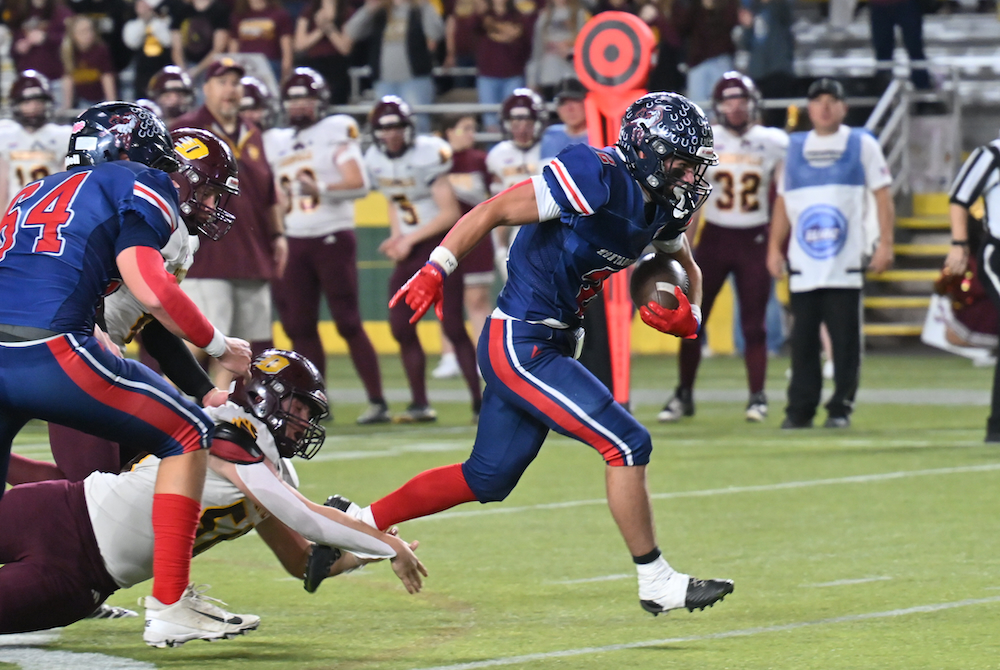
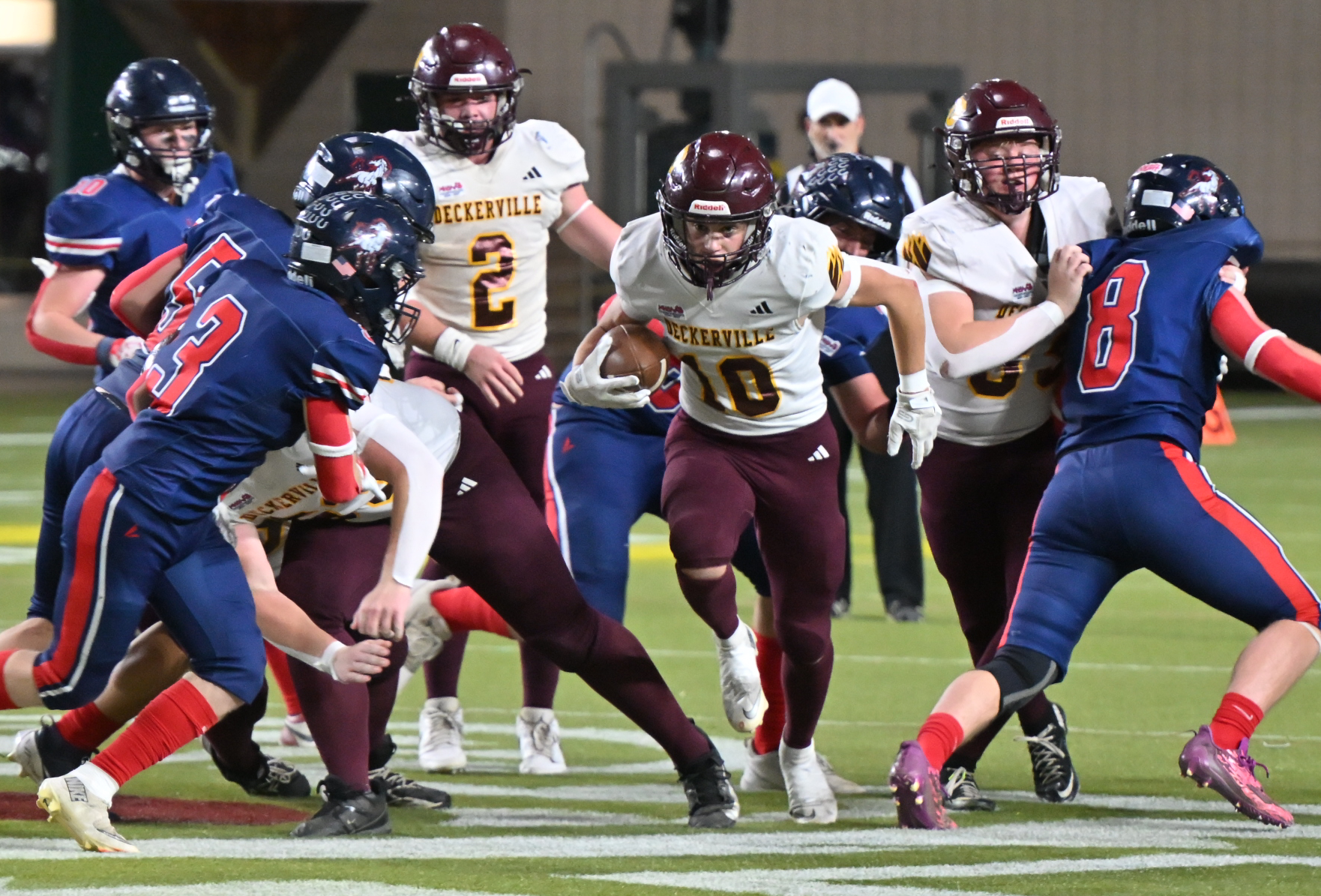
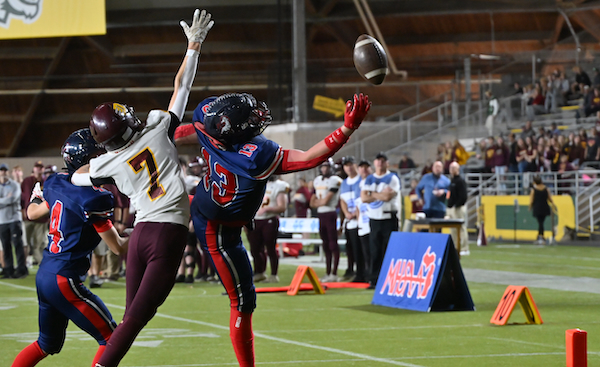
PHOTOS (Top) Montabella’s Austin Jensen (2) pulls away for a first-half touchdown run Saturday at the Superior Dome. (Middle) Deckerville’s Ashton Wedge (10) breaks through an opening. (Below) The Mustangs’ Mason Bogart (13) and Eagles’ Ashton Peruski (7) try to pull in a pass in the end zone. (Photos by Cara Kamps – Click for more.)