

Inside Selection Sunday: Mapnalysis 2012
October 24, 2012
By Geoff Kimmerly
Second Half editor
Between double checking data for more than a third of our 626 football teams, and creating 136 first-round games for our most popular tournament, the morning of MHSAA football "Selection Sunday" is both one of the most exciting and nerve-wracking of the school year.
So for those scratching their heads the last few days over how we picked the brackets this season, I offer one question and one warning:
How would you have done so differently?
And before you answer, remember that moving the position of one school affects at least seven more – if not all 32 in that division.
This was the second year I was involved in the football selection process, which while appearing simple on its face actually is layered with hours of discussions, calculations, checking and re-checking, and anything else we at the MHSAA can do to make sure we’ve created the best tournament possible.
Simply put, it’s more than just drawing circles and calling them good.
Below are a brief description of what we do, the history behind the process, and some challenges we face each time we draw these brackets – including some examples of our toughest this time around.
The process
Our past: The MHSAA playoff structure – with 256 teams in eight divisions, and six wins equaling an automatic berth – debuted in 1999. An 8-player tournament was added in 2011, resulting in nine champions total when November is done.
That’s a long way from our start. The first playoffs were conducted in 1975 with four champions. Four more football classes were added in 1990 for a total of eight champions each fall. Through 1998, only 128 teams made the postseason, based on their playoff point averages within regions (four for each class) that were drawn before the beginning of the season. The drawing of Districts and Regions after the end of the regular season did not begin until the most recent playoff expansion.
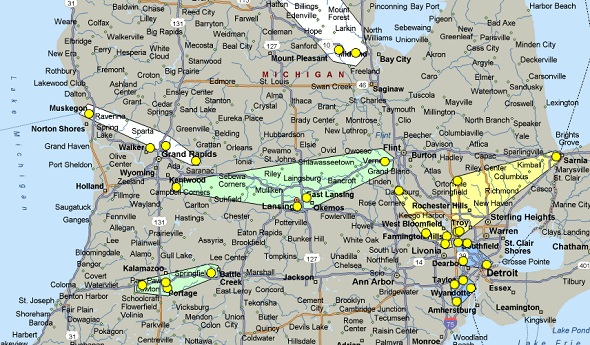
In early years of the current process (or until the middle of the last decade), lines were drawn by hand. Dots representing qualifying schools were pasted on maps, one map for each division, and those maps were then covered by plastic sheets. Districts and Regionals literally were drawn with dry-erase markers.
Our present: After a late Saturday night tracking scores, we file in as the sun rises Sunday morning for a final round of gathering results we may still need (which can include making a few early a.m. calls to athletic directors). Then comes re-checking and triple-checking of enrollments, co-ops, some records and more before the numbers are crunched and the field of 256 is set.
Those teams are then split into eight equal divisions based on enrollment, and their locations are marked on digital maps that are projected on wall-size screens and then discussed by nearly half of the MHSAA staff plus a representative from the Michigan High School Football Coaches Association. Only the locations themselves are marked (by yellow dots) – not records, playoff points averages or names of the schools or towns. In fact, mentions of those are strictly prohibited. Records and playoff points are not part of the criteria. Matchups, rivalries, previous playoff pairings, etc. also DO NOT come into play.
Geography rules: Drawing Districts and Regionals is all about location. Travel distance and ease DO come into play. Yes, ease is important. Schools near the same major highway might be further from each other in mileage than other options but have a better trip. A good example this year is in Division 6, which has seven teams in the U.P. and the northern Lower Peninsula. That meant Shelby needed to be included with those teams to make eight, and left Montague to a District that includes Hemlock – more than halfway across the Lower Peninsula. But at least, in this case, much of that trip will be on one roadway, M-46.
There is certainly conversation about every possible option. The staff splits into two groups, each handling four divisions (plus one of the groups handles 8-player too), and then the entire committee comes together to view all nine maps. There wasn’t one division where the group as a whole said, “That looks great, what’s next?”
Observations and answers
A different ballgame: I was asked whatever happened to Districts, meaning teams opening with opponents nearby. Remember that with eight divisions and 32 teams in each, the difference between maximum and minimum enrollments for each division is smaller than it used to be with just four classes, and the probability of finding two schools in the same division next door to each other is lower. This is especially true for our smaller schools, and those pairings are more spread out. Division 7 provides an excellent example. Opponents Dansville and Ottawa Lake Whiteford are 84 miles apart. But in another option considered, Dansville would’ve played Gobles – and those two are separated by 114 miles.
Points still matter: And that means strength of schedule is a big factor. After Districts are drawn, playoff point average determines the home team for those two games and Regionals as well. There are five Districts in which the team with the best or second-best record did not get home games because those teams’ playoff point averages ranked third among the four teams in those brackets. A number of other Districts have 8-1 teams playing at other 8-1 teams. It’s true: there are times a school can’t help the opponents it plays, because of league affiliation perhaps, and they have no control over how an opponent does the rest of the season. But a Class B team playing in a league with Class D schools can’t expect to compare averages well against teams in their division who face similarly-sized opponents during the regular season.
No boating: This didn’t come up last season, but did twice Sunday. We had to decide if it was a better trip for teams in the thumb to go around Saginaw Bay to play northern opponents, or instead send teams a little bit south of the thumb but with a straight shots north. As the bird flies, the thumb teams were closer in some cases. But I’ve never heard of a team hopping into a boat to get to a playoff game.
The fifth wheels: The toughest lines to draw are around areas with five schools in the same division. Remember, Districts come in fours, and one dot affects the rest. The Grand Rapids area gave us tough calls because of five teams in Divisions 2 and 4. The same was true in the southwest corner in Division 7 and the southeast corner in Division 6. No matter how we circled it, one of those teams got stuck with a longer trip. This time, that group included Caledonia, Grand Rapids South Christian, Blissfield and Gobles.
It’s easy to say certain areas of these maps should’ve been drawn differently. But again, keep in mind a statewide view.
Some of our pairings could create gigantic matchups earlier in the playoffs than those teams might like. But again, who is to decide which teams are the best and which matchups most “gigantic” before they prove it on the field? At least three teams touted during this fall as potentially the best in the state this season didn’t even win their conference titles.
And as I said in this analysis last year, determining the playoff schedule is just one step in many. Nine MHSAA champions must survive until the end, regardless of which opponents they face along the way.
Their journeys begin Friday.
1st & Goal: 2025 Week 3 Review
By
Geoff Kimmerly
MHSAA.com senior editor
September 15, 2025
With at most only nine dates on every football team’s regular-season schedule, every game from August through October can make a difference when it comes to playoff hopes and league title aspirations.
 We just finished up Week 3 this fall, but several of the weekend’s games may end up having that impact – and we dive into that below.
Bay & Thumb
HEADLINER Saginaw Swan Valley 31, Freeland 7 The Vikings bounced back from a seven-point Week 2 loss to Frankenmuth to defeat the Falcons (2-1) for the first time since 2019 – and after losing last year’s meeting 34-0. Swan Valley also is 2-1 after starting 0-3 a year ago, its best start since 2020. Click for more from the Saginaw News.
Watch list Saginaw Valley Lutheran 27, Saginaw Nouvel Catholic Central 20 Valley Lutheran qualified for the playoffs last season for the first time since 2012, and the Chargers are 3-0 for the first time according to Michigan-Football.com after their first win over Nouvel (2-1) in program history.
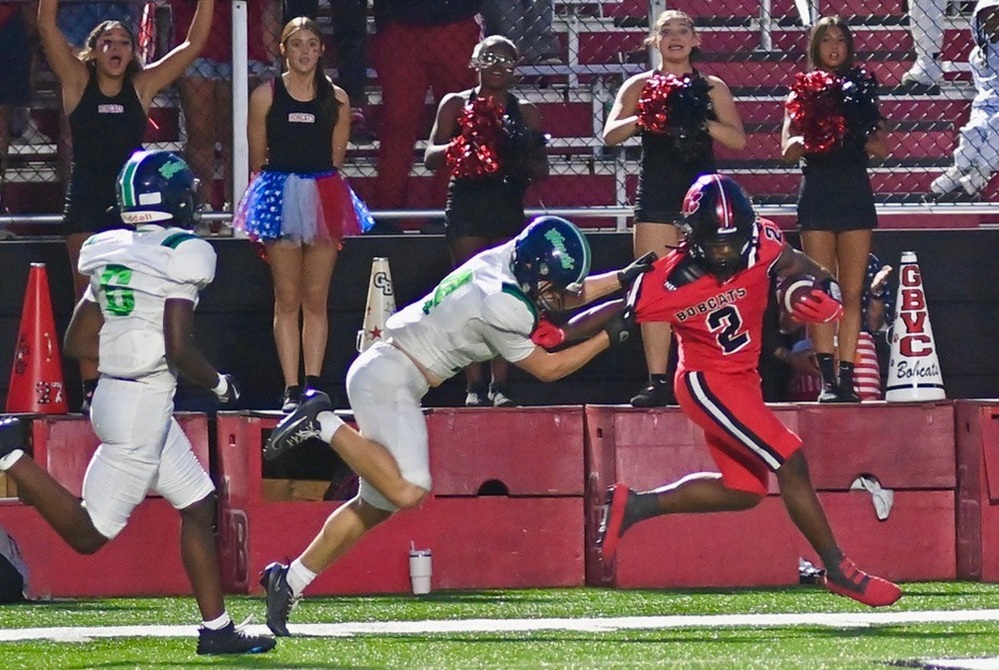
On the move Harbor Beach 33, Ubly 6 The Pirates (3-0) kicked off Big Thumb Conference Black play by winning the matchup that decided last year’s league title, adding to last year’s two wins (regular season and playoff) over the rival Bearcats. Grand Blanc 56, Saginaw Heritage 27 The Bobcats (3-0) moved to 2-0 in the Saginaw Valley League South by winning the matchup that decided last season’s league title in their favor. Caro 46, Marine City Cardinal Mooney 7 The Tigers won two games a year ago and have won no more than three in a season since 2018. But they’re up to 2-1 this fall after a big win over a Cardinal Mooney team that while 0-3 has made the playoffs every year this decade.
Greater Detroit
HEADLINER Waterford Mott 42, Walled Lake Western 34 While only three games into the Lakes Valley Conference schedule, Mott has defeated the champion and runner-up from last year with this breaking Western’s 28-game LVC winning streak going back to 2021. Mott (2-1) was only 3-5 last season after making the Division 2 Semifinals in 2023. Click for more from the Detroit Free Press.
Watch list Orchard Lake St. Mary’s 49, Warren De La Salle Collegiate 10 The Eaglets are 3-0 for the first time since 2021 after downing De La Salle (1-2) for the first time since 2019. It was the best-possible way for St. Mary’s to set up for this week’s titanic matchup with Detroit Catholic Central.
On the move Northville 17, Howell 7 The Mustangs (3-0) avenged last season’s 27-12 loss to Howell, breaking the Highlanders’ 11-game regular-season winning streak. Harper Woods 35, Birmingham Groves 8 The Pioneers (3-0) avenged last year’s loss to Groves (1-2) that ended up deciding the Oakland Activities Association White championship. Gibraltar Carlson 42, Pontiac Notre Dame Prep 21 The Marauders’ offense has been rolling during the team’s 3-0 start, putting up a combined 152 to at least double up every opponent including the reigning Division 5 champion Fighting Irish (1-2), whose regular-season schedule is quickly looking like it will end up one of the toughest in the state this fall.
Mid-Michigan
HEADLINER Ithaca 42, Saginaw Michigan Lutheran Seminary 40 (OT) This Tri-Valley Conference Blue opener ended up being everything it was billed, as Ithaca stopped an MLS two-point conversion try to start overtime and won the night on the next possession. Offense reigned as both teams are averaging more than 40 points per game through these first three weeks. Click for more from the Saginaw News.
Watch list St. Johns 27, Fowlerville 26 After opening 5-0 a year ago, St. Johns (3-0) is off to another solid start after a third-straight win over the Gladiators by seven or fewer points. Fowlerville (2-1), off to its best start since 2020, will attempt to rebound against undefeated Williamston this week.
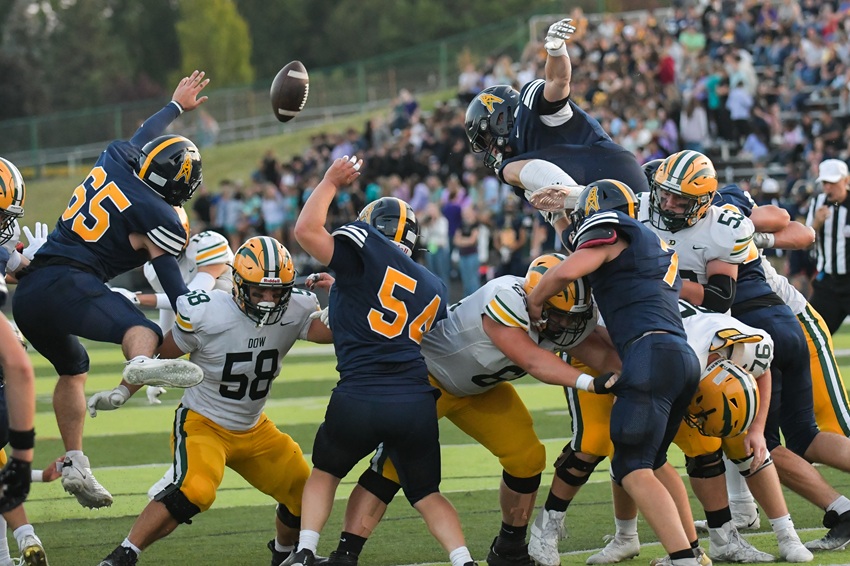
On the move Williamston 28, Mason 0 The Hornets (3-0) have now defeated three 2024 playoff teams and with Mason (1-2) also the reigning Capital Area Activities Conference Red champion. Mount Pleasant 63, Midland Dow 39 The Oilers (3-0) received their strongest challenge of the early season and responded by scoring their most points in a game since 2016 while handing Dow (2-1) its only loss. Mount Pleasant Sacred Heart 49, Vestaburg 7 Both of these teams returned this season to 11-player football from 8-player, and they will meet again in Week 6.
Northern Lower Peninsula
HEADLINER Gaylord 28, Marquette 27 (OT) The Blue Devils’ turnaround season continued as they moved to 3-0 after going 0-5 to start 2024, this time avenging a 30-0 loss to the Sentinels (1-2) to open the Big North Conference schedule. Gaylord stopped a two-point conversion try to hold on for the victory. Click for more from the Petoskey News-Review.
Watch list Kalkaska 24, East Jordan 20 This arguably was the best win of Kalkaska’s first 3-0 start since 2017, as it avenged last year’s 44-13 loss, gave the Blazers as many wins already as all of last season and came against an East Jordan team (2-1) that’s been in the playoffs every season this decade.
On the move Ogemaw Heights 49, Gladwin 14 The Falcons (2-1) bounced back from a Week 2 defeat to open Jack Pine Conference I play by avenging last year’s District Final loss to Gladwin (0-3). Kingsley 48, Grayling 21 The Stags (2-1) also bounced back from a Week 2 defeat as they began Northern Michigan Football League Legends play by sending Grayling to 1-2 overall. Elk Rapids 8, Oscoda 6 The Elks’ first two games this season came against teams still undefeated, but they got on the board by avenging last year’s 20-0 loss to the Owls (1-2).
Southeast & Border
HEADLINER Ypsilanti Lincoln 21, Tecumseh 17 While the season is only three weeks old, Lincoln has handed a first loss this fall to all three of its opponents in opening 3-0 for the first time since 2012. The Railsplitters also are 2-0 in the Southeastern Conference White after playing in the SEC Red the last four seasons. Click for more from the Adrian Daily Telegram.
Watch list Riverview 38, Carleton Airport 6 The Pirates (2-1) opened with a loss to Division 1 Utica Eisenhower but have started Huron League play 2-0 as they look to take back league supremacy after finishing second a year ago.
On the move Chelsea 29, Adrian 12 The Bulldogs (3-0) also are 2-0 in the SEC White, running their overall league winning streak in the league to 12 in handing Adrian (2-1) its lone loss. Dexter 48, Ann Arbor Huron 16 The Dreadnaughts (3-0) will head into this week’s potential eventual SEC Red-deciding matchup with Saline having won all of their first three games by at least three touchdowns. Michigan Center 53, Hanover-Horton 14 The Cardinals’ playoff hopes last season hinged in part on a pair of losses by two points or fewer, and they avenged the first in a big way by sending the Comets to 1-2.
Southwest Corridor
HEADLINER Schoolcraft 32, Constantine 14 Schoolcraft (2-1) bounced back from a Week 2 defeat to break Constantine’s three-year hold on this rivalry series. The teams now go their separate ways in the Southwestern Athletic Conference, both as potential champions. Constantine also is 2-1. Click for more from the Kalamazoo Gazette.
Watch list Marshall 41, Parma Western 6 After a close Week 2 loss to Fowlerville, Marshall (2-1) found its stride to open Interstate 8 Athletic Conference play with its first win over Parma Western (1-2) since 2020. The Redhawks need just one more win this fall to equal last year’s season total.
On the move Battle Creek Pennfield 23, Buchanan 20 Pennfield (2-1) already has surpassed last year’s lone victory, handing returning playoff qualifier Buchanan (2-1) its only defeat. Lawton 22, Kalamazoo United 19 The Blue Devils (2-1) bounced back from a Week 2 loss heading into SAC Valley play, defeating the Titans (1-2) for the second-straight season. Niles 30, Paw Paw 14 Although Paw Paw (0-3) is off to a rough start, this matchup did decide the Wolverine Conference title last year. Niles (3-0) has won six straight in the series including in the playoffs the last two years as well.
Upper Peninsula
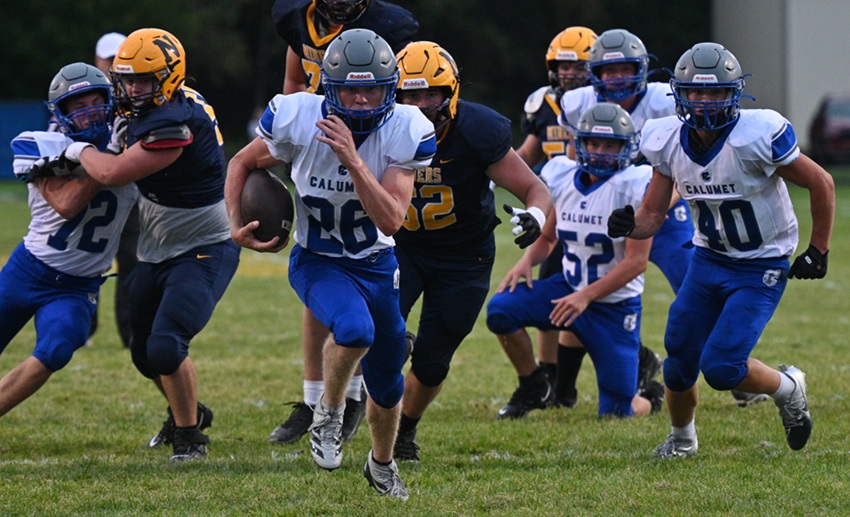
HEADLINER Calumet 33, Negaunee 18 The Copper Kings (3-0) earned a significant upper hand on Negaunee in the Western Peninsula Athletic Conference Copper, moving into an early three-way tie for first with Menominee and Kingsford by breaking a five-game losing streak against the Miners (2-1). Menominee and Kingsley are up next, respectively, for Calumet. Click for more from the Houghton Daily Mining Gazette.
Watch list Escanaba 27, Petoskey 10 Escanaba (3-0) is moving smoothly through the start of Big North Conference play and checking in as the No. 6 team in Division 4 playoff-point average after downing the reigning league champion Northmen (1-2).
On the move Houghton 42, Hancock 0 The Gremlins (1-2) have won six straight in the Copper Bowl and surely hope this one will get them on track with plenty of tough competition ahead. Kingsford 25, Gladstone 13 After starting the season with a close loss to Escanaba, Kingsford (2-1) has opened West-PAC Copper play with two double-digit wins – right in time to face rival Negaunee this week. Menominee 50, Ishpeming Westwood 8 The Maroons (3-0) got back on the field after their Week 2 game was canceled, earning some no doubt valuable prep in advance of this week’s matchup with Calumet.
West Michigan
HEADLINER Whitehall 35, Zeeland West 28 After playing the eventual Division 3 champion to one of last season’s highest-scoring games – a 60-43 loss – Whitehall (2-1) avenged with the go-ahead score during this game’s final minute. The Dux (2-1) hadn’t lost a nonleague game since 2018. Click for more from the White Lake Mirror.
Watch list Grand Rapids Catholic Central 28, Jackson Lumen Christi 14 The Cougars’ first game this season against an in-state opponent was one to remember as they moved to 3-0 in downing the reigning Division 6 champion Titans (1-2).
On the move Grand Rapids Forest Hills Northern 42, Grand Rapids Forest Hills Central 10 Forest Hills Northern (1-2) earned its first win over the rival Huskies since 2004 and after FHC had won the last 10 (including once in the playoffs) since the teams began playing each other annually again in 2016. Grand Rapids West Catholic 27, Grand Rapids South Christian 20 The Falcons will take a winning streak into Ottawa-Kent Conference White play this week after avenging last season’s three-point loss to the Sailors (1-2). East Kentwood 54, Jenison 7 East Kentwood is 3-0 for the first time since 2017 after handing Jenison (2-1) its only loss and with this week’s matchup against Rockford a major opportunity to prove it’s an O-K Red contender.
8-Player
HEADLINER Climax-Scotts 44, Adrian Lenawee Christian 41 These two have built a nice cross-state rivalry first in 11-player and now in 8-player over the last six seasons. Climax-Scotts (2-1) broke a 28-28 tie during the closing minutes of the third quarter this time to send the Cougars to 2-1 as well.
Watch list Gogebic 38, Ishpeming 16 The Miners (3-0) have rumbled with 173 points (and only 22 allowed) over their first three games, coming off a 5-3 finish a year ago and seeking their first playoff season since 2014.
On the move Felch North Dickinson 58, Crystal Falls Forest Park 7 The Nordics (3-0) continued to impress, this time with their first win over Forest Park (1-2) since 2012 and the era when these two frequently met in both the regular season and playoffs. Mendon 56, Concord 26 Three of Owen Gorham’s nine carries went for second or third-quarter touchdowns as Mendon (3-0) scored the first points Concord (2-1) had given up. Pickford 53, Newberry 6 Pickford (3-0) appears in midseason form already, outscoring its first three opponents by a combined 168-14 as it opened Great Lakes Eight East play with a big win over previously-undefeated Newberry (2-1).
MHSAA.com's weekly “1st & Goal” previews and reviews are powered by MI Student Aid, a division within the Department of Lifelong Education, Advancement, and Potential (MiLEAP). MI Student Aid encourages students to pursue postsecondary education by providing access to student financial resources and information. MI Student Aid administers the state’s scholarship and grant programs that help make college Accessible, Affordable and Attainable for you. Click to connect with MI Student Aid and find more information on Facebook and Twitter @mistudentaid.
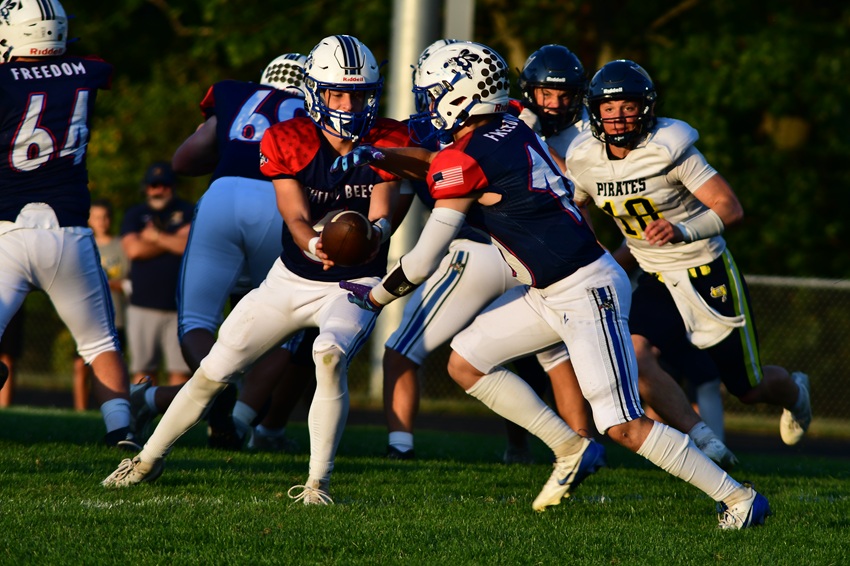
PHOTOS (Top) Grand Blanc cheerleaders root for their ball carrier as a Heritage defender attempts to make a tackle Friday. (2) Mount Pleasant attempts to block a Midland Dow kick. (3) Bath's Rylen Dixon (10) takes a handoff during his team's game against Pewamo-Westphalia. (4) Calumet's Ben Anderson finds a hole and gains several yards against Negaunee. (Grand Blanc/Heritage photo by Terry Lyons. Mount Pleasant/Dow photo by High School Sports Scene. Bath/P-W photo by John Johnson. Calumet/Negaunee photo by Cara Kamps.)