

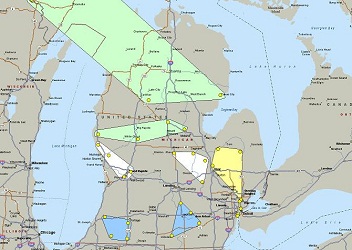
Inside Selection Sunday: Mapping the Football Playoffs
October 24, 2011
Sitting on the other side of this process for a number of years, I can admit to occasionally scratching my cynical head over some of the matchups that have come out of Selection Sunday.
How could teams so far from each other play in the same district? Why would two schools in the same town play in different regionals? Are they picking out of a hat at 1661 Ramblewood Drive?
Now, I have answers.
Sunday morning, we filed into headquarters for what might be the most important non-game day on the MHSAA calendar. “We” were made up of half of the MHSAA staff, plus a representative from the Michigan High School Football Coaches Association.
Here’s some of what I learned from being a part of the process:
? First, a brief history lesson. In early years (or until the middle of the last decade), lines were drawn by hand. Dots representing qualifying schools were pasted on maps, one map for each division, and those maps were then covered by plastic sheets. Districts and regionals literally were drawn with dry-erase markers. No longer. Using a variety of spreadsheets and mapping software, we’ve gone digital. Staff is split into two teams, each considering four divisions (and the 8-player map) before we reconvene and look at all nine divisions together.
? We are presented digital maps of the state covered in dots. That’s about it. The rule of the day, simply, is “geography rules.” Which teams are represented by the dots is not considered, much less discussed, until lines are drawn. While considering my group’s first map, I began to bring up teams – and immediately was shot down (with good reason). Teams, matchups, rivalries, previous playoff pairings, etc. DO NOT come into play. We draw boxes in what we figure are the most logical ways of making districts and regions work.
? Travel distance and ease DO come into play. This especially is true when considering which districts will include teams from the Upper Peninsula. An example: Marquette is closer to the schools we placed in its district – Fenton, Bay City Western and Okemos – than some other options because those schools are closer to I-75. Schools further north on the map but farther from a main highway would’ve created longer trips.
? Sometimes, maps get ugly. And sometimes, it was a matter of choosing the least ugly situation. Of course, a D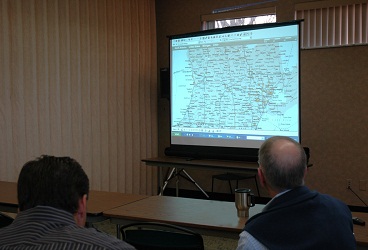 ivision 4 District of Lansing Sexton, Dearborn Heights Robichaud, Battle Creek Pennfield and Vicksburg isn’t ideal. But with no other Division 4 schools within 35 miles of Lansing, we were put in a tough spot. Add in that there were 13 teams in the Detroit area, leaving one as the odd team out of three districts based there. Something had to give, and drawing things up as we did caused the fewest messes.
? Considering how to set up the entire state is different than figuring out what teams make the most sense for just one school or area. And shifting just one dot on a map can change things for all 32.
? Back to “geography rules.” The Division 8 district including Saugatuck, Muskegon Catholic, Mendon and St. Joseph Lake Michigan Catholic might be the most competitive, on paper, in the state. Saugatuck is the reigning MHSAA runner-up in the division, and Muskegon Catholic and Mendon were ranked Nos. 1 and 2, respectively, in the most recent Association Press poll. Seeing that after we’d drawn the line caused a collective “ouch.” But again, the line was drawn based on dots on a map.
I thought back on some of the matchups I’d questioned in the past, and came back to what I’d ask people now: How would you do things differently?
I imagine there would be some creative answers, but I also would guess we considered those scenarios too.
And remember, determining the playoff schedule is just one step in many. Eight state champions must survive it, regardless of which opponents they face along the way.
Performance: River Rouge's Mareyohn Hrabowski
December 6, 2019
 Mareyohn Hrabowski
River Rouge junior – Football
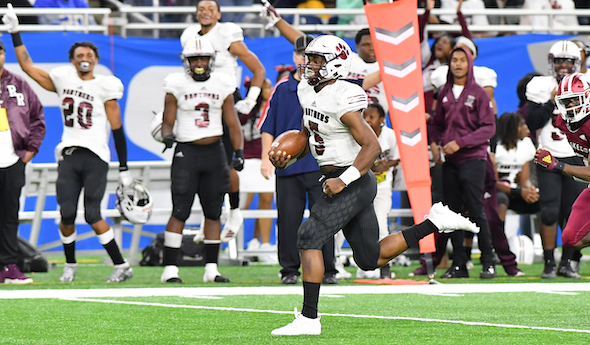
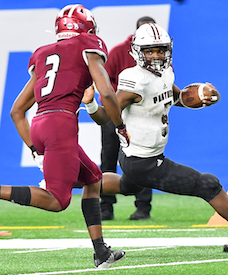
The Panthers’ multi-talented quarterback has become the state’s most-discussed emerging star from last weekend’s MHSAA 11-Player Football Finals after leading River Rouge to an arguably unexpected 30-7 win over Muskegon in the Division 3 championship game. Hrabowski ran 15 times for 175 yards and three touchdowns and completed 6-of-12 passes for 45 yards more in leading the Panthers to their first Finals title in the sport, earning the MHSAA “Performance of the Week.”
For the season, Hrabowski ran 115 times for 1,175 yards (10.2 per carry) and 14 touchdowns and completed 78 of 108 passes for 1,045 yards and 11 scores with only two interceptions. In making its second trip to the Finals, River Rouge set a program wins record finishing 13-1 with its only loss in Week 1, by three, to eventual Division 4 champion Grand Rapids Catholic Central. The Panthers also outscored their five playoff opponents by an average score of 37-7. But the crowning achievement certainly was defeating Muskegon – the Big Reds were last season’s Division 3 runners-up and the top-ranked team entering this fall’s playoffs, and had received national recognition this fall while quarterbacked by Ohio State recruit Cameron Martinez. After the Big Reds took a 7-0 lead with a score during the final minute of the first quarter Saturday, Hrabowski scored on runs of 1, 40 and 35 yards to put the Panthers up 21-7 less than a minute into the third quarter.
The 6-foot-3, 205-pound signal caller had showed his skills well all fall, but the attention likely will grow substantially after his Ford Field performance. He announced earlier this week he’d received a scholarship offer from Bowling Green, and he’ll surely be one of the most anticipated players to watch heading into next fall. Hrabowski also will play basketball for River Rouge, last season’s Division 2 runner-up in that sport, and run track next spring. He carries a 3.5 grade-point average with algebra and environmental science his favorite classes, and he enjoys building and fixing things – mechanical engineering is a field of study he’s considering after high school.
Coach Corey Parker said: “Mareyohn is a great kid, he plays the game hard, he plays the game smart, he plays the game the right way, he’s always focused and is very coachable. He’s a great leader and works hard to get the most out of his teammates. He’s hard on his offensive line on the field, yet maintains a great relationship with all of them off the field – that speaks to his character. … We were not shocked by his state championship performance at all; we knew he had a chance of having a big game if he could get through the emotional roller coaster the state championship throws at you. Mareyohn was your prototype dual threat QB at Ford Field Saturday. He ran the ball exceptionally well and completed several passes for first downs during crucial points in the game. I’m very proud of him and our QB coach, Larry Johnson. (Mareyohn) developed as the season went on and peaked at the right time.”
Performance Point: “After the game, just enjoying the moment after beating the No. 1 team in the state, and letting it soak in – the crowd, everybody was really happy. We won our first state championship in school history, so it was really big for the city, and it means a lot for everyone. It was a really big night for us, the whole team and the city.”
 Taking the spotlight: “Before the game a lot of people were talking about Muskegon. A lot of people thought they were going to win. When we won the game, people started talking about River Rouge, and it put us on the map. We were looking forward to playing a game like that. We knew that the championship, that it was going to be a good team. We like playing against competition. Those big games get us hype.”
Finals formula: “To make it this far, it definitely takes teamwork, and trust, and believing in your coaches. And never giving up. It’s not easy making it to the state championship. It takes a lot of hard work. You’ve got to be consistent. Team bonding in camps, and getting to know each other and hanging out together really builds a lot of trust and believing in each other.”
Big plays, big-time player: “I was really looking forward to the opportunity. I like playing against competition. I worked as hard as I could to get to this point, and I knew I wasn’t going to give up. … I think every time I ran the ball, passed the ball, I did it like it was going to be my last. Every touchdown that I ran, I ran as hard as I could. And playing against Muskegon, it built my confidence every single time we got a big play – and that played a big role in how I played the game that night.”
More to come: “I watch (Baltimore Ravens’ QB) Lamar Jackson a lot. I like some of my game being like his a little bit. (I’m planning on) getting a little bit faster in the offseason and getting more tools for my box for next season. ... I want to show that I can pass the ball, not only run the ball, and hopefully next year will be fortunate enough to make the state championship again and win. And just keep on showing people I’m one of the best quarterbacks in Michigan.”
– Geoff Kimmerly, Second Half editor
Past honorees
Nov. 28: Kathryn Ackerman, Grand Haven swimming - Report
Nov. 21: Emily Van Dyke, Southfield Christian volleyball - Report
Nov. 14: Taylor Wegener, Ida volleyball - Report
Nov. 7: Carter Solomon, Plymouth cross country - Report
Oct. 31: Jameson Goorman, Muskegon Western Michigan Christian soccer - Report
Oct. 24: Austin Plotkin, Brimley cross country - Report
Oct. 17: Jack Spamer, Brighton cross country - Report
Oct. 10: Kaylee Maat, Hudsonville volleyball - Report
Oct. 3: Emily Paupore, Negaunee cross country - Report
Sept. 26: Josh Mason, South Lyon soccer - Report
Sept. 19: Ariel Chang, Utica Eisenhower golf - Report
Sept. 12: Jordyn Shipps, DeWitt swimming - Report
PHOTOS: (Top) River Rouge's Mareyohn Hrabowski (5) breaks away for one of his three touchdown runs Saturday while his teammates cheer him on. (Middle) Hrabowski works to evade a defender.