

Inside Selection Sunday: Mapping the Football Playoffs
October 24, 2011
Sitting on the other side of this process for a number of years, I can admit to occasionally scratching my cynical head over some of the matchups that have come out of Selection Sunday.
How could teams so far from each other play in the same district? Why would two schools in the same town play in different regionals? Are they picking out of a hat at 1661 Ramblewood Drive?
Now, I have answers.
Sunday morning, we filed into headquarters for what might be the most important non-game day on the MHSAA calendar. “We” were made up of half of the MHSAA staff, plus a representative from the Michigan High School Football Coaches Association.
Here’s some of what I learned from being a part of the process:
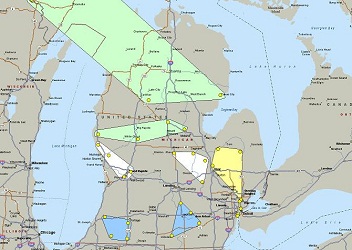
? First, a brief history lesson. In early years (or until the middle of the last decade), lines were drawn by hand. Dots representing qualifying schools were pasted on maps, one map for each division, and those maps were then covered by plastic sheets. Districts and regionals literally were drawn with dry-erase markers. No longer. Using a variety of spreadsheets and mapping software, we’ve gone digital. Staff is split into two teams, each considering four divisions (and the 8-player map) before we reconvene and look at all nine divisions together.
? We are presented digital maps of the state covered in dots. That’s about it. The rule of the day, simply, is “geography rules.” Which teams are represented by the dots is not considered, much less discussed, until lines are drawn. While considering my group’s first map, I began to bring up teams – and immediately was shot down (with good reason). Teams, matchups, rivalries, previous playoff pairings, etc. DO NOT come into play. We draw boxes in what we figure are the most logical ways of making districts and regions work.
? Travel distance and ease DO come into play. This especially is true when considering which districts will include teams from the Upper Peninsula. An example: Marquette is closer to the schools we placed in its district – Fenton, Bay City Western and Okemos – than some other options because those schools are closer to I-75. Schools further north on the map but farther from a main highway would’ve created longer trips.
? Sometimes, maps get ugly. And sometimes, it was a matter of choosing the least ugly situation. Of course, a D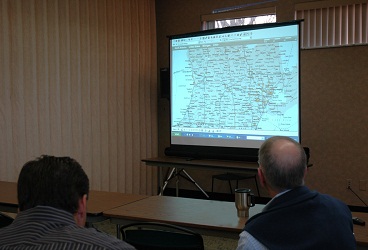 ivision 4 District of Lansing Sexton, Dearborn Heights Robichaud, Battle Creek Pennfield and Vicksburg isn’t ideal. But with no other Division 4 schools within 35 miles of Lansing, we were put in a tough spot. Add in that there were 13 teams in the Detroit area, leaving one as the odd team out of three districts based there. Something had to give, and drawing things up as we did caused the fewest messes.
? Considering how to set up the entire state is different than figuring out what teams make the most sense for just one school or area. And shifting just one dot on a map can change things for all 32.
? Back to “geography rules.” The Division 8 district including Saugatuck, Muskegon Catholic, Mendon and St. Joseph Lake Michigan Catholic might be the most competitive, on paper, in the state. Saugatuck is the reigning MHSAA runner-up in the division, and Muskegon Catholic and Mendon were ranked Nos. 1 and 2, respectively, in the most recent Association Press poll. Seeing that after we’d drawn the line caused a collective “ouch.” But again, the line was drawn based on dots on a map.
I thought back on some of the matchups I’d questioned in the past, and came back to what I’d ask people now: How would you do things differently?
I imagine there would be some creative answers, but I also would guess we considered those scenarios too.
And remember, determining the playoff schedule is just one step in many. Eight state champions must survive it, regardless of which opponents they face along the way.
Reading 'Nightmare' 2-Way Gamechanger
November 8, 2019
By Doug Donnelly
Special for Second Half
READING – Nick Affholter didn’t score a point for the Reading Rangers this season. No touchdowns, no extra points, no 2-point conversions.
 But, when it came time to vote for the Most Valuable Player in the Big 8, the conference coaches left no doubt that Affholter – an offensive and defensive lineman – was the best player in the conference.
“As a coach, he has been my nightmare,” Concord coach Max Clark said.
“When game-planning for the last three years, we’ve had to begin our planning based on how we can avoid him,” said Matt Schwartzkopf, head coach at Springport.
Frank Keller of Jonesville recalled a specific play that painted the picture of Affholter’s impact.
“I remember one time we ran a sweep on the other side of the field, and he tackled our running back for a two-yard loss – on a sweep,” Keller said. “He was just dominant on both sides of the ball. He’s the best kid on the field.”
Those coaches are happy they won’t have to worry about Affholter anymore. Tonight, he’ll lead his 9-1 Rangers in a District Final against the undefeated Cassopolis Rangers. For Reading, it’s a chance to continue a journey that could the program back-to-back Division 8 championships. Both coaches will tell you the game starts up front, and that’s where Affholter excels.
“He’s been dominant the last couple of years,” Reading head coach Rick Bailey said. “I think last year our running back (Ethan LoPresto) stole a lot of the spotlight, but people knew how good Nick was. He’s the most dominant one-on-one football player that I’ve ever seen at the high school level. This is the first time I can remember in my 35 years that an offensive lineman was selected the league MVP.”
Affholter is a multi-sport, four-year varsity football player, a class officer at Reading – where he carries a 4.0 grade point average – and a member of the National Honor Society and leader of the school’s chapter of Fellowship of Christian Athletes.
“He’s humble and kind,” Bailey said. “He’s a total team player.”
Clark also saw something else in Affholter.
“He has never been anything but an amazing sport and leader,” the Concord coach said. “He stayed after, cleaning up the bench after a basketball game at our court when most of his team was all out chatting with family and friends.”
Reading is in the midst of a dominant run in football. When Affholter was a freshman, the Rangers had their second consecutive 3-6 season. As a sophomore they improved to 8-3, before bowing out of the Division 7 playoffs with a loss to Cassopolis. Last season, Reading ran the table, going 14-0 while scoring 678 points and giving up just 114 in finishing the season at Ford Field.
This year, Reading had to replace last year’s league MVP in LoPresto and started the season with a 14-0 loss to 2018 Division 7 champion Pewamo-Westphalia. Since then, however, the Rangers have been incredible, winning nine straight games while shutting out four opponents and outscoring all of them by a combined 449-38. Reading averages 420 yards rushing a game.
Affholter is a two-way starting lineman. On offense, he plays tackle and gives Bailey the closest thing to a sure thing.
“We’ve been able to dominate teams on his side. We just count on Nick’s block as a win,” Bailey said. “His technique is good, but I think people would be surprised of how athletic he is. If they watch him, they’ll see he can run. People are always surprised with his quickness and foot speed. It’s hard to simulate what he’s going to do.”
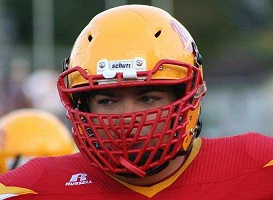 Affholter is also a difference-maker on defense.
“Two of our opponents simply chose not to run the football, and only a few tried to run it on his side,” Bailey said. “One team just lined up and threw the ball on every single play, except the last play of the game when they ran the ball when he was out.”
Clark said Concord tried something completely different against Reading.
“I showed up to Reading with a completely different offense because of him and his brother,” Clark said.
Reading still pulled out a 44-12 win.
Affholter has taken the postseason accolades in stride.
“I worked really hard for it,” he said. “It’s nice to see offensive lineman get some love. Just because we don’t touch the ball doesn’t mean we aren’t impacting the game.
“I don’t know how many offensive linemen get recognized like that. I figured I’d get all-conference, and that would be that. Seeing other people notice me and not just a running back or quarterback is pretty awesome.”
Affholter said he is 6-foot-3, 300 pounds, which makes him a half-inch taller and 20 pounds heavier than his twin brother Ben.
“I love playing football with my brother,” Nick said. “We do everything together. My little brother is up on the team now. He’s 6-foot, 230. He’s still growing.”
Their dad was an All-American offensive lineman at Hillsdale College, and their mom played volleyball there. Nick started playing football in grade school, where his grandfather began teaching him footwork.
“I love finishing my blocks,” he said. “I get excited when I get a pancake block. That was always special to me.”
He’s a student of the game, too, spending hours each week studying film of his opponent.
“I watch a lot of film of the defensive linemen or the offensive linemen,” Affholter said. “You can figure out what they are going to do in certain situations, see what their favorite move is. You know what to look for when the play starts. It definitely gives you an edge.”
Reading is sure to lean on Affholter tonight. The visiting Rangers have been just as stout as the home Rangers, outscoring opponents 403-17 this season.
“It’s going to be a great game,” Bailey said. “They are a big play waiting to happen.”
Affholter says the Reading home crowd will be rocking at Barre Field.
“Being out there on the football field is home,” he said. “It’s amazing. Every Friday night the stands are always full. I think it rivals any small-town football community anywhere.”
 Doug Donnelly has served as a sports and news reporter and city editor over 25 years, writing for the Daily Chief-Union in Upper Sandusky, Ohio from 1992-1995, the Monroe Evening News from 1995-2012 and the Adrian Daily Telegram since 2013. He's also written a book on high school basketball in Monroe County and compiles record books for various schools in southeast Michigan. E-mail him at [email protected] with story ideas for Jackson, Washtenaw, Hillsdale, Lenawee and Monroe counties.
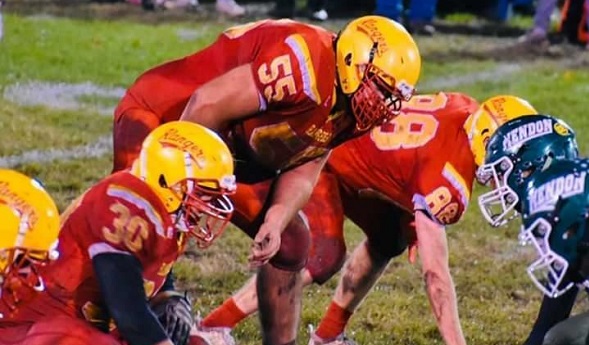
FOOTBALL: (Top) Reading’s Nick Affholter lines up against Mendon during last week’s 38-0 playoff win. (Middle) Affholter, who also has a twin and younger brother on the varsity. (Photos courtesy of the Reading athletic department.)