

Inside Selection Sunday: Mapping the Football Playoffs
October 24, 2011
Sitting on the other side of this process for a number of years, I can admit to occasionally scratching my cynical head over some of the matchups that have come out of Selection Sunday.
How could teams so far from each other play in the same district? Why would two schools in the same town play in different regionals? Are they picking out of a hat at 1661 Ramblewood Drive?
Now, I have answers.
Sunday morning, we filed into headquarters for what might be the most important non-game day on the MHSAA calendar. “We” were made up of half of the MHSAA staff, plus a representative from the Michigan High School Football Coaches Association.
Here’s some of what I learned from being a part of the process:
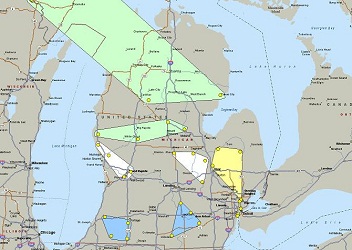
? First, a brief history lesson. In early years (or until the middle of the last decade), lines were drawn by hand. Dots representing qualifying schools were pasted on maps, one map for each division, and those maps were then covered by plastic sheets. Districts and regionals literally were drawn with dry-erase markers. No longer. Using a variety of spreadsheets and mapping software, we’ve gone digital. Staff is split into two teams, each considering four divisions (and the 8-player map) before we reconvene and look at all nine divisions together.
? We are presented digital maps of the state covered in dots. That’s about it. The rule of the day, simply, is “geography rules.” Which teams are represented by the dots is not considered, much less discussed, until lines are drawn. While considering my group’s first map, I began to bring up teams – and immediately was shot down (with good reason). Teams, matchups, rivalries, previous playoff pairings, etc. DO NOT come into play. We draw boxes in what we figure are the most logical ways of making districts and regions work.
? Travel distance and ease DO come into play. This especially is true when considering which districts will include teams from the Upper Peninsula. An example: Marquette is closer to the schools we placed in its district – Fenton, Bay City Western and Okemos – than some other options because those schools are closer to I-75. Schools further north on the map but farther from a main highway would’ve created longer trips.
? Sometimes, maps get ugly. And sometimes, it was a matter of choosing the least ugly situation. Of course, a D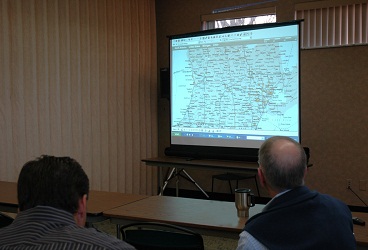 ivision 4 District of Lansing Sexton, Dearborn Heights Robichaud, Battle Creek Pennfield and Vicksburg isn’t ideal. But with no other Division 4 schools within 35 miles of Lansing, we were put in a tough spot. Add in that there were 13 teams in the Detroit area, leaving one as the odd team out of three districts based there. Something had to give, and drawing things up as we did caused the fewest messes.
? Considering how to set up the entire state is different than figuring out what teams make the most sense for just one school or area. And shifting just one dot on a map can change things for all 32.
? Back to “geography rules.” The Division 8 district including Saugatuck, Muskegon Catholic, Mendon and St. Joseph Lake Michigan Catholic might be the most competitive, on paper, in the state. Saugatuck is the reigning MHSAA runner-up in the division, and Muskegon Catholic and Mendon were ranked Nos. 1 and 2, respectively, in the most recent Association Press poll. Seeing that after we’d drawn the line caused a collective “ouch.” But again, the line was drawn based on dots on a map.
I thought back on some of the matchups I’d questioned in the past, and came back to what I’d ask people now: How would you do things differently?
I imagine there would be some creative answers, but I also would guess we considered those scenarios too.
And remember, determining the playoff schedule is just one step in many. Eight state champions must survive it, regardless of which opponents they face along the way.
Drive for Detroit: Week 1 Preview
August 23, 2017
By Geoff Kimmerly
Second Half editor
Football remains the most played high school sport in Michigan, not to mention the most popular for fans who fill our stadiums every fall weekend.
 Finally, it’s time to start talking about it again – and you’ve come to the right place.
Below is the first of 14 “Drive for Detroit” weekly previews aimed at giving you the most intriguing games in your corner of the state every week through November’s 11-Player Finals at Ford Field.
The original motivation of our weekly football previews has been to give fans a few games they can check out no matter where they live or might be visiting in our great state. For that reason, you’ll see the games at University of Michigan this weekend under “Southeast & Border” although those teams playing don’t necessarily call that part of the state home, and you’ll find the rest listed under regions where the home team is located even if the away team is from far away.
With most of the state’s games this weekend split over Thursday and Friday, we’ve also listed which day all of them below will be played – but check out the MHSAA Score Center for the full schedule plus scores all three nights as they come in.
Be sure to check out as well the list of 19 games airing this weekend on MHSAA.tv, including all three from the Vehicle City Gridiron Classic at Flint’s Atwood Stadium, seven games from the Prep Kickoff Classic at Wayne State University and all four games from Saturday’s GRidiron Classic at Grand Valley State University.
The weekly “Drive for Detroit” previews are powered by MI Student Aid. Please click the adjacent linked logo and read below for more information on how MI Student Aid is providing Michigan’s high school students with money to help pay for college.
Bay & Thumb
Marysville (10-1) at Richmond (8-2), Thursday
A 38-21 win over the Blue Devils in last season’s opener was the start to Marysville’s best finish since 2000, as the Vikings’ only loss came in a District Final to eventual Division 4 runner-up Detroit Country Day. Richmond still went on to a perfect run through the Blue Water Area Conference and fifth straight playoff berth, and will look to make it three wins in four years over the reigning Macomb Area Conference Gold champ.
Others that caught my eye: THURSDAY Marine City (4-5) at Algonac (11-2), Flint Carman-Ainsworth (6-4) vs. Grand Blanc (5-5) at Atwood Stadium, Lake Fenton (8-2) at New Lothrop (10-2), FRIDAY Unionville-Sebewaing (9-2) at Ubly (12-1).
Greater Detroit
Macomb Dakota (7-4) at Orchard Lake St. Mary’s (10-4), Thursday
A host of intriguing games will be played this weekend as part of the Prep Kickoff Classic at Wayne State University; four of them are listed below. But it’s tough again to look past this one. The Cougars won the opener with the Eaglets 35-28 a year ago on the way to a 16th straight playoff appearance. St. Mary’s, meanwhile, rebounded to only win a third straight Division 3 championship with a one-point nail-biter over Muskegon in the season’s final game at Ford Field.
Others that caught my eye: THURSDAY Southfield Arts & Technology (8-4) vs. Davison (10-1) at Wayne State University, Walled Lake Western (12-2) vs. West Bloomfield (6-5) at Wayne State University, SATURDAY Oak Park (7-4) vs. Utica Eisenhower (12-1) at Wayne State University, River Rouge (11-2) vs. Detroit East English (5-4) at Wayne State University.
Mid-Michigan
Hudsonville (8-2) at Grand Ledge (7-3), Thursday
Grand Ledge was considered the Lansing area’s best team for most of last season and will vie for that status again with a senior-loaded squad; more on that next week when the Comets take on another contender in DeWitt. Grand Ledge’s only loss through the first eight games last fall was in the opener 21-14 to Hudsonville, which went on to a fourth straight playoff appearance with losses only to Ottawa-Kent Conference Red rivals Rockford and Grandville.
Others that caught my eye: THURSDAY Haslett (4-5) at Fowlerville (7-3), Battle Creek Pennfield (5-5) at Williamston (5-5), FRIDAY Beal City (7-4) at Mount Pleasant Sacred Heart (5-5), East Lansing (6-4) at St. Johns (5-4).
Northern Lower Peninsula
Roscommon (9-2) at Grayling (7-4), Thursday
The Bucks turned a 20-14 opening-night win over Grayling last year into the start of their best season since 2006, including their first playoff appearance since 2012. The Vikings, meanwhile, continued as one of the most consistent programs in the north, putting together their best record in three seasons and seventh playoff appearance in eight seasons.
Others that caught my eye: THURSDAY Big Rapids (3-6) at Cadillac (6-4), FRIDAY Hillman (5-5) at Gaylord St. Mary (6-4), AuGres-Sims (7-3) at Rogers City (4-5), Lansing Sexton (7-4) at Gaylord (4-5).
Southeast & Border
Rockford (7-4) at Saline (11-1), Thursday
A team-wide illness took the Rams out of this much-anticipated matchup a year ago, but it’s a go this week and with no less expectation. After taking a forfeit loss to start and then falling the following week to Lowell, Rockford strung together six straight wins to make the playoffs for a 21st straight season – tied for longest active streak in the state with Menominee. Saline is coming off a second straight 11-1 finish, and with its 2014 run to the Division 1 Final is a combined 34-4 over the last three seasons. The Yellowjackets might have been the second-best team in Michigan in 2016, falling to eventual Division 1 champion Detroit Cass Tech 43-42 in a Regional Final.
Others that caught my eye: THURSDAY Brighton (7-3) vs. Belleville (7-3) at University of Michigan, Constantine (6-4) at Homer (8-3), FRIDAY Clarkston (9-3) vs. Lapeer (7-3) at University of Michigan, Pewamo-Westphalia (14-0) at Monroe St. Mary Catholic Central (4-5).
Southwest Corridor
Dearborn Divine Child (10-3) at Benton Harbor (10-1), Friday
Its former struggles becoming a distant memory, Benton Harbor has proven to not be a one or even two-year phenomenon. The Tigers once again won’t have an easy go as an independent this fall playing teams from all over the Lower Peninsula and one from Chicago. But they started 10-0 last year before falling by a point in a Division 4 District Final, and expectations are high again despite starting out against a Division 3 semifinalist from a year ago. Divine Child bounced back last fall from a sub-.500 record in 2015 to post its best since 1985. This one will be key for the Falcons as well with their nonleague slate also including playoff regulars East Lansing and Warren DeLaSalle.
Others that caught my eye: THURSDAY Portage Northern (5-5) at Battle Creek Lakeview (6-3), Fennville (3-6) at Schoolcraft (10-1), Marcellus (4-5) at Decatur (4-5), FRIDAY Lawton (8-2) at Watervliet (7-3).
Upper Peninsula
Iron Mountain (8-3) at Ishpeming (3-5), Friday
After Ishpeming’s dominance of the Mid-Peninsula Conference for most of this decade, last year belonged instead to Negaunee and Iron Mountain. The Mountaineers opened 2016 by handing the Hematites their first loss since 2014 and ending Ishpeming’s 27-game regular-season winning streak; Iron Mountain went on to its best overall finish since 2011. But Ishpeming, which hadn’t had a sub-.500 season previously since 2001, surely has been looking forward to starting over against this familiar opponent.
Others that caught my eye: FRIDAY Gladstone (3-6) at Gwinn (6-4), Niagara Northern Elite, Wis. (1-0 this season) at Norway (9-3), SATURDAY Marinette, Wis. (0-1 this season) at Menominee (12-2), Hancock (5-4) at Lake Linden-Hubbell (10-1).
West Michigan
Jackson Lumen Christi (12-2) at Grand Rapids West Catholic (12-2), Friday
The Grand Rapids area in particular is loaded this weekend with matchups of some of its best against contenders from the Detroit and Lansing areas, including a replay of last season’s Division 4 Final between Grand Rapids Catholic Central and Detroit Country Day. But West Catholic/Lumen Christi wins out by a step this time because both are reigning MHSAA champions – West Catholic in Division 5 for the fourth straight year and Lumen Christi in Division 6. The teams have split openers the last two seasons, as West Catholic won last year’s meeting 30-13 – and the Falcons might be favorites off the bat again returning star quarterback Gaetano Vallone while Lumen Christi graduated 2,000-yard rusher Bo Bell.
Others that caught my eye: THURSDAY Farmington Hills Harrison (5-4) at East Grand Rapids (8-3), DeWitt (10-2) at Grand Rapids Christian (9-2), Hudsonville Unity Christian (10-3) at Allendale (8-3), FRIDAY Detroit Country Day (13-1) at Grand Rapids Catholic Central (13-1).
8-Player
Battle Creek St. Philip (5-4) at Wyoming Tri-unity Christian (11-1), Friday
Tri-unity broke into the playoffs last season for the first time and drove all the way to the 8-Player Semifinals before falling for the first and only time in 2016. So this likely won’t resemble at all the Defenders’ only other matchup with St. Philip, a 68-0 11-player loss in 2008. The Tigers, 8-player runners-up in 2015, lost four of their last five last season to just miss the playoffs – proof of the improving strength of the 8-player field. That said, it wouldn’t be a surprise if they returned to the elite.
Others that caught my eye: THURSDAY Peck (5-4) at Lawrence (8-2), Rudyard (5-4) at Cedarville (6-4), FRIDAY Rapid River (6-4) at Crystal Falls Forest Park (9-2), Bellaire (3-6) at Pickford (10-2).
Second Half’s weekly “Drive for Detroit” previews are powered by MI Student Aid, a part of the Student Financial Services Bureau located within the Michigan Department of Treasury. MI Student Aid encourages students to pursue postsecondary education by providing access to student financial resources and information, including various student financial assistance programs to help make college more affordable for Michigan students. MI Student Aid administers the state’s 529 savings programs (MET/MESP) and eight additional aid programs within its Student Scholarships and Grants division. Click for more information and connect with MI Student Aid on Facebook and Twitter @mistudentaid.
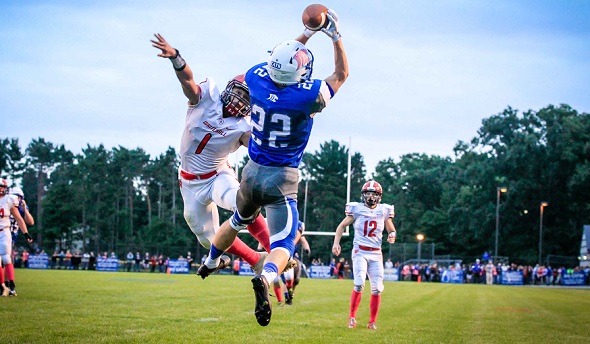
PHOTO: A Montague receiver snags a pass over a Whitehall defender last season. (Photo by Tim Reilly.)