

Inside Selection Sunday: Mapping the Football Playoffs
October 24, 2011
Sitting on the other side of this process for a number of years, I can admit to occasionally scratching my cynical head over some of the matchups that have come out of Selection Sunday.
How could teams so far from each other play in the same district? Why would two schools in the same town play in different regionals? Are they picking out of a hat at 1661 Ramblewood Drive?
Now, I have answers.
Sunday morning, we filed into headquarters for what might be the most important non-game day on the MHSAA calendar. “We” were made up of half of the MHSAA staff, plus a representative from the Michigan High School Football Coaches Association.
Here’s some of what I learned from being a part of the process:
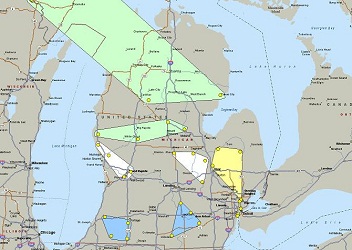
? First, a brief history lesson. In early years (or until the middle of the last decade), lines were drawn by hand. Dots representing qualifying schools were pasted on maps, one map for each division, and those maps were then covered by plastic sheets. Districts and regionals literally were drawn with dry-erase markers. No longer. Using a variety of spreadsheets and mapping software, we’ve gone digital. Staff is split into two teams, each considering four divisions (and the 8-player map) before we reconvene and look at all nine divisions together.
? We are presented digital maps of the state covered in dots. That’s about it. The rule of the day, simply, is “geography rules.” Which teams are represented by the dots is not considered, much less discussed, until lines are drawn. While considering my group’s first map, I began to bring up teams – and immediately was shot down (with good reason). Teams, matchups, rivalries, previous playoff pairings, etc. DO NOT come into play. We draw boxes in what we figure are the most logical ways of making districts and regions work.
? Travel distance and ease DO come into play. This especially is true when considering which districts will include teams from the Upper Peninsula. An example: Marquette is closer to the schools we placed in its district – Fenton, Bay City Western and Okemos – than some other options because those schools are closer to I-75. Schools further north on the map but farther from a main highway would’ve created longer trips.
? Sometimes, maps get ugly. And sometimes, it was a matter of choosing the least ugly situation. Of course, a D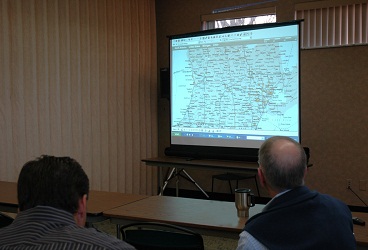 ivision 4 District of Lansing Sexton, Dearborn Heights Robichaud, Battle Creek Pennfield and Vicksburg isn’t ideal. But with no other Division 4 schools within 35 miles of Lansing, we were put in a tough spot. Add in that there were 13 teams in the Detroit area, leaving one as the odd team out of three districts based there. Something had to give, and drawing things up as we did caused the fewest messes.
? Considering how to set up the entire state is different than figuring out what teams make the most sense for just one school or area. And shifting just one dot on a map can change things for all 32.
? Back to “geography rules.” The Division 8 district including Saugatuck, Muskegon Catholic, Mendon and St. Joseph Lake Michigan Catholic might be the most competitive, on paper, in the state. Saugatuck is the reigning MHSAA runner-up in the division, and Muskegon Catholic and Mendon were ranked Nos. 1 and 2, respectively, in the most recent Association Press poll. Seeing that after we’d drawn the line caused a collective “ouch.” But again, the line was drawn based on dots on a map.
I thought back on some of the matchups I’d questioned in the past, and came back to what I’d ask people now: How would you do things differently?
I imagine there would be some creative answers, but I also would guess we considered those scenarios too.
And remember, determining the playoff schedule is just one step in many. Eight state champions must survive it, regardless of which opponents they face along the way.
Griggs, Kelloggsville Set to Break Free Again
August 22, 2017
By Dean Holzwarth
Special for Second Half
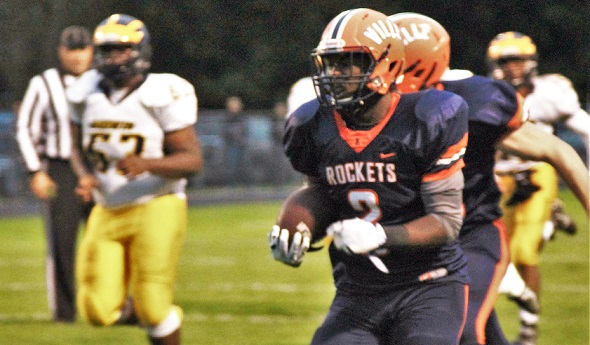
WYOMING – If opposing teams think it’s going to be easy tackling Thomas Griggs this season, they might want to rethink their approach.
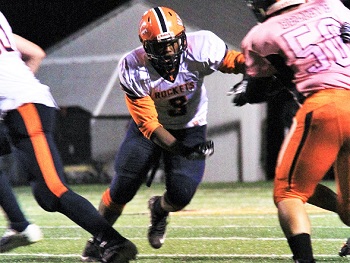
 Griggs, a 5-foot-10, 210-pound running back for the Wyoming Kelloggsville football team, is difficult to stop and a load to bring down.
“He was referred to in the South Bend Tribune last year as a bowling ball with legs,” longtime Rockets head coach Don Galster said. “Those kids did not want to tackle him.”
Just a year ago, Griggs blossomed into one of the top running backs in the Grand Rapids area while leading Kelloggsville to a major turnaround.
The Rockets went 3-6 in 2015, but behind Grigg’s breakout season, finished 8-2 while winning the Ottawa-Kent Conference Silver title with an unbeaten league run.
Those eight were the most wins for a Kelloggsville team since 2009, when it went 10-1.
After a wild 50-47 loss to Whitehall in the opener, Kelloggsville reeled off eight straight wins and advanced to the playoffs. Its season, however, ended in Pre-District play against former conference rival Allendale.
“Last year was really good,” said Griggs, a three-year starter. “Everybody didn’t think we were capable of doing what we did, but our senior class last year put in the hard work. Being able to contribute to last year’s success made me feel even better.”
Griggs rushed for nearly 1,400 yards and tallied 20 touchdowns. He averaged 8.7 yards per carry while wreaking havoc on opposing defenses.
“My stats were good as a sophomore, but we didn’t win a lot of games,” Griggs said. “Coming into my junior year I knew I was going to do better because I worked hard over the summer.”
Griggs, a soft-spoken young man with aspirations to play college football, has a valuable skill set. He’s a punishing hard-nosed runner, but possesses other key attributes.
“What makes him special is he’s got great vision, great feet and he reads blocks very well,” Galster said. “He just doesn’t want to go down, and he has learned how to run the ball in our offense, which has been key.”
As evident by his yards per carry average, it typically takes more than one defender to pull Griggs to the ground. He takes pride in his ability to stay on his feet.
“I always want to break at least one tackle every play,” Griggs said. “I don’t want to let that first person tackle me, and I try to get as many yards as I can.”
 Galster remembers his first encounter with his standout senior. It was an early glimpse into the future.
“He was in eighth grade and the principal brought him over to introduce me to him,” Galster recalled. “I thought, ‘This is a big kid,’ and he just has a ton of ability. He works hard, and he’s a quiet leader. Every year he’s gotten better, and he makes the other guys better.”
Griggs started playing football when he was 7. He actually started out as a center before moving to fullback.
It was a role he embraced.
“In my head, I think I can do anything. So when they put me at center, I had the mindset of I was going to be the best center,” Griggs said.
The Rockets are expected to compete for another conference crown with a bevy of talent back in the fold.
Griggs is one of three returning to the backfield, including dual-threat quarterback Alex Guzman. The Rockets graduated only two seniors on offense.
“There’s not a lot of jealousy with those guys, and it motivates them to work harder,” Galster said. “We have a lot of weapons, but these guys understand that it all starts with the offensive line. If they open holes for them, then we will have some success.”
Griggs said having multiple options on the ground will make it tough for other teams to game plan.
“It’s better for us as a team because other teams can’t come into the game saying they are only going to stop me and then they are going to win,” he said. “We have other players that are going to show up and do what they have to do.”
Kelloggsville’s senior class is a tight-knit group with the potential to duplicate last year’s run.
“As a group, we’re pretty good, and we have that hate-to-lose mentality,” said Griggs, who also averaged 19 points per game as a starting basketball point guard last winter. “I’m glad people have started to notice us, and now we just have to keep it going.”
 Dean Holzwarth covered primarily high school sports for the Grand Rapids Press and MLive for 16 years and more recently served as sports editor of the Ionia Sentinel and as a sports photojournalist for WZZM and WOODTV. Contact him at [email protected] with story ideas for Allegan, Kent and Ottawa counties.
PHOTOS: (Top) Wyoming Kelloggsville's Thomas Griggs runs away from the crowd against Wyoming Godwin Heights. (Middle) Griggs readies to receive a handoff against Belding. (Photos courtesy of the Wyoming Kelloggsville yearbook staff.)