

Inside Selection Sunday: Mapping the Football Playoffs
October 24, 2011
Sitting on the other side of this process for a number of years, I can admit to occasionally scratching my cynical head over some of the matchups that have come out of Selection Sunday.
How could teams so far from each other play in the same district? Why would two schools in the same town play in different regionals? Are they picking out of a hat at 1661 Ramblewood Drive?
Now, I have answers.
Sunday morning, we filed into headquarters for what might be the most important non-game day on the MHSAA calendar. “We” were made up of half of the MHSAA staff, plus a representative from the Michigan High School Football Coaches Association.
Here’s some of what I learned from being a part of the process:
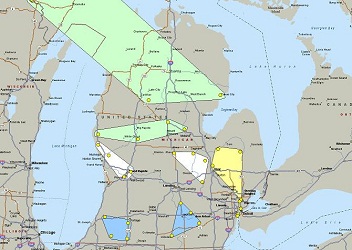
? First, a brief history lesson. In early years (or until the middle of the last decade), lines were drawn by hand. Dots representing qualifying schools were pasted on maps, one map for each division, and those maps were then covered by plastic sheets. Districts and regionals literally were drawn with dry-erase markers. No longer. Using a variety of spreadsheets and mapping software, we’ve gone digital. Staff is split into two teams, each considering four divisions (and the 8-player map) before we reconvene and look at all nine divisions together.
? We are presented digital maps of the state covered in dots. That’s about it. The rule of the day, simply, is “geography rules.” Which teams are represented by the dots is not considered, much less discussed, until lines are drawn. While considering my group’s first map, I began to bring up teams – and immediately was shot down (with good reason). Teams, matchups, rivalries, previous playoff pairings, etc. DO NOT come into play. We draw boxes in what we figure are the most logical ways of making districts and regions work.
? Travel distance and ease DO come into play. This especially is true when considering which districts will include teams from the Upper Peninsula. An example: Marquette is closer to the schools we placed in its district – Fenton, Bay City Western and Okemos – than some other options because those schools are closer to I-75. Schools further north on the map but farther from a main highway would’ve created longer trips.
? Sometimes, maps get ugly. And sometimes, it was a matter of choosing the least ugly situation. Of course, a D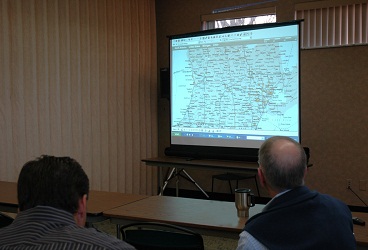 ivision 4 District of Lansing Sexton, Dearborn Heights Robichaud, Battle Creek Pennfield and Vicksburg isn’t ideal. But with no other Division 4 schools within 35 miles of Lansing, we were put in a tough spot. Add in that there were 13 teams in the Detroit area, leaving one as the odd team out of three districts based there. Something had to give, and drawing things up as we did caused the fewest messes.
? Considering how to set up the entire state is different than figuring out what teams make the most sense for just one school or area. And shifting just one dot on a map can change things for all 32.
? Back to “geography rules.” The Division 8 district including Saugatuck, Muskegon Catholic, Mendon and St. Joseph Lake Michigan Catholic might be the most competitive, on paper, in the state. Saugatuck is the reigning MHSAA runner-up in the division, and Muskegon Catholic and Mendon were ranked Nos. 1 and 2, respectively, in the most recent Association Press poll. Seeing that after we’d drawn the line caused a collective “ouch.” But again, the line was drawn based on dots on a map.
I thought back on some of the matchups I’d questioned in the past, and came back to what I’d ask people now: How would you do things differently?
I imagine there would be some creative answers, but I also would guess we considered those scenarios too.
And remember, determining the playoff schedule is just one step in many. Eight state champions must survive it, regardless of which opponents they face along the way.
Drive for Detroit: Week 6 in Review
October 3, 2016
By Geoff Kimmerly
Second Half editor
A total of 52 Michigan high school football teams celebrated 6-0 starts this past weekend and qualifying for the MHSAA playoffs set to begin in four weeks. A handful more celebrated the first league championships awarded this season.
And we’re just getting started.
Take a look below at the results that rang most significant from Week 6, including a number of games that set up what we’ll be watching as the regular season heads into its final third.
Bay & Thumb
Davison 20, Midland 0
The Saginaw Valley League Red race appears down to two teams after Davison handed Midland its first league loss of this season. The Cardinals – now 6-0 and with more wins than in any season total since 2012 – take on co-leader Lapeer this week. Midland does remain in the hunt, however; the Chemics (3-3) get Lapeer in Week 8 with a chance to share the title if the Lightning is successful Friday. Click for more from the Midland Daily News.
Also noted:
Fenton 54, Holly 35 – The Tigers (4-2) are among teams that dropped their first game or two but have come back strong, and now sit a win ahead of Holly (4-2) and two others atop the Flint Metro League standings.
Marine City 27, St. Clair 6 – The Mariners (2-4) continued their run at finishing a 34th straight winning season by earning their second victory in a row, with St. Clair falling to 3-3.
Unionville-Sebewaing 20, Reese 12 – The Patriots (5-1) held on to a share of the lead in the Greater Thumb Conference West with a third straight win over Reese (4-2).
Flint Carman-Ainsworth 34, Bay City Central 34 – The Cavaliers (4-2) remain tied atop the Saginaw Valley League Blue with Midland Dow after facing their toughest challenge this season from Central (3-3).
Greater Detroit
Detroit Cass Tech 31, Detroit Martin Luther King 18
The Technicians (6-0) were held to their fewest points this season, but the story was Cass Tech’s defense. King (5-1) hadn’t scored fewer than 39 points in a game since last season’s Division 2 Regional Final win over Detroit East English and put up 31 and 27 in beating Cass Tech twice last fall. And just like in 2015, don’t be stunned if these two face off again in the Detroit Public School League final at Ford Field in three weeks. Click for more from MLive-Detroit.
Also noted:
Allen Park 23, Trenton 10 – The Jaguars (6-0) now hold a one-win lead in the Downriver League on both Trenton (5-1) and Wyandotte Roosevelt with three games to play and victories over both.
Warren Cousino 36, Grosse Pointe North 33 – Cousino (5-1) hasn’t been considered a football power for about a decade, but the Patriots are creeping toward their best finish since 2007 and sit in first in the Macomb Area Conference Blue after dealing Grosse Pointe North (4-2) a first league loss.
Birmingham Groves 14, Farmington Hills Harrison 7 (OT) – The Falcons (6-0) won their second Oakland Activities Association White game by seven points or fewer this fall to remain a half-win ahead of Rochester Adams, this week’s opponent, and send Harrison to 3-3.
Oak Park 14, Clarkston 7 – The Knights (4-2) are a win back in the OAA White standings but have two of the league’s most impressive victories over Adams and now Clarkston (4-2), which is tied for second in the OAA Red.
Mid-Michigan
Breckenridge 38, Carson City-Crystal 0
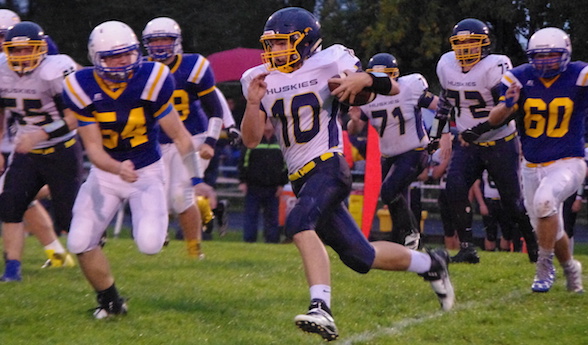
One of the state’s top turnaround stories keeps getting better. The Huskies, 6-0 after going 0-9 only a year ago, clinched their first playoff berth since 1993 while taking over first place in the Mid-State Activities Conference alone by handing the Eagles (4-2) their first league loss. Breckenridge hasn’t won six games in a season since 1994. Click for more from the Mount Pleasant Morning Sun.
Also noted:
Ithaca 17, Saginaw Michigan Lutheran Seminary 6 – The Yellowjackets (6-0) had beaten the rest of their Tri-Valley Conference West opponents by at least 27 and now look good to clinch at least a share of the title after fending off the Cardinals (4-2).
Howell 48, Grand Blanc 46 – Not only did the Highlanders (4-2) end a five-game losing streak to the Bobcats (4-2), but they opened up a chance to claim a share of the Kensington Lakes Activities Association West title against Brighton in Week 8.
Pewamo-Westphalia 40, Laingsburg 7 – The Pirates (6-0) did score their fewest points since opening night and also gave up their first score since Week 1, but still win comfortably to hold on to first place in the Central Michigan Athletic Conference, a win ahead of the Wolfpack (5-1).
Lake Odessa Lakewood 34, Olivet 27 – The Vikings (6-0) clinched a share of a second straight Greater Lansing Activities Conference title, potentially relegating Olivet (4-2) to second place for the second straight season as well.
Northern Lower Peninsula
Frankfort 26, Maple City Glen Lake 21
This matchup for first place in the Northern Michigan Football Conference Leaders division was as good as billed, with Frankfort holding on to a slim lead as the only team without a league loss. The Panthers (6-0) scored the go-ahead points this time with just more than four minutes to play, and a final drive by Glen Lake (4-2) ended in a turnover. Click for more from the Traverse City Record-Eagle.
Also noted:
Boyne City 21, Kalkaska 14 – The Ramblers (4-2) continued their rebound from an 0-2 start by possibly eliminating another contender in the NMFC Legends division; Kalkaska (5-1) is a win back of Boyne City and Traverse City St. Francis in the league standings.
Charlevoix 21, East Jordan 0 – The Red Rayders (5-1) bounced back from a tough Week 5 loss to Glen Lake with a third straight shutout of East Jordan (4-2) – which is hoping to rebound and earn its first playoff berth since 2003.
AuGres-Sims 22, Whittemore-Prescott 20 – The Wolverines (5-1) kept pace a half-win behind leader Lincoln Alcona in the North Star League by winning their first meeting with the Cardinals (3-3) since 1992.
Cadillac 16, Gaylord 12 – The Vikings (5-1) hung on for a Homecoming win to remain tied for first in the Big North Conference and send Gaylord (2-4) potentially out of playoff contention.
Southeast & Border
Milan 27, Grosse Ile 6
The Big Reds may be breathing only a little easier after taking over first place alone in the Huron League and sending Grosse Ile (5-1) into second place. Two league games remain, and nemesis Monroe St. Mary Catholic Central is up next for Milan, which surely will be amped up after losing the title-decider to the Falcons last year. Click for more from the Southgate News-Herald.
Also noted:
Hillsdale 14, Hudson 6 – The Hornets (4-2) kept themselves in the Lenawee County Athletic Association discussion by knocking Hudson (5-1) out of a first-place tie with Ida; both now trail the leader by a win and play Ida successively over the next two weeks.
Jackson Lumen Christi 21, Coldwater 20 (OT) – The Titans (4-2) have avenged both of their 2015 Interstate 8 Athletic Conference losses over the last two weeks and sit a win back of league leader Harper Creek, this week’s opponent for the reigning champ Cardinals (4-2).
Sand Creek 12, Clinton 7 – Just as Morenci’s win the week before over Clinton was one of its best in some time, Sand Creek (6-0) can claim the same as it held on to a first-place tie in the Tri-County Conference while likely knocking the reigning champ Redskins (4-2) out of contention.
Springport 20, Concord 16 – Concord (5-1) had won three games by a touchdown or less to take the lead in the Big 8 Conference, but first place is now a tie between the Yellowjackets, Springport (5-1), Quincy and Homer; Springport’s only loss was by two to the Trojans.
Southwest Corridor
Constantine 60, Watervliet 58
The Southwestern Athletic Conference Lakeshore race has three first-place teams with one game to play, with Constantine, Watervliet and Delton Kellogg all 3-1 in league play and Watervliet playing Delton next. This Falcons/Panthers matchup mirrored at least in score Constantine’s 49-48 Division 6 District Final win last fall. This time, the teams combed for more than 1,000 yards of total offense. Click for more from JoeInsider.com.
Also noted:
Benton Harbor 21, Traverse City West 16 – Benton Harbor (6-0) continued its best start since 1985 with a second straight and second-ever playoff berth after beating West (4-2), which has lost its two games by a combined seven points.
Climax-Scotts 48, Pittsford 28 – The Panthers (6-0) ran their Southern Central Athletic Association winning streak to 48 in clinching a share of this season’s championship and sending Pittsford (3-3) into a tie for second place.
Kalamazoo Central 14, Battle Creek Lakeview 7 – Central (3-3) moved into first place in the Southwestern Michigan Athletic Conference East by handing the reigning co-champ Spartans (3-2) their second straight loss – and second straight by seven or fewer points.
Schoolcraft 56, Lawton 7 – Second-place Gobles still can shake things up a bit this week, but Schoolcraft claimed (6-0) a share of the SAC Central championship by knocking Lawton (5-1) out of the tie for first.
Upper Peninsula
Menominee 28, Escanaba 14
The Eskymos are playing their best football since the start of this decade, but the Great Northern U.P. Conference looks to still belong to Menominee (6-0) after this matchup of previously undefeated teams. The Maroons can clinch a share of the league title this week against Sault Ste. Marie and still haven't given up more than 14 points in a game. Escanaba (5-1) hadn’t given up more than 13 in a game but did hold Menominee to a season low. Click for more from the Escanaba Daily Press.
Also noted:
Calumet 34, Iron River West Iron County 7 – The Copper Kings (5-1) pulled within a win of clinching a share of the West-Peninsula Athletic Conference title by downing West Iron (3-3); Calumet’s final two league games are against teams that are a combined 1-11.
St. Ignace 36, Gaylord St. Mary 8 – The Saints (5-1) are one of the first league champions of 2016 after clinching a share of the NMFC Legacy title by sending St. Mary (5-1) into a four-team tie for second place.
Hancock 47, Hurley, Wis. 40 – The Bulldogs (4-2) most likely ended Hurley’s West-PAC chances and gave themselves an outside shot while continuing their best season since at least 2010.
Negaunee 28, Norway 14 – The Miners (6-0) remain the only undefeated team in the Mid-Peninsula Athletic Conference and can clinch a share of the league title this week against rival Ishpeming, with Norway (5-1) and Iron Mountain cheering for the Hematites.
West Michigan
Rockford 7, Grandville 6
The Ottawa-Kent Conference Red is not a league teams come to looking to rebound from a slow start. But it's been quite a month for Rockford (4-2), which opened 0-2 and now finds itself back in the driver's seat in the Red after just surviving the league's top team to date. Grandville (5-1) had beaten all of its opponents by at least 30, but now will be rooting especially for Hudsonville in Week 9 to beat Rockford and create a shared championship. Click for more from the Grand Rapids Press.
Also noted:
East Grand Rapids 28, Grand Rapids Christian 7 – The Pioneers (4-2) moved to the top of the O-K Gold standings ahead of the Eagles (5-1), running their streak to two straight over Christian after losing their regular-season meeting but winning their playoff rematch last fall.
Byron Center 54, Hamilton 32 – The Bulldogs (5-1) have turned the O-K Green into a two-team race by delivering upstart Hamilton (5-1) the first loss of an otherwise outstanding turnaround season.
North Muskegon 14, Montague 6 – In one of the weekend’s biggest shockers, North Muskegon (2-4) handed West Michigan Conference co-leader Montague (5-1) its first defeat; Montague now trails Muskegon Oakridge by a win.
Reed City 12, Remus Chippewa Hills 8 – The Coyotes (6-0) can clinch a share of the Central State Activities Association Gold title this week after just edging former co-leader Chippewa Hills (5-1).
8-Player
New Haven Merritt 36, Owendale-Gagetown 32
This arguably is the best win of Merritt’s five-season history. Although these teams play in different divisions of the Mid-Michigan 8-Man Football League, they lead those divisions. During its first season, 2012, Merritt (6-0) lost both of its games to Owendale-Gagetown by at least 50 points; the Mustangs cut the deficit to 24 when the teams met last October. The Bulldogs (5-1) had won 16 straight regular-season games. Click for more from the Huron Daily Tribune.
Also noted:
Lawrence 32, Camden-Frontier 8 – The Redskins absolutely have been impressive with a 4-1 start, but Lawrence (6-0) proved to still be another level above at this point in the season.
Webberville 16, Battle Creek St. Philip 14 – These two at this point are among what would be the final teams selected for the 16-team playoff field, and Webberville (5-1) owns a nice advantage now – although St. Philip (4-2) still has plenty of opportunities to secure its spot.
PHOTO: Breckenridge quarterback Carter Staley (10) breaks away during the Huskies' win over Carson City-Crystal on Friday. (Photo courtesy of Gratiot County Herald.)