

Ishpeming 'Makes Way' to MHSAA Title
November 24, 2012
By Geoff Kimmerly
Second Half editor
DETROIT – When Ishpeming coach Jeff Olson watched film this week of Saturday opponent Detroit Loyola, he saw a team that continuously “demoralized” its opponents.
By midway through the second quarter of the MHSAA Division 7 Final, his players understood what he meant.
Senior Brad Wootke, easily the Hematites’ biggest player, joked after about getting knocked around by the multiple more sizable Bulldogs across the line. Junior quarterback Alex Briones rolled his eyes into his head describing a blast he withstood.
But it would’ve taken more than that to knock Ishpeming off its path to an MHSAA football title. As Olson also explained, “They guys made their own way, and they made it all year.”
The Hematites doled out plenty of physicality and turned away a few late rushes to hang on to a 20-14 Division 7 championship win at Ford Field.
“First of all, we’re a hard-nosed football team. We don’t take anyone prisoners. We’re going to fight all we can,” Briones said. “They’re big, but we just didn’t let them dominate us.”
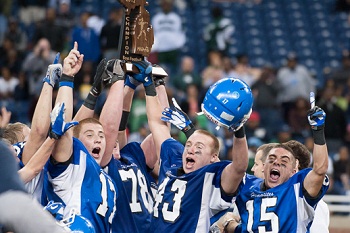
The championship was Ishpeming’s first since 1979, and came two seasons after the team fell 28-26 to Hudson in a 2010 Final. The Hematites finished this fall 13-1.
Loyola, 13-0 entering the day, was playing in its first MHSAA championship game and could be back again soon – the Bulldogs had only five seniors this fall.
But Loyola also was ranked No. 1 heading into these playoffs, featured the second-leading scorer in MHSAA single-season history in senior running back Keymonn’e Gabriel, and had eight players – to Ishepming’s one – weighing in between 250 and 290 pounds.
The No. 4-ranked Hematites were underdogs. And they knew it. But they obviously didn't believe it.
“Our coach he said it best before the game when we were at our school. He said the game’s going to be won or lost on the first smack, the first hit,” Gabriel said. “I guess we were just on the receiving end. We didn't come out strong like we were supposed to, and we just came up a little bit short.”
Although Loyola led at halftime, that advantage was slim – only 8-6. The Bulldogs had outgained the Hematites, but only 153-80. Seven minutes into the second half, Ishpeming appeared to change the tide with senior Eric Kostreva’s second touchdown run. But Loyola turned it back when Gabriel scored on a 20-yard run on the final play of the third quarter to make the score 14-12.
In the end, it would come down to a few close plays, all coming on fourth down. Ishpeming made good on both of its fourth-down attempts. Loyola was successful on four of five – but that one miss might have eventually been the decider.
Loyola faced fourth-and-seven with 7:47 to play and trailing 20-14, when Gabriel ran on a punt fake for 38 yards to Ishpeming’s 17-yard line. But four plays later, on fourth-and-one, Gabriel was hung up for no gain by the waiting Briones, who had senior R.J. Poirier right behind providing support.
Then it was Ishpeming’s turn to convert instead. Its first fourth-down make set up a third-quarter touchdown. That wasn't the case this time. But making good on a fourth-and-one try from its own 18 – after twice trying to draw Loyola off-side and calling two timeouts – allowed the Hematites to drain two more minutes off the clock before junior Tyler Windahl’s 44-yard punt pinned the Bulldogs on their 28 with 1:14 to play.
Loyola made one more first down, but ended the game on its 41-yard line.
 “I’m surprised I didn't want to go for it right off the bat. When we called timeout, I said we’re going to punt it, and I think half of you guys (his players) said, ‘Nope, we’re going for it,’” Olson said. “And when I thought about it, we always go for it on fourth and one. But if somebody offers me fourth and three inches for a state championship, I’m going for it.
“We weren't going to punt it away and hope it happened. We wanted to make it happen.”
Gabriel finished with 21 carries for 129 yards and a touchdown rushing, and also caught four passes for 52 yards and a score. That gave him 326 points this season – second-most in MHSAA history, and final unofficial rushing numbers of 145 carries, 2,516 yards and 36 scores. The yards rank 20th in MHSAA history for one season, and the rushing touchdowns are 11th.
He did so running in part behind junior tackles Malik McDowell (6-foot-7, 290 pounds) and Kajohn Armstrong (6-5, 275), and Loyola certainly felt the impact Saturday when Armstrong had to leave the game early with an injury.
“Our seniors are the reason we’re here; they were our leaders although there were only five of them. But now it’s time for the other group to step up,” Loyola coach John Callahan said. “We had a lot of sophomores playing, a lot of freshman playing. I’m pretty sure I know what we did and what we didn't do, and we've got all offseason to work on and correct, and next season, to start over again.”
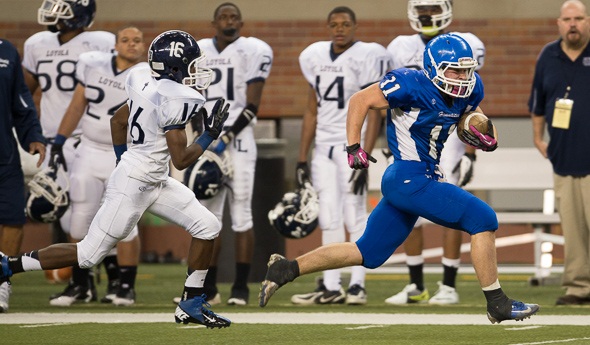
Kostreva ran 20 times for 182 yards and all three Ishpeming touchdowns, and also had 16 tackles. He’s one of 12 seniors who helped guide the program through a tough start to the fall after Olson’s son, Daniel, was found after committing suicide in July.
Jeff Olson said after this game wasn't about him, but Briones was quick to point out that the players certainly wanted to win in part for their coach and the memory of their former teammate.
“I didn't know how this year would go. But I know once I got on the football field, it was a relief for me,” Olson said. “It was where I really felt comfortable. It’s because of these guys right here. They made it comfortable for me.”
Click for full statistics and to watch a replay of the game. See below for the full press conference.
PHOTOS: (Top) Ishpeming running back Eric Kostreva (11) races down the sideline as Detroit Loyola's Anthony Frierson gives chase Saturday. (Middle) The Hematites celebrate their first MHSAA championship since 1979. (Click for more from Terry McNamara Photography.)
1st & Goal: 2025 Week 5 Preview
By
Geoff Kimmerly
MHSAA.com senior editor
September 26, 2025
Football falls always seem to move fast, and we’ve already reached the midpoint of this 2025 regular season in what again feels like record time.
 It’s never too early to start considering playoff possibilities, and you can follow along with by keeping an eye on MHSAA.com’s Playoff Point Summary page, which shows how all teams rank in their respective divisions, updating as scores are received all weekend. Remember, the top 32 in 11-player divisions and top 16 in 8-player will continue once the regular season concludes Oct. 25.
Scores for every game across the state this weekend will be posted on the MHSAA Scores page as they conclude. Tune into several on the NFHS Network, including those with “WATCH” linked below.
Bay & Thumb
Port Huron (3-1) at Port Huron Northern (3-1)
The midpoint of the regular season is also the midpoint of the Macomb Area Conference Blue schedule, and the standings show these two as the only teams undefeated in league play after two games. They’ve split their last eight, with two of those matchups in the playoffs. Reigning league champion Northern’s loss this season came to still-undefeated Madison Heights Lamphere by a 3-2 score, and the Huskies won last year’s showdown with the Red Hawks 30-23.
Keep an eye on these FRIDAY Clio (4-0) at Goodrich (4-0) WATCH, Unionville-Sebewaing (3-1) at Harbor Beach (4-0) WATCH, St. Clair Shores South Lake (3-1) at Marine City (3-1), Traverse City Central (2-2) at Midland Dow (3-1) WATCH.
Greater Detroit
South Lyon (4-0) at Walled Lake Western (3-1) WATCH
South Lyon is seeking to make the playoffs this season for the first time since 2022, and also sits alone atop the Lakes Valley Conference after Western saw its league winning streak end at 28 games with a Week 3 loss to Waterford Mott. The Warriors have defeated South Lyon the last three seasons, including 49-7 a year ago. But the Lions already have avenged 2024 defeats to White Lake Lakeland and Milford.
Keep an eye on these FRIDAY Farmington (3-1) at Birmingham Seaholm (4-0) WATCH, Rochester Adams (3-1) at Clarkston (3-1) WATCH, Detroit Community (4-0) at Melvindale Academy for Business & Tech (4-0), Grosse Pointe South (4-0) at Roseville (3-1).
Mid-Michigan
Michigan Center (4-0) at Leslie (4-0) WATCH
These two are only a game into the Cascades Conference East schedule but the only teams undefeated overall in the league with the next-best 2-2. This fall has seen nearly a direct reversal of Michigan Center’s 1-3 start a year ago, when the Cardinals then fell to 1-4 with a 33-31 loss to the Blackhawks. Leslie is the reigning league champion and last week avenged its lone 2024 regular-season defeat by downing Grass Lake.
Keep an eye on these FRIDAY Northville (4-0) at Brighton (3-1) WATCH, Grand Rapids Catholic Central (4-0) at Middleville Thornapple Kellogg (3-1) WATCH, Montrose (4-0) at Ovid-Elsie (3-1) WATCH, Williamston (4-0) at St. Johns (4-0) WATCH.
Northern Lower Peninsula
Traverse City St. Francis (4-0) at Kingsley (3-1) WATCH
The Northern Michigan Football Conference Legends division has at least one premier matchup every week, and this might be the best as these were two of the three co-champions a year ago and have a rivalry going back to the start of the league in 2014. St. Francis holds a 9-3 advantage during that time, and claimed last year’s meeting 49-20, but the series is knotted 3-3 since 2019.
Keep an eye on these FRIDAY Escanaba (4-0) at Cheboygan (2-2) WATCH, Mount Pleasant Sacred Heart (2-2) at East Jordan (2-2) WATCH, Clare (3-1) at Ogemaw Heights (3-1) WATCH, Midland (3-1) at Traverse City West (2-2).
Southeast & Border
Dearborn Divine Child (4-0) at Jackson Lumen Christi (2-2) WATCH
Divine Child has reached the playoffs the last three seasons, and this year has become one of the most intriguing stories of the first half. The Falcons have yet to give up a point, outscoring their four opponents by a combined 172-0. They’ve fallen 35-7 and 35-0 to Lumen Christi during their two seasons together in the Catholic High School League AA, and the Titans are certainly used to challenges with one of the state’s toughest schedules already featuring a pair of state champions and a semifinalist.
Keep an eye on these FRIDAY Hudson (4-0) at Adrian Madison (3-1) WATCH, Chelsea (4-0) at Dexter (3-1), Union City (3-1) at Quincy (4-0) WATCH, Adrian (3-1) at Ypsilanti Lincoln (4-0) WATCH.
Southwest Corridor
Buchanan (3-1) at Berrien Springs (3-0) WATCH
Berrien Springs is the reigning champion and Buchanan last season’s runner-up in the Lakeland Conference thanks to the Shamrocks’ 31-6 win over the Bucks last October. Berrien Springs actually has won the league the last two seasons and Buchanan won the first championship in 2022. The Shamrocks have had two weeks to prep for this matchup as they didn’t have a game for Week 4, but Buchanan should be riding high after bouncing back from a three-point Week 3 loss with a big win over Niles Brandywine.
Keep an eye on these FRIDAY Grand Rapids Kenowa Hills (4-0) at Battle Creek Harper Creek (3-1), Vicksburg (3-1) at Three Rivers (4-0) WATCH, Watervliet (2-2) at Kalamazoo United (2-2) WATCH, Hastings (3-1) at Battle Creek Pennfield (2-2) WATCH.
Upper Peninsula
Pewamo-Westphalia (4-0) vs. Bark River-Harris (3-0) at Gaylord WATCH
Whichever teams wins, this is a great result for both after both faced the likelihood of sitting home this week after losing their previously-scheduled opponents. Instead, they’ll meet in Gaylord, both among the top small-school teams on their sides of Mackinac Bridge this season. P-W, which already is facing an open date next week, has given up a combined 12 points this season and topped 50 all of its last three games. The Broncos’ Week 4 game was canceled but their early run has included a 30-22 win over Iron Mountain.
Keep an eye on these FRIDAY Menominee (4-0) at Houghton (2-2) WATCH, Calumet (3-1) at Kingsford (3-1) WATCH, Iron Mountain (2-1) at L’Anse (4-0) WATCH, Sault Ste. Marie (0-4) at Marquette (2-2) WATCH.
West Michigan
Zeeland West (3-1) at Zeeland East (3-1)
West has won the last nine meetings between these neighbors, going back to 2019. But there seems to be a bit more buzz around this matchup again, perhaps because the Dux –reigning champions in Division 3 – took a loss to Whitehall in Week 3, although the Chix also suffered their first last week to Hudsonville Unity Christian.
Keep an eye on these FRIDAY Reed City (3-1) at Big Rapids (4-0) WATCH, Rockford (3-1) at Grandville (3-1), Hudsonville (4-0) at Jenison (3-1), Cedar Springs (3-1) at Lowell (4-0) WATCH.
8-Player
Norway (4-0) at Pickford (4-0) WATCH
Pickford has won all three games between these two over the last two seasons, and last year’s Division 1 runner-up has been putting up video-game numbers again outscoring its first four opponents by a combined score of 234-14. But don’t sleep on the Knights, who have put up 212 points and given up only 30 so far, with a 58-8 win over otherwise-unbeaten Powers North Central. Likewise, Pickford handed Newberry its only defeat, 53-6.
Keep an eye on these FRIDAY Breckenridge (3-1) at Blanchard Montabella (4-0) WATCH, Kingston (4-0) at Brown City (3-1) WATCH, Hillman (4-0) at Indian River Inland Lakes (4-0) WATCH. SATURDAY Bay City All Saints (3-1) at Onekama (4-0) WATCH.
MHSAA.com's weekly “1st & Goal” previews and reviews are powered by MI Student Aid, a division within the Department of Lifelong Education, Advancement, and Potential (MiLEAP). MI Student Aid encourages students to pursue postsecondary education by providing access to student financial resources and information. MI Student Aid administers the state’s scholarship and grant programs that help make college Accessible, Affordable and Attainable for you. Click to connect with MI Student Aid and find more information on Facebook and Twitter @mistudentaid.
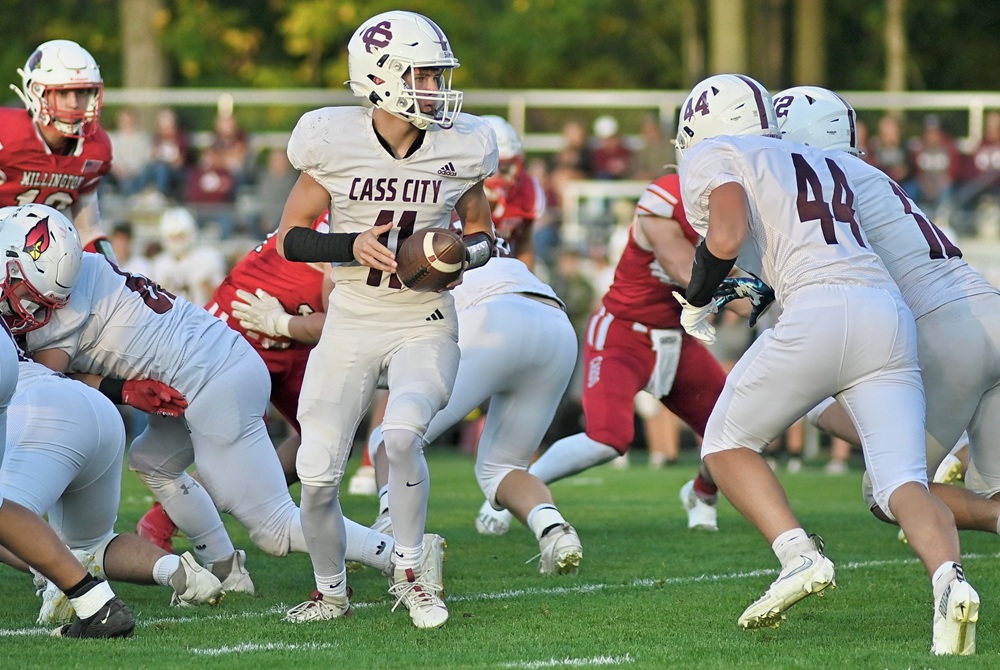
PHOTO Cass City quarterback Preston Dorland (11) prepares to hand off to one of his backs during his team's 17-14 overtime win over Millington last week. (Photo by Terry Lyons.)