

Ithaca Focuses Again on Number 1
August 17, 2015
By Geoff Kimmerly
Second Half editor
ITHACA – Leaders talked Thursday about getting back to Ford Field after finishing 2014 with a loss.
The coach discussed the value of experience and how seniors are key to a successful season.
 Players started their first workout on their home practice field by stretching and working on special teams. When they were thirsty, they drank water. They wore helmets, shoulder pads, shorts and shoes.
Ithaca might’ve had the nation’s longest active 11-player football winning streak snapped last season – but during this afternoon, nothing seemed much different than for about 600 other teams in Michigan looking to begin this fall 1-0.
“That’s the first question everybody asked me last season. But it’s over now, and we’ve just got to focus on this season,” said senior Jake Smith, the returning quarterback, of the five-season run. “There’s not as much pressure anymore. We don’t have to carry on a streak. But we want to start a new one.”
And that's where this practice and any by the Yellowjackets likely will differ from most in Michigan this fall.
The practice field was filled with veterans, with nine starters back on offense and 13 who started at least one game on defense during last season's run to the Division 6 championship game, which ended in a 22-12 streak-breaking loss to Monroe St. Mary Catholic Central.
Those are some key numbers to immediately digest, but numbers became part of the swirl around Ithaca’s incredible run of the last five seasons.
First up was 44 – the number of games Ithaca won in a row to pass Cheboygan for the MHSAA’s longest streak that came all during the playoff era, which began in 1975.
Then came 57 – the number of games Ithaca had won consecutively when it took over sole possession as the nation’s most consistent winner thanks to a loss by Regina High School in Iowa City, Iowa, last August.
There was 72 – the number of consecutive wins by Hudson from Sept. 1968-Nov. 1975 that remains the MHSAA record, although, it is noted, that streak included only one playoff win before Hudson fell in the inaugural Class C Final to see its run end.
Finally, the end came at 69 – the number of games Ithaca won from opening night in 2010 until falling in to Monroe St. Mary on Nov. 28.
And now there’s only 1 – the number of wins in a row Ithaca will play for when it opens against Clare on Aug. 28, and the ranking in its division the Yellowjackets will strive for again after winning four of the last five Division 6 titles.
 “I hate to think of it as a start over,” Ithaca coach Terry Hessbrook said as his team started its first practice at home after three days of camp in Hawks, near Rogers City. “There’s lots of experience out here, and it’s been a nice few days. I haven’t had to raise my voice because they know what the goal is, and they know what the process is that you’ve got to go through to get to it. And it’s quite a climb – you don’t get to start where you finish (the year before).
“(But) you finish on such a high, even if you lose.”
Rewind to last season’s loss, if only for a minute.
Monroe St. Mary relied in part on a senior quarterback in Bryce Windham and a 1,000-yard rusher in senior running back John Lako. Ithaca, meanwhile, returned to Ford Field with only six seniors and only a few who played significant roles – and really, were a surprise after conquering a road that included No. 8 Millington, No. 10 Madison Heights Madison and No. 5 Boyne City, the final two wins decided by senior-like clutch play in the fourth quarter.
Ithaca and Monroe St. Mary literally traded scores in the Final, although Ithaca never led. Smith ran for a 3-yard score with 33 seconds left in the third quarter to pull the Yellowjackets to within three points at 15-12. But neither team scored again until St. Mary added a touchdown with 1:41 to play.
And yet, the welcome at home that night had Ithaca feeling like it was a champion still.
“We had more people show up when we returned than maybe when we won the third or fourth (title),” said Hessbrook, who starred as a running back at Ithaca from 1982-84 and took over as head coach before the 2004 season. “The community kind’ve stood in unison and said, ‘That was pretty cool that we just got to go on that ride.’
“I get chills just talking about it.”
There could be more to come.
Smith, who has had college football conversations with Harvard and Yale among others, threw for 2,134 yards and 27 touchdowns last season and ran for 1,391 more yards and 20 scores. His top three receivers last season all were juniors; Spence DeMull is recovering from an injury, but caught 66 passes for 1,193 yards and 16 TDs. Senior Jace Demenov, the team’s leading tackler the last two seasons, is moving from offensive line to a tight end/receiver combo and is among a few who should emerge as reliable targets. Nose tackle Jonah Loomis was the team’s second-leading tackler last season and also is a senior this fall.
Eight of this season’s seniors were on the varsity as sophomores, so they’ve played 28 games – including 10 during the playoffs. Still, Ithaca is coming off a loss … not something it’s been used to of late.
 “(Local people) ask who is coming back, and we just say everybody,” Demenov said. “In years past, people knew who was coming back and what it was going to be like. People are asking this year who do we have, are we going to be good.
“It’s a game that we lost, an important game for us. We all worked for it, and to have an ending like that really bugged us. It was fun saying we had the longest streak in the nation, but the pressure’s not off. We’re coming back stronger than ever.”
As one might expect, history says Ithaca should remain elite. Hudson went 9-0 in 1976 coming off its streak-ending loss in the 1975 Final. Cheboygan won 10 of its next 11 starting at the end of 1982 and finished 1983 at 8-1. Farmington Hills Harrison came off the end of its 36-game winning streak from 1999-2002 by finishing the latter 8-3 and going 11-2 in 2003, and Fowler won the 1998 Class D title with a 10-3 record after seeing its 33-game win streak end in a 1997 Regional Final.
Still, there isn’t a script Hessbrook can refer to in this situation since so few have been in such a spot. He said it’s up to these seniors to leave their mark – be it playing 10 games, or 12, or getting all the way back to Ford Field.
Winning 14 in a row wouldn’t be 70 or 71 – but more than good enough, even if it comes with fewer people watching Ithaca’s every move.
“I think they should follow us,” Smith said. “We slipped up one game. We’re still a great team that’s going to go out there and put on a show for the fans.
“Anybody that follows us this year is not going to be disappointed.”
 Geoff Kimmerly joined the MHSAA as its Media & Content Coordinator in Sept. 2011 after 12 years as Prep Sports Editor of the Lansing State Journal. He has served as Editor of Second Half since its creation in Jan. 2012. Contact him at [email protected] with story ideas for the Barry, Eaton, Ingham, Livingston, Ionia, Clinton, Shiawassee, Gratiot, Isabella, Clare and Montcalm counties.
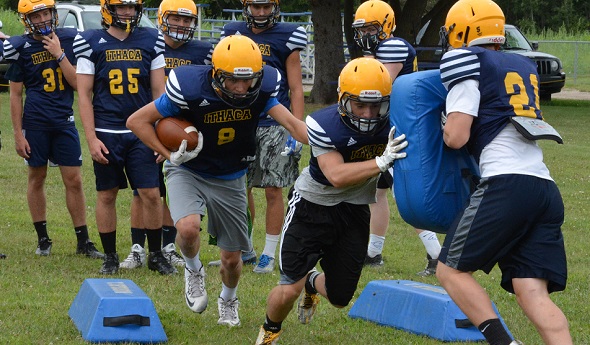
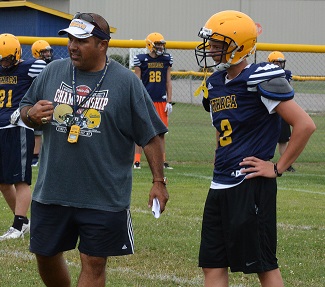
PHOTOS: (Top) Ithaca players work on a blocking drill during Thursday's practice. (Middle) Coach Terry Hessbrook, left, explains how to field a kick to one of his special teamers. (Below) Jake Smith, carrying the ball, follows blocker Grant Gimmey.

MHSAA Provides Update on 2025 Football Playoff Hopefuls, Bracket Reveal Schedule
By
Geoff Kimmerly
MHSAA.com senior editor
October 23, 2025
Here is a list of Michigan High School Athletic Association football playing schools, displaying their win-loss records and playoff averages through the eighth week of the season, plus information on this season's MHSAA Playoffs bracket and Finals schedule announcements.
Schools on this list are divided by division and ordered by playoff average. The top 32 teams by playoff average in each 11-player division and top 16 teams by playoff average in each 8-player division will qualify for the MHSAA Football Playoffs beginning Oct. 31. Divisions were determined prior to the start of the season, and the lists below include not only teams currently positioned to potentially qualify, but also the next eight teams in each division.
To review a list of all football playoff schools, individual school playoff point details and to report errors, visit the Football Playoff Point Summary page.
The announcement of the qualifiers and first-round pairings for both the 11 and 8-player playoffs will take place at 5 p.m. Sunday, Oct. 26, on the “Selection Sunday Show” on the NFHS Network. A subscription is not required to watch the Selection Sunday Show.
The playoff qualifiers and pairings will be posted to the MHSAA Website following the Selection Sunday Show, and times and dates will be added Monday, Oct. 27.
The MHSAA Football Playoffs conclude with the 8-Player Finals on Nov. 22 at Northern Michigan University’s Superior Dome and 11-Player Finals to be played Nov. 28 and 30 at Ford Field.
11-Player Division 1
1. Clarkston, 7-1, 83.125
2. Hudsonville, 8-0, 82.000
3. Detroit Catholic Central, 8-0, 76.661
4. Grand Blanc, 8-0, 76.625
5. Saline, 7-1, 75.875
6. Belleville, 7-1, 74.500
7. Howell, 7-1, 72.875
7. Rochester Adams, 6-2, 72.875
7. Rockford, 6-2, 72.875
10. Detroit Cass Tech, 8-0, 72.500
11. Brownstown Woodhaven, 7-1, 70.750
12. Oxford, 6-2, 70.000
13. Romeo, 6-2, 69.875
14. Brighton, 6-2, 68.250
15. West Bloomfield, 6-2, 67.750
16. Davison, 7-1, 67.375
17. East Kentwood, 6-2, 67.000
18. Dearborn Fordson, 6-2, 66.250
19. Farmington, 6-2, 65.875
20. Macomb Dakota, 6-2, 64.625
21. Northville, 6-2, 63.750
22. Utica, 6-2, 63.375
23. Grand Ledge, 6-2, 62.000
24. Rochester Hills Stoney Creek, 5-3, 58.750
25. Utica Eisenhower, 5-3, 57.375
26. Sterling Heights Stevenson, 5-3, 57.125
27. Grandville, 4-4, 54.125
28. Jenison, 4-4, 53.375
29. Hartland, 4-4, 52.500
30. Dearborn, 4-4, 50.500
31. Salem, 4-4, 50.250
32. Ann Arbor Huron, 4-4, 49.625
33. Rochester, 4-4, 48.875
34. Kalamazoo Central, 5-3, 48.500
35. Caledonia, 3-5, 44.286
36. Novi, 3-5, 44.250
37. Ann Arbor Pioneer, 3-5, 43.750
38. Livonia Stevenson, 3-5, 43.625
39. Holt, 4-4, 43.250
40. Walled Lake Northern, 3-5, 42.375
11-Player Division 2
1. South Lyon, 8-0, 75.875
2. Dexter, 7-1, 73.875
3. Gibraltar Carlson, 8-0, 73.375
4. Portage Central, 8-0, 72.500
5. Grosse Pointe South, 7-1, 70.125
6. Midland Dow, 7-1, 66.750
7. Walled Lake Western, 6-2, 65.875
8. Port Huron Northern, 6-2, 65.625
9. Livonia Franklin, 6-2, 64.750
10. Muskegon, 6-2, 64.458
11. White Lake Lakeland, 6-2, 64.375
12. St. Clair Shores Lakeview, 6-2, 61.125
13. Byron Center, 5-3, 59.875
14. North Farmington, 5-3, 59.500
15. Portage Northern, 6-2, 59.179
16. Warren Cousino, 6-2, 59.125
17. Orchard Lake St. Mary's, 5-2, 58.893
18. Birmingham Groves, 5-3, 55.000
18. Birmingham Seaholm, 5-3, 55.000
20. Lansing Everett, 5-3, 54.875
20. Traverse City Central, 5-3, 54.875
22. Lincoln Park, 5-3, 53.500
23. Allen Park, 5-3, 53.250
24. Traverse City West, 4-4, 52.500
25. Roseville, 4-4, 52.000
25. Temperance Bedford, 4-4, 52.000
27. Muskegon Mona Shores, 5-3, 51.875
28. Waterford Mott, 4-4, 51.000
29. East Lansing, 3-5, 49.000
30. Grand Rapids Northview, 5-3, 48.875
31. Milford, 4-4, 47.250
32. Bloomfield Hills Brother Rice, 4-4, 47.161
33. South Lyon East, 4-4, 47.125
34. Warren Mott, 4-4, 46.875
35. Midland, 4-4, 45.000
36. Dearborn Heights Crestwood, 5-3, 44.375
37. Saginaw Heritage, 3-5, 43.000
38. Ferndale, 4-4, 41.875
39. Southgate Anderson, 3-5, 41.750
40. Battle Creek Central, 4-4, 41.625
40. Berkley, 4-4, 41.625
40. Oak Park, 3-5, 41.625
11-Player Division 3
1. DeWitt, 8-0, 76.458
2. Mount Pleasant, 8-0, 75.000
3. Gaylord, 8-0, 65.625
4. Niles, 8-0, 65.000
5. Grand Rapids Kenowa Hills, 7-1, 64.750
6. Warren Fitzgerald, 7-1, 63.750
7. Adrian, 7-1, 58.500
7. East Grand Rapids, 6-2, 58.500
9. Detroit Martin Luther King, 5-3, 57.667
10. Cedar Springs, 7-1, 57.500
11. Ypsilanti Lincoln, 6-2, 56.875
12. Port Huron, 5-3, 56.250
13. Hastings, 6-2, 56.000
13. Lowell, 6-2, 56.000
15. Fenton, 5-3, 55.625
16. Mason, 5-3, 53.625
16. St. Joseph, 5-3, 53.625
18. Zeeland West, 6-2, 53.125
19. Holly, 5-3, 52.500
20. Marysville, 6-2, 51.125
21. Redford Thurston, 6-2, 50.625
22. Zeeland East, 5-3, 50.250
23. Coldwater, 6-2, 49.375
24. Linden, 6-2, 49.125
24. Middleville Thornapple Kellogg, 5-3, 49.125
26. Trenton, 4-4, 48.250
27. Marquette, 5-3, 48.000
28. Riverview, 6-2, 45.750
29. Coopersville, 4-4, 45.500
30. Warren De La Salle Collegiate, 3-5, 44.929
31. Owosso, 5-3, 44.875
32. Bay City John Glenn, 5-3, 42.625
33. Bay City Western, 3-5, 41.375
34. Fruitport, 4-4, 40.875
35. Petoskey, 4-4, 40.125
36. Stevensville Lakeshore, 3-5, 38.000
37. Ypsilanti Community, 3-5, 37.500
38. Jackson Northwest, 3-5, 36.125
39. Grand Rapids Forest Hills Central, 2-6, 35.375
40. River Rouge, 2-6, 35.292
11-Player Division 4
1. Harper Woods, 8-0, 84.750
2. Williamston, 8-0, 65.375
3. Goodrich, 8-0, 64.875
4. Hudsonville Unity Christian, 8-0, 64.750
5. Chelsea, 7-1, 63.750
6. Battle Creek Harper Creek, 7-1, 61.625
7. Haslett, 6-2, 58.125
8. Escanaba, 7-1, 57.750
9. Dearborn Divine Child, 7-1, 57.042
10. Portland, 8-0, 56.000
11. Ludington, 8-0, 54.375
12. Redford Union, 6-2, 52.625
13. Wyoming Godwin Heights, 7-1, 52.375
14. Madison Heights Lamphere, 5-3, 51.875
15. Center Line, 7-1, 51.250
15. Paw Paw, 5-3, 51.250
17. Big Rapids, 7-1, 51.125
18. Edwardsburg, 6-2, 50.375
19. Vicksburg, 5-3, 48.875
20. Grand Rapids South Christian, 4-4, 47.625
21. Freeland, 6-2, 47.375
22. Tecumseh, 5-3, 47.000
23. Macomb Lutheran North, 7-1, 45.625
24. Grand Rapids Christian, 5-3, 45.500
25. Harper Woods Chandler Park, 6-2, 44.250
26. Spring Lake, 5-3, 43.750
26. Three Rivers, 4-4, 43.750
28. St. Johns, 4-4, 42.500
29. Lansing Sexton, 5-3, 42.250
30. St. Clair, 5-3, 41.750
31. Ortonville Brandon, 4-4, 39.000
32. Fowlerville, 4-4, 38.875
33. Holland Christian, 4-4, 38.750
34. Detroit Henry Ford, 4-4, 37.500
35. Lake Fenton, 3-5, 37.375
36. Croswell-Lexington, 4-4, 36.750
37. Clio, 4-4, 35.875
38. Otsego, 3-5, 35.542
39. Charlotte, 4-4, 35.500
40. Sparta, 3-5, 34.500
11-Player Division 5
1. Grand Rapids Catholic Central, 8-0, 72.475
2. Grand Rapids West Catholic, 7-1, 58.625
3. Pontiac Notre Dame Prep, 6-2, 55.375
4. Frankenmuth, 7-1, 55.250
5. Romulus Summit Academy North, 7-1, 54.375
6. Saginaw Swan Valley, 7-1, 53.500
7. Richmond, 7-1, 53.125
8. Ogemaw Heights, 7-1, 52.250
9. Ann Arbor Father Gabriel Richard, 8-0, 51.736
10. Monroe Jefferson, 7-1, 51.625
11. Detroit Southeastern, 6-2, 50.250
12. Armada, 6-2, 46.750
13. Whitehall, 5-3, 45.000
14. Clare, 6-2, 44.000
15. Michigan Center, 8-0, 43.875
16. Kingsford, 6-2, 43.444
17. Berrien Springs, 5-1, 43.375
18. Detroit Denby, 6-2, 42.667
19. Flat Rock, 5-3, 41.750
20. Gladwin, 5-3, 41.500
21. Howard City Tri County, 5-3, 40.875
22. Kalamazoo Hackett Catholic Prep, 6-2, 40.542
23. Muskegon Oakridge, 5-3, 40.250
24. Dowagiac, 5-3, 40.167
25. Romulus, 4-4, 39.500
26. Negaunee, 5-3, 39.194
27. Detroit Cody, 5-3, 38.250
28. Wyoming Kelloggsville, 5-3, 37.375
29. Yale, 4-4, 36.125
30. Whitmore Lake, 6-2, 36.054
31. Shepherd, 5-3, 36.000
32. Hopkins, 4-4, 35.625
33. Hazel Park, 5-3, 35.375
34. Detroit Voyageur College Prep, 4-4, 34.625
35. Lake Odessa Lakewood, 3-5, 32.125
36. Muskegon Orchard View, 4-4, 31.375
37. Alma, 3-5, 30.750
37. Cheboygan, 3-5, 30.750
39. Midland Bullock Creek, 4-4, 30.500
40. Birch Run, 4-4, 29.125
11-Player Division 6
1. Almont, 8-0, 59.375
2. Jackson Lumen Christi, 5-3, 56.042
3. Detroit Edison, 7-1, 53.000
4. Belding, 7-1, 52.375
5. Olivet, 7-1, 49.625
6. Kent City, 8-0, 48.500
6. Marine City, 6-2, 48.500
8. Montrose, 8-0, 45.750
9. Reed City, 6-2, 45.500
10. Kingsley, 6-2, 45.000
11. Traverse City St. Francis, 6-2, 43.446
12. Flint Hamady, 6-2, 42.375
13. Ecorse, 6-2, 41.875
14. Dearborn Heights Robichaud, 5-3, 41.054
15. Ovid-Elsie, 6-2, 39.625
16. Calumet, 6-2, 39.230
17. Boyne City, 5-3, 39.000
18. Durand, 6-2, 38.625
19. Ida, 6-2, 37.750
20. Detroit Pershing, 5-3, 37.375
21. Clawson, 5-3, 34.875
21. Napoleon, 5-3, 34.875
23. Warren Michigan Collegiate, 4-4, 34.250
24. Central Montcalm, 6-2, 34.000
25. Montague, 4-4, 33.500
26. Flint New Standard Academy, 7-1, 32.750
27. Buchanan, 5-3, 32.333
28. Adrian Madison, 5-3, 32.250
28. Detroit Central, 5-3, 32.250
30. Sanford Meridian, 5-3, 30.875
31. Brooklyn Columbia Central, 5-3, 29.500
32. Clinton Township Clintondale, 4-4, 29.250
33. Kalkaska, 5-3, 29.143
34. Lansing Catholic, 2-6, 29.000
35. Gladstone, 3-5, 28.444
36. Hart, 4-4, 28.375
37. St. Clair Shores South Lake, 3-5, 28.250
38. Royal Oak Shrine Catholic, 5-3, 27.125
39. Onsted, 3-5, 27.000
40. Mason County Central, 4-4, 26.625
11-Player Division 7
1. Menominee, 8-0, 54.028
2. Monroe St. Mary Catholic Central, 7-1, 51.000
3. Charlevoix, 8-0, 43.250
4. Millington, 7-1, 41.000
5. Pewamo-Westphalia, 7-0, 40.893
6. Schoolcraft, 7-1, 40.125
7. Clinton, 6-2, 39.500
8. Constantine, 6-2, 39.250
9. Saginaw Valley Lutheran, 8-0, 38.125
10. Hanover-Horton, 6-2, 37.500
11. Elkton-Pigeon-Bay Port Laker, 6-2, 37.250
12. Cass City, 6-2, 36.625
12. Lawton, 6-2, 36.625
14. North Muskegon, 6-2, 35.571
15. Ottawa Lake Whiteford, 7-1, 34.875
16. Bronson, 7-1, 34.625
17. McBain, 6-2, 34.375
18. Ithaca, 6-2, 33.250
19. Harrison, 6-2, 31.500
20. Saranac, 6-2, 30.321
21. LeRoy Pine River, 5-3, 29.375
22. Detroit Community, 5-3, 29.278
23. Ravenna, 4-4, 29.125
24. Rochester Hills Lutheran Northwest, 4-4, 28.554
25. Union City, 5-3, 27.875
26. Shelby, 5-3, 27.500
27. Jonesville, 5-3, 26.750
27. Leslie, 4-4, 26.750
29. Manton, 5-3, 26.500
30. Burton Bendle, 5-3, 26.250
31. Galesburg-Augusta, 4-4, 25.625
32. Burton Atherton, 4-4, 25.250
33. Morley Stanwood, 3-5, 24.500
34. Quincy, 5-3, 24.000
35. Stockbridge, 4-4, 23.250
36. Coloma, 3-5, 23.125
37. Houghton Lake, 3-5, 22.500
38. Detroit Northwestern, 2-6, 22.250
39. Otisville LakeVille Memorial, 2-6, 22.125
40. Bath, 4-4, 21.946
11-Player Division 8
1. Hudson, 8-0, 46.000
2. Melvindale Academy for Business & Tech, 8-0, 44.903
3. Madison Heights Madison, 7-1, 43.375
4. Harbor Beach, 8-0, 40.000
5. Beal City, 8-0, 39.875
6. Maple City Glen Lake, 6-1, 38.554
7. Allen Park Cabrini, 8-0, 37.750
8. Springport, 8-0, 36.250
9. Decatur, 6-2, 35.000
10. Bark River-Harris, 6-1, 34.605
11. Fowler, 6-2, 34.571
12. New Lothrop, 5-3, 34.500
13. White Pigeon, 6-2, 32.750
14. Unionville-Sebewaing, 6-2, 32.375
15. Southfield Bradford Academy, 5-3, 31.722
16. Saginaw Nouvel Catholic Central, 6-2, 31.250
17. Mancelona, 5-3, 29.250
17. Saginaw Michigan Lutheran Seminary, 5-3, 29.250
19. East Jordan, 5-3, 28.643
20. Genesee, 4-4, 28.250
20. Manchester, 5-3, 28.250
22. Iron Mountain, 5-2, 27.911
23. Frankfort, 5-3, 27.893
24. Clarkston Everest Collegiate, 5-3, 27.875
25. Centreville, 4-4, 27.625
26. Waterford Our Lady of the Lakes, 4-4, 27.375
27. Riverview Gabriel Richard, 3-5, 26.625
28. Auburn Hills Oakland Christian, 5-3, 25.667
29. Reese, 4-4, 24.500
30. L'Anse, 5-3, 24.375
31. Mount Pleasant Sacred Heart, 4-4, 22.929
32. Petersburg Summerfield, 4-4, 22.875
33. Muskegon Catholic Central, 3-5, 22.375
34. Reading, 3-5, 22.000
35. Ubly, 3-5, 21.750
36. West Iron County, 3-4, 21.250
37. Farwell, 3-5, 20.750
37. St Louis, 2-6, 20.750
39. Vassar, 2-6, 18.500
40. Vermontville Maple Valley, 2-6, 18.375
8-Player Division 1
1. Norway, 8-0, 37.696
2. Martin, 8-0, 37.333
3. Blanchard Montabella, 8-0, 35.125
4. Indian River Inland Lakes, 8-0, 34.375
5. Kingston, 7-1, 32.750
6. Gobles, 6-2, 31.190
7. Pickford, 6-1, 31.179
8. Bessemer, 7-1, 31.083
9. Bay City All Saints, 6-2, 30.268
10. Central Lake, 5-3, 30.250
11. Merrill, 6-2, 29.625
12. Capac, 6-2, 29.500
13. Brown City, 6-2, 29.250
14. Climax-Scotts, 6-2, 29.125
15. Newberry, 6-2, 28.768
16. Breckenridge, 5-3, 28.643
17. Marcellus, 5-3, 26.565
18. Concord, 4-4, 24.875
19. Colon, 5-3, 24.625
20. Fulton, 4-4, 24.500
21. Dryden, 4-4, 24.393
22. Rogers City, 4-4, 23.589
23. Brimley, 3-5, 22.601
24. Eau Claire, 4-4, 21.833
8-Player Division 2
1. Onekama, 8-0, 36.250
2. Portland St. Patrick, 8-0, 35.607
3. Mendon, 8-0, 34.750
4. Britton Deerfield, 7-1, 34.625
5. Deckerville, 7-1, 33.875
6. Grand Rapids Sacred Heart, 7-1, 33.565
7. Felch North Dickinson, 8-0, 33.458
8. Pittsford, 7-1, 32.375
9. Mio, 7-1, 31.143
10. Morrice, 7-1, 30.875
11. Powers North Central, 6-2, 30.375
12. Cedarville, 6-2, 30.000
13. Lake Linden-Hubbell, 6-2, 29.833
14. Gaylord St. Mary, 7-1, 29.000
15. Marion, 6-2, 28.125
16. Hillman, 5-3, 26.714
17. Waldron, 5-3, 26.250
18. Adrian Lenawee Christian, 5-3, 26.125
18. Au Gres-Sims, 5-3, 26.125
20. St. Ignace, 5-3, 26.018
21. Kinde North Huron, 5-2, 25.357
22. Bear Lake, 6-2, 24.750
23. Peck, 5-3, 24.089
24. Brethren, 4-4, 23.375