

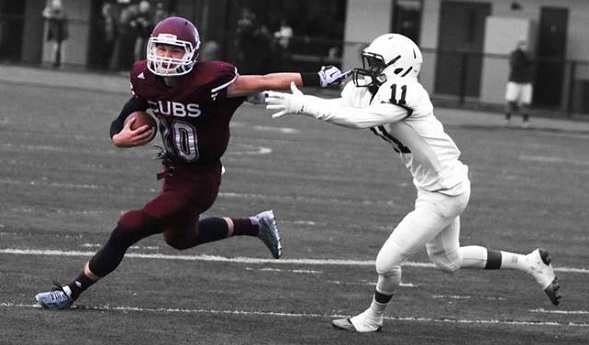
Jesuit's Nelson Thrives in Many Roles
By
Tom Markowski
Special for Second Half
August 31, 2016
DETROIT – Scott Nelson and his football coaches at U-D Jesuit are doing their best to deter specialization.
 Nelson, a senior defensive back/receiver, was the sixth man on the U-D team that won the school’s first basketball MHSAA title, in Class A, this past spring. He started in the outfield on the school’s varsity baseball team as a sophomore – although he chose not to play baseball this past season so as to concentrate on football and basketball.
“When I grew up I just played sports,” Nelson said. “I stopped playing hockey to play football.
“I love competing. I love playing sports.”
U-D is an all-male private school located on the city’s northwest side. The academic curriculum is demanding, and most students who attend the Jesuit school choose to go there for that reason without the thought of participating in athletics. Some programs have thrived; the school's basketball, soccer and bowling teams have won MHSAA championships over the last 15 years, while the baseball, tennis and lacrosse teams have finished Finals runners-up.
It’s different for coach Oscar Olejniczak’s football program. Participation is a must for football coaches. They need players, and lots of them, to conduct practices properly. U-D has not been able to field a junior varsity team the past two seasons. Olejniczak has 44 on varsity, which is a workable number, but it is paramount that the good athletes in the school participate in more than one sport to help fill out the rosters.
“I encourage every one of our players to play two sports,” Olejniczak said. “If they play three sports, no problem, but academics is so tough here that two is all most can handle.
“When you play two sports … it helps them 100 percent. Each sport uses different muscles. It helps with hand-eye coordination.
“It’s a big mistake when you play one sport. People get into their ear. I’m sorry to say sometimes it comes from the coaches.”
 It’s likely Nelson could have played any one of the three sports in college. In the end he chose football for the simple fact that he likes it more than the others. Nevertheless, he fully intends on playing basketball this winter. And why not? He’ll have a chance to start on a team that’ll once again be one of the state’s best.
“I’m biased,” Nelson said. “Multiple sports give you different skills. Basketball gives me that. You have to be in great shape to play basketball. On the basketball court, I’m not the best player. That helped me mentally. Playing with Cassius (Winston, now at Michigan State), people aren’t concentrating on you. That’s fine. Let me do my role. And that’s what I’ll do, and I’ll do my best. In football it’s different. I am an important part. With my coaches, they know I shouldn’t have a bad game. I put pressure on myself. I know I can make the big plays.”
Defensive coordinator George Harris knew that before Nelson did. Nelson played on the freshmen team before he was moved up to the varsity in time for the 2013 Division 2 playoffs. Not only did he dress, but Nelson was shocked to learn he would start that first playoff game against Warren Woods Tower.
“A senior was late for team prayer service,” Harris said. “We have rules here, and we suspended him for the first quarter. So I asked (Nelson) if he knew the coverages and everything. His eyes got real big.
“His football I.Q. was high for a young kid. He wasn’t afraid of the moment. That year we had a (preseason) 7-on-7 scrimmage and he had six interceptions in one game. I said, oh my goodness. He has a lot more confidence now. He’s more physical. That comes from just growing into his body. I can pull things out of his brain, and we can now talk the same language.”
The skills the other sports taught him undoubtedly made Nelson a better football player. At 6-foot-2 and 185 pounds, he’ll likely play safety in college. Northwestern is the lone school that’s recruiting him to play receiver. The other schools that have offered him a scholarship want him to play defense. Nelson has narrowed his choices down to five: Northwestern, Iowa, Michigan State, Penn State and Wisconsin.
Nelson is coming off of what was a breakthrough season. He accounted for 21 touchdowns, which came passing (2), rushing (13), receiving (4) and on kick returns (2).
This season he was not expected to play quarterback, but he was pressed into service, due to injury, in the opener at Detroit Mumford. The Cubs led 2-0 late in the first half and prevailed, 23-14.
As far as his college future, Nelson is uncertain whether he’ll make his decision during the season or after.
There’s no hurry. The Cubs, which made the playoffs last fall losing to eventual Division 2 champion Detroit Martin Luther King 35-24 in a Pre-District, are optimistic that they’ll make a return trip.
 Tom Markowski is a columnist and directs website coverage for the State Champs! Sports Network. He previously covered primarily high school sports for the The Detroit News from 1984-2014, focusing on the Detroit area and contributing to statewide coverage of football and basketball. Contact him at [email protected] with story ideas for Oakland, Macomb and Wayne counties.
PHOTO: Scott Nelson (10) eludes a pursuing defender. (Photo courtesy of U-D Jesuit/Brent Wilkerson.)
Cisco Recalled for Jefferson Greatness, Care for Kids & Staff Over Half-Century as Coach
By
Doug Donnelly
Special for MHSAA.com
October 1, 2026
Marc Cisco was a gruff old football coach who was intimidating and set in his ways.
 Not really.
In fact, to those who knew him, Cisco was more like a teddy bear who had passions for good football, watching student-athletes play the game right and spending time with his close circle of friends.
Cisco died Sept. 24 in Grand Rapids at the age of 90, leaving a legacy on high school football in southeast Michigan. He was best known for coaching the Monroe Jefferson varsity football team for a remarkable 47 years. His teams won 241 games, including the 1994 Class B championship in the Pontiac Silverdome.
“It appeared he was this mean old guy. He might yell at you, but he would be the first one to pat you on the back and tell you good job,” said one of his former players, Jeff Potter. “He really cared about his kids and nurtured his players. He was mostly a big teddy bear.”
Cisco made a career in education as a teacher and coach. In addition to coaching the Jefferson football team for 47 years, he coached track & field for almost as many seasons.
His son, Zeke, played for his father and was the Jefferson quarterback. Later, Zeke was a walk-on at the University of Nebraska. When Zeke was away at college and would come home for a visit each May, he would volunteer to work at the Jefferson Invitational track meet because that’s where he would find his dad.
“He was just a coach,” Zeke said. “My childhood was all about sports. If I wanted to see him in the fall, I had to go to practice. If I want to hang around with him in the winter, he kept score at basketball games, so I would go to the basketball games. He kept the scoreboard during wrestling meets. I usually would sit under his legs, underneath the scorers’ table. I would hit him in the legs a lot because he would get bored and forget to add the score on.
“He was nestled in the fabric of the high school in every way, shape or form.”
Niles Kruger, sports editor at The Monroe News, said when Zeke was at Nebraska, Marc Cisco was usually one of the first coaches every Friday to call in his stats and scores because he would be jumping in a car to drive to watch his son play.
“He was one of my favorite postgame interviews because he was always the same, win or lose,” Kruger said. “He was quite a character and pretty good at cussing. He would always say afterwards, ‘Clean that up for me.’”
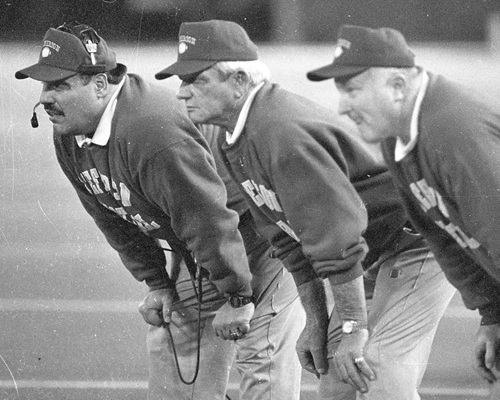
Cisco had a tremendous relationship with his assistant coaches. Several members of the Jefferson coaching staff were there for at least 40 of Cisco’s 47 years.
“His vacations, his fun things to do, were always with other coaches, their wives and their families,” Zeke Cisco said. “They would get together for card nights. They would go to Toledo Raceway (harness racing) Park. Pretty much every coach’s driveway, roof and deck were all built by the other coaches on the staff. They took care of each other.”
Cisco’s legacy includes an extended coaching tree filled with former players. Zeke has built a very successful program at Byron Center. Jason Gendron is the Gibraltar Carlson coach and in the middle of a tremendous run with the Marauders. Potter has coached at Ida for a decade and made that program a playoff regular.
“He was a big part of why I became a coach,” Potter said. “He was like a second family. My dad coached with him for 40 years. He was my Godfather. Our offense now is pretty much the same offense we ran in high school.”
Cisco had spent time in Florida after retiring but made his home in Reading near the Michigan-Indiana border the last few years.
“He would drive up to our games on Fridays,” Zeke said. “He would be in the parking lot at 3 o’clock.”
Marc had health issues over the last year, suffering from a stroke and congestive heart failure. He took a turn for the worse a little more than a week ago. He and his wife Donna, also a former coach at Jefferson, were together for more than 56 years. She survives.
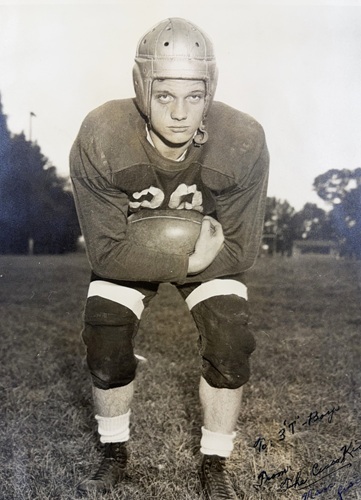
Marc Cisco was a legend long before he started blowing the coaching whistle. Growing up in Morenci, he earned 16 varsity letters – four each in football, basketball, baseball and track – before graduating in 1954. The Bulldogs football team won 44 straight games during his career, and he made The Associated Press all-state team three times.
Larry Tuttle, the winningest baseball coach in Michigan high school history, was a student at Morenci when Cisco was a player.
“I never missed one of his games because my mom and dad would go to all of them,” he said. “Later on, we became good friends. He was such a great football player.”
Cisco played football at Michigan State University under head coach Duffy Daugherty and later at the University of Toledo.
He got his teaching start at Britton Macon High School in Lenawee County, before moving closer to the banks of Lake Erie and Jefferson in 1961.
It was 1963 when Cisco first coached Jefferson, leading the varsity to a 4-3 season – the first of three straight winning campaigns. The tide turned in 1966 when Jefferson went 0-6. The team won seven games over the next three seasons before Cisco stepped down.
He regained the job in 1973 and stayed until 2012. He was the Bears’ varsity coach 41 years in all. From the time his 1983 team went 9-0 until the mid-2000s, Jefferson was a model of consistency, producing winner after winner. The 1993 team went 10-1, the 1994 team 12-1, and the 1999 team 11-2. It was the 1994 Bears that won the Class B title.
Zeke Cisco said when his father retired, it was rather unceremonious. There was no big announcement or celebration, although the school had much earlier renamed the football and track stadium after him.
“He just sort of stepped away,” he said. “He would come up here and watch his grandsons play.”
Marc Cisco never took himself or his wins too seriously.
“You know, I used to always give him hell,” Zeke said. “I'd call him and go, oh, ‘It's the winningest coach Monroe County.’ He goes, ‘I'm also the losingest coach in Monroe County.’”
 Doug Donnelly has served as a news and sports reporter at the Adrian Daily Telegram and the Monroe News for 30 years, including 10 years as city editor in Monroe. He's written a book on high school basketball in Monroe County and compiles record books for various schools in southeast Michigan. He is now publisher and editor of The Blissfield Advance, a weekly newspaper. E-mail him at [email protected] with story ideas for Jackson, Washtenaw, Hillsdale, Lenawee and Monroe counties.
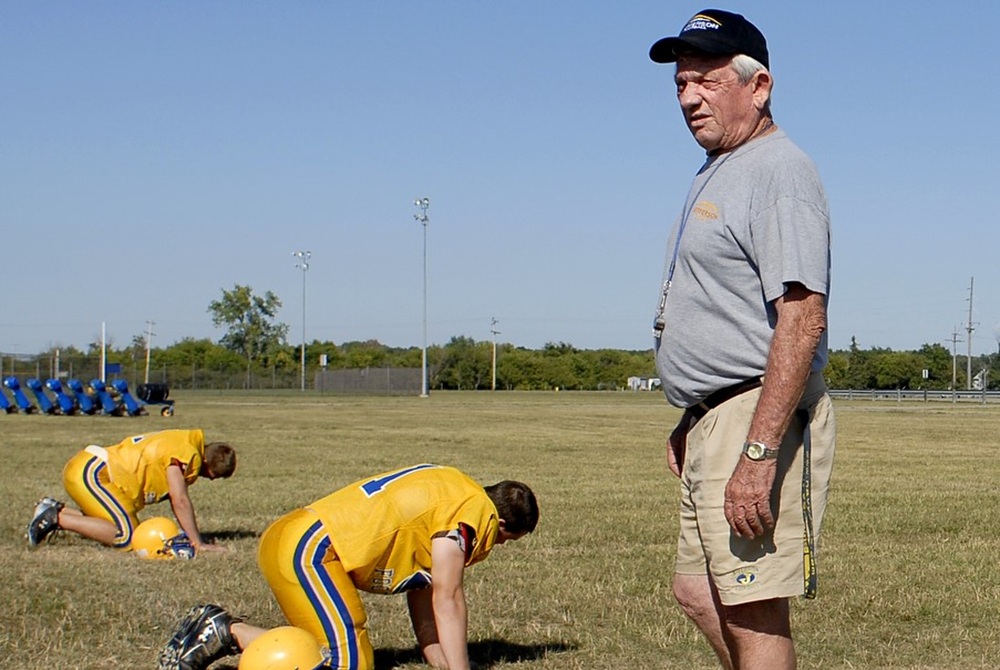
PHOTOS (Top) Marc Cisco coaches his Monroe Jefferson football team. (Middle) From left, John Castiglione, Cisco and Dave Potter monitor the action at the Silverdome during their team’s 1994 Class B Final. (Below) Cisco, while starring at Morenci. (Jefferson photos courtesy of the Monroe News. Morenci photo courtesy of Larry Tuttle.)