

Kalamazoo Rivals 'United' for Football
By
Pam Shebest
Special for MHSAA.com
August 24, 2015
KALAMAZOO — With a big grin, Isaac DeVries said he was relieved a year ago when he heard his Kalamazoo Christian football team was uniting with Hackett Catholic Prep for the next two seasons.
“My first thought was ‘I don’t have to play special teams’,” the K-Christian senior said, laughing. “There’s more people to play. Getting breaks every once in a while is always good.”
 K-Christian junior Alex Visser echoed DeVries sentiments.
“(Two years ago) we only had 13 players on the team, and that was tough,” DeVries said. “We had to play both ways the entire game. The idea of having more players on our team sounded real nice.
“It was different at first because you didn’t really know the (Hackett) kids, but once we got into the season, it was good.”
One year later, the feeling among the players is more than relief.
Despite graduating 22 players and returning only six letterwinners from 2014, the Hackett/Christian co-operative program – which goes by Kalamazoo United – has 22 players on the varsity and 26 on the junior varsity.
It’s coming off a 6-4 finish and appearance in the Division 4 playoffs. Prior to last season, K-Christian last made the playoffs in 2011, while Hackett last qualified in 2006.
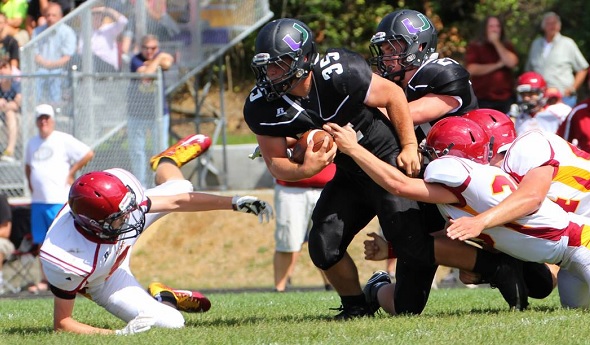
The team’s helmets are black with a “U” on the sides – one half of the U green for Hackett, the other purple for Kalamazoo Christian. Instead of choosing Fighting Irish or Comets – the mascots for those schools – the team is called the Titans and made up nearly evenly of athletes from both.
“The best thing is we’re all friends,” Hackett sophomore Keaton Ashby said. “As a team, we’re brothers. This is a family.
“Personally, I love how we all treat each other. We’re not Hackett and Christian; we’re Kalamazoo United.”
Low numbers at both schools led to the football merger, Hackett athletic director Mike Garvey said.
“(K-Christian AD Jerry Weesies) and I were concerned with the health and safety of the kids with so few numbers,” he said. “It’s hard to maintain a football program if you can’t provide a junior varsity program.”
 Weesies said 8-player football was discussed and discarded.
While talking about combining the two rivals into one team, much of the concern came from parents.
“We initially knew we were going to get push back,” Weesies said. “We knew from both sides there would be some faith-based religious push backs. Also push back from the rivalry. We anticipated it. It was there initially and died quickly.
“What changed the course so quickly, once we started moving forward in spite of some of the push back, was the kids got along so well and so quickly started doing summer activities together that some of the parents said, ’Oh, look at my son. He’s happy. These are just kids.’”
As the victories started coming, that brotherhood strengthened.
None of last year’s players had previously experienced the playoffs. United lost to Eaton Rapids 36-0 in the first round, but that’s only made the players hungrier for success.
“It was great, sitting there at the (MHSAA playoff pairings show) watch party, watching to see who we were going to play,” Hackett senior Jacob Buchman said. “It was one of the best feelings in the world.”
While the players are brothers in football, that doesn’t diminish the rivalry in other sports.
DeVries, who also plays basketball, said it just makes their hoops rivalry more intense.
“Everyone wants to win that one, just to get bragging rights during football season,” he said. “It’s always fun playing Hackett in basketball and (to) see all the guys you know cheering against you.”
Three of the football team’s six returnees are team captains.
Patrick Koning was chosen by the coaches.
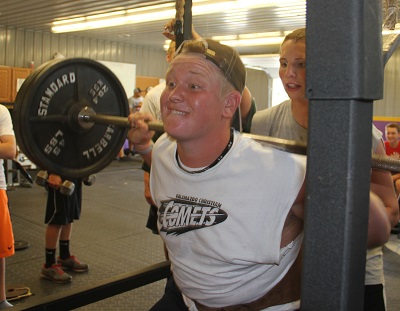
 “He is a leader both in the weight room and in conditioning,” first-year head coach Jesse Brown said. “He’s a charismatic leader.”
The other two were chosen by team vote.
Buchman, a unanimous choice, “is the hardest worker and put in the most work over the summer,” Brown said. “He’s always uplifting, and people listen when he speaks.”
The third captain is Jordan Corstange, who “leads by his performance,” Brown said. “He’s very important with what he does on the field.”
The fourth will be chosen weekly by the coaches based on his performance.
“It could be a different guy every week or it could be the same one for a couple of weeks,” Brown said.
Ashby will lead the team at quarterback.
“He has a big frame and a strong arm,” Brown said. “He’s a very intelligent player, and that made the coaches’ decision unanimous.”
This year’s United team not only has a new coach but also a new affiliation: the Southwestern Athletic Conference. When the Kalamazoo Valley Association disbanded this spring after more than 65 years, United became part of the 20-team SAC and opens the season by hosting Decatur on Thursday.
The team will play in the SAC Division 1 with Coloma, Fennville, Watervliet and former KVA partners Constantine and Delton Kellogg
“The (SAC) merger has changed some things for us,” Brown said. “It’s schools that are comparable to the size of Christian and Hackett. The KVA became unbalanced with the size of schools.
”As the enrollment in Hackett and Christian was going down, others were going up. It’s hard to take a team with 17 to 25 kids going against one with 60.”
Koning said there will be adjustments to playing in a new conference.
“The difference is that with the KVA, it’s been there for a long time, as long as I can remember,” he said. “You knew what was going on with each team.
“Some teams would run the same formation every year. This year, we don’t know much about each team, so it’s just going to be adapting to each team we play.”
While the players might not be familiar with the SAC, Brown and three of his assistants played in the conference. Brown graduated from Martin High School, David Arrasmith and Rob Hardy from Gobles and Vinny Church from Bloomingdale.
“Some of our (13) coaches don’t know which school these (United) kids are from, and that’s a really neat thing,” Brown said. “You just can’t tell. They’re all stand-up young men.”
Summer conditioning and workouts take place at K-Christian, but the team’s home field is Soisson-Rapacz-Clason Field, which was shared by both Hackett and K-Christian football teams in the past.
A few players dropped out of the program when the teams merged.
“I play for the love of the sport,” Koning said. “Some people who didn’t love it left. We just love the sport. It doesn’t matter who you play with or how you get to play, you just play.
“I learned how easy it is to have chemistry with new people. The chemistry with both schools coming together. We really meshed, and this year was easier than last year because we already knew each other.”
“The team’s goal last season was to be successful,” Visser added. “There were a lot of people doubting the whole United thing. We wanted to just go out there and win some games and be successful.”
But this season, expectations are higher: “We want to make the playoffs again,” Visser said.
Ashby said he hopes the co-op team continues past this season.
“I think this is the greatest thing that Hackett and Christian has ever done,” he said. “We put ourselves out there every single day. Honestly, we are improving even more. This is a great opportunity to keep going with another contract.”
 Pam Shebest served as a sportswriter at the Kalamazoo Gazette from 1985-2009 after 11 years part-time with the Gazette while teaching French and English at White Pigeon High School. She continues to freelance for MLive.com covering mainly Kalamazoo Wings hockey and can be reached at [email protected] with story ideas for Calhoun, Kalamazoo and Van Buren counties.
PHOTOS: (Top) Kalamazoo United running back Jacob Buchman breaks through tacklers during a game last season. (Middle) Patrick Koning, a captain this fall, works out while spotted by teammate Isaac DeVries. (Below) Coach Jesse Brown is in his first season leading the program. (Top photo by Dan Cooke; others by Pam Shebest.)
Performance: Detroit King's Dequan Finn
November 29, 2018
 Dequan Finn
Detroit Martin Luther King senior – Football
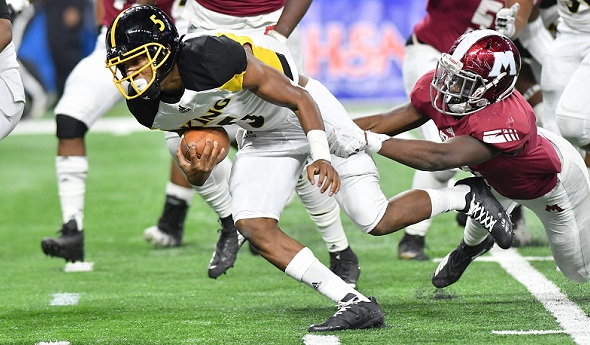
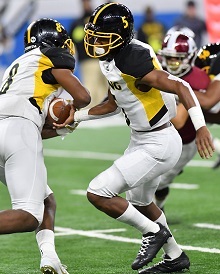
The Crusaders’ standout quarterback capped his high school career by leading his team to a 41-25 win over Muskegon to clinch the Division 3 championship Saturday at Ford Field. Finn completed 9-of-13 passes for 173 yards and four touchdowns and ran for another 73 yards and a score on 11 carries to earn the Michigan Army National Guard “Performance of the Week.”
This wasn’t Finn’s first time succeeding on the state’s biggest stage – the 6-foot-1, 195-pound signal-caller also quarterbacked King to the Division 2 championship in 2016, and the Crusaders fell just shy of making the Finals in 2017 as well, losing by a point in their Semifinal against Warren DeLaSalle. King was 35-6 over his three seasons as the varsity starter, and this fall he threw for 2,109 yards and 26 touchdowns and ran for 1,262 yards and 21 scores. He was further recognized Tuesday by being awarded this season’s statewide Mr. Football Award from State Champs Sports Network.
 King finished 12-2 this fall, winning the Detroit Public School League Black division championship and defeating league champs River Rouge, Warren Woods Tower and DeWitt plus Allen Park on the way to Ford Field. The Crusaders’ losses came Week 2 – at Muskegon, 24-21 – and then in the PSL playoffs final to Detroit Cass Tech, 42-8. But Finn led the team’s rebound after each defeat and will get the chance to continue leading an offense at the college level. (He has been committed to sign with Central Michigan University, although the Chippewas recently fired coach John Bonamego and Finn didn’t have a comment on his future plans in the immediate aftermath of the championship win.) Finn also owns an MHSAA Finals championship in track & field – he helped King win the 800-meter relay in Lower Peninsula Division 2 this past spring – and excels academically, carrying a 3.1 grade-point average.
Coach Tyrone Spencer said: “He did a phenomenal job. That’s our 35th win together. I’m just proud of him, the way he did for us. He’s a great leader, a great competitor and a great football player. … Just his play-making ability, his decision-making. He was calm. He’s been here before, and he looked like it. He didn’t look rattled, or he wasn’t doing too much. He just played in the moment, and that’s why he plays so well.”
Performance Point: “It’s just a real moment right now,” Finn said during postgame interviews. “I’m just thankful for having it, for my team, and for just going hard these three years. It was a good experience. … I just tried to be the best me I could be – the best version of me.”
 Second time’s the charm: “(Playing Muskegon twice) helped a lot, just (with) pre-snap reads – I knew where to go every single play. It was a big advantage for us to go against them Week 2. We still had that 24-21 loss in our minds. … It was an emotional game. We took it personally.”
Playoff rebound: “Coach Spencer said there’s a state championship out there (after the Cass Tech loss). If you want to get it, you’ve got to go get it. We just had to lock in mentally and prepare. That’s all we had to do, prepare and execute.”
From last season to this one: “(My) maturity, me knowing what to do and what not to do at certain points. Knowing down and distance; for instance, knowing what plays to run and what plays not to run. It’s just the little stuff.”
From Week 2 to today: “I learned I just had to calm down, not get too high, not get too low. Just remain calm at all times.”
- Geoff Kimmerly, Second Half editor
Every week during the 2018-19 school year, Second Half and the Michigan Army National Guard recognizes a “Performance of the Week" from among the MHSAA's 750 member high schools.
The Michigan Army National Guard provides trained and ready forces in support of the National Military Strategy, and responds as needed to state, local, and regional emergencies to ensure peace, order, and public safety. The Guard adds value to our communities through continuous interaction. National Guard soldiers are part of the local community. Guardsmen typically train one weekend per month and two weeks in the summer. This training maintains readiness when needed, be it either to defend our nation's freedom or protect lives and property of Michigan citizens during a local natural disaster.
Past 2018-19 honorees
November 22: Paige Briggs, Lake Orion volleyball - Read
November 15: Hunter Nowak, Morrice football - Read
November 8: Jon Dougherty, Detroit Country Day soccer - Read
November 1: Jordan Stump, Camden-Frontier volleyball - Read
October 25: Danielle Staskowski, Pontiac Notre Dame Prep golf - Read
October 18: Adam Bruce, Gladstone cross country - Read
October 11: Ericka VanderLende, Rockford cross country - Read
October 4: Kobe Clark, Schoolcraft football - Read
September 27: Jonathan Kliewer, Grand Rapids Forest Hills Northern soccer - Read
September 20: Kiera Lasky, Bronson volleyball - Read
September 13: Judy Rector, Hanover-Horton cross country - Read
PHOTOS: (Top) Detroit Martin Luther King's Dequan Finn pulls away from a Muskegon defender during Saturday's Division 3 championship win at Ford Field. (Middle) Finn hands off to teammate Peny Boone.