

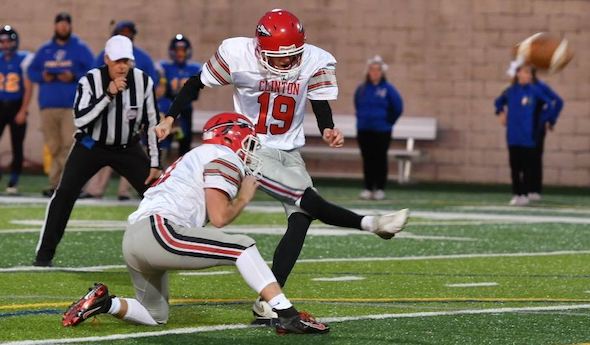
Kicker Steps Into Historic Moment
December 8, 2020
By Doug Donnelly
Special for Second Half
CLINTON – After what Jonathan Baughey has gone through, kicking a football through two yellow goal posts doesn’t seem like a very big deal.

But, when it came against an undefeated, state-ranked team on the last play of the Division 6 District championship game, it was just that.
“It was definitely a scary moment,” said Baughey, a junior from Clinton High School in Lenawee County.
Baughey’s 22-yard field goal as time expired gave Clinton a 16-13 victory over Blissfield and sent his team into a Regional Final against Warren Michigan Collegiate.
It’s been a long road for Baughey, who thought that after a successful kidney transplant in 2015 that his football career was over. At the urging of a family friend and Clinton middle school coach, however, Baughey tried kicking. It was a good choice as he’s now etched his name into Clinton football lore by making probably the biggest field goal in school history.
 “He’s been through so much, and I couldn’t be happier for him,” said Clinton football coach Jeremy Fielder. “We had a lot confidence in him kicking in that situation. There was no hesitation.”
Baughey was born with one kidney functioning at 25 percent and the other at 75.
“From birth he always had kidney issues,” said his mother, Kelly Baughey. “We knew growing up he would need a transplant. They tested his father and I, and we were both matches. His dad (Kevin) decided that he wanted to do it for him. He was his donor.”
Kevin Baughey never hesitated.
“It wasn’t a decision at all,” he said. “I would have given him both if I needed to.”
For years, dealing with the kidney issue was just part of Jonathan’s life. He would tire easier than other kids, but he learned to cope with it.
“I was more of a tired kid,” Baughey said. “When I was younger, it wasn’t about contact, it was about how tired I would get. I couldn’t keep up with a lot of other kids. It was hard.”
He had a kidney removed in December of 2012. After that, he said, “it was a roller coaster.” The transplant didn’t come until June of 2015, soon after he finished the sixth grade.
It took roughly six weeks in the hospital for Baughey to recover from the transplant.
“As soon as I had the transplant, I started feeling better than I had felt,” he said. “I had more energy.”
Baughey played flag football as a kid and had started playing tackle football. But when he neared the time for a transplant, he figured his football days were done. That’s when family friend and Clinton middle school coach Keith Tschirhart suggested he try kicking for the Clinton middle school team.
“I had played soccer and thought it was something I could do, so I tried it,” Baughey said. “I went out with him to the football field to see how I would do. It was pretty rough at the beginning. It took some time.”
He didn’t get much practice that first season.
“We never really kicked extra points,” he said.
Baughey kept working at it though and made it through his eighth-grade season. As a freshman he figured he would continue kicking, most likely for the Clinton JV team. He went to the tryouts.
“I kicked my first football and the coach said I was on the varsity,” he said.
Fielder said Baughey made an immediate impact.
“We didn’t have a kicker,” he said. “We had no one. I even told the coaches, ‘What are we going to do?’ Then, I saw him kick the ball and it was like, ‘He’s our kicker.’”
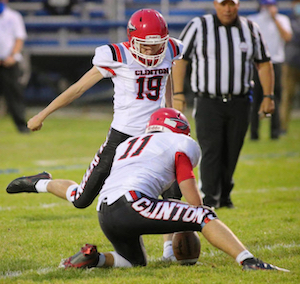 It was big adjustment for Baughey. Not only had he once thought he would never play football again – but he found himself suddenly on the varsity as a freshman, not knowing anyone on the team. And, being exclusively a kicker, meant he practiced mainly by himself.
“That was the struggle that I went through,” he said. “I didn’t know anyone. The only kids I knew were the snapper and the holder.”
Clinton grad Erik Bouse stepped in to help Baughey. Bouse had been a standout kicker for Clinton for three seasons before graduating in 2017.
“He was the one who I mainly worked with,” Baughey said. “He helped me a lot. He really started me out not creating bad habits and helped with the mental part of it.”
As a freshman, Baughey made 42 of his 50 extra-point attempts and a 21-yard field goal. As a sophomore he made 48 of 54 with a 19-yard field goal. This season he has made 29 of 37 extra-point attempts. The winning field goal against Blissfield was his only field goal of the season, on two tries.
Baughey is exclusively a kicker because of the potential risk of injury following the transplant. He wears a special pad on his stomach under his uniform because that is where doctors put his new kidney.
His mother said the no-contact rule causes some angst for her.
“He knows there is a chance he could get hit,” she said. “He wears a shield for padding. The transplant team has okayed him to play.”
Baughey practices every day, often by himself. He goes to the game field and starts at the extra point yardage and works his way back, making at least two kicks at each distance before moving on to the next level. He’ll use his cell phone to record himself, then watch the videos to make sure he is kicking correctly and not developing bad habits.
“The biggest part for me is to go out and know that I can do it,” he said. “You have to know you are going to kick it through the uprights, not just think you are going to. I like to pick out a small target, even a leaf or something, and just clear my mind and just kick the ball.”
When Clinton got the ball back with just over three minutes to go in the District Final against Blissfield, Baughey started thinking the game might come down to his foot.
“I went to the net and started kicking,” he said.
Clinton drove the ball inside the Blissfield 10-yard line, but did not reach the end zone. Fielder called a timeout on fourth down with only a few seconds left. Baughey jogged onto the field and lined up when Blissfield called a timeout.
“I remember walking to the sidelines and taking a deep breath,” he said. “People came up and talked to me and told me I could do it”
Baughey blocked everything out.
“I was really mentally focused,” he said. “After I made the kick, I started clapping. I turned around and all my teammates were jumping up and down. I ran to our coaches and everyone started hugging.”
His father, his donor, could not have been happier to see the ball go through the uprights.
“I was beside myself happy,” Kevin Baughey said. “Thinking about all of the time he spent working in the offseason, and then seeing the confidence his coaches showed with making the call to go for the field goal ... I was as proud as I could possibly be.”
 Doug Donnelly has served as a sports and news reporter and city editor over 25 years, writing for the Daily Chief-Union in Upper Sandusky, Ohio from 1992-1995, the Monroe Evening News from 1995-2012 and the Adrian Daily Telegram since 2013. He's also written a book on high school basketball in Monroe County and compiles record books for various schools in southeast Michigan. E-mail him at [email protected] with story ideas for Jackson, Washtenaw, Hillsdale, Lenawee and Monroe counties.
PHOTOS: (Top) Clinton's Jonathan Baughey connects on a kick. (Middle) Baughey, following through on another kick this season, clinched his team's District title with a game-winning field goal. (Photos courtesy of the Clinton football program.)

#TBT: Searching for The Hinker Bell
September 28, 2017
By Geoff Kimmerly
Second Half editor
Menominee will host Escanaba on Friday in the 121st meeting between two of the Upper Peninsula’s largest high schools and proudest football programs – but with the trophy celebrating the game still missing after it first disappeared more than half a century ago.
The two teams from 1948-1962 played for the The Hinker Bell, a locomotive bell that hasn’t been seen since 1963.
A decade ago, Escanaba Daily Press sports editor (and now Second Half correspondent) Denny Grall wrote about a newfound search for The Hinker Bell. But the mystery continues, and Grall’s story below tells of many of the twists and turns that to that point that had come in trying to locate it.
ESCANABA — Another search is underway to find the Hinker Bell.
The former locomotive bell went to the winner of the Escanaba-Menominee football game for about 15 years but has been missing for more than 40 years. It came from a locomotive owned by the Bay de Noquet Company and used on the LS&I Railroad that operated in Delta and Menominee counties.
The locomotive was built in 1906 by Baldwin Locomotive Works in Philadelphia and the bell was believed to have been cast in the railroad foundry, according to a 1953 newspaper clipping.
In 1948, one of the locomotive owners presented the bell to his friend, John Hinker of Menominee, an ardent sports fan who donated materials for the press box at Menominee’s Walton Blesch Field.
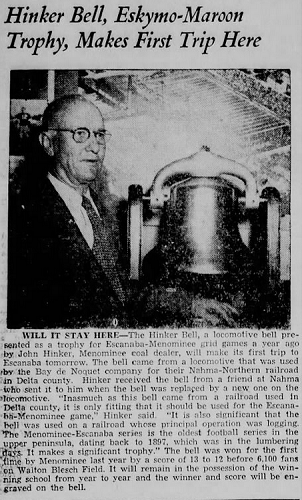 Hinker gave the bell to then Menominee coach Mickey McCormick and indicated proper use for the bell would be as an award for the gridiron rivalry.
Now Hinker’s great great nephew is trying to find the bell, which has not been seen since Escanaba’s current high school opened in 1963.
Tim Waters of Land O’ Lakes, Wis., who has launched the search, became interested by researching his family tree. “It is a big trophy (between 80 and 150 pounds by various estimates) and it is odd that it is missing,” Waters said in a recent telephone chat.
“One theory is that it is in somebody’s hunting camp or a home and they are using it as their own trophy,” said Waters.
“We have a pretty good investigation going on and all help is appreciated. If somebody does have it, we’re not looking to prosecute them. We’re just looking to get the darn thing back. Nobody will be in trouble.”
Waters refuted the old idea the bell was melted down. He has contacted numerous bell collectors, and they said a junk yard would have known it was worth a lot more than melted metal.
“The bell was not destroyed. We’ve come to that conclusion,” he said. “It was not put in a scrap yard.”
Waters contacted Coplan Iron and Metal of Escanaba and learned that bells were not melted or crushed and said the firm never accepted a bell with engravings matching the Hinker Bell.
Waters learned those businesses would sell them for the weight value to people who wanted them for yard ornaments/dinner bells, or to collectors.
“It is a treasure and it needs to be found,” said Waters.
Waters said the last known photo of the bell was with then EHS football coach Al Sigman and Esky players John Fisher and Phil Davidson in 1960. Escanaba beat Menominee from 1959-63 but could not find the bell in 1964 when the Maroons won. No one he has talked to remembers seeing the bell present at the first three games during the tenure of coach Jerry Cvengros.
The current Escanaba High School opened in 1963 and Bay de Noc Community College then occupied the old facility, which has since been demolished.
“Records indicate there was no report (of a missing bell) filed by Escanaba school district to the police department,” Waters said.
“The Hinker Bell is part of U.P. Michigan’s history, as is football and the railroads,” Waters said. “The people of Escanaba and Menominee deserve to have this trophy returned to their high schools.”
Waters, who has never seen an Escanaba or Menominee football game but is planning to rectify that omission this season, is hoping students at the two schools will join in the treasure hunt and talk about it with their parents and grandparents.
He has already contacted EHS athletic director Rob Ryan, who plans to thoroughly search the school basement.
He would like to find a photo of the bell to help collectors in their search. “Each bell was for a special locomotive,” said Waters.
“If they have a good picture we can pass it around and say we are looking for this bell. If they can pinpoint what this bell was on, they can help get the word out.”
He has also extended the search to the website at upfootball.com, which has generated interest but no bell. “If the bell is in the area still today, I don’t think it will take long to surface,” he said.
“If we don’t find this bell, we are going to try to make up a replacement as close as possible if the two schools are interested in that,” he said.
Waters is hoping that real estate agents, postal workers, delivery personnel, construction workers, etc., may have seen the bell during their travels and can help retrieve it.