


Kicking Bad Habits
May 4, 2018
Forty years ago, as a youngster on a venerable staff at the national office of the National Federation of State High School Associations, where the playing rules for high school football were published, I would entertain my colleagues with a quixotic proposal – year after year – to eliminate the kickoff from football.
As a college player, I got my first playing time as a member of the kickoff team. I knew it was because the coaches didn’t want to risk injury to better players.
As a high school coach, when I conducted preseason scrimmages, I always insisted that kickoffs not occur because I didn’t want to risk season-ending injuries before the season even began.
So, as the world of football from youth levels to the pros is eliminating kickoffs or altering rules to reduce their frequency, I write smugly, “What took you so long?”
Rules committees on every level for every sport have an obligation to examine the data for their sports closely and determine precisely the circumstances that cause the most injuries. And then they must create and enforce rules that will eliminate or greatly modify that most injurious situation.
If the data tells us now what my gut told me as a young coach and administrator, we should give kickoffs the boot.
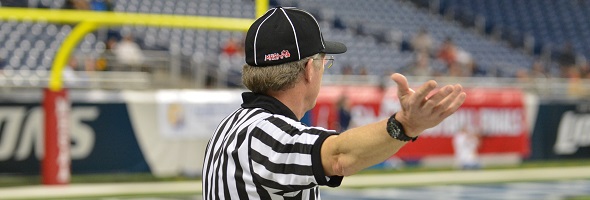
Be the Referee: 40-Second Play Clock
August 29, 2019
This week, MHSAA Assistant Director Brent Rice explains the change in football to a 40-second play clock.
Be The Referee is a series of short messages designed to help educate people on the rules of different sports, to help them better understand the art of officiating, and to recruit officials.
Below is this week's segment - 40-Second Play Clock - Listen
One of the rules changes in high school football this year involves timing between downs.
All varsity games will be played with a 40-second play clock that begins after the conclusion of the previous play, with exceptions for things like timeouts, penalties, measurements and at the start of a period – when a 25-second count will be used.
In experiments in Michigan over the past few seasons, the 40-second play clock proved to improve the pace of play and consistency between plays because it is not dependent on the referee’s subjective signal. And while some schools may choose to purchase visible play clocks for their fields, it is not required. The Back Judge, who has the primary responsibility for the play clock, will signal at 10 seconds and count the last five seconds.