

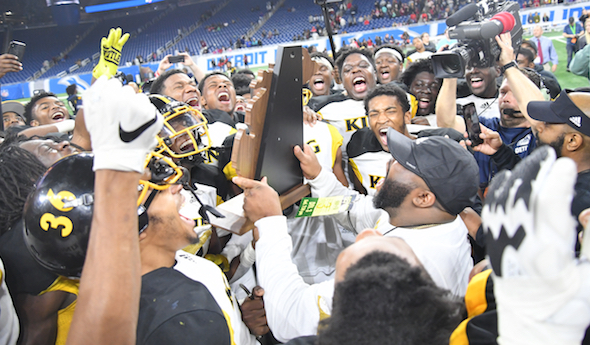
King Avenges Early Defeat to Reign Again
November 24, 2018
By Tom Kendra
Special for Second Half
DETROIT – Rematches are rare in high school football, especially for teams located on opposite sides of the state.
But Detroit Martin Luther King on Saturday got the chance to avenge a Week 2 loss at Muskegon, and star senior quarterback Dequan Finn and his talented supporting cast made the most of it.
Finn, a 6-foot-1,190-pound senior who has committed to sign with Central Michigan University, threw four touchdown passes and ran for another as the Crusaders’ offensive versatility was the difference in a 41-25 victory over previously unbeaten Muskegon in the Division 3 Final at Ford Field.
“So many great King teams have lost to Muskegon, and it felt great to be the first to beat them,” said Tyrone Spencer, who has two MHSAA titles and a Semifinal appearance in his three years as King’s head coach. “They are a great program with a rich tradition, and it feels good to beat them for a state championship.”
King (12-2) won its third Finals championship in four years, after claiming back-to-back Division 2 crowns in 2015 and 2016. The Crusaders have won four titles overall, with their first also in Division 2 in 2007.
Muskegon (13-1) was shooting for its seventh MHSAA title, but instead finished runner-up for the fifth time, and saw its state-best 27-game winning streak snapped.
The final championship game of the weekend was a matchup between arguably the two best quarterbacks in the state – and neither disappointed.
Muskegon junior Cameron Martinez (5-11, 190) was once again the workhorse for the Big Reds, carrying 37 times for 211 yards and two touchdowns. He completed only 1-of-4 passes, but that completion was good for a 13-yard touchdown to senior Ali’vonta Wallace.
Finn, meanwhile, was deadly with his arm and feet.
Finn completed 9-of-13 passes for 173 yards and the four scores, as his offensive line gave him plenty of time to pick apart the Muskegon secondary. He was also King’s second-leading rusher with 11 carries for 73 yards and another touchdown.
“I’m just happy with the whole team, the effort that we gave,” said Finn. “It’s a surreal moment right now. I’m lost for words.”
The quarterback matchup went back-and-forth for three quarters, and when Martinez plunged in from two yards out late in the third quarter to draw his team within 21-17, it appeared the stage was set for a fantastic finish.
Instead, King’s myriad offensive weapons overwhelmed Muskegon over the final 12 minutes.
Three players scored in the fourth quarter as the Crusaders pulled away – senior receiver Ahmad Gardner on a 22-yard pass from Finn, junior running back Peny Boone on a 52-yard run and senior receiver Darrell Wyatt on a three-yard pass from Finn that was nearly intercepted in the end zone.
“There were a lot of plays that could have been big for us, but there were dropped passes and a missed interception,” said Martinez, who finished his junior year with a school-record 2,527 rushing yards. “In a game like this, you can’t afford to make mistakes.”
Muskegon, which was playing in an MHSAA Finals game for the sixth time in seven years, got off to a great start.
The Big Reds forced a punt on King’s first possession, and despite taking over at their own 3-yard line, marched 97 yards in 13 plays behind their dominating offensive line. Martinez sprinted in from 10 yards out for a 7-0 lead.
 Making openings for Martinez were four seniors up front – tackles Anthony Bradford (6-5, 360) and Evan Towers (6-4, 285) and guards Marquis Cooper (6-1, 330) and Da’Quarious Johnson (6-0, 260) – along with junior center DeAndre Mills-Ellis (6-0, 290).
King countered with the passing of Finn, who connected with senior wideout Dominick Polidore-Hannah on a pair of first-half touchdown passes covering 42 and 22 yards as the Crusaders took a 14-10 halftime lead.
The third quarter was even as Finn and Martinez each had scoring runs, but King’s athleticism prevailed over Muskegon’s size and strength during the final quarter.
“We won 27 games in a row, and you have no idea how remarkable that is,” Muskegon ninth-year head coach Shane Fairfield told his huddled team on the Ford Field turf afterwards. “It hurts and it should hurt, but we haven’t felt this in a while.”
Boone made Muskegon pay for spreading out to cover the pass, hammering his way for 111 yards on 14 carries. Gardner and Polidore-Hannah each caught three passes. Leading King defensively was junior free safety Joe Frazier with 11 tackles, sophomore safety Jaylen Reed and senior safety Ray Williams with 10 tackles apiece and senior linebacker Rich Miller with nine stops.
The victory was sweet revenge for the Crusaders and especially Finn. In the Week 2 meeting, he mishandled a snap with 35 seconds remaining. Muskegon’s Billie Roberts recovered the fumble, and the Big Reds held on for a 24-21 win at Hackley Stadium in Muskegon. They went on to be ranked No. 1 in Division 3 the entire regular season and heading into the playoffs
“Our kids didn’t have any quit in them,” Spencer said. “I told them to give more effort, and that’s what they did. We got some breaks tonight, but (Muskegon) had some breaks when we went to their place and played. It’s a part of the game, and I’ll take it all day. Our guys never quit, and I’m proud of them.”
Senior Demario Robinson was the second-leading rusher for the Big Reds with 47 yards on six carries, while senior Carlos Hernandez booted a 37-yard field goal on the final play of the first half. Wallace led the defense with seven tackles, junior linebacker Tarran Walker had six and senior defensive back Isaiah Moore made five stops.
Muskegon, the winningest team in state history with 844 victories over 124 years of football (dating back to 1895), beat Farmington Hills Harrison last year for the Division 3 title. The Big Reds also have lost twice to Birmingham Brother Rice (2012 and 2013), twice to Orchard Lake St. Mary’s (2014 and 2016) and now King in championship games.
Fairfield scheduled the regular-season game against King to help prepare his team for the type of athletes it might see at Ford Field. He did not expect to see King again, as the Crusaders have traditionally slotted into the Division 2 bracket. But a drop in enrollment put both teams in the same division – and on a collision course.
Both had to survive Pre-District playoff scares, as Muskegon edged East Grand Rapids by one score (42-35), while King beat River Rouge by just one point (7-6).
After that, both teams rolled over their next three opponents en route to Ford Field.
Saturday’s matchup was the second time the two schools have met in an MHSAA Finals game, with the first meeting in the Class A Final in 1989 at the Pontiac Silverdome. Muskegon, which is now 5-1 all-time against King, prevailed in that title game 16-13.
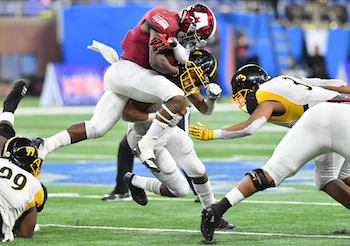
PHOTOS: (Top) Detroit Martin Luther King raises the Division 3 championship trophy Saturday night at Ford Field. (Middle) Crusaders defenders work to bring down a Muskegon ball carrier.
1st & Goal: 2025 Football Finals Review
By
Geoff Kimmerly
MHSAA.com senior editor
December 3, 2025
This season’s MHSAA Football Finals saw only two of 20 teams reach championship games for the first time – the lowest number of first-timers since the start of the 2020s – but several more play for Finals titles for the first time in a decade, or two, or even three or four.
 Dearborn Divine Child won its first championship since 1985, Portland St. Patrick its first since 1992, and Harbor Beach, Menominee and Detroit Catholic Central all claimed their first titles in more than a decade as this fall came to a close over the last two weekends.
We also had repeat winners – Orchard Lake St. Mary’s, Jackson Lumen Christi and Martin – and although their runs ended in defeat, Blanchard Montabella and Dexter did advance to championship weekends for the first time.
MHSAA.com once again covered all 10 championship games, with quick recaps and links to those stories below followed by notations of performances entered into the MHSAA Finals record books and a report on some of the main storylines to emerge as those championships were being decided.
Finals in Review
11-Player Division 1: Detroit Catholic Central 42, Detroit Cass Tech 19 – Read
DCC claimed its first Finals championship since 2009 by emerging from this matchup of undefeated teams and avenging a 2024 Semifinal loss to eventual champion Cass Tech. While Shamrocks senior Samson Gash has received some of the highest statewide praise for his offensive talents this season, junior brother Gideon Gash starred this time with three touchdown catches all 37 yards or longer.
11-Player Division 2: Orchard Lake St. Mary’s 51, Dexter 14 – Read
Orchard Lake St. Mary’s repeated as Division 2 champion following quarterback Jabin Gonzales (304 yards/4 TDs passing, 102 yards rushing) but also thanks to a stellar defensive effort against the Dreadnaughts’ record-setting offensive attack. The Eaglets held Dexter to just 266 total yards, and only 69 during the second half after taking a 24-14 lead into the break.
11-Player Division 3: DeWitt 54, Mount Pleasant 20 – Read
This was another matchup of undefeated contenders, and DeWitt again lit up the scoreboard in winning its second championship. The Panthers set a team Finals record for most rushing yards (575) with senior Traverse Moore claiming the individual Finals rushing record with 397 – 83 more than the previous all-time best.
11-Player Division 4: Dearborn Divine Child 23, Hudsonville Unity Christian 22 – Read
Divine Child’s first Finals championship since 1985 was a product of steady play on both sides of the ball. Offensively, Marcello Vitti ran 19 times for 120 yards and a score and Drew Sheridan completed 19 passes for 241 yards and two touchdowns. Defensively, Divine Child stopped a two-point conversion try midway through the fourth quarter to keep a one-point lead, then held Unity to two yards on its final possession.
11-Player Division 5: Grand Rapids West Catholic 42, Pontiac Notre Dame Prep – Read
West Catholic jumped out to a 28-0 lead and didn’t allow reigning champion Notre Dame Prep to get on the scoreboard until the final minute of the first half. The 1-2 punch of running back Collin Abram and quarterback Grady Augustyn accounted for a combined 347 yards for the Falcons, and the Fighting Irish also lost all-state quarterback Sam Stowe for the majority of the second half with an injury.
11-Player Division 6: Jackson Lumen Christi 28, Kingsley 15 – Read
The Titans claimed a fourth-straight Finals championship and repeat in Division 6 by scoring the game’s only second-half points – 14 to go ahead and stay there during the fourth quarter. Lumen Christi’s Sean Walicki starred on both sides of the ball, running for 142 yards and two touchdowns and making 17 tackles.
11-Player Division 7: Menominee 34, Schoolcraft 6 – Read
Two years after finishing Division 7 runner-up and only four points shy of Lumen Christi in that title decider, Menominee returned to Ford Field and won its first championship since 2007. Clayton Miller ran for 112 yards and three touchdowns for the Maroons, who finished a perfect 14-0. Schoolcraft’s only points came with 6:09 to play.
11-Player Division 8: Harbor Beach 31, Hudson 20 – Read
The 11-Player Finals opened with a matchup of undefeated contenders. Harbor Beach withstood Hudson’s powerful running attack and followed quarterback Caden Bucholtz (146 yards/1 TD rushing, 82 yards/2 TDs passing) to its first Finals title since 2012. The Pirates took a 21-0 lead into the final four minutes of the first half and got a scoring run, touchdown reception and 20-yard field goal from Skiler Kruse.
8-Player Division 1: Martin 52, Blanchard Montabella 8 - Read
Hudson claimed its third Division 1 title in four seasons with a dominating performance, as Montabella scored the game’s first points but were held off the board the rest of the way. Quarterback Haylen Buell ran for 179 yards and three touchdowns on only nine carries, and completed all seven of his passes – including one for another score – for the undefeated Clippers.
8-Player Division 2: Portland St. Patrick 53, Felch North Dickinson 0 – Read
The Shamrocks seemed to set the tone on the opening kickoff – returning it to North Dickinson’s 3-yard line – on the way to winning their first 8-player championship and first in either football format since 1992. St. Patrick led 20-0 after just seven minutes and 33-0 at halftime, with seven players reaching the end zone at least once by the end of the contest.
Record Report
Detroit Catholic Central and Jackson Lumen Christi moved into a first-place tie with Farmington Hills Harrison for 11-Player Finals appearances as all three have played in 18. (Harrison closed in June 2019).
DeWitt senior Traverse Moore earned seven 11-Player Finals record book listings, his most notable for an all-time best 397 yards rushing – which broke Kadale Williams of Lumen Christi’s record of 314 set just last season. Moore also set records with three touchdown runs during the first quarter, and his 461 total yards (including 64 passing) are the second-most in Finals history. He made four more lists as well, including for 24 points scored.
Mount Pleasant quarterback Xavier Creguer also set a record during the Division 3 game, his 91-yard scoring run the longest rush in 11-player championship game history.
Three kickers made the 11-player single-game extra points list with six apiece – Orchard Lake St. Mary’s Beckett Keifer in Division 2, DeWitt’s Vincent Rose in Division 3 and Grand Rapids West Catholic’s Landon Smith in Division 5
A trio of quarterbacks also made 11-player record lists. Orchard Lake St. Mary’s Jabin Gonzales did so with 304 yards passing, his four touchdown tosses, and 406 total yards (including 102 rushing); the total yards rank eighth all-time. Detroit Cass Tech’s Donald Tabron II made passing lists with 25 completions, 37 attempts and 285 yards, and Dearborn Divine Child quarterback Drew Sheridan also made the completions list with 19. Tabron’s attempts rank eighth, and his completions tied for fourth on that list.
On the receiving end of some fine quarterback play, Cass Tech’s Corey Sadler Jr. made the 11-player single-game receptions list with 11, tying for third-most catches, while Grand Rapids West Catholic’s Thomas Puksta made the single-game receiving yardage list with 161 and Detroit Catholic Central’s Gideon Gash tied for the second-most touchdown receptions with three.
Dexter’s Cole Novara rewrote the season receiving records this fall, and added an 11-player championship game listing with a 96-yard kickoff return touchdown. St. Mary’s Daniel Taylor Jr. also made a return list, bringing back a fumble 59 yards for a score.
DeWitt with 54 points made the 11-player team single-game scoring list, but that was just the start. The Panthers’ 575 rushing yards and 639 total yards were records, their seven rushing touchdowns tied another one, their 24 first downs made a record list and their combined 959 total yards with Mount Pleasant made the total offense list for both teams in one game.
Orchard Lake St. Mary’s also made the 11-player scoring list with 51 points, and earned another entry with 314 passing yards. Dexter made the single-game completions list in that game with 24, and Detroit Cass Tech made that same list with 25 completions. Hudsonville Unity Christian made the single-game rushing carries list with 66.
Grand Rapids West Catholic tied the Finals record with two other teams by returning two interceptions for touchdowns.
Hudson made the list of teams that did not punt in a Final, and also joined Harbor Beach – which punted once – on the list for fewest punts by both teams combined in one game.
Martin quarterback Haylen Buell made the 8-player total yardage list with 313 in the Division 1 game, leading a Clippers attack that also made the single-quarter points list with 30, single-Final rushing list with 364 yards and rushing touchdown list with six.
Portland St. Patrick quarterback Jerryd Scheurer made the list for fastest touchdowns to begin an 8-Player Final, scoring on a run just 20 seconds into his team’s Division 2 win against Felch North Dickinson. St. Patrick also made the single-game touchdowns list with seven.
Stories Behind the Scores
Single Wing, Several Records: We detailed above most of how DeWitt ran its way into the Finals record book, but the Panthers’ strategy this season deserves more credit for its brilliance. Recognizing his team’s strength on the offensive line and depth of dynamic ball carriers, DeWitt coach Rob Zimmerman leaned heavily on single wing concepts that saw direct snaps to Traverse Moore – technically his quarterback – who then ran behind multiple blockers or worked through counters and other slights of hand that opened up multiple running lanes on just about every play. The Panthers have added several record book entries over the last 25 years thanks to a high-scoring spread passing attack, but they followed last season’s 702 points (ranking eighth all-time before this fall) with 727 this season that will ran fifth on the single-season scoring list. Moore finished with 2,512 yards and 33 touchdowns rushing, and it will be interesting to see if other programs follow suit by incorporating single-wing looks.
Memorable Menominee: The Maroons were once known as one of the last teams to run the single wing, and although they’ve added different looks and more balance under fourth-year coach Chad Brandt, that tough-running, physical culture lives on – and played a big part in Menominee’s perfect season and first Finals championship since 2007. The Maroons just missed winning the Division 7 title in 2023, losing to Jackson Lumen Christi 34-30, but came through this time to claim the Upper Peninsula’s first 11-player championship since 2015. This season, only 16 UP teams played 11-player, while 19 played 8-player.
Watch List: A total of 44,733 fans attended the 11 or 8-Player Finals this season, the highest combined total for the three days since 2019 and despite a snowstorm that blanketed much of the Lower Peninsula over the 11-player weekend. A notable crowd of fans also watched online; although this was the first year the 11-Player Finals were streamed only, on the NFHS Network, we know that the Division 1 championship game drew the fourth-most viewers all-time of any event from any state broadcast on the Network, and that they watched the game for the most minutes ever for a Network broadcast.
MHSAA.com's weekly “1st & Goal” previews and reviews are powered by MI Student Aid, a division within the Department of Lifelong Education, Advancement, and Potential (MiLEAP). MI Student Aid encourages students to pursue postsecondary education by providing access to student financial resources and information. MI Student Aid administers the state’s scholarship and grant programs that help make college Accessible, Affordable and Attainable for you. Click to connect with MI Student Aid and find more information on Facebook and Twitter @mistudentaid.
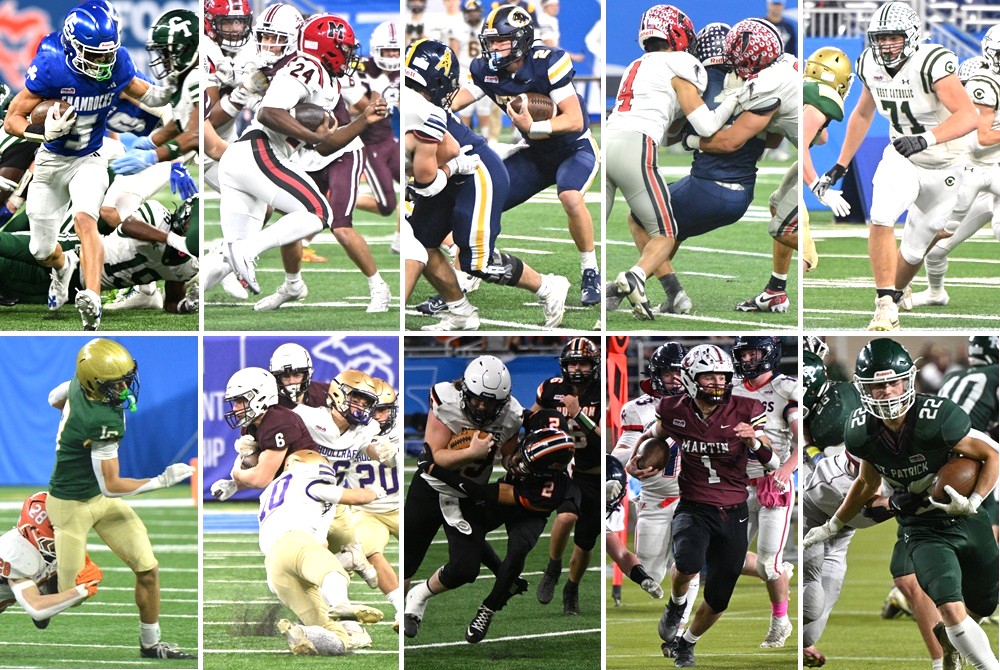
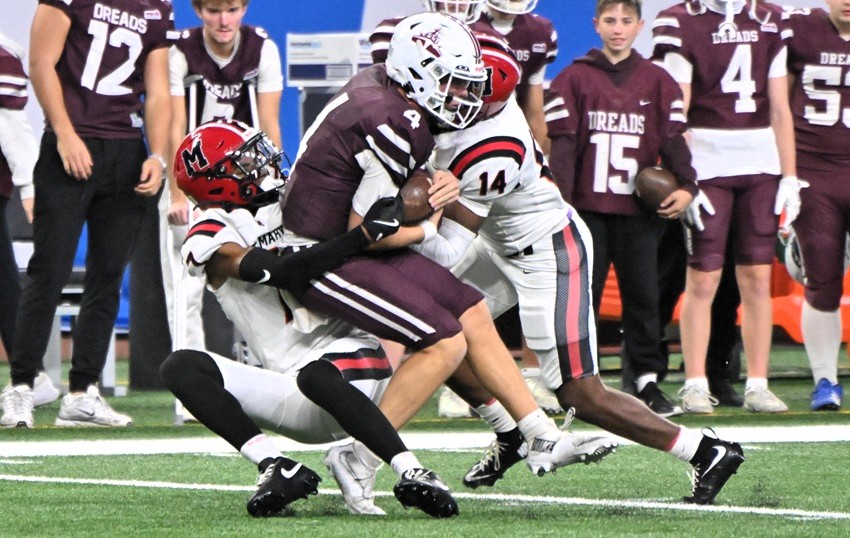
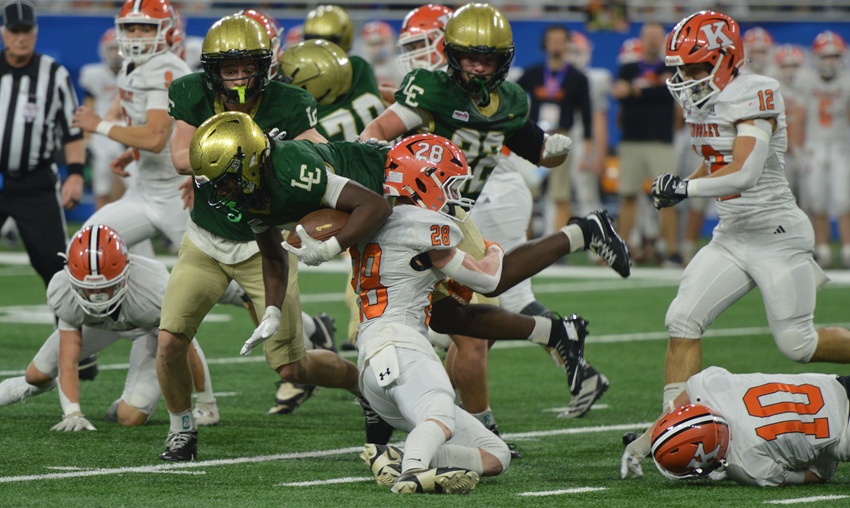
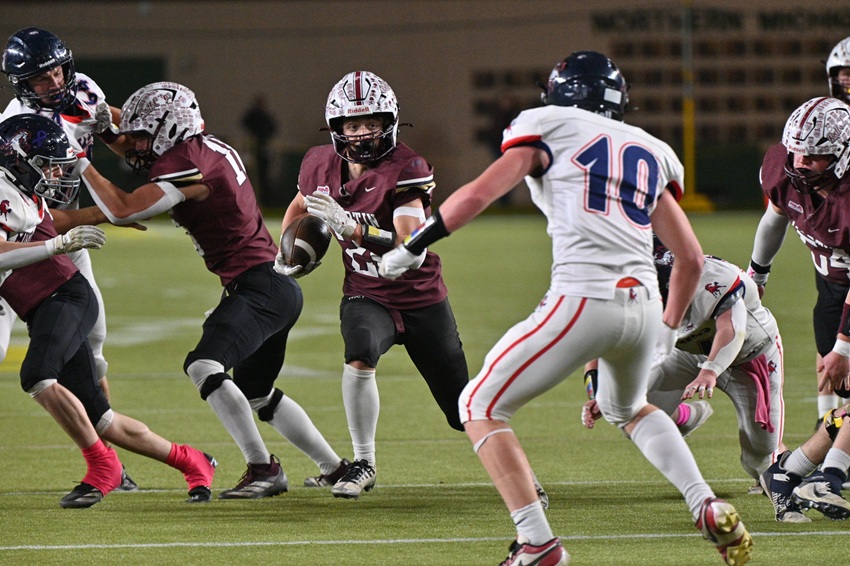
PHOTOS (Top) This collage shows action photos from all 10 MHSAA Finals played this season. (2) Orchard Lake St. Mary’s Kareem Pruit (7) brings down Dexter quarterback Cooper Arnedt in 11-player Division 2. (3) Kingsley’s Nolan Hodges (28) wraps up Lumen Christi’s Ayden Gatewood in Division 6. (4) Martin’s Seth Toris (24) charges through a hole with Montabella’s Noah Carlson lining up to attempt a tackle in 8-player Division 1.