

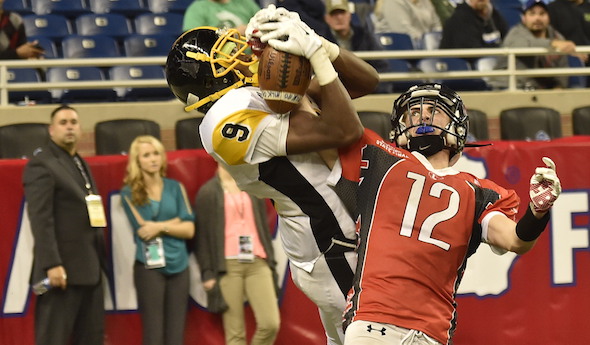
King Completes Perfect Run on Final Play
November 27, 2015
By Bill Khan
Special for Second Half
DETROIT — Armani Posey was supposed to be a two-week stopgap at quarterback for Detroit Martin Luther King.
 Two weeks turned into 11 weeks, building toward a championship finish for the ages.
In a moment that was “The Catch” and “The Drive” all rolled into one, Posey heaved a 40-yard touchdown pass to senior receiver Donnie Corley on the final play of the game to give King a 40-38 victory over Lowell in the Division 2 title game Friday at Ford Field.
Lowell led 31-13 in the third quarter before Posey responded by throwing four of his record-tying five touchdown passes in the final 15:41 of the game. The final drive began with 37 seconds remaining at King's 3-yard line after a punt out of bounds and a penalty.
It was a scenario tailor-made for John Elway — or Armani Posey.
"What happened today is a memory forever," Posey said. "I dreamed about that and went out there and did it today. I couldn't imagine that type of performance, but we got the job done. Shout-out to the O-line."
When the starter was suspended for two weeks, King coach Dale Harvel was in search of a quarterback for the Week 4 game against Detroit Denby and the week 5 game against eventual Division 1 finalist Detroit Cass Tech. Harvel wanted a mature senior to, at the very least, manage an offense that is loaded with Division I college prospects. Posey turned into much more than a game manager.
"What we found out was he settled down everybody in the offense, because the first week we struggled a little bit against (Warren) DeLaSalle and struggled against East (English) Village," Harvel said. "We were able to win because we were playing good defense. He's been a settling effect on our offense and we couldn't go away from him, because we were in a rhythm with our offense. So, we stuck with him all year."
Posey's first position was quarterback, but that was way back in his elementary school days playing in the Detroit Police Athletic League for the East Side Tigers. One of his teammates back in the day happened to be the young man with whom his legacy will forever be linked.
"He played quarterback when I played for the Tigers," Corley said. "He's always been a good quarterback. I didn't know he was going to play this well. He had five touchdowns for 300 yards today? That's amazing."
After starting the game with three three-and-outs and his team falling behind 17-0, Posey finished 19 for 27 for 383 yards, five touchdowns and no interceptions. He broke the MHSAA Finals record of 335 yards set by Olivet's Jay Cousineau in the 2010 Division 5 Final. He matched the record of five touchdown passes shared by Macomb Dakota's Mitch Lovett (2007, Division 1) and Cass Tech's Jayru Campbell (2011, Division 1). Posey also ran seven times for 20 yards and a touchdown.
It took a rare defensive stop by King to put Posey and Corley in a position to produce a moment that will be talked about for decades.
Lowell drove from its own 35 to King's 39 before its only negative play of the game, a 2-yard loss on a run by quarterback Ryan Stevens, forced only the second punt of the game for the Red Arrows. Stevens nailed the punt out of bounds at the 5 with 37 seconds left. An illegal procedure penalty on King before the first snap moved it back inside the 3.
"They battled, right down to where we punted the ball down to the 5 with (37) seconds on the clock," Lowell coach Noel Dean said. "I thought that would be a pretty good spot to be in. Credit them — they made the plays at the end."
 King made several plays on its way to the end zone.
A 22-yard pass to Lavert Hill, a 10-yard pass to Corley and a 25-yard pass to Dontre Boyd got the ball to the Lowell 40 with 10 seconds left. Boyd had to watch the final play from the sidelines, having injured his shoulder after his catch on a tackle by Alex Anschutz. Boyd had 126 yards on five catches.
"He could've easily dropped the football," Harvel said. "He focused on that football and knew he was going to get hit — a good legal hit. He caught the football and made the play for a first down for us and made the opportunity to throw that pass to Donnie. All of his teammates understand what he sacrificed for his football team out there today."
"To me, that was the biggest play of the game," said Corley, who was about to make the most memorable play of the 2015 season.
King had two shots at the end zone in the final 10 seconds. On the first play, Posey overthrew Ambry Thomas down the left side. Two seconds remained on the clock for a play that would make one team's dreams come true and crush another's.
As King lined up for the final play, Corley was in single coverage on the left side. This was an inviting prospect for the Crusaders, considering Corley is being recruited by Michigan, Michigan State, Notre Dame and Ohio State.
Corley said the Lowell cornerback called for safety help over the top, but that the safety didn't hear in the instructions.
"When we didn't see the safety move over, I was repeating, 'Throw it to Donnie, throw it to Donnie,'" Harvel said. "Nobody could hear me, but it was comforting to me to say that, even though nobody could hear me."
As Corley ran toward the left side of the end zone, Posey had time to heave the ball to his star receiver. Corley, who has a 37-inch vertical leap, won a jump ball against the corner who appeared to get a hand on the ball, then fell to the ground safely inbounds.
"It was a beautiful ball," said Corley, who caught six passes for 108 yards and two touchdowns. "It couldn't have been any better. He threw it just inbounds and in the back of the end zone. I knew where I was on the field. I couldn't believe it — I'm not gonna lie. We fought back from 17-0 and we won."
It's only the second time that the winning score in an MHSAA championship game took place on the final play. Steve Mann caught a 17-yard touchdown pass from Charlie Johnson to give Detroit Country Day an 18-14 victory over Muskegon Catholic Central in the 1986 Class C title game.
For most of the afternoon, this wasn't a championship game that appeared to be destined for a dramatic finish.
Max Dean's third touchdown run of the game, a 4-yarder with 8:24 left in the third quarter, gave Lowell a 31-13 lead. The Red Arrows had leads of 17-0 and 24-7 in the first half.
A 25-yard touchdown pass from Posey to Corley with 3:41 left in the third quarter and a 41-yard pass from Posey to Thomas got King back in the game, down only 31-26 with 11:44 remaining.
Lowell responded with a 10-play, 73-yard drive that culminated with a 2-yard touchdown run by Stevens with 7:10 remaining.
Aided by a personal foul for facemasking, King crept to within 38-34 on a 2-yard pass from Posey to Hill and a 2-point pass from Posey to Martell Pettaway with 4:42 to go.
Lowell got two first downs on its next possession, forcing the Crusaders to use their remaining timeouts. They were able to manage the clock well on the final drive, particularly when Hill gave up the opportunity for a few more yards to get out of bounds with 28 seconds left on the first play. The clock stopped temporarily when Corley's 10-yard catch got a first down. Boyd was on the field for a couple of minutes after being injured making his 25-yard catch, allowing King to discuss its options and be ready at the line when the clock started running as play resumed.
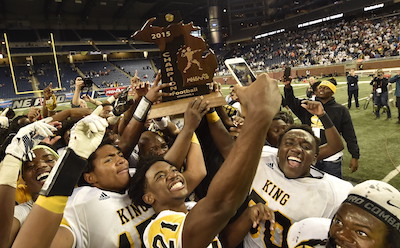
Corley's catch gave King its second MHSAA championship, matching the achievement of the 2007 team. It was King's fourth victory of three points or fewer in a 14-0 season.
Lowell scored on its first four possessions before taking a knee to end the first half during its fifth, leading 17-0 before King even registered a first down.
After getting first-and-goal at the King 5, Lowell settled for a 21-yard field goal by George Gonzales to open the scoring with 4:52 left in the first quarter.
A 36-yard pass to senior Gabe Steed was the key play on a 10-play, 70-yard scoring drive that ended with a 1-yard run by Dean with 11:03 left in the second quarter.
A 62-yard pass to a wide-open David Kruse on Lowell's third drive set up a 4-yard touchdown run by Stevens with 7:02 left in the first half. At this point, Lowell had a 173-9 advantage in total offense and a 17-0 lead.
It appeared King would suffer its fourth straight three-and-out to start the game when an intentional grounding penalty left the Crusaders facing third-and-20 from their own 25. That's when King's explosive offense finally showed life, as Boyd had a 73-yard catch and run down to the Lowell 2. Two plays later, Posey scored on a 3-yard bootleg to the right, cutting Lowell's lead to 17-7 with 4:21 left in the first half.
Lowell responded immediately, using a 66-yard pass to Sawyer Olesko to set up a 3-yard touchdown run by Dean with 1:53 to go in the first half, making it a 24-7 game.
King tightened the margin before the break, as Hill made an acrobatic 41-yard catch at the Lowell 12, then grabbed a 12-yard touchdown pass from Posey on the next play to cut Lowell's lead to 24-13 with 25 seconds left in the half. The extra point attempt failed.
Lowell (12-2) used some trickery to build its lead to 31-13, with Nathan Stephens taking a short direct snap on a fourth-and-one punt and running 38 yards to the King 5. Two plays later, Dean scored his third touchdown from four yards out with 8:24 left in the third quarter.
Dean finished with 99 yards rushing and three touchdowns on 22 carries. Stevens was 6 for 9 for 186 yards, running 22 times for 66 yards and two touchdowns.
The MHSAA Football Finals are sponsored by the Michigan National Guard.
PHOTOS: (Top) Detroit Martin Luther King’s Donnie Corley pulls down a touchdown pass on the final play of the game to give the Crusaders the lead and win. (Middle) King players celebrate their second MHSAA championship.
MHSAA Vault: Shooks a Legend as Freshman Coach
By
Geoff Kimmerly
MHSAA.com senior editor
September 4, 2026
The following originally appeared in the Lansing State Journal on Oct. 28, 2004, and was reprinted by the MHSAA that winter.
Wayne Shooks retired from coaching entirely in 2008 and died Tuesday at the age of 84.
Wayne Shooks tried the varsity football thing once. Some time during the late 1980s, longtime DeWitt coach Gail Thornton asked Shooks to be his offensive coordinator.
“I didn't sleep a night. My wife, after three weeks, said, ‘You're going back to freshmen,’” Shooks remembered.
And those three weeks were in the month of June.
But Shooks' wife must have been on to something. Because few, if any, freshman football coaches have accomplished what Shooks finished with one last win last fall.
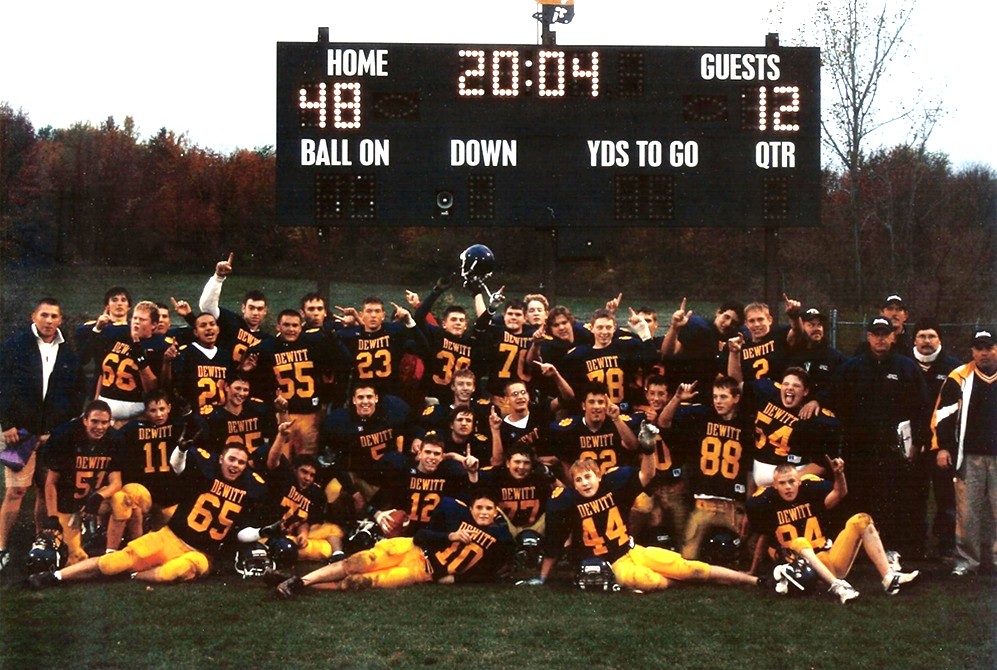
He ended his 16th and final season as freshman coach with a 135-2-1 record.
Amazing.
“You can't lose a game for him, or you'll feel bad,” DeWitt senior Mat Brynick recalled from his days as a freshman. “Coach never says it, but it's what everyone expects.
“He taught us how to win.”
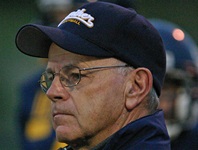 Guys like Shooks, 62, usually go unappreciated.
They get the kids fresh to high school, fresh to high school sports, and still learning things like not spiking the ball after a touchdown.
But few freshman football coaches are as legendary as Shooks is in DeWitt. They are so unappreciated that it's impossible to find out if anyone has accomplished what he's done.
Shook is not big on numbers. Never has been during his 41 years teaching in the district, or more than 20 coaching everything from football to basketball to wrestling to tennis. Oh, and track since 1980.
He also coached 8th-grade football for a few years, junior varsity for one season and was a varsity assistant. But he'll be remembered for what he did with the freshmen.
The losses came in 1993 to Mason during a terrible wind storm, and in 2002 to Greenville. That same year, the Panthers tied Haslett, meaning it was the only year during his tenure that DeWitt wasn't sure if it finished first in its league, since league titles aren't handed out at the freshmen level.
“The kids felt bad. They did their best,” Shooks remembered.
But the losses, however few, were more of a relief for Shooks than a letdown.
Don't take that to mean Shooks doesn't like to win.
Sure, he embraced the role of teacher as much as any freshman coach. But as DeWitt varsity coach Rob Zimmerman said, “If he was a 5th-grade coach, he'd be the most competitive 5th-grade coach you've ever seen.”
“I never pointed (our record) out, it was not our goal,” Shooks said. “Our goal was to win the next week. Although the kids knew it. They just assumed we were going to go 9-0, I guess.”
Guess so.
Shooks had more easily-attainable goals:
- Have fun
- Learn fundamentals
- Emphasize the logical stuff, like the importance of bringing equipment to school every day
“He does a really good job teaching expectations about being young men and being great students,” Zimmerman said. “It's gigantic.”
And it kept kids coming back to junior varsity and varsity. You could hear the fun coming out in Brynick's voice.
He was remembering his freshman football experience, remembering his time with perhaps Michigan's most successful coach at that level.
“I remember a few games, we'd find one play that works, and we ran it to death, pounding it and pounding it,” Brynick recalled. “He loves running the same play over and over. If you can do that, march 80 yards down the field, you're doing something right. No one could stop us.”
That was not all Brynick remembered, or didn't.
Shooks almost never yelled. If he did, it meant a kid messed something up over and over and over again.
He has a doctorate in zoology. Education is obviously a big deal. He loves to win, but he loves to teach. And he's hesitant to go looking for any attention for what he's done.
All made him a perfect freshmen football coach.
“Sometimes I don't think people understand about coaches. You think college level, they are coaches first, that's their job, but not at the high school level,” Shooks said.
“It's not what I've done, it's what they've done. I've always believed the focus should be on the kids. My job is a teacher. I coach because I love to coach.”
PHOTO DeWitt freshman coach Wayne Shooks, fourth from right, stands for a photo with this final football team in 2004. (Photos courtesy of the DeWitt football program.)