

King Completes Perfect Run on Final Play
November 27, 2015
By Bill Khan
Special for Second Half
DETROIT — Armani Posey was supposed to be a two-week stopgap at quarterback for Detroit Martin Luther King.
 Two weeks turned into 11 weeks, building toward a championship finish for the ages.
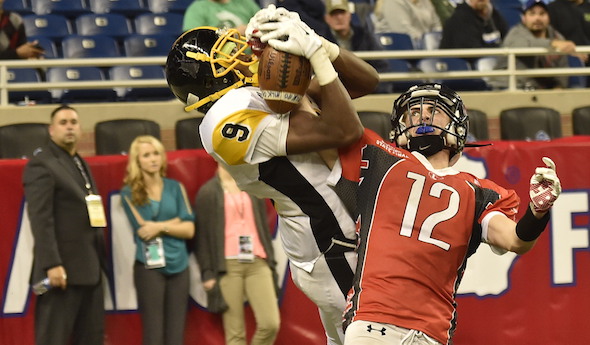
In a moment that was “The Catch” and “The Drive” all rolled into one, Posey heaved a 40-yard touchdown pass to senior receiver Donnie Corley on the final play of the game to give King a 40-38 victory over Lowell in the Division 2 title game Friday at Ford Field.
Lowell led 31-13 in the third quarter before Posey responded by throwing four of his record-tying five touchdown passes in the final 15:41 of the game. The final drive began with 37 seconds remaining at King's 3-yard line after a punt out of bounds and a penalty.
It was a scenario tailor-made for John Elway — or Armani Posey.
"What happened today is a memory forever," Posey said. "I dreamed about that and went out there and did it today. I couldn't imagine that type of performance, but we got the job done. Shout-out to the O-line."
When the starter was suspended for two weeks, King coach Dale Harvel was in search of a quarterback for the Week 4 game against Detroit Denby and the week 5 game against eventual Division 1 finalist Detroit Cass Tech. Harvel wanted a mature senior to, at the very least, manage an offense that is loaded with Division I college prospects. Posey turned into much more than a game manager.
"What we found out was he settled down everybody in the offense, because the first week we struggled a little bit against (Warren) DeLaSalle and struggled against East (English) Village," Harvel said. "We were able to win because we were playing good defense. He's been a settling effect on our offense and we couldn't go away from him, because we were in a rhythm with our offense. So, we stuck with him all year."
Posey's first position was quarterback, but that was way back in his elementary school days playing in the Detroit Police Athletic League for the East Side Tigers. One of his teammates back in the day happened to be the young man with whom his legacy will forever be linked.
"He played quarterback when I played for the Tigers," Corley said. "He's always been a good quarterback. I didn't know he was going to play this well. He had five touchdowns for 300 yards today? That's amazing."
After starting the game with three three-and-outs and his team falling behind 17-0, Posey finished 19 for 27 for 383 yards, five touchdowns and no interceptions. He broke the MHSAA Finals record of 335 yards set by Olivet's Jay Cousineau in the 2010 Division 5 Final. He matched the record of five touchdown passes shared by Macomb Dakota's Mitch Lovett (2007, Division 1) and Cass Tech's Jayru Campbell (2011, Division 1). Posey also ran seven times for 20 yards and a touchdown.
It took a rare defensive stop by King to put Posey and Corley in a position to produce a moment that will be talked about for decades.
Lowell drove from its own 35 to King's 39 before its only negative play of the game, a 2-yard loss on a run by quarterback Ryan Stevens, forced only the second punt of the game for the Red Arrows. Stevens nailed the punt out of bounds at the 5 with 37 seconds left. An illegal procedure penalty on King before the first snap moved it back inside the 3.
"They battled, right down to where we punted the ball down to the 5 with (37) seconds on the clock," Lowell coach Noel Dean said. "I thought that would be a pretty good spot to be in. Credit them — they made the plays at the end."
 King made several plays on its way to the end zone.
A 22-yard pass to Lavert Hill, a 10-yard pass to Corley and a 25-yard pass to Dontre Boyd got the ball to the Lowell 40 with 10 seconds left. Boyd had to watch the final play from the sidelines, having injured his shoulder after his catch on a tackle by Alex Anschutz. Boyd had 126 yards on five catches.
"He could've easily dropped the football," Harvel said. "He focused on that football and knew he was going to get hit — a good legal hit. He caught the football and made the play for a first down for us and made the opportunity to throw that pass to Donnie. All of his teammates understand what he sacrificed for his football team out there today."
"To me, that was the biggest play of the game," said Corley, who was about to make the most memorable play of the 2015 season.
King had two shots at the end zone in the final 10 seconds. On the first play, Posey overthrew Ambry Thomas down the left side. Two seconds remained on the clock for a play that would make one team's dreams come true and crush another's.
As King lined up for the final play, Corley was in single coverage on the left side. This was an inviting prospect for the Crusaders, considering Corley is being recruited by Michigan, Michigan State, Notre Dame and Ohio State.
Corley said the Lowell cornerback called for safety help over the top, but that the safety didn't hear in the instructions.
"When we didn't see the safety move over, I was repeating, 'Throw it to Donnie, throw it to Donnie,'" Harvel said. "Nobody could hear me, but it was comforting to me to say that, even though nobody could hear me."
As Corley ran toward the left side of the end zone, Posey had time to heave the ball to his star receiver. Corley, who has a 37-inch vertical leap, won a jump ball against the corner who appeared to get a hand on the ball, then fell to the ground safely inbounds.
"It was a beautiful ball," said Corley, who caught six passes for 108 yards and two touchdowns. "It couldn't have been any better. He threw it just inbounds and in the back of the end zone. I knew where I was on the field. I couldn't believe it — I'm not gonna lie. We fought back from 17-0 and we won."
It's only the second time that the winning score in an MHSAA championship game took place on the final play. Steve Mann caught a 17-yard touchdown pass from Charlie Johnson to give Detroit Country Day an 18-14 victory over Muskegon Catholic Central in the 1986 Class C title game.
For most of the afternoon, this wasn't a championship game that appeared to be destined for a dramatic finish.
Max Dean's third touchdown run of the game, a 4-yarder with 8:24 left in the third quarter, gave Lowell a 31-13 lead. The Red Arrows had leads of 17-0 and 24-7 in the first half.
A 25-yard touchdown pass from Posey to Corley with 3:41 left in the third quarter and a 41-yard pass from Posey to Thomas got King back in the game, down only 31-26 with 11:44 remaining.
Lowell responded with a 10-play, 73-yard drive that culminated with a 2-yard touchdown run by Stevens with 7:10 remaining.
Aided by a personal foul for facemasking, King crept to within 38-34 on a 2-yard pass from Posey to Hill and a 2-point pass from Posey to Martell Pettaway with 4:42 to go.
Lowell got two first downs on its next possession, forcing the Crusaders to use their remaining timeouts. They were able to manage the clock well on the final drive, particularly when Hill gave up the opportunity for a few more yards to get out of bounds with 28 seconds left on the first play. The clock stopped temporarily when Corley's 10-yard catch got a first down. Boyd was on the field for a couple of minutes after being injured making his 25-yard catch, allowing King to discuss its options and be ready at the line when the clock started running as play resumed.
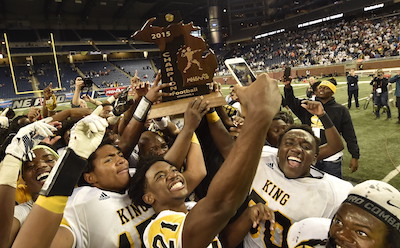
Corley's catch gave King its second MHSAA championship, matching the achievement of the 2007 team. It was King's fourth victory of three points or fewer in a 14-0 season.
Lowell scored on its first four possessions before taking a knee to end the first half during its fifth, leading 17-0 before King even registered a first down.
After getting first-and-goal at the King 5, Lowell settled for a 21-yard field goal by George Gonzales to open the scoring with 4:52 left in the first quarter.
A 36-yard pass to senior Gabe Steed was the key play on a 10-play, 70-yard scoring drive that ended with a 1-yard run by Dean with 11:03 left in the second quarter.
A 62-yard pass to a wide-open David Kruse on Lowell's third drive set up a 4-yard touchdown run by Stevens with 7:02 left in the first half. At this point, Lowell had a 173-9 advantage in total offense and a 17-0 lead.
It appeared King would suffer its fourth straight three-and-out to start the game when an intentional grounding penalty left the Crusaders facing third-and-20 from their own 25. That's when King's explosive offense finally showed life, as Boyd had a 73-yard catch and run down to the Lowell 2. Two plays later, Posey scored on a 3-yard bootleg to the right, cutting Lowell's lead to 17-7 with 4:21 left in the first half.
Lowell responded immediately, using a 66-yard pass to Sawyer Olesko to set up a 3-yard touchdown run by Dean with 1:53 to go in the first half, making it a 24-7 game.
King tightened the margin before the break, as Hill made an acrobatic 41-yard catch at the Lowell 12, then grabbed a 12-yard touchdown pass from Posey on the next play to cut Lowell's lead to 24-13 with 25 seconds left in the half. The extra point attempt failed.
Lowell (12-2) used some trickery to build its lead to 31-13, with Nathan Stephens taking a short direct snap on a fourth-and-one punt and running 38 yards to the King 5. Two plays later, Dean scored his third touchdown from four yards out with 8:24 left in the third quarter.
Dean finished with 99 yards rushing and three touchdowns on 22 carries. Stevens was 6 for 9 for 186 yards, running 22 times for 66 yards and two touchdowns.
The MHSAA Football Finals are sponsored by the Michigan National Guard.
PHOTOS: (Top) Detroit Martin Luther King’s Donnie Corley pulls down a touchdown pass on the final play of the game to give the Crusaders the lead and win. (Middle) King players celebrate their second MHSAA championship.
1st & Goal: 2026 Week 2 Preview
By
Geoff Kimmerly
MHSAA.com senior editor
September 3, 2026
If you’re traveling for the long weekend and see stadium lights shining in the distance, you might want to make a quick stop and check out one of these matchups.
 Nearly 80 percent of this weekend’s games will be played Thursday, although those waiting for Friday won’t miss out as there are plenty of opportunities that night as well to see high-profile nonleague clashes or conference openers that could eventually determine championships.
Staying close to home? Tune in to the NFHS Network for the majority of games across the state, and follow the MHSAA Scores page for results as they’re submitted.
Bay & Thumb
Almont (1-0) at Armada (1-0) – Thursday
Almont has continued to set the standard in the Blue Water Area Conference with three straight league championships. The Raiders’ most recent league loss came in 2022 – to Armada, which has finished second once and third in the league twice over that stretch. Both opened this season with wins over 2025 playoff teams, Armada over St. Clair Shores Lakeview and Almont over Marysville.
Keep an eye on these THURSDAY Saginaw Swan Valley (1-0) at Freeland (0-1), Lapeer (0-1) at Goodrich (1-0), Saginaw Heritage (0-1) at Midland Dow (1-0), Marysville (0-1) at Port Huron (1-0).
Greater Detroit
Detroit Martin Luther King (1-0) at Orchard Lake St. Mary’s (1-0) – Friday
This power pair is facing off for the first time since 2006, and theirs will certainly be one of the most discussed games statewide this weekend. St. Mary’s is coming off winning last season’s Division 2 championship and opened with a 35-27 win over Muskegon Mona Shores, while King reached the Division 3 Regional Finals last fall and began this one by downing annual Ohio contender Toledo Whitmer.
Keep an eye on these THURSDAY Howell (1-0) at Belleville (0-1), Rochester Adams (0-1) at Rochester (1-0), Clarkston (1-0) at Rochester Hills Stoney Creek (1-0). FRIDAY Davison (1-0) at Detroit Catholic Central (1-0).
Mid-Michigan
DeWitt (1-0) at Mason (1-0) – Thursday
This has developed into one of the most intriguing rivalries in the Lansing area, with both teams playing at Ford Field over the last three seasons – with 2023 also when these two started their current series. DeWitt has a 2-1 edge and won last year’s matchup 44-37 – the Panthers’ closest game during a run to the Division 3 championship – but Mason has brought back nearly its entire starting lineup this fall.
Keep an eye on these THURSDAY Fenton (0-1) at Haslett (0-1), Durand (1-0) at New Lothrop (1-0), Lansing Sexton (1-0) at Portland (1-0), Hastings (0-1) at Williamston (1-0).
Northern Lower Peninsula
Ogemaw Heights (1-0) at Traverse City St. Francis (1-0) – Friday
Ogemaw Heights made its first run to the Semifinals last season since 2009, and its only loss of the regular season came 42-32 to St. Francis in Week 2. The Falcons opened last week with an impressive win over Freeland, and the Gladiators downed Elk Rapids. This matchup is joined on St. Francis’ schedule by three games against teams that finished last season at Ford Field.
Keep an eye on these THURSDAY Escanaba (0-1) at Gaylord (1-0), East Jordan (0-1) at Oscoda (0-1). FRIDAY Boyne City (0-1) at Charlevoix (1-0), Grand Rapids Christian (0-1) at Traverse City West (0-1).
Southeast & Border
Pewamo-Westphalia (1-0) at Ottawa Lake Whiteford (0-1) – Friday
These two small-school powers are playing for the first time, but it might not be the last time this season as both stand to be in the Division 7 playoff chase in two months. Whiteford also played a first-time opponent last week, falling to Monroe St. Mary Catholic Central 37-28, while the Pirates are also coming off a tough opener after having outlasted North Muskegon 17-9.
Keep an eye on these THURSDAY Monroe Jefferson (1-0) at Carleton Airport (0-1), Brooklyn Columbia Central (1-0) at Michigan Center (1-0), Union City (1-0) at Reading (1-0). FRIDAY Flat Rock (0-1) at Monroe St. Mary Catholic Central (1-0).
Southwest Corridor
Cedar Springs (0-1) at Battle Creek Harper Creek (1-0) – Friday
Harper Creek hasn’t received enough attention for its run over the last three seasons, which has included two straight Interstate 8 Athletic Conference titles and a combined 22-6 record. The Beavers opened this campaign with a fourth-straight win (and third-straight shutout) of rival Battle Creek Lakeview and now will have a chance to avenge last fall’s lone regular-season loss. Cedar Springs won that Week 2 matchup 30-20 and is seeking to bounce back after falling to Zeeland West last week.
Keep an eye on these THURSDAY Grand Rapids Forest Hills Central (0-1) at Portage Central (0-1), Lansing Everett (0-1) at Battle Creek Central (1-0). FRIDAY Stevensville Lakeshore (1-0) at Niles (0-1), Lowell (0-1) at St. Joseph (1-0).
Upper Peninsula
Menominee (1-0) at Marquette (1-0) – Thursday
These former Great Northern Conference rivals are meeting for the first time since 2022, the last season of football for that league. The Sentinels have won four of their last five matchups, but both have found success since their last time facing off. Over the last three seasons, Menominee has played at Ford Field twice – winning last year’s Division 7 title – and Marquette has reached the Division 3 playoffs twice and opened with a close but impressive loss last week to Negaunee.
Keep an eye on these THURSDAY Ishpeming Westwood (0-1) at Calumet (1-0), Houghton (0-1) at Kingsford (1-0). FRIDAY Gladstone (1-0) at Negaunee (1-0), North Muskegon (0-1) vs. Iron Mountain (1-0) at Petoskey.
West Michigan
East Kentwood (1-0) at Byron Center (1-0) – Thursday
Rare are the days when Muskegon/Rockford isn’t be the default “game of the week” in West Michigan. But don’t look past this matchup this time. East Kentwood is coming off a run to the Division 1 Semifinals last season, which included a 43-14 win over 2024 Division 2 runner-up Byron Center in Week 2. The Bulldogs emerged from an 0-2 start last season, including that defeat by the Falcons, to go 7-2 the rest of the way, and they’ve already avenged the first of last year’s losses by downing Hudsonville 41-20 last week.
Keep an eye on these THURSDAY Grand Rapids South Christian (1-0) at East Grand Rapids (1-0), Detroit Cass Tech (1-0) at Grandville (1-0). FRIDAY Muskegon (0-1) at Rockford (0-1), Midland (1-0) at Zeeland West (1-0).
8-Player
Portland St. Patrick at Blanchard Montabella – Friday
There may not be a team in MHSAA 8-player football history that scheduled a tougher slate to start the season than Montabella, which avenged last fall’s Division 1 championship game loss with a 62-12 win over Martin last week and now gets the reigning Division 2 champion Shamrocks. St. Patrick handed the Mustangs their only regular-season defeat a year ago, 42-16, in Week 9 on the way to a perfect run, and even had a few more days to prepare this time with its Week 1 opponent Wyoming Tri-unity Christian canceling its season.
Keep an eye on these THURSDAY Merrill (1-0) at Morrice (1-0), Central Lake (1-0) at Gaylord St. Mary (1-0), Britton Deerfield (1-0) at Climax-Scotts (1-0). FRIDAY Pickford (1-0) at Rudyard (1-0).
MHSAA.com's weekly “1st & Goal” previews and reviews are powered by MI Student Aid, a division within the Department of Lifelong Education, Advancement, and Potential (MiLEAP). MI Student Aid encourages students to pursue postsecondary education by providing access to student financial resources and information. MI Student Aid administers the state’s scholarship and grant programs that help make college Accessible, Affordable and Attainable for you. Click to connect with MI Student Aid and find more information on Facebook and Twitter @mistudentaid.
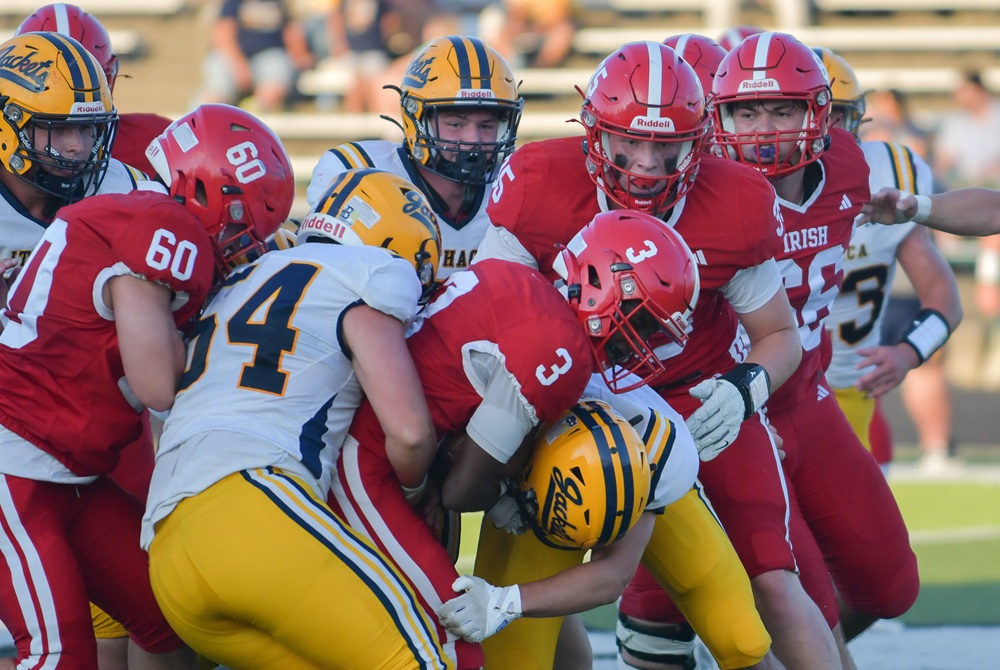
PHOTO Ithaca defenders wrap up a Mount Pleasant Sacred Heart ball carrier during their 48-6 Week 1 win. (Click for more from High School Sports Scene.)