

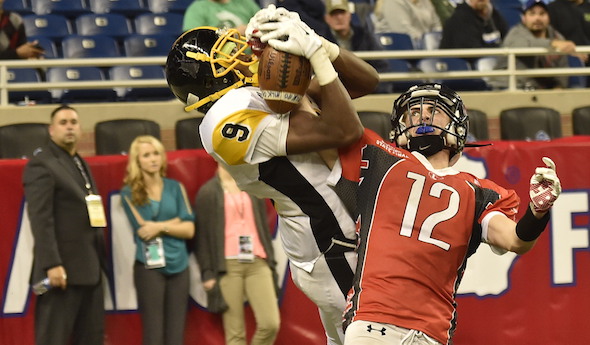
King Completes Perfect Run on Final Play
November 27, 2015
By Bill Khan
Special for Second Half
DETROIT — Armani Posey was supposed to be a two-week stopgap at quarterback for Detroit Martin Luther King.
 Two weeks turned into 11 weeks, building toward a championship finish for the ages.
In a moment that was “The Catch” and “The Drive” all rolled into one, Posey heaved a 40-yard touchdown pass to senior receiver Donnie Corley on the final play of the game to give King a 40-38 victory over Lowell in the Division 2 title game Friday at Ford Field.
Lowell led 31-13 in the third quarter before Posey responded by throwing four of his record-tying five touchdown passes in the final 15:41 of the game. The final drive began with 37 seconds remaining at King's 3-yard line after a punt out of bounds and a penalty.
It was a scenario tailor-made for John Elway — or Armani Posey.
"What happened today is a memory forever," Posey said. "I dreamed about that and went out there and did it today. I couldn't imagine that type of performance, but we got the job done. Shout-out to the O-line."
When the starter was suspended for two weeks, King coach Dale Harvel was in search of a quarterback for the Week 4 game against Detroit Denby and the week 5 game against eventual Division 1 finalist Detroit Cass Tech. Harvel wanted a mature senior to, at the very least, manage an offense that is loaded with Division I college prospects. Posey turned into much more than a game manager.
"What we found out was he settled down everybody in the offense, because the first week we struggled a little bit against (Warren) DeLaSalle and struggled against East (English) Village," Harvel said. "We were able to win because we were playing good defense. He's been a settling effect on our offense and we couldn't go away from him, because we were in a rhythm with our offense. So, we stuck with him all year."
Posey's first position was quarterback, but that was way back in his elementary school days playing in the Detroit Police Athletic League for the East Side Tigers. One of his teammates back in the day happened to be the young man with whom his legacy will forever be linked.
"He played quarterback when I played for the Tigers," Corley said. "He's always been a good quarterback. I didn't know he was going to play this well. He had five touchdowns for 300 yards today? That's amazing."
After starting the game with three three-and-outs and his team falling behind 17-0, Posey finished 19 for 27 for 383 yards, five touchdowns and no interceptions. He broke the MHSAA Finals record of 335 yards set by Olivet's Jay Cousineau in the 2010 Division 5 Final. He matched the record of five touchdown passes shared by Macomb Dakota's Mitch Lovett (2007, Division 1) and Cass Tech's Jayru Campbell (2011, Division 1). Posey also ran seven times for 20 yards and a touchdown.
It took a rare defensive stop by King to put Posey and Corley in a position to produce a moment that will be talked about for decades.
Lowell drove from its own 35 to King's 39 before its only negative play of the game, a 2-yard loss on a run by quarterback Ryan Stevens, forced only the second punt of the game for the Red Arrows. Stevens nailed the punt out of bounds at the 5 with 37 seconds left. An illegal procedure penalty on King before the first snap moved it back inside the 3.
"They battled, right down to where we punted the ball down to the 5 with (37) seconds on the clock," Lowell coach Noel Dean said. "I thought that would be a pretty good spot to be in. Credit them — they made the plays at the end."
 King made several plays on its way to the end zone.
A 22-yard pass to Lavert Hill, a 10-yard pass to Corley and a 25-yard pass to Dontre Boyd got the ball to the Lowell 40 with 10 seconds left. Boyd had to watch the final play from the sidelines, having injured his shoulder after his catch on a tackle by Alex Anschutz. Boyd had 126 yards on five catches.
"He could've easily dropped the football," Harvel said. "He focused on that football and knew he was going to get hit — a good legal hit. He caught the football and made the play for a first down for us and made the opportunity to throw that pass to Donnie. All of his teammates understand what he sacrificed for his football team out there today."
"To me, that was the biggest play of the game," said Corley, who was about to make the most memorable play of the 2015 season.
King had two shots at the end zone in the final 10 seconds. On the first play, Posey overthrew Ambry Thomas down the left side. Two seconds remained on the clock for a play that would make one team's dreams come true and crush another's.
As King lined up for the final play, Corley was in single coverage on the left side. This was an inviting prospect for the Crusaders, considering Corley is being recruited by Michigan, Michigan State, Notre Dame and Ohio State.
Corley said the Lowell cornerback called for safety help over the top, but that the safety didn't hear in the instructions.
"When we didn't see the safety move over, I was repeating, 'Throw it to Donnie, throw it to Donnie,'" Harvel said. "Nobody could hear me, but it was comforting to me to say that, even though nobody could hear me."
As Corley ran toward the left side of the end zone, Posey had time to heave the ball to his star receiver. Corley, who has a 37-inch vertical leap, won a jump ball against the corner who appeared to get a hand on the ball, then fell to the ground safely inbounds.
"It was a beautiful ball," said Corley, who caught six passes for 108 yards and two touchdowns. "It couldn't have been any better. He threw it just inbounds and in the back of the end zone. I knew where I was on the field. I couldn't believe it — I'm not gonna lie. We fought back from 17-0 and we won."
It's only the second time that the winning score in an MHSAA championship game took place on the final play. Steve Mann caught a 17-yard touchdown pass from Charlie Johnson to give Detroit Country Day an 18-14 victory over Muskegon Catholic Central in the 1986 Class C title game.
For most of the afternoon, this wasn't a championship game that appeared to be destined for a dramatic finish.
Max Dean's third touchdown run of the game, a 4-yarder with 8:24 left in the third quarter, gave Lowell a 31-13 lead. The Red Arrows had leads of 17-0 and 24-7 in the first half.
A 25-yard touchdown pass from Posey to Corley with 3:41 left in the third quarter and a 41-yard pass from Posey to Thomas got King back in the game, down only 31-26 with 11:44 remaining.
Lowell responded with a 10-play, 73-yard drive that culminated with a 2-yard touchdown run by Stevens with 7:10 remaining.
Aided by a personal foul for facemasking, King crept to within 38-34 on a 2-yard pass from Posey to Hill and a 2-point pass from Posey to Martell Pettaway with 4:42 to go.
Lowell got two first downs on its next possession, forcing the Crusaders to use their remaining timeouts. They were able to manage the clock well on the final drive, particularly when Hill gave up the opportunity for a few more yards to get out of bounds with 28 seconds left on the first play. The clock stopped temporarily when Corley's 10-yard catch got a first down. Boyd was on the field for a couple of minutes after being injured making his 25-yard catch, allowing King to discuss its options and be ready at the line when the clock started running as play resumed.
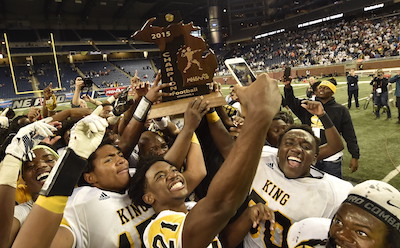
Corley's catch gave King its second MHSAA championship, matching the achievement of the 2007 team. It was King's fourth victory of three points or fewer in a 14-0 season.
Lowell scored on its first four possessions before taking a knee to end the first half during its fifth, leading 17-0 before King even registered a first down.
After getting first-and-goal at the King 5, Lowell settled for a 21-yard field goal by George Gonzales to open the scoring with 4:52 left in the first quarter.
A 36-yard pass to senior Gabe Steed was the key play on a 10-play, 70-yard scoring drive that ended with a 1-yard run by Dean with 11:03 left in the second quarter.
A 62-yard pass to a wide-open David Kruse on Lowell's third drive set up a 4-yard touchdown run by Stevens with 7:02 left in the first half. At this point, Lowell had a 173-9 advantage in total offense and a 17-0 lead.
It appeared King would suffer its fourth straight three-and-out to start the game when an intentional grounding penalty left the Crusaders facing third-and-20 from their own 25. That's when King's explosive offense finally showed life, as Boyd had a 73-yard catch and run down to the Lowell 2. Two plays later, Posey scored on a 3-yard bootleg to the right, cutting Lowell's lead to 17-7 with 4:21 left in the first half.
Lowell responded immediately, using a 66-yard pass to Sawyer Olesko to set up a 3-yard touchdown run by Dean with 1:53 to go in the first half, making it a 24-7 game.
King tightened the margin before the break, as Hill made an acrobatic 41-yard catch at the Lowell 12, then grabbed a 12-yard touchdown pass from Posey on the next play to cut Lowell's lead to 24-13 with 25 seconds left in the half. The extra point attempt failed.
Lowell (12-2) used some trickery to build its lead to 31-13, with Nathan Stephens taking a short direct snap on a fourth-and-one punt and running 38 yards to the King 5. Two plays later, Dean scored his third touchdown from four yards out with 8:24 left in the third quarter.
Dean finished with 99 yards rushing and three touchdowns on 22 carries. Stevens was 6 for 9 for 186 yards, running 22 times for 66 yards and two touchdowns.
The MHSAA Football Finals are sponsored by the Michigan National Guard.
PHOTOS: (Top) Detroit Martin Luther King’s Donnie Corley pulls down a touchdown pass on the final play of the game to give the Crusaders the lead and win. (Middle) King players celebrate their second MHSAA championship.

MHSAA Provides Update on 2025 Football Playoff Hopefuls, Bracket Reveal Schedule
By
Geoff Kimmerly
MHSAA.com senior editor
October 23, 2025
Here is a list of Michigan High School Athletic Association football playing schools, displaying their win-loss records and playoff averages through the eighth week of the season, plus information on this season's MHSAA Playoffs bracket and Finals schedule announcements.
Schools on this list are divided by division and ordered by playoff average. The top 32 teams by playoff average in each 11-player division and top 16 teams by playoff average in each 8-player division will qualify for the MHSAA Football Playoffs beginning Oct. 31. Divisions were determined prior to the start of the season, and the lists below include not only teams currently positioned to potentially qualify, but also the next eight teams in each division.
To review a list of all football playoff schools, individual school playoff point details and to report errors, visit the Football Playoff Point Summary page.
The announcement of the qualifiers and first-round pairings for both the 11 and 8-player playoffs will take place at 5 p.m. Sunday, Oct. 26, on the “Selection Sunday Show” on the NFHS Network. A subscription is not required to watch the Selection Sunday Show.
The playoff qualifiers and pairings will be posted to the MHSAA Website following the Selection Sunday Show, and times and dates will be added Monday, Oct. 27.
The MHSAA Football Playoffs conclude with the 8-Player Finals on Nov. 22 at Northern Michigan University’s Superior Dome and 11-Player Finals to be played Nov. 28 and 30 at Ford Field.
11-Player Division 1
1. Clarkston, 7-1, 83.125
2. Hudsonville, 8-0, 82.000
3. Detroit Catholic Central, 8-0, 76.661
4. Grand Blanc, 8-0, 76.625
5. Saline, 7-1, 75.875
6. Belleville, 7-1, 74.500
7. Howell, 7-1, 72.875
7. Rochester Adams, 6-2, 72.875
7. Rockford, 6-2, 72.875
10. Detroit Cass Tech, 8-0, 72.500
11. Brownstown Woodhaven, 7-1, 70.750
12. Oxford, 6-2, 70.000
13. Romeo, 6-2, 69.875
14. Brighton, 6-2, 68.250
15. West Bloomfield, 6-2, 67.750
16. Davison, 7-1, 67.375
17. East Kentwood, 6-2, 67.000
18. Dearborn Fordson, 6-2, 66.250
19. Farmington, 6-2, 65.875
20. Macomb Dakota, 6-2, 64.625
21. Northville, 6-2, 63.750
22. Utica, 6-2, 63.375
23. Grand Ledge, 6-2, 62.000
24. Rochester Hills Stoney Creek, 5-3, 58.750
25. Utica Eisenhower, 5-3, 57.375
26. Sterling Heights Stevenson, 5-3, 57.125
27. Grandville, 4-4, 54.125
28. Jenison, 4-4, 53.375
29. Hartland, 4-4, 52.500
30. Dearborn, 4-4, 50.500
31. Salem, 4-4, 50.250
32. Ann Arbor Huron, 4-4, 49.625
33. Rochester, 4-4, 48.875
34. Kalamazoo Central, 5-3, 48.500
35. Caledonia, 3-5, 44.286
36. Novi, 3-5, 44.250
37. Ann Arbor Pioneer, 3-5, 43.750
38. Livonia Stevenson, 3-5, 43.625
39. Holt, 4-4, 43.250
40. Walled Lake Northern, 3-5, 42.375
11-Player Division 2
1. South Lyon, 8-0, 75.875
2. Dexter, 7-1, 73.875
3. Gibraltar Carlson, 8-0, 73.375
4. Portage Central, 8-0, 72.500
5. Grosse Pointe South, 7-1, 70.125
6. Midland Dow, 7-1, 66.750
7. Walled Lake Western, 6-2, 65.875
8. Port Huron Northern, 6-2, 65.625
9. Livonia Franklin, 6-2, 64.750
10. Muskegon, 6-2, 64.458
11. White Lake Lakeland, 6-2, 64.375
12. St. Clair Shores Lakeview, 6-2, 61.125
13. Byron Center, 5-3, 59.875
14. North Farmington, 5-3, 59.500
15. Portage Northern, 6-2, 59.179
16. Warren Cousino, 6-2, 59.125
17. Orchard Lake St. Mary's, 5-2, 58.893
18. Birmingham Groves, 5-3, 55.000
18. Birmingham Seaholm, 5-3, 55.000
20. Lansing Everett, 5-3, 54.875
20. Traverse City Central, 5-3, 54.875
22. Lincoln Park, 5-3, 53.500
23. Allen Park, 5-3, 53.250
24. Traverse City West, 4-4, 52.500
25. Roseville, 4-4, 52.000
25. Temperance Bedford, 4-4, 52.000
27. Muskegon Mona Shores, 5-3, 51.875
28. Waterford Mott, 4-4, 51.000
29. East Lansing, 3-5, 49.000
30. Grand Rapids Northview, 5-3, 48.875
31. Milford, 4-4, 47.250
32. Bloomfield Hills Brother Rice, 4-4, 47.161
33. South Lyon East, 4-4, 47.125
34. Warren Mott, 4-4, 46.875
35. Midland, 4-4, 45.000
36. Dearborn Heights Crestwood, 5-3, 44.375
37. Saginaw Heritage, 3-5, 43.000
38. Ferndale, 4-4, 41.875
39. Southgate Anderson, 3-5, 41.750
40. Battle Creek Central, 4-4, 41.625
40. Berkley, 4-4, 41.625
40. Oak Park, 3-5, 41.625
11-Player Division 3
1. DeWitt, 8-0, 76.458
2. Mount Pleasant, 8-0, 75.000
3. Gaylord, 8-0, 65.625
4. Niles, 8-0, 65.000
5. Grand Rapids Kenowa Hills, 7-1, 64.750
6. Warren Fitzgerald, 7-1, 63.750
7. Adrian, 7-1, 58.500
7. East Grand Rapids, 6-2, 58.500
9. Detroit Martin Luther King, 5-3, 57.667
10. Cedar Springs, 7-1, 57.500
11. Ypsilanti Lincoln, 6-2, 56.875
12. Port Huron, 5-3, 56.250
13. Hastings, 6-2, 56.000
13. Lowell, 6-2, 56.000
15. Fenton, 5-3, 55.625
16. Mason, 5-3, 53.625
16. St. Joseph, 5-3, 53.625
18. Zeeland West, 6-2, 53.125
19. Holly, 5-3, 52.500
20. Marysville, 6-2, 51.125
21. Redford Thurston, 6-2, 50.625
22. Zeeland East, 5-3, 50.250
23. Coldwater, 6-2, 49.375
24. Linden, 6-2, 49.125
24. Middleville Thornapple Kellogg, 5-3, 49.125
26. Trenton, 4-4, 48.250
27. Marquette, 5-3, 48.000
28. Riverview, 6-2, 45.750
29. Coopersville, 4-4, 45.500
30. Warren De La Salle Collegiate, 3-5, 44.929
31. Owosso, 5-3, 44.875
32. Bay City John Glenn, 5-3, 42.625
33. Bay City Western, 3-5, 41.375
34. Fruitport, 4-4, 40.875
35. Petoskey, 4-4, 40.125
36. Stevensville Lakeshore, 3-5, 38.000
37. Ypsilanti Community, 3-5, 37.500
38. Jackson Northwest, 3-5, 36.125
39. Grand Rapids Forest Hills Central, 2-6, 35.375
40. River Rouge, 2-6, 35.292
11-Player Division 4
1. Harper Woods, 8-0, 84.750
2. Williamston, 8-0, 65.375
3. Goodrich, 8-0, 64.875
4. Hudsonville Unity Christian, 8-0, 64.750
5. Chelsea, 7-1, 63.750
6. Battle Creek Harper Creek, 7-1, 61.625
7. Haslett, 6-2, 58.125
8. Escanaba, 7-1, 57.750
9. Dearborn Divine Child, 7-1, 57.042
10. Portland, 8-0, 56.000
11. Ludington, 8-0, 54.375
12. Redford Union, 6-2, 52.625
13. Wyoming Godwin Heights, 7-1, 52.375
14. Madison Heights Lamphere, 5-3, 51.875
15. Center Line, 7-1, 51.250
15. Paw Paw, 5-3, 51.250
17. Big Rapids, 7-1, 51.125
18. Edwardsburg, 6-2, 50.375
19. Vicksburg, 5-3, 48.875
20. Grand Rapids South Christian, 4-4, 47.625
21. Freeland, 6-2, 47.375
22. Tecumseh, 5-3, 47.000
23. Macomb Lutheran North, 7-1, 45.625
24. Grand Rapids Christian, 5-3, 45.500
25. Harper Woods Chandler Park, 6-2, 44.250
26. Spring Lake, 5-3, 43.750
26. Three Rivers, 4-4, 43.750
28. St. Johns, 4-4, 42.500
29. Lansing Sexton, 5-3, 42.250
30. St. Clair, 5-3, 41.750
31. Ortonville Brandon, 4-4, 39.000
32. Fowlerville, 4-4, 38.875
33. Holland Christian, 4-4, 38.750
34. Detroit Henry Ford, 4-4, 37.500
35. Lake Fenton, 3-5, 37.375
36. Croswell-Lexington, 4-4, 36.750
37. Clio, 4-4, 35.875
38. Otsego, 3-5, 35.542
39. Charlotte, 4-4, 35.500
40. Sparta, 3-5, 34.500
11-Player Division 5
1. Grand Rapids Catholic Central, 8-0, 72.475
2. Grand Rapids West Catholic, 7-1, 58.625
3. Pontiac Notre Dame Prep, 6-2, 55.375
4. Frankenmuth, 7-1, 55.250
5. Romulus Summit Academy North, 7-1, 54.375
6. Saginaw Swan Valley, 7-1, 53.500
7. Richmond, 7-1, 53.125
8. Ogemaw Heights, 7-1, 52.250
9. Ann Arbor Father Gabriel Richard, 8-0, 51.736
10. Monroe Jefferson, 7-1, 51.625
11. Detroit Southeastern, 6-2, 50.250
12. Armada, 6-2, 46.750
13. Whitehall, 5-3, 45.000
14. Clare, 6-2, 44.000
15. Michigan Center, 8-0, 43.875
16. Kingsford, 6-2, 43.444
17. Berrien Springs, 5-1, 43.375
18. Detroit Denby, 6-2, 42.667
19. Flat Rock, 5-3, 41.750
20. Gladwin, 5-3, 41.500
21. Howard City Tri County, 5-3, 40.875
22. Kalamazoo Hackett Catholic Prep, 6-2, 40.542
23. Muskegon Oakridge, 5-3, 40.250
24. Dowagiac, 5-3, 40.167
25. Romulus, 4-4, 39.500
26. Negaunee, 5-3, 39.194
27. Detroit Cody, 5-3, 38.250
28. Wyoming Kelloggsville, 5-3, 37.375
29. Yale, 4-4, 36.125
30. Whitmore Lake, 6-2, 36.054
31. Shepherd, 5-3, 36.000
32. Hopkins, 4-4, 35.625
33. Hazel Park, 5-3, 35.375
34. Detroit Voyageur College Prep, 4-4, 34.625
35. Lake Odessa Lakewood, 3-5, 32.125
36. Muskegon Orchard View, 4-4, 31.375
37. Alma, 3-5, 30.750
37. Cheboygan, 3-5, 30.750
39. Midland Bullock Creek, 4-4, 30.500
40. Birch Run, 4-4, 29.125
11-Player Division 6
1. Almont, 8-0, 59.375
2. Jackson Lumen Christi, 5-3, 56.042
3. Detroit Edison, 7-1, 53.000
4. Belding, 7-1, 52.375
5. Olivet, 7-1, 49.625
6. Kent City, 8-0, 48.500
6. Marine City, 6-2, 48.500
8. Montrose, 8-0, 45.750
9. Reed City, 6-2, 45.500
10. Kingsley, 6-2, 45.000
11. Traverse City St. Francis, 6-2, 43.446
12. Flint Hamady, 6-2, 42.375
13. Ecorse, 6-2, 41.875
14. Dearborn Heights Robichaud, 5-3, 41.054
15. Ovid-Elsie, 6-2, 39.625
16. Calumet, 6-2, 39.230
17. Boyne City, 5-3, 39.000
18. Durand, 6-2, 38.625
19. Ida, 6-2, 37.750
20. Detroit Pershing, 5-3, 37.375
21. Clawson, 5-3, 34.875
21. Napoleon, 5-3, 34.875
23. Warren Michigan Collegiate, 4-4, 34.250
24. Central Montcalm, 6-2, 34.000
25. Montague, 4-4, 33.500
26. Flint New Standard Academy, 7-1, 32.750
27. Buchanan, 5-3, 32.333
28. Adrian Madison, 5-3, 32.250
28. Detroit Central, 5-3, 32.250
30. Sanford Meridian, 5-3, 30.875
31. Brooklyn Columbia Central, 5-3, 29.500
32. Clinton Township Clintondale, 4-4, 29.250
33. Kalkaska, 5-3, 29.143
34. Lansing Catholic, 2-6, 29.000
35. Gladstone, 3-5, 28.444
36. Hart, 4-4, 28.375
37. St. Clair Shores South Lake, 3-5, 28.250
38. Royal Oak Shrine Catholic, 5-3, 27.125
39. Onsted, 3-5, 27.000
40. Mason County Central, 4-4, 26.625
11-Player Division 7
1. Menominee, 8-0, 54.028
2. Monroe St. Mary Catholic Central, 7-1, 51.000
3. Charlevoix, 8-0, 43.250
4. Millington, 7-1, 41.000
5. Pewamo-Westphalia, 7-0, 40.893
6. Schoolcraft, 7-1, 40.125
7. Clinton, 6-2, 39.500
8. Constantine, 6-2, 39.250
9. Saginaw Valley Lutheran, 8-0, 38.125
10. Hanover-Horton, 6-2, 37.500
11. Elkton-Pigeon-Bay Port Laker, 6-2, 37.250
12. Cass City, 6-2, 36.625
12. Lawton, 6-2, 36.625
14. North Muskegon, 6-2, 35.571
15. Ottawa Lake Whiteford, 7-1, 34.875
16. Bronson, 7-1, 34.625
17. McBain, 6-2, 34.375
18. Ithaca, 6-2, 33.250
19. Harrison, 6-2, 31.500
20. Saranac, 6-2, 30.321
21. LeRoy Pine River, 5-3, 29.375
22. Detroit Community, 5-3, 29.278
23. Ravenna, 4-4, 29.125
24. Rochester Hills Lutheran Northwest, 4-4, 28.554
25. Union City, 5-3, 27.875
26. Shelby, 5-3, 27.500
27. Jonesville, 5-3, 26.750
27. Leslie, 4-4, 26.750
29. Manton, 5-3, 26.500
30. Burton Bendle, 5-3, 26.250
31. Galesburg-Augusta, 4-4, 25.625
32. Burton Atherton, 4-4, 25.250
33. Morley Stanwood, 3-5, 24.500
34. Quincy, 5-3, 24.000
35. Stockbridge, 4-4, 23.250
36. Coloma, 3-5, 23.125
37. Houghton Lake, 3-5, 22.500
38. Detroit Northwestern, 2-6, 22.250
39. Otisville LakeVille Memorial, 2-6, 22.125
40. Bath, 4-4, 21.946
11-Player Division 8
1. Hudson, 8-0, 46.000
2. Melvindale Academy for Business & Tech, 8-0, 44.903
3. Madison Heights Madison, 7-1, 43.375
4. Harbor Beach, 8-0, 40.000
5. Beal City, 8-0, 39.875
6. Maple City Glen Lake, 6-1, 38.554
7. Allen Park Cabrini, 8-0, 37.750
8. Springport, 8-0, 36.250
9. Decatur, 6-2, 35.000
10. Bark River-Harris, 6-1, 34.605
11. Fowler, 6-2, 34.571
12. New Lothrop, 5-3, 34.500
13. White Pigeon, 6-2, 32.750
14. Unionville-Sebewaing, 6-2, 32.375
15. Southfield Bradford Academy, 5-3, 31.722
16. Saginaw Nouvel Catholic Central, 6-2, 31.250
17. Mancelona, 5-3, 29.250
17. Saginaw Michigan Lutheran Seminary, 5-3, 29.250
19. East Jordan, 5-3, 28.643
20. Genesee, 4-4, 28.250
20. Manchester, 5-3, 28.250
22. Iron Mountain, 5-2, 27.911
23. Frankfort, 5-3, 27.893
24. Clarkston Everest Collegiate, 5-3, 27.875
25. Centreville, 4-4, 27.625
26. Waterford Our Lady of the Lakes, 4-4, 27.375
27. Riverview Gabriel Richard, 3-5, 26.625
28. Auburn Hills Oakland Christian, 5-3, 25.667
29. Reese, 4-4, 24.500
30. L'Anse, 5-3, 24.375
31. Mount Pleasant Sacred Heart, 4-4, 22.929
32. Petersburg Summerfield, 4-4, 22.875
33. Muskegon Catholic Central, 3-5, 22.375
34. Reading, 3-5, 22.000
35. Ubly, 3-5, 21.750
36. West Iron County, 3-4, 21.250
37. Farwell, 3-5, 20.750
37. St Louis, 2-6, 20.750
39. Vassar, 2-6, 18.500
40. Vermontville Maple Valley, 2-6, 18.375
8-Player Division 1
1. Norway, 8-0, 37.696
2. Martin, 8-0, 37.333
3. Blanchard Montabella, 8-0, 35.125
4. Indian River Inland Lakes, 8-0, 34.375
5. Kingston, 7-1, 32.750
6. Gobles, 6-2, 31.190
7. Pickford, 6-1, 31.179
8. Bessemer, 7-1, 31.083
9. Bay City All Saints, 6-2, 30.268
10. Central Lake, 5-3, 30.250
11. Merrill, 6-2, 29.625
12. Capac, 6-2, 29.500
13. Brown City, 6-2, 29.250
14. Climax-Scotts, 6-2, 29.125
15. Newberry, 6-2, 28.768
16. Breckenridge, 5-3, 28.643
17. Marcellus, 5-3, 26.565
18. Concord, 4-4, 24.875
19. Colon, 5-3, 24.625
20. Fulton, 4-4, 24.500
21. Dryden, 4-4, 24.393
22. Rogers City, 4-4, 23.589
23. Brimley, 3-5, 22.601
24. Eau Claire, 4-4, 21.833
8-Player Division 2
1. Onekama, 8-0, 36.250
2. Portland St. Patrick, 8-0, 35.607
3. Mendon, 8-0, 34.750
4. Britton Deerfield, 7-1, 34.625
5. Deckerville, 7-1, 33.875
6. Grand Rapids Sacred Heart, 7-1, 33.565
7. Felch North Dickinson, 8-0, 33.458
8. Pittsford, 7-1, 32.375
9. Mio, 7-1, 31.143
10. Morrice, 7-1, 30.875
11. Powers North Central, 6-2, 30.375
12. Cedarville, 6-2, 30.000
13. Lake Linden-Hubbell, 6-2, 29.833
14. Gaylord St. Mary, 7-1, 29.000
15. Marion, 6-2, 28.125
16. Hillman, 5-3, 26.714
17. Waldron, 5-3, 26.250
18. Adrian Lenawee Christian, 5-3, 26.125
18. Au Gres-Sims, 5-3, 26.125
20. St. Ignace, 5-3, 26.018
21. Kinde North Huron, 5-2, 25.357
22. Bear Lake, 6-2, 24.750
23. Peck, 5-3, 24.089
24. Brethren, 4-4, 23.375