

Lawrence Completes Turnaround with Title
November 21, 2014
By Geoff Kimmerly
Second Half editor
GREENVILLE – Derek Gribler was a sophomore at the Lawrence school board meeting two years ago when it was decided the Tigers would try 8-player football the following fall.
Although the team had finished a combined 1-17 the previous two seasons, playing mostly bigger schools with multiple freshmen trying to match much larger seniors, there was skepticism. Some simply didn’t like the move.
Friday night, it was hard to imagine a better fit.
Counting on a variety of skill players and a speedy defense necessary to succeed in the 8-player game, Lawrence finished its second season after the switch as an MHSAA champion with a 56-12 win over Cedarville at Legacy Field.
Often, successful groups growing up anticipate success at the varsity level. But the Tigers didn’t give championships a thought during their struggles only a few seasons ago.
“Not a single second. Not in any of those practices, not in any of those games,” said Lawrence senior linebacker Jimmy Phelps, like Gribler a four-year varsity player. “Being a 14-year-old kid in a conference where you’d get 60 kids going out for a team; you’re a 14-year-old boy going against 18-year-old men for four quarters every day.
“Football always was my favorite sport, (but) there’s a time you see your rivals in conference and you’re going up against 6-(foot)-2, 200-pound kids and you’re 14-years old and 5-2, 135 pounds. It’s not really fun when those guys hit your guts.”
Moving to 8-player appears to have swung the advantage far into Lawrence’s favor.
The Tigers finished this fall 12-0 and 21-3 over their two seasons of 8-player football, becoming the first team in MHSAA history to win both 8 and 11-player football titles. Lawrence won the Class DD 11-player championship in 1997, but before 2013 hadn’t had a winning season since 2007.
Gribler, a running back before this fall, became over the last four months perhaps the most impressive standout in the MHSAA’s brief history of the 8-player format.
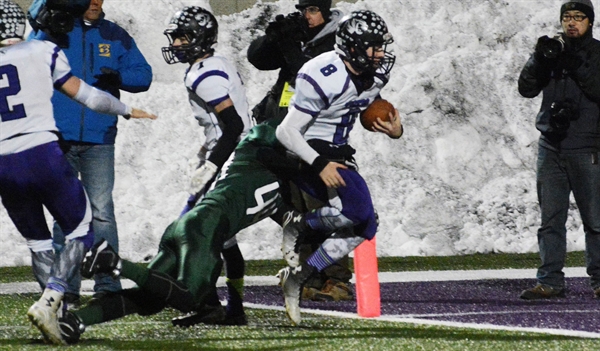
He followed up last week’s six touchdown passes and three touchdown runs against reigning champion Peck with three rushing and two passing scores against the Trojans. Gribler ran for 103 yards on just 12 carries and completed 11 of 14 pass attempts for 256 yards Friday, and for the season he threw for 2,599 yards and 42 touchdowns and ran for 1,704 yards and 24 scores.
 With only three seasons against which to compare, Lawrence setting three MHSAA 8-Player Final offensive records might not seem as impressive. But they’re marks that could stand for a while – 23 first downs, 341 yards rushing and 597 total yards.
Lawrence coach Cody Caswell came into 8-player with a spread offense background and has built a network of 8-player coaches including contacts in Oklahoma and Idaho. He tailored the offense this year to allow Gribler to read and make decisions on the fly on nearly every play.
Gribler ran four yards for the team’s first score just 1:06 into the game, and added two more scoring runs and a 27-yard touchdown pass to senior Mike Cammire as the Tigers built a 28-6 lead by the end of the first quarter. Cammire finished with six catches for 110 yards and junior running back Hunter Coombs helped set the tone with 127 yards and two touchdowns on only six rushes.
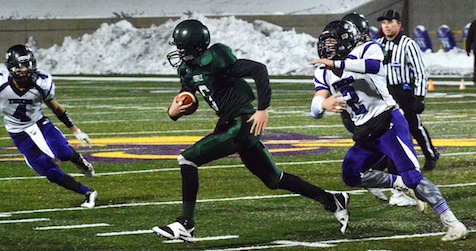
Meanwhile, the Lawrence defense spent much of the night chasing Cedarville senior quarterback Joey Duncan and forcing him to throw on the run. Cedarville gained only 276 yards and turned the ball over three times. Its 12 points were a season low.
The Tigers finished with a school-record five shutouts under the direction of coordinator Aaron Amthor, and forced 39 turnovers while giving the ball away only five times.
“We believed we had the best defense in the state along with the best offense in the state. We didn’t go in like, ‘I wonder how this is going to go.‘ We thought we should stop them,” Caswell said. “Our motto all year was ‘fast and physical,’ and that’s what they do”
Cedarville had made the 11-player playoffs seven straight seasons before moving to 8-player in 2011. But the Trojans had fallen short of high playoff expectations the last three years, finishing all three with losses to teams they had beaten during the regular season.
 Friday’s Final appearance was the program’s first, and its 11 wins this fall a team record.
Duncan threw for 125 yards and a touchdown and ran for 58 more yards. Senior running back Mike Bailey ran for 84, and senior receiver Brad Causley caught seven passes for 95 yards. Senior Blake Melvin ran for a score, and junior Mike Haske caught the other.
Duncan and Causley also played significant roles on the basketball team’s run to the Class D Semifinals in March, and that experience paid off the last four weeks.
“It definitely helped our mindset. We’re used to winning, used to tournament time, and that helped us compose ourselves in big games,” Duncan said. “This year, we knew we had something special. We had a feeling that we were not going to lose, not give up. It definitely was a good mountain to overcome, and hopefully for years to come they can keep the winning going.”
Click for full game statistics.
PHOTOS: (Top) Lawrence’s Derek Gribler drags a Cedarville defensive player into the end zone on one of his three scoring runs. (Middle) Cedarville’s Brad Causley works to get past Tigers defenders. (Below) Lawrence coach Cody Caswell talks with his team after Friday’s championship victory.
Drive for Detroit: Week 4 in Review
September 22, 2014
By Geoff Kimmerly
Second Half editor
A total of 93 teams remain undefeated after the fourth week of this MHSAA football season.
A number of them had to overcome major challenges last week to remain flawless.
Read on for last week's most significant results from every corner of the state, kicked off by a bit of the story behind one of the surprise 4-0 teams of 2014.
Southwest and Border
Vicksburg 25, Paw Paw 20
This wins out as the biggest result from a weekend of many from this part of the state for a few reasons, including its contribution to Vicksburg's overall body of work. The Bulldogs won four games last season and three in 2012, but improved to 4-0 this fall by beating the reigning Wolverine B East champion after beating reigning West champion Edwardsburg a week ago. Paw Paw (3-1) has lost only four regular-season games since the start of 2010. Click to read more from the Kalamazoo Gazette.
Also noted:
Edwardsburg 24, Plainwell 22 – The Eddies (3-1) bounced back from a two-point loss to Vicksburg by beating a Plainwell (3-1) team that had outscored its first three opponents by a combined 105-19.
Decatur 28, Gobles 14 – Decatur (4-0) has won 12 straight nonleague games over the last four seasons, including two over the always-solid Tigers (3-1).
Stevensville Lakeshore 17, St. Joseph 7 – The Lancers (4-0) are already starting to separate in the Southwestern Michigan Athletic Conference West having now beaten the Bears (3-1) in addition to reigning champion Portage Central in successive weeks.
Coldwater 35, Parma Western 28 – Coldwater is 4-0 for the first time since 1983 and got there by holding off a Parma Western (2-2) team that has lost two games by a combined eight points.
West Michigan
Rockford 28, Hudsonville 27
This was everything it was billed, the Rams winning for the fifth straight time but the matchup returning to “classic” status after a few one-sided contests. Hudsonville (3-1) scored late in the fourth quarter to pull within a point of the lead, but went for a 2-point conversion and the lead – and Rockford (4-0) made the stop. Click for more from the Grand Rapids Press.
Also noted:
Grand Rapids West Catholic 35, Hudsonville Unity Christian 21 – Unity Christian (2-2) has impressed early, but West Catholic (4-0) remains the elite of small Class B programs on this side of the state.
East Kentwood 39, Grandville 38 – The Falcons (4-0) are off to their best start since 2004, and Grandville (2-2) is only 11 points over two losses from the same record.
Whitehall 41, Mason County Central 27 – Whitehall (4-0) is off to its best start since 2006 thanks to avenging last season’s 14-point loss to Mason County Central (2-2).
Muskegon 37, East Grand Rapids 7 – Few prepared for league play like Muskegon (4-0), which opened with wins over Detroit Catholic Central, Grand Rapids Christian, Grandville and now the Pioneers (2-2).
Bay and Thumb
Millington 27, Frankenmuth 13
The rivalry remains revved, with Millington ending Frankenmuth’s 17-game Tri-Valley Conference East winning streak and on the Eagles’ home field. Frankenmuth (3-1) had last lost a league game in 2011, also to the Cardinals (4-0). Click for more from The Saginaw News.
Also noted:
Flint Beecher 32, Goodrich 13 – The Bucs (4-0) look like early favorites to push reigning champion Montrose in the Genesee Area Conference Red, although Goodrich (3-1) gets the Rams first, this week.
Coleman 29, Carson City-Crystal 26 – A pair of two-point losses kept Coleman (3-1) from last season’s Mid-State Activities Conference title, making this three-point win over the reigning champion Eagles (3-1) that much sweeter.
Grand Blanc 13, Brighton 10 – The Bobcats (3-1) are off to a great start toward repeating as champions of the Kensington Lakes Activities Association West, with Brighton (2-2) last season’s runner-up.
Mount Pleasant 24, Midland 21 – This has turned into a Saginaw Valley Association rivalry, with four of the last five between the two decided by eight points or fewer; Mount Pleasant (3-1) has beaten Midland (2-2) four of those last five.
Greater Detroit
Ypsilanti Community 20, Chelsea 14
Coming off its first sub-.500 season in the last 16, Chelsea (3-1) has looked so far much more like its usual playoff team self. That makes this arguably the most impressive win of the new Ypsilanti Community’s first two seasons – and gives the Grizzlies (3-1) a nice edge in the tough Southeastern Conference White. Click for more from annarbor.com.
Also noted:
Dearborn Heights Robichaud 36, Saginaw Nouvel 13 – The Bulldogs (4-0) are off to another impressive start as they play for a fourth-straight playoff berth, while Nouvel (1-3) finds itself in a rare position of needing to win out to guarantee a return.
Oxford 21, Lake Orion 14 – What better way for Oxford (4-0) to prepare for reigning Division 1 champion and league favorite Clarkston than by beating last season’s Oakland Activities Association Red co-runner-up Lake Orion (2-2).
Birmingham Brother Rice 28, Warren DeLaSalle 21 – Rival Detroit Catholic Central is up next for Brother Rice (4-0), but the Warriors first had to survive a second-straight close one against the Pilots (3-1).
Warren Michigan Collegiate 20, Detroit University Prep 0 – Not only did the Cougars (4-0) avenge last season’s two-point loss to University Prep (3-1), but they also continued a now three-game shutout streak.
Mid-Michigan
Battle Creek Harper Creek 52, Charlotte 45 (3 OT)
This has been the best game of the four-week history of the Interstate 8 Athletic Conference, with Harper Creek rebounding from a Week 3 loss to league favorite Jackson Lumen Christi by surviving against the Orioles (1-3). Harper Creek (2-2) led by three scores at one point before Charlotte surged back and tied the score with less than a minute left in regulation. Click for more from the Battle Creek Enquirer.
Also noted:
Lansing Everett 42, Holt 41 (OT) – These are two of five Capital Area Activities Conference Blue teams that look capable of making the playoffs, and Everett (2-2) can breathe just a bit easier while Holt (1-3) has its work cut out to stay alive.
Grand Ledge 20, Okemos 7 – The Chieftains (2-2) clearly are improved and another CAAC Blue playoff contender, but Grand Ledge (2-2) remains a step ahead.
St. Johns 42, Mason 21 – This solidified the Redwings (4-0) as DeWitt’s top competition in the CAAC Red, and left Mason (1-3) needing to win out against a manageable group after starting with four strong opponents.
Williamston 32, Eaton Rapids 13 – The Hornets (4-0) are back among the best in the Lansing area, off to their best start since their Finals runner-up season of 2010 after soundly defeating the Greyhounds (2-2).
Upper Peninsula
Negaunee had outscored Iron Mountain (2-2) by a combined score of 64-14 the last two seasons dominating this matchup while the Mountaineers worked through a couple of middling seasons. Iron Mountain looks up to one of the toughest schedules in the U.P., while the Miners (2-2), coming off back-to-back 10-win seasons, must rebound from two straight losses with a tough second half of the schedule looming. Click for more from the Iron Mountain Daily News.
Also noted:
Ishpeming 38, Ishpeming Westwood 14 – Make that 17 straight over Westwood (3-1) for the Hematites (4-0), who by way of their eight-game schedule need one more win to become the first team this season to qualify for the playoffs.
Menominee 49, Gladstone 6 – The Braves (3-1) remain off to a strong start, but Menominee (4-0) remains the team to beat in the Great Northern U.P. Conference.
Marquette 24, Escanaba 22 – The Redmen (3-1) kicked off the Great Northern U.P. Conference schedule by breaking a three-game losing streak to the Eskymos (1-3).
Lake Linden-Hubbell 28, Bessemer 20 – The Lakes improved to 3-1 while dropping Bessemer to the same in a battle of 2013 playoff teams.
Lower Up North
Tawas 34, Lincoln Alcona 20
Tawas looked like it might be on the upswing with a 2-1 start after winning a combined five games over the last two seasons. Beating a Lincoln Alcona team that had won 15 straight regular-season games made the point loud and clear. The Tigers (3-1) beat Tawas by 20 in 2013 and 36 points in 2012. Click for more from the Bay City Times.
Also noted:
Petoskey 42, Traverse City West 21 – Despite falling to favorite Cadillac last week, Petoskey (3-1) stayed in the Big North Conference mix by doubling up the Titans (1-3).
Cadillac 41, Alpena 28 – Make that 15 wins in 16 games for Cadillac (4-0), although Alpena (2-2) deserves a mention for its improvement.
Elk Rapids 38, Maple City Glen Lake 12 – Despite a 1-2 start, don’t forget the Elks (2-2), who beat solid Glen Lake (2-1) in impressive fashion.
Hillman 34, Rogers City 32 (2 OT) – The Tigers are figuring out every way to win, now doing so twice by more than 40 points and twice by a touchdown or less; Rogers City (1-3) is better than its record.
8-Player
Peck 53, Dryden 6
The way both had outscored their first three opponents, this looked like it could be higher scoring. But the reigning MHSAA champion Peck (4-0) impressed as much on defense as offense, scoring at least 48 points for the fourth time this fall while giving up its first score of the season. Dryden (3-1) hadn’t given up a point since opening night. Click for more from the Port Huron Times-Herald.
Also noted:
Deckerville 54, Morrice 26 – The Eagles (4-0) continued to shine against the Orioles (2-2), who playing 8-player for the first time after some success at the 11-player level.
Posen 30, Ewen-Trout Creek 24 – After opening with two losses, Posen (2-2) has bounced back well in pursuit of a second-straight playoff berth.
PHOTO: Mount Pleasant has won four of its last five against Midland, including 24-21 on Friday. (Click to see more from HighSchoolSportsScene.com).