

Lawrence Completes Turnaround with Title
November 21, 2014
By Geoff Kimmerly
Second Half editor
GREENVILLE – Derek Gribler was a sophomore at the Lawrence school board meeting two years ago when it was decided the Tigers would try 8-player football the following fall.
Although the team had finished a combined 1-17 the previous two seasons, playing mostly bigger schools with multiple freshmen trying to match much larger seniors, there was skepticism. Some simply didn’t like the move.
Friday night, it was hard to imagine a better fit.
Counting on a variety of skill players and a speedy defense necessary to succeed in the 8-player game, Lawrence finished its second season after the switch as an MHSAA champion with a 56-12 win over Cedarville at Legacy Field.
Often, successful groups growing up anticipate success at the varsity level. But the Tigers didn’t give championships a thought during their struggles only a few seasons ago.
“Not a single second. Not in any of those practices, not in any of those games,” said Lawrence senior linebacker Jimmy Phelps, like Gribler a four-year varsity player. “Being a 14-year-old kid in a conference where you’d get 60 kids going out for a team; you’re a 14-year-old boy going against 18-year-old men for four quarters every day.
“Football always was my favorite sport, (but) there’s a time you see your rivals in conference and you’re going up against 6-(foot)-2, 200-pound kids and you’re 14-years old and 5-2, 135 pounds. It’s not really fun when those guys hit your guts.”
Moving to 8-player appears to have swung the advantage far into Lawrence’s favor.
The Tigers finished this fall 12-0 and 21-3 over their two seasons of 8-player football, becoming the first team in MHSAA history to win both 8 and 11-player football titles. Lawrence won the Class DD 11-player championship in 1997, but before 2013 hadn’t had a winning season since 2007.
Gribler, a running back before this fall, became over the last four months perhaps the most impressive standout in the MHSAA’s brief history of the 8-player format.
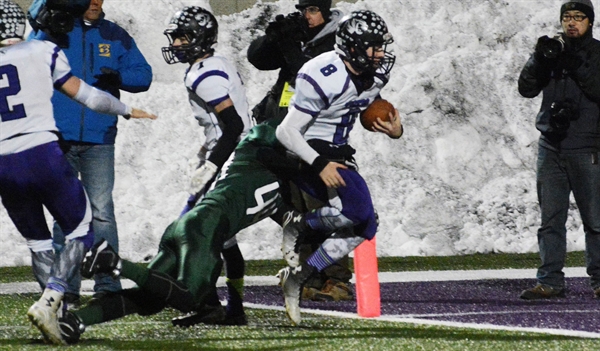
He followed up last week’s six touchdown passes and three touchdown runs against reigning champion Peck with three rushing and two passing scores against the Trojans. Gribler ran for 103 yards on just 12 carries and completed 11 of 14 pass attempts for 256 yards Friday, and for the season he threw for 2,599 yards and 42 touchdowns and ran for 1,704 yards and 24 scores.
 With only three seasons against which to compare, Lawrence setting three MHSAA 8-Player Final offensive records might not seem as impressive. But they’re marks that could stand for a while – 23 first downs, 341 yards rushing and 597 total yards.
Lawrence coach Cody Caswell came into 8-player with a spread offense background and has built a network of 8-player coaches including contacts in Oklahoma and Idaho. He tailored the offense this year to allow Gribler to read and make decisions on the fly on nearly every play.
Gribler ran four yards for the team’s first score just 1:06 into the game, and added two more scoring runs and a 27-yard touchdown pass to senior Mike Cammire as the Tigers built a 28-6 lead by the end of the first quarter. Cammire finished with six catches for 110 yards and junior running back Hunter Coombs helped set the tone with 127 yards and two touchdowns on only six rushes.
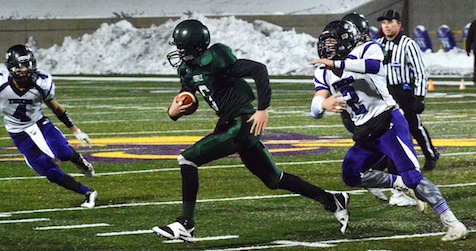
Meanwhile, the Lawrence defense spent much of the night chasing Cedarville senior quarterback Joey Duncan and forcing him to throw on the run. Cedarville gained only 276 yards and turned the ball over three times. Its 12 points were a season low.
The Tigers finished with a school-record five shutouts under the direction of coordinator Aaron Amthor, and forced 39 turnovers while giving the ball away only five times.
“We believed we had the best defense in the state along with the best offense in the state. We didn’t go in like, ‘I wonder how this is going to go.‘ We thought we should stop them,” Caswell said. “Our motto all year was ‘fast and physical,’ and that’s what they do”
Cedarville had made the 11-player playoffs seven straight seasons before moving to 8-player in 2011. But the Trojans had fallen short of high playoff expectations the last three years, finishing all three with losses to teams they had beaten during the regular season.
 Friday’s Final appearance was the program’s first, and its 11 wins this fall a team record.
Duncan threw for 125 yards and a touchdown and ran for 58 more yards. Senior running back Mike Bailey ran for 84, and senior receiver Brad Causley caught seven passes for 95 yards. Senior Blake Melvin ran for a score, and junior Mike Haske caught the other.
Duncan and Causley also played significant roles on the basketball team’s run to the Class D Semifinals in March, and that experience paid off the last four weeks.
“It definitely helped our mindset. We’re used to winning, used to tournament time, and that helped us compose ourselves in big games,” Duncan said. “This year, we knew we had something special. We had a feeling that we were not going to lose, not give up. It definitely was a good mountain to overcome, and hopefully for years to come they can keep the winning going.”
Click for full game statistics.
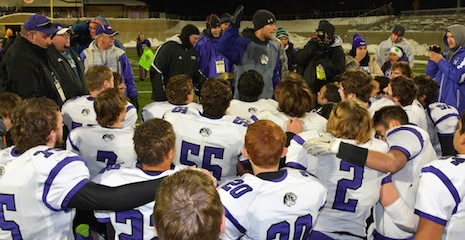
PHOTOS: (Top) Lawrence’s Derek Gribler drags a Cedarville defensive player into the end zone on one of his three scoring runs. (Middle) Cedarville’s Brad Causley works to get past Tigers defenders. (Below) Lawrence coach Cody Caswell talks with his team after Friday’s championship victory.
Drive for Detroit: Playoff R2 Preview
November 3, 2016
By Geoff Kimmerly
Second Half editor
It's predictable perhaps – and yet still intriguing – how the MHSAA Football Playoffs just a week into the five-week run.
 Of 38 teams selected for at-large bids to the 256-team 11-player field, only seven remain.
Of 36 undefeated teams at the end of the regular season, including six in 8-player, 34 are still alive.
At least for now. Two matchups of undefeated opponents are among games highlighted in this week's "Drive for Detroit" preview – powered by MI Student Aid. See those below, and remember to tune in to MHSAA.com for all of this weekend's matchups, scores and next week's matchups as they're determined. All games below are Friday unless noted.
Division 1
Clarkston (8-2) at Davison (10-0)
It’s been four years since these M-15 powers faced off. Clarkston has enjoyed the success since that last matchup, winning Division 1 back-to-back in 2013 and 2014, and now stands in the way of Davison extending its first 10-win season since 2006. Junior Tariq Reid has run for 2,003 yards and 36 touchdowns this fall, and no doubt will be called upon heavily as the Cardinals go for their first District title since 2008.
Others that caught my eye: Rockford (7-3) at Grandville (9-1), Detroit Cass Tech (10-0) at Dearborn (9-1), Macomb Dakota (7-3) at Utica Eisenhower (10-0).
Division 2
Traverse City Central (9-1) at Lowell (10-0)
This could be a history-making evening for Traverse City Central, which is looking to advance to the Regional round for the first time since old Traverse City High did so in 1991. The Trojans vanquished for good rival Traverse City West by a point last week but now face another team that has survived close games as well; reigning Division 2 champion Lowell pulled off a couple of impressive comebacks this fall on the way to a fourth straight season with at least 10 wins.
Others that caught my eye: Birmingham Brother Rice (7-3) at Birmingham Groves (9-1), Grosse Pointe North (8-2) at Grosse Pointe South (7-3), Oak Park (7-3) at Detroit Martin Luther King (8-2) on Saturday.
Division 3
East Grand Rapids (8-2) at Muskegon (9-1)
The west side of the state has earned its football reputation from high-powered matchups like this one could be; these are two of the storied programs in state history, although both also are hungry to add to their legacies. East Grand Rapids is seeking its first MHSAA championship since 2010 and Muskegon is playing to contend for its first since 2008. The Big Reds won their recent meetings in 2014 and 2015, and have yet to be challenged much aside from a Week 2 loss to Lincolnshire, Ill. East Grand Rapids has won seven straight since opening 1-2 with losses to Grand Rapids Catholic Central and later Lowell.
Others that caught my eye: Romulus (9-1) at Allen Park (10-0), Grand Rapids Christian (9-1) at Byron Center (9-1), Coldwater (8-2) at Chelsea (10-0).
Division 4
Marysville (10-0) at Detroit Country Day (10-0), Saturday
Country Day is surging as it seeks its first MHSAA title since 1999; the Yellowjackets have played arguably their three toughest opponents of the season the last three weeks, and handed Bloomfield Hills Cranbrook Kingswood a decisive 35-7 defeat to open the playoffs. But a defense giving up only eight points per game will face its toughest challenge from a Marysville offense led by 1,000-yard rushers Danta Chrcek (1,595) and Phillip Griffor (1,073). The Vikings are playing for their first 11-win season since 1992.
Others that caught my eye: Hudsonville Unity Christian (8-2) at Benton Harbor (10-0), Lansing Sexton (7-3) at Lake Odessa Lakewood (9-1), Detroit Mumford (8-2) at River Rouge (9-1).
Division 5
Grand Rapids West Catholic (8-2) at Portland (10-0)
It’s hard to not see this as one of the key games in the entire Division 5 bracket. Reigning champion West Catholic opened with a big road win 42-20 last week over Lansing Catholic and now gets the Cougars’ main league rival in Portland, which beat Lansing Catholic by only a point way back in Week 4. The deciding matchup tonight could be the Raiders’ powerful run game and its ability to hold onto the ball (and keep the Falcons' offense off the field) against a West Catholic defense that has given up more than seven points only once since Week 3. (Watch this game tonight on the PrepZone on FoxSportsDetroit.com.)
Others that caught my eye: Remus Chippewa Hills (9-1) at Reed City (10-0), Frankenmuth (9-1) at Freeland (10-0), Muskegon Oakridge (9-1) at Ithaca (10-0) on Saturday.
Division 6
Jackson Lumen Christi (8-2) at Schoolcraft (10-0), Saturday
This could show Schoolcraft’s stature as a contender for its first MHSAA championship since 2001. The Eagles have rumbled to nearly 47 points per game and beat rival Constantine twice in the last three weeks, but can show their stuff on a grander level against one of the state’s best-known powerhouse programs. Lumen Christi hasn’t lost since Week 3 and after opening 1-2 with defeats to West Catholic and Battle Creek Harper Creek. A win this week could be a key confidence boost for the Titans too as they pursue a first Finals trip since 2009.
Others that caught my eye: Maple City Glen Lake (8-2) at Roscommon (9-1), Calumet (9-1) at Negaunee (10-0), Napoleon (8-2) at Grass Lake (9-1).
Division 7
Saugatuck (10-0) at Pewamo-Westphalia (10-0), Saturday
A matchup of offensive stars Jared Smith and Blake Dunn make this one of the state’s most intriguing matchups in any division, regardless of the fact it’s also a rematch of last season’s District Final. Smith is up to 2,108 yards rushing this season on just 166 carries – for a 12.7 yards per carry average – and will go down as one of the top running backs in state history after setting an MHSAA record for single-season yardage as a junior with more than 3,000 as the Pirates finished Division 7 runners-up. Dunn has run for only 1,916 yards this season – 16.1 per carry – and thrown for 729 more.
Others that caught my eye: Detroit Loyola (8-2) at Grosse Pointe Woods University Liggett (10-0), Flint Hamady (8-2) at New Lothrop (9-1), Unionville-Sebewaing (9-1) at Ubly (10-0).
Division 8
Mendon (8-2) at Climax-Scotts (10-0)
Climax-Scotts finally broke a four-year playoff losing streak to Mendon last season with an 8-6 first-round win, and should be confident heading into a possible repeat, this time for a District title. The Panthers haven’t been challenged much, aside from a 20-point win over Pittsford in Week 6. Mendon has had to do a little more work under first-year coach and alum Robert Kretschman, but is riding a six-game winning streak and three-win improvement from a year ago. (Watch this game tonight on the PrepZone on FoxSportsDetroit.com.)
Others that caught my eye: Saginaw Nouvel (7-3) at Saginaw Michigan Lutheran Seminary (8-2), Newberry (8-2) at St. Ignace (9-1), Lincoln Alcona (9-1) at Frankfort (10-0).
8-Player
Crystal Falls Forest Park (9-1) at Powers North Central (10-0)
Forest Park in Week 2 gave North Central its closest game in two seasons of 8-player football, which means this rematch could go a couple different ways. The Jets, who won that night 60-42 and have scored 56 or more points in every game, may need quarterback Jason Whitens to add significantly to his 36 touchdown passes on only 91 completions this fall if the offenses come out firing again. Or Forest Park and senior running back Dan Nocerini (2,181 yards/39 TDs rushing) could work to keep Whitens off the field and the score a little lower this second time around.
Other Regional Finals: Pickford (9-1) at Engadine (10-0), New Haven Merritt (10-0) at Deckerville (9-0), Wyoming Tri-unity Christian (10-0) at Portland St. Patrick (10-0) on Saturday.
Second Half’s weekly “Drive for Detroit” previews are powered by MI Student Aid, a part of the Student Financial Services Bureau located within the Michigan Department of Treasury. MI Student Aid encourages students to pursue postsecondary education by providing access to student financial resources and information, including various student financial assistance programs to help make college more affordable for Michigan students. MI Student Aid administers the state’s 529 savings programs (MET/MESP) and eight additional aid programs within its Student Scholarships and Grants division. Click for more information and connect with MI Student Aid on Facebook and Twitter @mistudentaid.
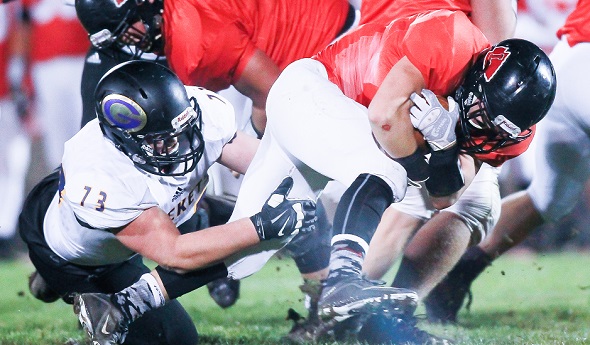
PHOTO: Lowell downed Greenville in a Division 2 playoff opener last week. (Click to see more from HighSchoolSportsScene.com.)