

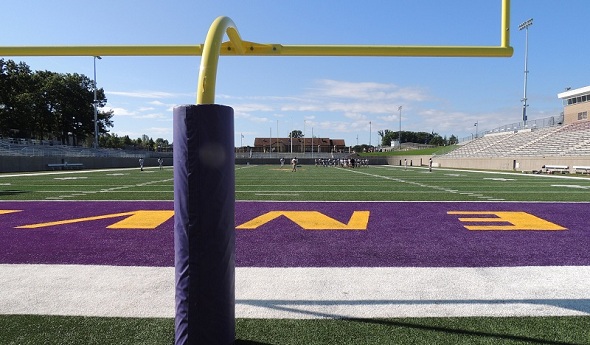
A Legacy Begins in Greenville
By
Geoff Kimmerly
MHSAA.com senior editor
August 24, 2012
GREENVILLE – Curtis Heppe has no idea what to expect, but a few guesses and a dream or two of how it will feel tonight to lead his teammates into Greenville's Legacy Field for the first time.
“It’s going to be electric, for sure. It’s a new vibe. It’s high-tech there,” the Yellow Jackets quarterback said Thursday after his team’s final preseason practice.
Those expectations are shared by a community that will be cheering on the local team in a new home after nearly a century at the legendary Black Field.
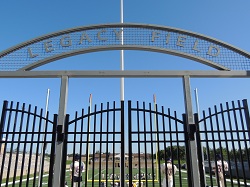 Workers put the finishing touches on the near-$7 million facility this week in advance of the season's first varsity game, tonight against rival Belding. Legacy Field officially opened for Wednesday’s freshman game, and Heppe said that even for that lower-level appetizer, the stadium began to come alive.
“We’ve just wanted Friday night to come. To get in and see how intense, how nice this place is,” he said. “Coming out of that tunnel, seeing our fans, it’s going to be the best feeling.”
Tonight’s grand opening will be the culmination of efforts from not just administrators, but students and community members as well – down to the name of the stadium itself.
“Legacy Field” was selected by Greenville’s school board. But it came as a suggestion from the school’s student council, which took submissions from classmates and then with faculty and administrators whittled the list to three favorites – Stinger Stadium and Community Field were next on their list.
But that’s just one way Legacy Field is a blend of old and new and ideas from all over town.
“In development, (it’s been) probably 10 years. We’ve been talking about it ever since I’ve been here, that one day we’d be able to do this,” said Greenville athletic director Brian Zdanowski, who is entering his 15th school year at that post. “It came through strategic planning. It came through community input. And then ultimately, our board bought in that there was enough interest in the community.”
Deeply rooted
A walk through Legacy Field is a history lesson. But first, an explanation of the Yellow Jackets’ past.
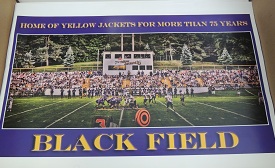
Black Field had served as the team’s home since 1916. It is nestled downtown next to Greenville’s former high school, which is now a library.
 The current high school, about 1.5 miles northwest, was built in 1963. Football teams continued to make the short trip for home games.
Black Field has its charms. With no track surrounding the field like at many multi-purpose stadiums, fans are only a few yards from the sideline. And all of that history added to the mystique for the latest players to wear the uniform.
The field also has had peculiarities. Zdanowski said at one point, the end zones were elevated in the corners. And the field wasn’t always square – a 10-yard penalty might measure 11 on one side of the field but only nine yards on the other.
But after just about every home game, students met for a bonfire on the grounds, an extension of the celebration by neighborhoods that surround Black Field and embraced the team for decades.
“It was the typical focal point of the community,” Zdanowski said.
Some things old, many new
Playing on Black Field was special, Heppe added. But he's equally if not more excited to be part of this new legacy. And architects made sure to bring that community feel to the new home this fall.
Destruction and construction began May 2, the day after last season’s final girls tennis match. The courts formerly sat in what is near the south end zone, and were moved closer to the track and soccer facility.
Amenities at the Yellow Jackets’ new football home are comparable to a college stadium’s, starting at the north side of the field.
 Players will enterthrough a tunnel that pours into the field like that of a miniature Spartan Stadium. Surrounding the tunnel are expansive locker rooms both for the home team and visitors, a similarly expansive training room and officials area and plenty of storage that will allow Greenville’s entire football program to be housed under that one roof. Unlike Black Field, tucked neatly among its neighbors, Legacy Field has plenty of parking and lighting, and builders were able to make that possible while also keeping intact a group of large oak trees near the south gate.
The turf is synthetic, like that played on by all but one member of the Yellow Jacket’s O-K Bronze conference. The difference from many is that the field has been dug out from the surrounding property, making it even more a focal point for those who will occupy the roughly 4,000 seats in the surrounding cement bowl. (The removed dirt was used to build two Little League fields on another part of the property.)
The sound system is of course state-of-the-art, and the press box, concessions area and restrooms also are equally expansive. But what locals should notice most are the throwbacks to the past that dot every corner of their new home.
Cut into the brick work near the concession counter is a block from Black Field that had been dedicated by the school’s class of 1924. Atop the building is the Centennial Clock, 100 years old this year, which formerly hung at the entrance the old school and was donated by the class of 1912. It has been housed by Greenville’s museum until being re-donated to the school district to become part of the stadium.
Molded into the cement walls on the west and south sides of the field are the numbers formerly worn by players Henry Loding and Greg Blumberg. Both died from football-related injuries; Loding in 1906 and Blumberg in 1977. Two trophy cases are cut into the stone on the facing of the press box, including one featuring mementos celebrating alum and former Detroit Lions tight end Ty Hallock.
Another addition of historical significance will come later. The school’s first Hall of Fame class will be inducted before the Sept. 7 game, and that display will be housed near the south ticket area so residents and fans can check it out without having the enter the stadium itself.
And one last thing was added to keep with tradition. To the west of the concession area, but within the stadium fence, sits a large gas fire pit for those postgame gatherings – plus a sound system where students can plug in their mp3 players.
“We said we’re not forgetting our past, but we’re embracing our future,” Zdanowski said. “I’m sure a lot of people have said that before. So we really wanted to make sure we got community input on it and do as much as we could to replicate Black Field. … And I think we won some people over. We really wanted to do what we said (we’d do).”
PHOTOS: (Top) Greenville's junior varsity ran through drills during a morning session at Legacy Stadium, which opened this week. (Top middle) The ticket area and gate for fans sit on the south side of the field. (Middle) A poster given out last season celebrated the final to be played at Black Field. (Bottom middle) A number of pieces of Black Field's past and Greenville tradition were brought over to or included in Legacy Field, including Centennial Clock, which formerly was part of the old school.
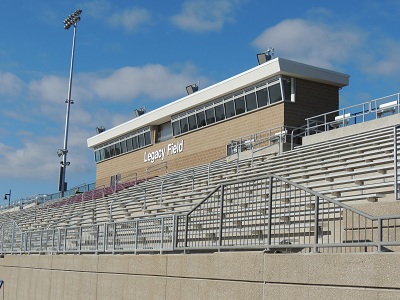 Legacy Field's press box is split into areas for game workers, coaches and media with a roll-up door for film crews.
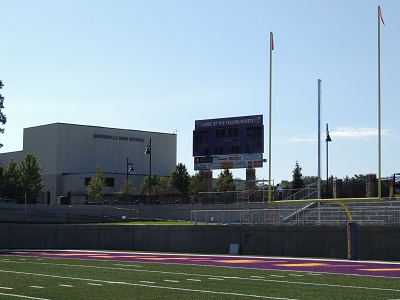
Legacy Field sits between Greenville's high school and middle school and adjacent to its soccer and track facilities.
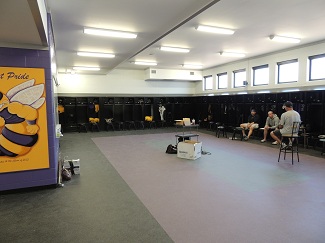 Coaches met in the spacious varsity locker room Monday morning. Junior varsity and freshman locker rooms are connected by a hallway with access to storage areas and the coaches' office.
 Players will enter Legacy Field through a tunnel at its north end. Above sits the concession area and restrooms, and the Centennial Clock that once ticked in the old Greenville school.
Leader Re-Energizes Past Power Stevenson
By
Tom Markowski
Special for Second Half
November 22, 2019
Regardless of how one looks at it, Justin Newcomb is the right person for the right job at the right time.
 Newcomb, 33, is one of the youngest head football coaches in the Detroit area, and he’s causing a stir. He’s in his second season at Sterling Heights Stevenson and the person most responsible for the Titans playing in an MHSAA Division 1 Semifinal on Saturday for the first time in a decade.
Stevenson (8-4), as an additional playoff qualifier, has played the underdog role to a T throughout the playoffs. There’s an advantage to that role, and Stevenson will take it up again when it takes on Davison (10-2) at Troy Athens at 1 p.m.
Once a football power, Stevenson fell back to the middle of the pack in the highly competitive Macomb Area Conference Red from 2010-18. Four times previously the program had reached an MHSAA Final, the last in 2009 when the Titans lost to Detroit Catholic Central, 31-21, in the Division 1 title game.
That was Hall of Fame coach Rick Bye’s 35th and final season at Stevenson. Since then, the Titans qualified for the playoffs three times and didn’t win a playoff game. That is, until this season.
“You’ve got goals,” Newcomb said. “You set goals at the start (of the season), and you just want to get the most out of (your) team.”
When Newcomb took over, the program had won just three games over the previous two seasons. The Titans were 4-5 overall in 2018, and just 1-4 in the MAC Red, which was won by eventual Division 1 champion Clinton Township Chippewa Valley. The average margin of defeat in those four league losses was 25.5 points.
“We took our lumps (in the MAC Red),” Newcomb said. “The challenge was getting kids to come out. When we first came in there was some interest lost. We had to beg some to come out. Now that we’re winning, kids are saying they want to come out.”
Despite his young age, Newcomb has coached high school football for 14 seasons. He started as an assistant under Mike Powell at Warren Cousino in 2006 when Newcomb was a student at Wayne State University. For 10 seasons he was the head varsity baseball coach at Cousino, but he gave that up when he took over for Powell as Cousino’s head football coach in 2017.
Though Newcomb finds himself in the right position at Stevenson, don’t view Stevenson’s sudden success as luck. Newcomb possesses an insatiable appetite for knowledge. If there’s a clinic to attend, you’ll likely find Newcomb there. And his ego doesn’t prevent him from talking to more experienced coaches to pry loose valuable information. Most often you’ll find Bye on the Stevenson sideline, not as an assistant but someone there whom Newcomb can confide in.
“Justin is positive and energetic,” Bye said. “He’s definitely not a guy who thinks he knows it all. He’s bought into everything, the Stevenson history, everything. He’s up on technology, much more so than I ever was. And he doesn’t let little things bother him. His practices have a tempo, and there’s little time wasted.”
 Not lost in Newcomb’s system is his military background. After graduating from Wayne State with a teaching degree, he joined the U.S. Army Reserve in 2011. He continues to serve today in the Individual Ready Reserve (IRR).
“It has a lot to do with the way we coach,” Newcomb said of his military experience. “(Coaching) is a lot more than just what goes on on the field. There’s (teaching) leadership roles and being responsible. In our culture, it’s all about winning. It’s all about playing time. The kids get caught up in that.
“Their attitudes have changed. We had to address the group as a whole. We had guys that first year that said that they play linebacker, and that’s it. Others came in saying they just play one way. That’s not how we do it. You’re here to help the team. Now the kids are doing whatever we need them to.”
A prime example is junior Giovanni El-Hadi. A college prospect (committed to University of Michigan), El-Hadi had been told, by some outside of the program, that he was an offensive lineman and wouldn’t play defense. This season El-Hadi is starting on defense for the first time and said earlier this fall that his time spent on the defensive side has helped improve his speed.
Another two-way starter on the line is senior Sal Madonna. Madonna is a two-year starter, and he and his brother, sophomore Biagio Madonna, are the sons of assistant coach Carmine Madonna – who played for Bye during the late 1990s.
“For me, I’ve been a part of Stevenson football for a long time,” Sal Madonna said. “Last year’s team wasn’t as connected as much. This year we bonded together. We trusted Coach Newcomb’s style. Even last year as juniors (we knew) to be successful, we had to buy in. We didn’t have the same mindset last year. We’re playing with a lot more confidence now.
“This means a lot to me. I remember being in the stands (at Troy Athens) when Jason Fracassa threw a touchdown pass in the (2009) Semifinals. Just like this team, that team never gave up.”
This team rebounded from a 2-3 start with a 13-7 comeback victory over Utica in Week 6. That game, more than others, was the turning point of the Titans’ season. Newcomb made a switch at quarterback, moving Biagio Madonna from linebacker and switching fellow sophomore Jordan Ramsey from quarterback to slot receiver and running back. With Ramsey, Newcomb was running a zone read offense. With Madonna, Stevenson is running an option attack.
In the victory over Utica, Stevenson used a trick play to score the winning touchdown. Last week in the 9-7 Regional Final victory over Detroit Cass Tech, the Titans had a goal-line stand in the first half and scored the winning touchdown on a double pass. Madonna threw to Dylan Kleinedler, who threw to Ramsey for a touchdown early in the second half. A Ramsey interception ended the game with 14 seconds left.
The previous week against Macomb Dakota, Newcomb decided not to go for the tying field goal from 40 yards out, and instead called on Madonna to throw the winning touchdown pass to Ramsey with a minute to play. Stevenson won 38-35 against a team it had lost to, 40-14, during the regular season and before Newcomb had made the quarterback switch.
“We’ve been fortunate the last few weeks with trick plays,” Newcomb said. “(But) getting here is a testament on just how hard these kids have worked.”
 Tom Markowski is a correspondent for the State Champs! Sports Network and previously directed its web coverage. He also covered primarily high school sports for the The Detroit News from 1984-2014, focusing on the Detroit area and contributing to statewide coverage of football and basketball. Contact him at [email protected] with story ideas for Oakland, Macomb and Wayne counties.
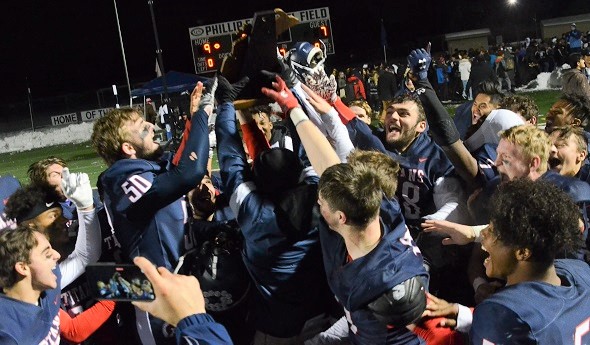
PHOTOS: (Top) Sterling Heights Stevenson players hoist their Division 1 Regional championship trophy after defeating Detroit Cass Tech last week. (Middle) Jordan Ramsey (5) breaks into the open against the Technicians. (Photos courtesy of the Stevenson football program.)