

A Legacy Begins in Greenville
By
Geoff Kimmerly
MHSAA.com senior editor
August 24, 2012
GREENVILLE – Curtis Heppe has no idea what to expect, but a few guesses and a dream or two of how it will feel tonight to lead his teammates into Greenville's Legacy Field for the first time.
“It’s going to be electric, for sure. It’s a new vibe. It’s high-tech there,” the Yellow Jackets quarterback said Thursday after his team’s final preseason practice.
Those expectations are shared by a community that will be cheering on the local team in a new home after nearly a century at the legendary Black Field.
 Workers put the finishing touches on the near-$7 million facility this week in advance of the season's first varsity game, tonight against rival Belding. Legacy Field officially opened for Wednesday’s freshman game, and Heppe said that even for that lower-level appetizer, the stadium began to come alive.
“We’ve just wanted Friday night to come. To get in and see how intense, how nice this place is,” he said. “Coming out of that tunnel, seeing our fans, it’s going to be the best feeling.”
Tonight’s grand opening will be the culmination of efforts from not just administrators, but students and community members as well – down to the name of the stadium itself.
“Legacy Field” was selected by Greenville’s school board. But it came as a suggestion from the school’s student council, which took submissions from classmates and then with faculty and administrators whittled the list to three favorites – Stinger Stadium and Community Field were next on their list.
But that’s just one way Legacy Field is a blend of old and new and ideas from all over town.
“In development, (it’s been) probably 10 years. We’ve been talking about it ever since I’ve been here, that one day we’d be able to do this,” said Greenville athletic director Brian Zdanowski, who is entering his 15th school year at that post. “It came through strategic planning. It came through community input. And then ultimately, our board bought in that there was enough interest in the community.”
Deeply rooted
A walk through Legacy Field is a history lesson. But first, an explanation of the Yellow Jackets’ past.
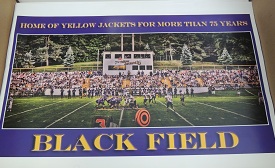
Black Field had served as the team’s home since 1916. It is nestled downtown next to Greenville’s former high school, which is now a library.
 The current high school, about 1.5 miles northwest, was built in 1963. Football teams continued to make the short trip for home games.
Black Field has its charms. With no track surrounding the field like at many multi-purpose stadiums, fans are only a few yards from the sideline. And all of that history added to the mystique for the latest players to wear the uniform.
The field also has had peculiarities. Zdanowski said at one point, the end zones were elevated in the corners. And the field wasn’t always square – a 10-yard penalty might measure 11 on one side of the field but only nine yards on the other.
But after just about every home game, students met for a bonfire on the grounds, an extension of the celebration by neighborhoods that surround Black Field and embraced the team for decades.
“It was the typical focal point of the community,” Zdanowski said.
Some things old, many new
Playing on Black Field was special, Heppe added. But he's equally if not more excited to be part of this new legacy. And architects made sure to bring that community feel to the new home this fall.
Destruction and construction began May 2, the day after last season’s final girls tennis match. The courts formerly sat in what is near the south end zone, and were moved closer to the track and soccer facility.
Amenities at the Yellow Jackets’ new football home are comparable to a college stadium’s, starting at the north side of the field.
 Players will enterthrough a tunnel that pours into the field like that of a miniature Spartan Stadium. Surrounding the tunnel are expansive locker rooms both for the home team and visitors, a similarly expansive training room and officials area and plenty of storage that will allow Greenville’s entire football program to be housed under that one roof. Unlike Black Field, tucked neatly among its neighbors, Legacy Field has plenty of parking and lighting, and builders were able to make that possible while also keeping intact a group of large oak trees near the south gate.
The turf is synthetic, like that played on by all but one member of the Yellow Jacket’s O-K Bronze conference. The difference from many is that the field has been dug out from the surrounding property, making it even more a focal point for those who will occupy the roughly 4,000 seats in the surrounding cement bowl. (The removed dirt was used to build two Little League fields on another part of the property.)
The sound system is of course state-of-the-art, and the press box, concessions area and restrooms also are equally expansive. But what locals should notice most are the throwbacks to the past that dot every corner of their new home.
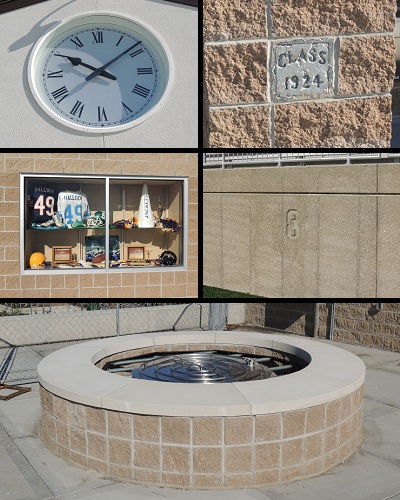
Cut into the brick work near the concession counter is a block from Black Field that had been dedicated by the school’s class of 1924. Atop the building is the Centennial Clock, 100 years old this year, which formerly hung at the entrance the old school and was donated by the class of 1912. It has been housed by Greenville’s museum until being re-donated to the school district to become part of the stadium.
Molded into the cement walls on the west and south sides of the field are the numbers formerly worn by players Henry Loding and Greg Blumberg. Both died from football-related injuries; Loding in 1906 and Blumberg in 1977. Two trophy cases are cut into the stone on the facing of the press box, including one featuring mementos celebrating alum and former Detroit Lions tight end Ty Hallock.
Another addition of historical significance will come later. The school’s first Hall of Fame class will be inducted before the Sept. 7 game, and that display will be housed near the south ticket area so residents and fans can check it out without having the enter the stadium itself.
And one last thing was added to keep with tradition. To the west of the concession area, but within the stadium fence, sits a large gas fire pit for those postgame gatherings – plus a sound system where students can plug in their mp3 players.
“We said we’re not forgetting our past, but we’re embracing our future,” Zdanowski said. “I’m sure a lot of people have said that before. So we really wanted to make sure we got community input on it and do as much as we could to replicate Black Field. … And I think we won some people over. We really wanted to do what we said (we’d do).”
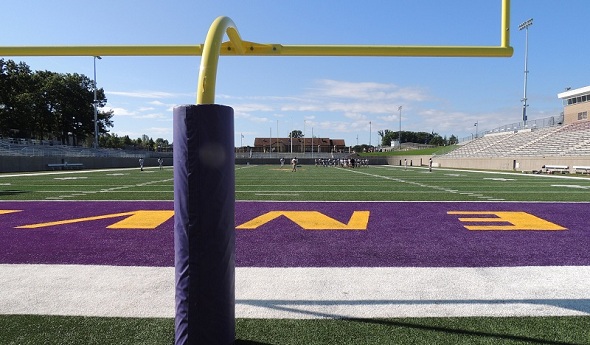
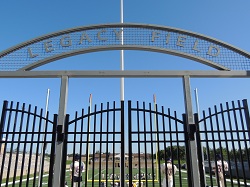
PHOTOS: (Top) Greenville's junior varsity ran through drills during a morning session at Legacy Stadium, which opened this week. (Top middle) The ticket area and gate for fans sit on the south side of the field. (Middle) A poster given out last season celebrated the final to be played at Black Field. (Bottom middle) A number of pieces of Black Field's past and Greenville tradition were brought over to or included in Legacy Field, including Centennial Clock, which formerly was part of the old school.
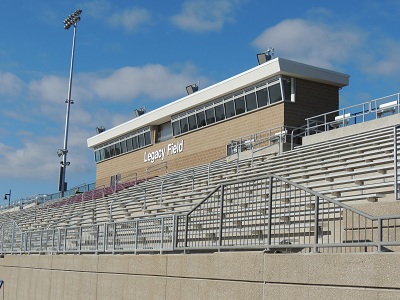 Legacy Field's press box is split into areas for game workers, coaches and media with a roll-up door for film crews.
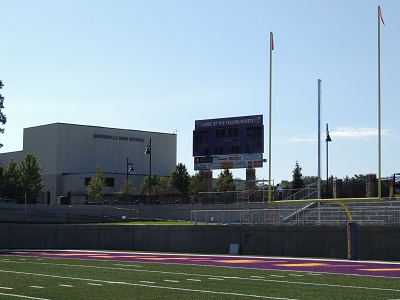
Legacy Field sits between Greenville's high school and middle school and adjacent to its soccer and track facilities.
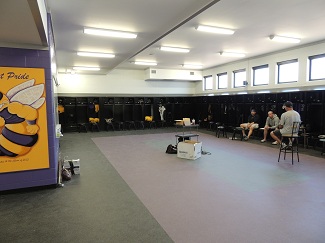 Coaches met in the spacious varsity locker room Monday morning. Junior varsity and freshman locker rooms are connected by a hallway with access to storage areas and the coaches' office.
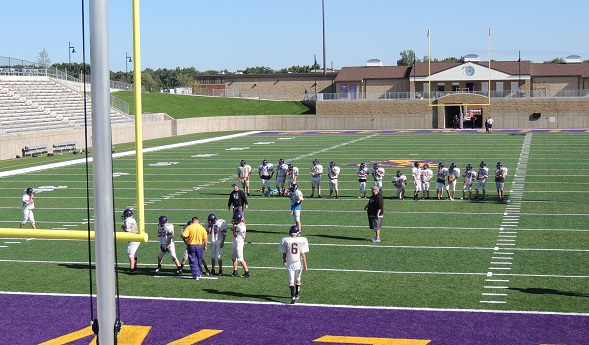 Players will enter Legacy Field through a tunnel at its north end. Above sits the concession area and restrooms, and the Centennial Clock that once ticked in the old Greenville school.
Drive for Detroit: Playoff Week 1 Preview
October 31, 2019
By Geoff Kimmerly
Second Half editor
Whether your team's preferred final destination is Ford Field in Detroit or the Superior Dome in Marquette, the first steps will be taken this weekend during 144 MHSAA Playoff games across both peninsulas.
 Someone's season is on the line in every game from here on out, and below we take a glance at a matchup in each division that is especially notable during these first rounds of the 11 and 8-player tournaments.
Don't let a little cool weather keep you out of the stands and supporting your favorite team at this most exciting time of year. But if you choose to stay in, take in one or more of the 30 games being broadcast on FOX Sports Detroit Prep Zone or MHSAA.tv. Click for listings and check back with MHSAA.com all weekend for scores and updated brackets.
"Drive for Detroit" is sponsored by MI Student Aid.
11-Player
Division 1
Saline (8-1) at Belleville (9-0), Saturday
This is the most power-packed opener in any division, with both teams making Division 1 Semifinals a year ago. Both have faced four playoff teams this fall, and the only loss between them was Saline’s Week 1 defeat against reigning champion Clinton Township Chippewa Valley. The Hornets are familiar with this time of year with six District titles over the last seven seasons and a Division 1 runner-up finish in 2014. But Belleville has seemed on the verge of a Ford Field run with now three straight perfect regular seasons and, like Saline, all but one of its wins this fall by double digits.
Keep an eye on these FRIDAY Brighton (7-2) at Holt (7-2), Davison (7-2) at Romeo (7-2), Rochester Adams (7-2) at Utica Eisenhower (7-2), Detroit Cass Tech (5-4) at Grosse Pointe South (7-2).
Division 2
Muskegon Mona Shores (7-2) at Midland (8-1)
This is a rematch of a 2018 Division 2 Semifinal won by the Sailors 49-28. Both of these teams were stung late this fall but should be dangerous again with fresh starts that come with the playoffs. Mona Shores, which went on last season to finish D2 runner-up, has losses to two league champions including big to rival Muskegon High two weeks ago in a matchup that determined the Ottawa-Kent Conference Black title. Midland was defeated by a similar score last week by rival Midland Dow as the two shared the Saginaw Valley League Red title. The winner of this District opener could see Dow next week – the Chargers take on Big North Conference champion Traverse City Central on the other side of the District bracket.
Keep an eye on these FRIDAY South Lyon (8-1) at Fenton (8-1), Farmington (7-1) at Oak Park (8-1), Port Huron (6-3) at Port Huron Northern (8-1). SATURDAY Detroit U-D Jesuit (6-3) at North Farmington (9-0).
Division 3
DeWitt (7-2) at East Lansing (7-2)
This is one of the most highly-anticipated rematches of the first week, with these two and Holt having shared the Capital Area Activities Conference Blue title, and with the Panthers and Trojans finishing with the same playoff point average – East Lansing got the home game because of its 21-2 win over DeWitt in Week 5. Minus that performance, the Panthers averaged 39.6 points per game this fall – so expecting another all-out shutdown by the Trojans’ defense might be an unfair ask. But DeWitt’s defense also will have to deliver, as East Lansing’s offense (32.7 ppg) is scoring at its highest pace in decades.
Keep an eye on these FRIDAY Lowell (5-4) at East Grand Rapids (6-3), Zeeland East (5-4) at Zeeland West (8-1), St. Joseph (6-3) at Edwardsburg (9-0), Bloomfield Hills Brother Rice (6-3) at Flint Kearsley (7-2).
Division 4
Sparta (8-1) at Muskegon Orchard View (9-0)
Both of these teams have enjoyed banner seasons. Orchard View posted its first winning record since 2014, earned its first playoff berth since 2008, won the Lakes 8 Conference title and finished the regular season perfect for the first time since 2005. Sparta made the playoffs for the first time since 2013, tying its most wins since 2011 with its best regular-season record since 2006. The Spartans finished second in the O-K Blue to Grand Rapids Catholic Central, which faces Allendale on the other side of this District bracket. Orchard View did beat five playoff teams on the way to the playoffs. But comparing their lone shared opponent, Sparta downed playoff qualifier Spring Lake 38-3 in Week 3 after Orchard View defeated the Lakers 22-17 on opening night.
Keep an eye on these FRIDAY Fowlerville (6-3) at Goodrich (7-2), North Branch (7-2) at Pontiac Notre Dame Prep (8-1), Ortonville Brandon (7-2) at St. Clair (8-1).
Division 5
Almont (9-0) at Richmond (8-1)
This is a rare occurrence; Almont defeated Richmond in Week 7 28-10 and went on to win the Blue Water Area Conference title outright while closing out its second-straight perfect regular season. However, the Blue Devils’ nonleague opponents both made the playoffs, and the bonus for playing those teams was enough to push Richmond past Almont into a home game this week. The Raiders, however, also won the first Richmond game this fall on the road, and their annually-awesome defense continues to play anywhere. Almont has given up 69 points this fall – 39 over five home games and 30 over four away. But take away the first Almont matchup, and Richmond is averaging a robust 33.5 points per game.
Keep an eye on these FRIDAY Central Montcalm (7-2) at Portland (7-2), Olivet (8-1) at Lansing Catholic (8-1), Reed City (6-3) at Kingsley (9-0), Kalamazoo United (5-4) at Berrien Springs (8-0).
Division 6
Menominee (6-3) at Ishpeming Westwood (7-2), Saturday
Menominee is the smallest of Great Northern Conference schools and will play in Division 6 this playoffs after years in Division 4 and then Division 5. That has the Maroons matching up with many of the best from the Western Peninsula Athletic Conference, including Westwood for the first time. The Patriots finished third in the Iron, the strongest of the two West PAC divisions this fall – and they also beat Copper champion Ishpeming 38-0 in Week 4. But Menominee presents an all-new challenge, and the Maroons are on a roll after putting up 48 points last week in handing Division 5 contender Hopkins its only loss this fall.
Keep an eye on these FRIDAY Lake City (6-3) at Maple City Glen Lake (8-1), Ravenna (7-2) at Muskegon Catholic Central (6-2), Jonesville (6-3) at Hillsdale (9-0), Constantine (7-2) at Niles Brandywine (9-0).
Division 7
Detroit Loyola (4-4) at Detroit Central (8-1)
While Cass Tech and Martin Luther King always get the bulk of attention out of the Detroit Public School League, Central has earned recognition too winning the PSL Division 3 title and 3/4 championship game. There are seven unbeaten teams in the Division 7 bracket, and they’re getting the most attention. But the Trail Blazers have won eight straight games (including a forfeit) since falling to Dearborn Heights Crestwood in Week 1. Loyola is a deceptive 4-4, considering the high level of competition it faces. A Central win in this one would further announce the Blazers will be tough to beat.
Keep an eye on these FRIDAY Harbor Springs (6-3) at Charlevoix (6-3), Byron (6-3) at Beaverton (9-0), Centreville (6-3) at Lawton (9-0). SATURDAY Houghton Lake (6-3) at Traverse City St. Francis (6-3).
Division 8
Addison (7-2) at Sand Creek (7-2)
Both of these teams have faced and will be ready for top competition. Cascades Conference champion Addison is hitting the road to start the playoffs, seeking its first postseason win since 2007 and after closing the regular season against reigning Division 8 champion Reading. Sand Creek tied for second in the Tri-County Conference, but behind undefeated Division 7 contender Clinton and with the same TCC record as annual Division 8 challenger Ottawa Lake Whiteford. The Aggies also finished just ahead of Britton Deerfield thanks to a 50-22 Week 5 win – four weeks after B-D defeated Addison 28-16 to open the season.
Keep an eye on these FRIDAY Flint Beecher (5-3) at Clarkston Everest Collegiate (8-0), Mendon (7-2) at Reading (8-1), White Pigeon (7-2) at Cassopolis (9-0). SATURDAY Ottawa Lake Whiteford (5-4) at Royal Oak Shrine Catholic (7-2).
8-Player
Division 1
Gaylord St. Mary (4-5) at Pellston (8-1)
Pellston is one of three teams statewide making its playoff debut this weekend, boasting its first winning regular-season record since 1995. The Hornets’ only loss was the eventual Midwest Central Michigan Conference East champion Hillman, and they are riding an offense scoring just more than 46 points per game. St. Mary’s story has been well-publicized; the Snowbirds had to forfeit four wins earlier this fall but won their final two games to still make the playoffs. On the field they’ve averaged nearly 58 points per game, making this a likely offensive showdown regardless of the possible wintery weather.
Keep an eye on these FRIDAY Mesick (7-2) at Kingston (7-2), Bellevue (6-3) at Martin (9-0), New Haven Merritt (8-1) at Morrice (8-1).
Division 2
Crystal Falls Forest Park (7-2) at Powers North Central (9-0)
One of the best Upper Peninsula rivalries of the last half-decade will play out again after the teams previously met in Week 6 – a 34-8 Jets win that helped lock up the Great Lakes Conference West title. These two have met in the playoffs as well the last three years – and combined for three straight MHSAA Finals championship from 2015-17 – and last year the Trojans avenged a 24-point regular-season loss with a 12-point win over the Jets in Pre-Regional play. The first meeting this fall, North Central contained an offense that otherwise has averaged 51.8 points per game. Not counting a forfeit win last week, the Jets had three shutouts and gave up only six points per game during this regular season.
Keep an eye on these FRIDAY Engadine (8-1) at Pickford (8-1), Brethren (5-4) at Climax-Scotts (7-2), Kinde North Huron (6-3) at Peck (5-4).
Second Half’s weekly “Drive for Detroit” previews are powered by MI Student Aid, a part of the Office of Postsecondary Financial Planning located within the Michigan Department of Treasury. MI Student Aid encourages students to pursue postsecondary education by providing access to student financial resources and information. MI Student Aid administers the state’s 529 college savings programs (MET/MESP), as well as scholarship and grant programs that help make college Accessible, Affordable and Attainable for you. Connect with MI Student Aid at www.michigan.gov/mistudentaid and find more information on Facebook and Twitter @mistudentaid.
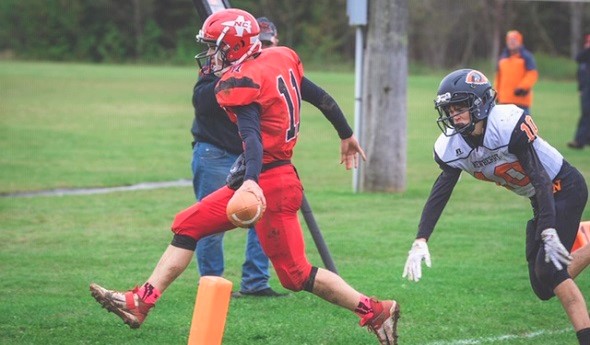
PHOTO: North Central clears a pylon for a score during a 54-0 win over Newberry on Oct. 11. (Photo by Jeff Rochefort.)