

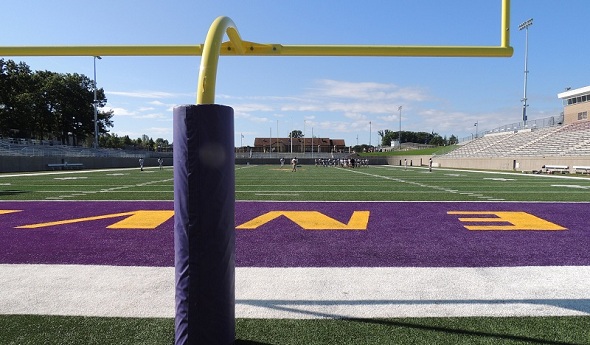
A Legacy Begins in Greenville
By
Geoff Kimmerly
MHSAA.com senior editor
August 24, 2012
GREENVILLE – Curtis Heppe has no idea what to expect, but a few guesses and a dream or two of how it will feel tonight to lead his teammates into Greenville's Legacy Field for the first time.
“It’s going to be electric, for sure. It’s a new vibe. It’s high-tech there,” the Yellow Jackets quarterback said Thursday after his team’s final preseason practice.
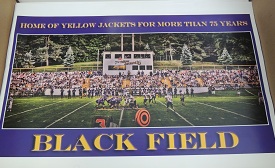
Those expectations are shared by a community that will be cheering on the local team in a new home after nearly a century at the legendary Black Field.
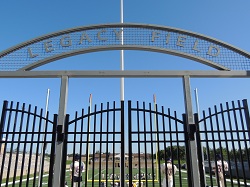 Workers put the finishing touches on the near-$7 million facility this week in advance of the season's first varsity game, tonight against rival Belding. Legacy Field officially opened for Wednesday’s freshman game, and Heppe said that even for that lower-level appetizer, the stadium began to come alive.
“We’ve just wanted Friday night to come. To get in and see how intense, how nice this place is,” he said. “Coming out of that tunnel, seeing our fans, it’s going to be the best feeling.”
Tonight’s grand opening will be the culmination of efforts from not just administrators, but students and community members as well – down to the name of the stadium itself.
“Legacy Field” was selected by Greenville’s school board. But it came as a suggestion from the school’s student council, which took submissions from classmates and then with faculty and administrators whittled the list to three favorites – Stinger Stadium and Community Field were next on their list.
But that’s just one way Legacy Field is a blend of old and new and ideas from all over town.
“In development, (it’s been) probably 10 years. We’ve been talking about it ever since I’ve been here, that one day we’d be able to do this,” said Greenville athletic director Brian Zdanowski, who is entering his 15th school year at that post. “It came through strategic planning. It came through community input. And then ultimately, our board bought in that there was enough interest in the community.”
Deeply rooted
A walk through Legacy Field is a history lesson. But first, an explanation of the Yellow Jackets’ past.
Black Field had served as the team’s home since 1916. It is nestled downtown next to Greenville’s former high school, which is now a library.
 The current high school, about 1.5 miles northwest, was built in 1963. Football teams continued to make the short trip for home games.
Black Field has its charms. With no track surrounding the field like at many multi-purpose stadiums, fans are only a few yards from the sideline. And all of that history added to the mystique for the latest players to wear the uniform.
The field also has had peculiarities. Zdanowski said at one point, the end zones were elevated in the corners. And the field wasn’t always square – a 10-yard penalty might measure 11 on one side of the field but only nine yards on the other.
But after just about every home game, students met for a bonfire on the grounds, an extension of the celebration by neighborhoods that surround Black Field and embraced the team for decades.
“It was the typical focal point of the community,” Zdanowski said.
Some things old, many new
Playing on Black Field was special, Heppe added. But he's equally if not more excited to be part of this new legacy. And architects made sure to bring that community feel to the new home this fall.
Destruction and construction began May 2, the day after last season’s final girls tennis match. The courts formerly sat in what is near the south end zone, and were moved closer to the track and soccer facility.
Amenities at the Yellow Jackets’ new football home are comparable to a college stadium’s, starting at the north side of the field.
 Players will enterthrough a tunnel that pours into the field like that of a miniature Spartan Stadium. Surrounding the tunnel are expansive locker rooms both for the home team and visitors, a similarly expansive training room and officials area and plenty of storage that will allow Greenville’s entire football program to be housed under that one roof. Unlike Black Field, tucked neatly among its neighbors, Legacy Field has plenty of parking and lighting, and builders were able to make that possible while also keeping intact a group of large oak trees near the south gate.
The turf is synthetic, like that played on by all but one member of the Yellow Jacket’s O-K Bronze conference. The difference from many is that the field has been dug out from the surrounding property, making it even more a focal point for those who will occupy the roughly 4,000 seats in the surrounding cement bowl. (The removed dirt was used to build two Little League fields on another part of the property.)
The sound system is of course state-of-the-art, and the press box, concessions area and restrooms also are equally expansive. But what locals should notice most are the throwbacks to the past that dot every corner of their new home.
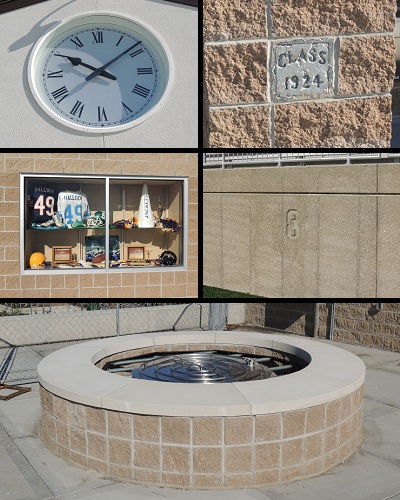
Cut into the brick work near the concession counter is a block from Black Field that had been dedicated by the school’s class of 1924. Atop the building is the Centennial Clock, 100 years old this year, which formerly hung at the entrance the old school and was donated by the class of 1912. It has been housed by Greenville’s museum until being re-donated to the school district to become part of the stadium.
Molded into the cement walls on the west and south sides of the field are the numbers formerly worn by players Henry Loding and Greg Blumberg. Both died from football-related injuries; Loding in 1906 and Blumberg in 1977. Two trophy cases are cut into the stone on the facing of the press box, including one featuring mementos celebrating alum and former Detroit Lions tight end Ty Hallock.
Another addition of historical significance will come later. The school’s first Hall of Fame class will be inducted before the Sept. 7 game, and that display will be housed near the south ticket area so residents and fans can check it out without having the enter the stadium itself.
And one last thing was added to keep with tradition. To the west of the concession area, but within the stadium fence, sits a large gas fire pit for those postgame gatherings – plus a sound system where students can plug in their mp3 players.
“We said we’re not forgetting our past, but we’re embracing our future,” Zdanowski said. “I’m sure a lot of people have said that before. So we really wanted to make sure we got community input on it and do as much as we could to replicate Black Field. … And I think we won some people over. We really wanted to do what we said (we’d do).”
PHOTOS: (Top) Greenville's junior varsity ran through drills during a morning session at Legacy Stadium, which opened this week. (Top middle) The ticket area and gate for fans sit on the south side of the field. (Middle) A poster given out last season celebrated the final to be played at Black Field. (Bottom middle) A number of pieces of Black Field's past and Greenville tradition were brought over to or included in Legacy Field, including Centennial Clock, which formerly was part of the old school.
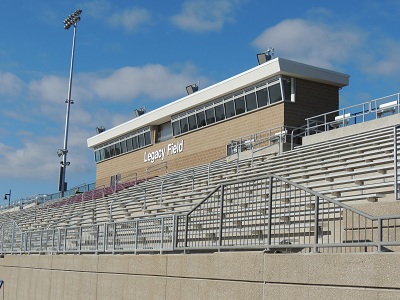 Legacy Field's press box is split into areas for game workers, coaches and media with a roll-up door for film crews.
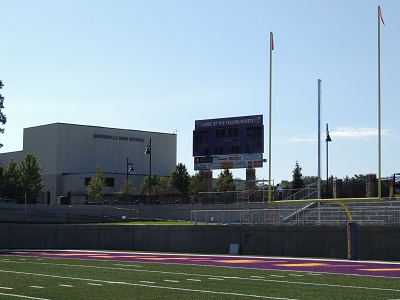
Legacy Field sits between Greenville's high school and middle school and adjacent to its soccer and track facilities.
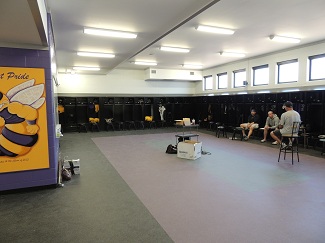 Coaches met in the spacious varsity locker room Monday morning. Junior varsity and freshman locker rooms are connected by a hallway with access to storage areas and the coaches' office.
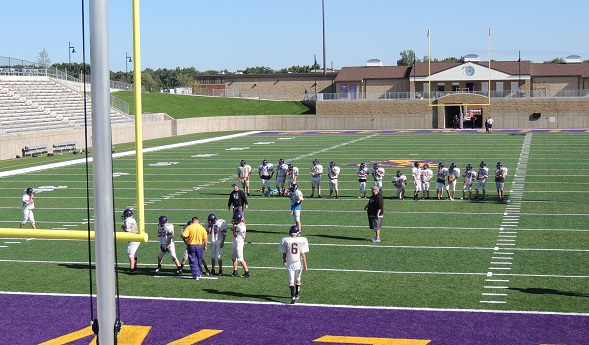 Players will enter Legacy Field through a tunnel at its north end. Above sits the concession area and restrooms, and the Centennial Clock that once ticked in the old Greenville school.
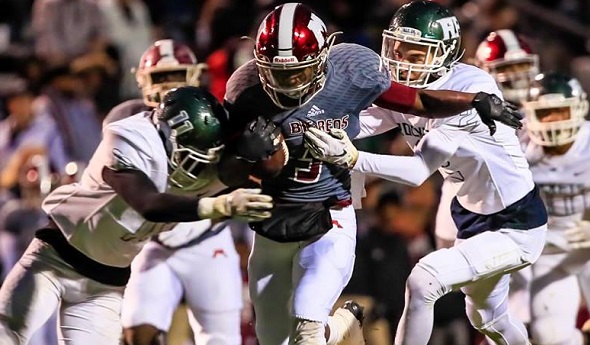
Drive for Detroit: Playoff Week 1 Preview
October 25, 2018
By Geoff Kimmerly
Second Half editor
Everything will seem to speed up from here for 288 Michigan high school football teams beginning their playoff runs this weekend.
 Temperatures dip below freezing, practices finish in the dark and urgency is at its utmost this time of year. But soon the reward will come into view – trips to Ford Field for the elite 11-player teams and Superior Dome for the best of the 8-player lineup.
All eight reigning champions and all eight 2017 runners-up are back as 11-player playoffs begin at the District level this weekend. Three of four 8-player finalists from last season, including one champion, are back as those brackets begin at the Pre-Regional level. A total of 125 games will be played tonight, with 19 more Saturday.
In addition to watching live from the stands, there are plenty of opportunity to watch playoff games all over the state either live or later this weekend. FOX Sports Detroit PLUS will bring the Division 7 opener at Kent City against Saugatuck to a live cable audience, and that game joins Haslett at East Lansing and Davison at Oxford to make up this week’s Prep Zone lineup streaming free of charge on FOXSportsDetroit.com and on the FOX Sports app. At least 13 more games will be viewable on MHSAA.tv, either live with subscription or free after 72 hours.
Below is a glance at a game of particular intrigue in each division. “Drive for Detroit” is powered by MI Student Aid.
Division 1
Grosse Pointe South (8-1) at Dearborn Fordson (8-1)
These two make up one side of what might be the strongest District in Division 1 – on the other side Detroit Cass Tech (9-0) takes on Detroit Western (6-3). The Blue Devils won the Macomb Area Conference White for the third straight season and tripped up only Week 9 against Romeo – over the first eight games, they gave up 5.4 points per game. For the second straight regular season, Fordson’s only loss came to undefeated Belleville – and this time by only three points. The Tractors also are one of only four in-state teams to give the Technicians a close game over the last two years – losing by just five in last season’s District Final – but they can’t look past Grosse Pointe South toward a possible rematch.
Others that caught my eye: FRIDAY Holland West Ottawa (6-3) at Hudsonville (6-3), Canton (6-3) at Detroit Catholic Central (6-3), Romeo (6-3) at Macomb Dakota (7-2). SATURDAY Brighton (7-2) at East Kentwood (8-1).
Division 2
Birmingham Groves (7-2) at Birmingham Seaholm (7-2)
This is one of those few rematches from Week 9 that crop up for the start of the playoffs every season, and Groves won this neighborly meeting 26-9 last week. But don’t think things can’t change over six days – it happens, and the Oakland Activities Association Blue champion Maples still gave up only 13 points per game during their first winning regular season since 2013. That said, Groves certainly knows how to turn it up in the playoffs. The Falcons are making their sixth straight postseason appearance and lost last year’s opener by just three to Brother Rice after making the Semifinals in 2016.
Others that caught my eye: FRIDAY Portage Central (7-2) at Portage Northern (7-2), Warren DeLaSalle (7-2) at Warren Mott (7-2), Walled Lake Western (6-3) at Fenton (7-2), St. Clair Shores Lake Shore (6-3) at Port Huron Northern (8-1).
Division 3
River Rouge (8-1) at Detroit Martin Luther King (7-2)
River Rouge’s enrollment has grown by more than 350 students over the last four years, as the Panthers went from Division 5-runner-up in 2015 to making Division 4 Semifinals the last two years and now playing in Division 3. Rouge’s only loss this fall was Week 1 to Cass Tech 40-7, and King fell by nearly the same score (42-8) to the Technicians in last week’s Detroit Public School League A championship game. The Crusaders also have lots of postseason experience, winning Division 2 in 2015 and 2016 and making the Semifinals last season before losing by a point to eventual champion Warren DeLaSalle. Just as impressive this fall, King’s only other defeat was by three to reigning Division 3 champion Muskegon – which has won 23 straight games and the rest this season by an average of 42 points per.
Others that caught my eye: FRIDAY East Grand Rapids (6-3) at Muskegon (9-0), Battle Creek Central (6-3) at Middleville Thornapple Kellogg (7-2), Garden City (6-3) at Warren Woods Tower (8-1), Haslett (8-1) at East Lansing (8-1).
Division 4
Bloomfield Hills Cranbrook Kingswood (6-3) at Farmington Hills Harrison (6-3), Saturday
The Harrison watch continues as John Herrington, the winningest coach in state football history, leads the Hawks into their final playoffs with the school closing next summer. After two straight losses, Harrison beat Farmington last week to earn an automatic playoff berth and slotted in Division 4 after finishing runner-up in Division 3 last season. The Cranes might not seem as dangerous as a year ago when they set a school wins record going 10-2. But they moved into the tougher Detroit Catholic League AA this fall, and all three losses this season were by seven or fewer points – and now they’re back in the familiar Division 4 bracket.
Others that caught my eye: FRIDAY Paw Paw (7-2) at Three Rivers (8-1), Lake Odessa Lakewood (7-2) vs. Flint Powers Catholic (6-3) at Atwood Stadium, Croswell-Lexington (6-3) at North Branch (7-2), Wyoming Godwin Heights (6-3) at Grand Rapids South Christian (5-4).
Division 5
Grand Rapids West Catholic (5-4) at Hudsonville Unity Christian (7-2)
It’s pretty well-known at this point that West Catholic has won five straight Division 5 titles and made six straight MHSAA Finals. The Falcons had to come back from a 1-3 start this fall and beat Coopersville in Week 9 to earn a shot at becoming an additional qualifier – but keep in mind they won it all in 2013 as an additional qualifier. Unity Christian has looked for a few years like a program inevitably on its way to Ford Field. The Crusaders made the Division 4 Semifinals in 2016 and lost last year’s D4 opener by just six to eventual champion Grand Rapids Catholic Central. They lost out on a share of a league title last week falling to Zeeland East, but both defeats this season came to Division 3 playoff teams – and Unity won three games over teams that made the Division 4 bracket.
Others that caught my eye: FRIDAY Berrien Springs (7-2) at Hopkins (8-1), Lansing Catholic (8-1) at Olivet (8-1), Detroit Osborn (6-3) at Detroit Denby (7-2). SATURDAY Clare (8-1) at Manistee (9-0).
Division 6
Michigan Center (8-1) at Grass Lake (8-1)
The Cardinals missed locking up a second straight Cascades Conference championship by less than a touchdown, falling to eventual title winner Grass Lake 14-10 in Week 6. Michigan Center led until the final two minutes – and this rematch should be a welcome opportunity. The Warriors are coming off a 55-7 loss to Division 8 contender Reading a week ago in the Cascades/Big 8 Conference champions crossover, but before that were giving up only 8.8 points per game. It’s easy to anticipate these teams keeping the score low and close again tonight.
Others that caught my eye: FRIDAY Ishpeming Westwood (7-2) at Calumet (9-0), Ecorse (7-2) vs. Warren Michigan Collegiate (8-1) at Madison Heights Bishop Foley, Constantine (6-3) at Schoolcraft (7-2), Hemlock (8-1) at Montrose (7-2).
Division 7
Saugatuck (8-1) at Kent City (8-1)
Kent City was a seven-point defeat to unbeaten Lake City from a second straight perfect regular season, and the Eagles get the chance to impress the statewide TV crowd by shutting down an Indians offense averaging nearly 51 points per game. Senior Brad Dunn leads Saugatuck with 2,189 yards and 38 touchdowns rushing, and senior Jacob Stewart (918/13) also could go over 1,000 yards for the season for the reigning Division 7 runner-up – which lost only to Schoolcraft, by a point. Kent City gives up just under 11 points per game and held Lake City to 22 below its final regular-season scoring average in that 14-7 Week 8 loss.
Others that caught my eye: FRIDAY Cass City (7-2) at Sandusky (8-1). SATURDAY Harbor Springs (7-2) at Roscommon (8-1), Oscoda (8-1) at Iron Mountain (7-2), Detroit Loyola (6-3) at Madison Heights Bishop Foley (8-1).
Division 8
Pittsford (7-2) at Reading (9-0)
The Rangers have put together strong teams over the years – they’re making their 24th playoff appearance, and the 2008 team reached the Division 7 Semifinals. But it’s a good argument this is Reading’s most impressive team of the playoff era as it outscores opponents 50-4 on average and outscored five playoff-bound teams by an average of 47-7. Pittsford has reasons to be confident too heading into its fifth straight playoffs and seventh in eight seasons. The Wildcats emerged from a four-team league where all four made the playoffs this fall, and their losses both were to playoff-bound teams. Pittsford also beat Waterford Our Lady (see below) big in Week 4 and is giving up only 8.7 points per game this fall.
Others that caught my eye: FRIDAY Waterford Our Lady (5-4) at Clarkston Everest Collegiate (8-1), Adrian Lenawee Christian (8-1) at Ottawa Lake Whiteford (9-0), Saginaw Nouvel (6-3) at Harbor Beach (8-1), Mendon (5-4) at White Pigeon (7-2).
8-Player Division 1
Kingston (8-1) at Deckerville (7-2)
Deckerville has played in two straight MHSAA Finals, falling just three points short of the Division 1 title a year ago. The Eagles opened their North Central Thumb League Blue title march this fall with a 36-20 win over Kingston in Week 5, and they’re 10-0 against the Cardinals since the teams began playing each other regularly again in 2010. Kingston this fall tied its most wins since 2006, and a ninth victory would tie a high since 1999 – while also breaking the streak and making the Cardinals instant Division 1 contenders.
Others that caught my eye: FRIDAY Battle Creek St. Philip (6-3) at Bellevue (8-1), Genesee (5-4) at Morrice (9-0), Camden-Frontier (5-4) at Colon (8-1).
8-Player Division 2
Crystal Falls Forest Park (5-4) at Powers North Central (8-1)
North Central clinched the Great Lakes Conference West ahead of second-place Forest Park thanks to a 52-28 win Week 6, and that was just the latest meeting between the two with potential championship implications. The Jets downed the Trojans 60-50 in a Regional Final in 2016 on the way to winning the 8-player title, and the Trojans beat the Jets 20-6 in last season’s playoff opener on the way to winning the Division 2 championship. North Central, with its only loss opening night to Engadine, would seem a big favorite this time – but Forest Park is putting up 44 points per game despite giving up 34 and should be comfortable if forced to trade score for score.
Others that caught my eye: FRIDAY Rapid River (6-3) at Engadine (8-1), Marion (6-3) at Onekama (7-2), SATURDAY Peck (5-4) vs. Portland St. Patrick (5-4) at Portland.
Second Half’s weekly “Drive for Detroit” previews and reviews are powered by MI Student Aid, a part of the Student Financial Services Bureau located within the Michigan Department of Treasury. MI Student Aid encourages students to pursue postsecondary education by providing access to student financial resources and information, including various student financial assistance programs to help make college more affordable for Michigan students. MI Student Aid administers the state’s 529 savings programs (MET/MESP) and eight additional aid programs within its Student Scholarships and Grants division. Click for more information and connect with MI Student Aid on Facebook and Twitter @mistudentaid.
PHOTO: Jeremiah Lockhart and Muskegon, here against Reeths-Puffer, are among reigning champions seeking to repeat as playoffs begin this week. (Photo by Tim Reilly.)