

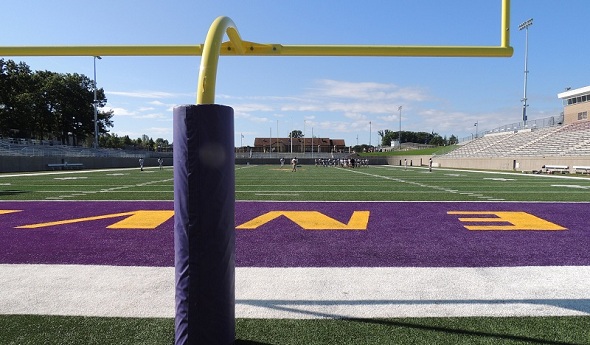
A Legacy Begins in Greenville
By
Geoff Kimmerly
MHSAA.com senior editor
August 24, 2012
GREENVILLE – Curtis Heppe has no idea what to expect, but a few guesses and a dream or two of how it will feel tonight to lead his teammates into Greenville's Legacy Field for the first time.
“It’s going to be electric, for sure. It’s a new vibe. It’s high-tech there,” the Yellow Jackets quarterback said Thursday after his team’s final preseason practice.
Those expectations are shared by a community that will be cheering on the local team in a new home after nearly a century at the legendary Black Field.
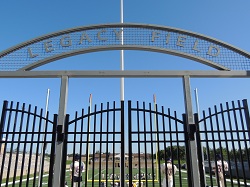 Workers put the finishing touches on the near-$7 million facility this week in advance of the season's first varsity game, tonight against rival Belding. Legacy Field officially opened for Wednesday’s freshman game, and Heppe said that even for that lower-level appetizer, the stadium began to come alive.
“We’ve just wanted Friday night to come. To get in and see how intense, how nice this place is,” he said. “Coming out of that tunnel, seeing our fans, it’s going to be the best feeling.”
Tonight’s grand opening will be the culmination of efforts from not just administrators, but students and community members as well – down to the name of the stadium itself.
“Legacy Field” was selected by Greenville’s school board. But it came as a suggestion from the school’s student council, which took submissions from classmates and then with faculty and administrators whittled the list to three favorites – Stinger Stadium and Community Field were next on their list.
But that’s just one way Legacy Field is a blend of old and new and ideas from all over town.
“In development, (it’s been) probably 10 years. We’ve been talking about it ever since I’ve been here, that one day we’d be able to do this,” said Greenville athletic director Brian Zdanowski, who is entering his 15th school year at that post. “It came through strategic planning. It came through community input. And then ultimately, our board bought in that there was enough interest in the community.”
Deeply rooted
A walk through Legacy Field is a history lesson. But first, an explanation of the Yellow Jackets’ past.
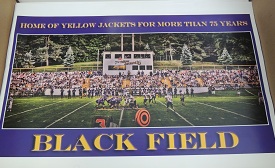
Black Field had served as the team’s home since 1916. It is nestled downtown next to Greenville’s former high school, which is now a library.
 The current high school, about 1.5 miles northwest, was built in 1963. Football teams continued to make the short trip for home games.
Black Field has its charms. With no track surrounding the field like at many multi-purpose stadiums, fans are only a few yards from the sideline. And all of that history added to the mystique for the latest players to wear the uniform.
The field also has had peculiarities. Zdanowski said at one point, the end zones were elevated in the corners. And the field wasn’t always square – a 10-yard penalty might measure 11 on one side of the field but only nine yards on the other.
But after just about every home game, students met for a bonfire on the grounds, an extension of the celebration by neighborhoods that surround Black Field and embraced the team for decades.
“It was the typical focal point of the community,” Zdanowski said.
Some things old, many new
Playing on Black Field was special, Heppe added. But he's equally if not more excited to be part of this new legacy. And architects made sure to bring that community feel to the new home this fall.
Destruction and construction began May 2, the day after last season’s final girls tennis match. The courts formerly sat in what is near the south end zone, and were moved closer to the track and soccer facility.
Amenities at the Yellow Jackets’ new football home are comparable to a college stadium’s, starting at the north side of the field.
 Players will enterthrough a tunnel that pours into the field like that of a miniature Spartan Stadium. Surrounding the tunnel are expansive locker rooms both for the home team and visitors, a similarly expansive training room and officials area and plenty of storage that will allow Greenville’s entire football program to be housed under that one roof. Unlike Black Field, tucked neatly among its neighbors, Legacy Field has plenty of parking and lighting, and builders were able to make that possible while also keeping intact a group of large oak trees near the south gate.
The turf is synthetic, like that played on by all but one member of the Yellow Jacket’s O-K Bronze conference. The difference from many is that the field has been dug out from the surrounding property, making it even more a focal point for those who will occupy the roughly 4,000 seats in the surrounding cement bowl. (The removed dirt was used to build two Little League fields on another part of the property.)
The sound system is of course state-of-the-art, and the press box, concessions area and restrooms also are equally expansive. But what locals should notice most are the throwbacks to the past that dot every corner of their new home.
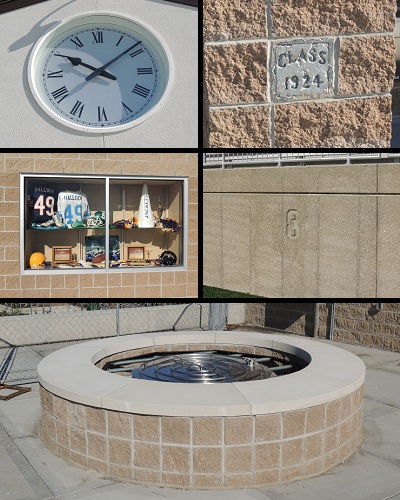
Cut into the brick work near the concession counter is a block from Black Field that had been dedicated by the school’s class of 1924. Atop the building is the Centennial Clock, 100 years old this year, which formerly hung at the entrance the old school and was donated by the class of 1912. It has been housed by Greenville’s museum until being re-donated to the school district to become part of the stadium.
Molded into the cement walls on the west and south sides of the field are the numbers formerly worn by players Henry Loding and Greg Blumberg. Both died from football-related injuries; Loding in 1906 and Blumberg in 1977. Two trophy cases are cut into the stone on the facing of the press box, including one featuring mementos celebrating alum and former Detroit Lions tight end Ty Hallock.
Another addition of historical significance will come later. The school’s first Hall of Fame class will be inducted before the Sept. 7 game, and that display will be housed near the south ticket area so residents and fans can check it out without having the enter the stadium itself.
And one last thing was added to keep with tradition. To the west of the concession area, but within the stadium fence, sits a large gas fire pit for those postgame gatherings – plus a sound system where students can plug in their mp3 players.
“We said we’re not forgetting our past, but we’re embracing our future,” Zdanowski said. “I’m sure a lot of people have said that before. So we really wanted to make sure we got community input on it and do as much as we could to replicate Black Field. … And I think we won some people over. We really wanted to do what we said (we’d do).”
PHOTOS: (Top) Greenville's junior varsity ran through drills during a morning session at Legacy Stadium, which opened this week. (Top middle) The ticket area and gate for fans sit on the south side of the field. (Middle) A poster given out last season celebrated the final to be played at Black Field. (Bottom middle) A number of pieces of Black Field's past and Greenville tradition were brought over to or included in Legacy Field, including Centennial Clock, which formerly was part of the old school.
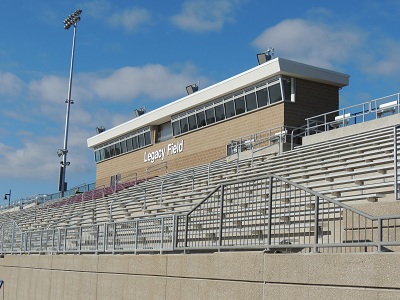 Legacy Field's press box is split into areas for game workers, coaches and media with a roll-up door for film crews.
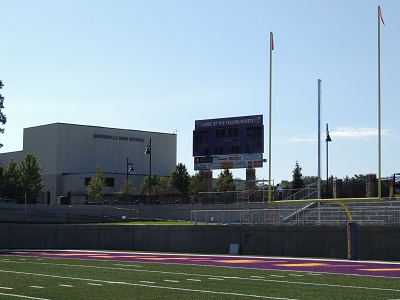
Legacy Field sits between Greenville's high school and middle school and adjacent to its soccer and track facilities.
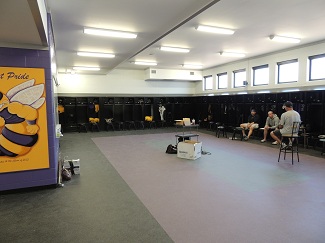 Coaches met in the spacious varsity locker room Monday morning. Junior varsity and freshman locker rooms are connected by a hallway with access to storage areas and the coaches' office.
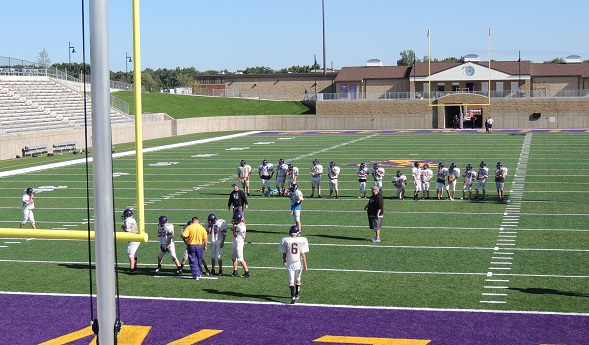 Players will enter Legacy Field through a tunnel at its north end. Above sits the concession area and restrooms, and the Centennial Clock that once ticked in the old Greenville school.
2025 MHSAA Football Playoff Pairings Announced
By
Geoff Kimmerly
MHSAA.com senior editor
October 26, 2025
Here are the pairings for the 2025 MHSAA Football Playoffs, which begin Oct. 31 and Nov. 1 with District Semifinals in the 11-Player Playoffs and Regional Semifinals in the 8-Player Playoffs.
Teams were divided into divisions before the start of play this fall. The top 32 teams in each division in 11-player and top 16 per division in 8-player, based on playoff-point average, were selected to the field. For 11-player, qualifiers were then divided into four regions with eight teams apiece, and for 8-player qualifiers were divided into four regions with four teams in each.
Pairings for the first three weeks of the tournament are based on regular-season playoff point averages, with the highest-ranked team hosting, regardless of the distance between the two schools. For 11-Player District Semifinal and 8-Player Regional Semifinal play, the top-seeded team in each bracket will host the fourth-seeded team, and the second-seeded team will host the third-seeded team.
District Finals for 11-player and Regional Finals for 8-player will follow during the weekend of Nov. 7-8, and the weekend of Nov. 14-15 will have Regional Finals in the 11-Player Playoffs and Semifinals in the 8-Player Playoffs. The 8-Player Semifinals will pair the winners of Region 1 vs. Region 2 and the winners of Region 3 vs. Region 4 at neutral sites assigned by the MHSAA.
Semifinal games in the 11-Player Playoffs will take place Nov. 21-22, pairing the winners of Region 1 vs. Region 2 and the winners of Region 3 vs. Region 4. The MHSAA also will assign 11-Player Semifinals at neutral sites.
All playoff tickets except for Finals (both 11 and 8-player) will be sold online only via GoFan.
For 11-Player, tickets to District Semifinals and District Finals cost $7, tickets to Regional Finals are $9, and tickets to Semifinals cost $10. For 8-player, tickets for Regional Semifinals are $7, tickets for Regional Finals are $9, and tickets for Semifinals cost $10.
The 8-Player Finals will take place Nov. 22 at Northern Michigan University’s Superior Dome in Marquette, and the 11-Player Finals will be played Nov. 28 and 30 at Ford Field in Detroit. An all-day ticket for 8-Player Finals costs $10 and includes admission to both games, and an all-day ticket for the 11-Player Finals costs $20 and includes admission to that day’s four games.
The 11-Player Finals schedule will be as follows:
Friday, Nov. 28
9:30 a.m. - Division 8
12:30 p.m. - Division 4
4 p.m. - Division 6
7 p.m. - Division 2
Sunday, Nov. 30
9:30 a.m. - Division 7
12:30 p.m. - Division 3
4 p.m. - Division 5
7 p.m. - Division 1
Pairings for both the 11 and 8-Player brackets are as follows:
11-Player Pairings
DIVISION 1
REGION 1
DISTRICT 1
Jenison (4-5) 52.778 at Hudsonville (9-0) 85.556
Grandville (4-5) 56.111 at Rockford (7-2) 75.444
DISTRICT 2
Kalamazoo Central (6-3) 53.778 at Howell (8-1) 80.111
Grand Ledge (7-2) 65.667 at East Kentwood (7-2) 70.222
REGION 2
DISTRICT 1
Hartland (5-4) 60.000 at Detroit Catholic Central (9-0) 81.056
Brighton (6-3) 69.333 at West Bloomfield (7-2) 72.333
DISTRICT 2
Davison (8-1) 70.000 at Clarkston (8-1) 87.111
Oxford (7-2) 77.556 at Grand Blanc (9-0) 81.444
REGION 3
DISTRICT 1
Salem (5-4) 57.333 at Saline (8-1) 77.500
Brownstown Woodhaven (7-2) 66.111 at Belleville (7-2) 72.889
DISTRICT 2
Northville (7-2) 70.111 at Detroit Cass Tech (9-0) 74.556
Dearborn Fordson (7-2) 70.889 at Farmington (7-2) 71.222
REGION 4
DISTRICT 1
Rochester (5-4) 53.333 at Rochester Adams (7-2) 76.111
Utica Eisenhower (5-4) 57.000 at Rochester Hills Stoney Creek (6-3) 64.111
DISTRICT 2
Sterling Heights Stevenson (5-4) 54.778 at Romeo (6-3) 69.444
Macomb Dakota (6-3) 63.444 at Utica (7-2) 67.778
DIVISION 2
REGION 1
DISTRICT 1
Muskegon Mona Shores (5-4) 52.111 at Muskegon (6-3) 64.556
Traverse City Central (5-4) 53.889 at Traverse City West (5-4) 59.222
DISTRICT 2
Lansing Everett (5-4) 55.778 at Portage Central (9-0) 76.111
Portage Northern (7-2) 62.528 at Byron Center (6-3) 66.333
REGION 2
DISTRICT 1
Waterford Mott (5-4) 53.889 at Midland Dow (8-1) 71.111
East Lansing (4-5) 56.111 at White Lake Lakeland (7-2) 68.000
DISTRICT 2
Bloomfield Hills Brother Rice (5-4) 54.611 at Walled Lake Western (7-2) 68.667
Orchard Lake St. Mary's (6-2) 63.083 at North Farmington (6-3) 64.889
REGION 3
DISTRICT 1
South Lyon East (4-5) 49.222 at South Lyon (9-0) 78.889
Livonia Franklin (6-3) 62.889 at Dexter (8-1) 76.500
DISTRICT 2
Lincoln Park (5-4) 52.444 at Gibraltar Carlson (9-0) 77.667
Temperance Bedford (4-5) 54.357 at Allen Park (5-4) 55.889
REGION 4
DISTRICT 1
Warren Mott (5-4) 50.222 at Birmingham Groves (6-3) 61.556
Birmingham Seaholm (5-4) 55.556 at Warren Cousino (6-3) 59.778
DISTRICT 2
Roseville (4-5) 52.889 at Grosse Pointe South (8-1) 70.333
St. Clair Shores Lakeview (7-2) 62.444 at Port Huron Northern (7-2) 69.111
DIVISION 3
REGION 1
DISTRICT 1
Bay City Western (4-5) 46.556 at Mount Pleasant (9-0) 76.444
Marquette (6-3) 51.889 at Gaylord (9-0) 66.000
DISTRICT 2
Coopersville (4-5) 47.000 at Grand Rapids Kenowa Hills (8-1) 67.111
Cedar Springs (8-1) 60.556 at East Grand Rapids (7-2) 60.778
REGION 2
DISTRICT 1
Zeeland West (6-3) 50.889 at Niles (9-0) 67.778
Zeeland East (6-3) 51.444 at St. Joseph (5-4) 54.889
DISTRICT 2
Coldwater (6-3) 47.111 at Lowell (7-2) 58.778
Middleville Thornapple Kellogg (6-3) 53.222 at Hastings (7-2) 58.556
REGION 3
DISTRICT 1
Owosso (6-3) 49.444 at DeWitt (9-0) 79.667
Linden (6-3) 50.222 at Mason (5-4) 55.444
DISTRICT 2
Ypsilanti Lincoln (6-3) 55.111 at Adrian (8-1) 60.333
Holly (6-3) 58.222 at Fenton (6-3) 58.444
REGION 4
DISTRICT 1
Riverview (6-3) 45.667 at Detroit Martin Luther King (5-4) 59.667
Redford Thurston (6-3) 52.222 at Trenton (5-4) 55.000
DISTRICT 2
Warren De La Salle Collegiate (3-6) 49.306 at Warren Fitzgerald (8-1) 65.889
Marysville (7-2) 54.444 at Port Huron (6-3) 59.889
DIVISION 4
REGION 1
DISTRICT 1
Freeland (7-2) 49.667 at Escanaba (8-1) 58.222
Big Rapids (8-1) 52.667 at Ludington (9-0) 56.778
DISTRICT 2
Holland Christian (5-4) 43.778 at Hudsonville Unity Christian (8-1) 61.333
Spring Lake (6-3) 45.444 at Wyoming Godwin Heights (7-2) 51.444
REGION 2
DISTRICT 1
Grand Rapids Christian (5-4) 45.333 at Battle Creek Harper Creek (8-1) 65.333
Grand Rapids South Christian (4-5) 47.444 at Portland (9-0) 58.444
DISTRICT 2
Three Rivers (5-4) 46.389 at Paw Paw (6-3) 56.111
Vicksburg (5-4) 48.556 at Edwardsburg (6-3) 51.222
REGION 3
DISTRICT 1
Lansing Sexton (6-3) 45.667 at Williamston (9-0) 69.500
St. Johns (5-4) 48.889 at Haslett (7-2) 61.111
DISTRICT 2
Lake Fenton (4-5) 43.000 at Goodrich (9-0) 68.000
Fowlerville (5-4) 44.444 at Chelsea (8-1) 67.778
REGION 4
DISTRICT 1
Tecumseh (6-3) 50.222 at Dearborn Divine Child (8-1) 59.667
Redford Union (7-2) 55.111 at Madison Heights Lamphere (6-3) 57.889
DISTRICT 2
Macomb Lutheran North (7-2) 44.111 at Harper Woods (9-0) 88.222
Center Line (7-2) 48.222 at Harper Woods Chandler Park (7-2) 49.222
DIVISION 5
REGION 1
DISTRICT 1
Negaunee (6-3) 40.875 at Ogemaw Heights (8-1) 54.389
Gladwin (5-4) 43.111 at Kingsford (6-3) 43.222
DISTRICT 2
Clare (6-3) 43.111 at Saginaw Swan Valley (8-1) 54.778
Howard City Tri County (5-4) 43.556 at Whitehall (5-4) 46.333
REGION 2
DISTRICT 1
Wyoming Kelloggsville (6-3) 40.778 at Grand Rapids Catholic Central (9-0) 74.206
Muskegon Oakridge (6-3) 43.000 at Grand Rapids West Catholic (8-1) 62.111
DISTRICT 2
Hopkins (5-4) 41.222 at Kalamazoo United (7-2) 43.286
Dowagiac (5-3) 41.827 at Berrien Springs (5-2) 42.802
REGION 3
DISTRICT 1
Detroit Cody (5-4) 37.222 at Ann Arbor Father Gabriel Richard (9-0) 52.667
Romulus (4-5) 41.111 at Michigan Center (8-1) 43.000
DISTRICT 2
Detroit Voyageur College Prep (4-5) 36.889 at Romulus Summit Academy North (7-1) 54.125
Flat Rock (6-3) 47.889 at Monroe Jefferson (8-1) 52.111
REGION 4
DISTRICT 1
Hazel Park (6-3) 39.333 at Pontiac Notre Dame Prep (7-2) 62.444
Detroit Denby (7-2) 46.556 at Detroit Southeastern (6-3) 49.000
DISTRICT 2
Yale (5-4) 39.000 at Frankenmuth (8-1) 57.778
Armada (6-3) 46.444 at Richmond (8-1) 55.222
DIVISION 6
REGION 1
DISTRICT 1
Calumet (7-2) 40.500 at Kingsley (7-2) 48.167
Boyne City (6-3) 41.944 at Traverse City St. Francis (6-2) 44.472
DISTRICT 2
Sanford Meridian (6-3) 36.111 at Reed City (7-2) 47.667
Montague (5-4) 36.444 at Central Montcalm (7-2) 37.444
REGION 2
DISTRICT 1
Ovid-Elsie (7-2) 42.000 at Belding (8-1) 57.222
Kent City (9-0) 49.667 at Olivet (8-1) 51.333
DISTRICT 2
Flint New Standard Academy (8-1) 34.264 at Montrose (9-0) 45.889
Durand (7-2) 40.222 at Flint Hamady (6-3) 40.444
REGION 3
DISTRICT 1
Onsted (4-5) 32.778 at Jackson Lumen Christi (6-3) 61.889
Buchanan (6-3) 34.357 at Napoleon (6-3) 38.556
DISTRICT 2
Adrian Madison (5-4) 33.889 at Ecorse (7-2) 48.000
Dearborn Heights Robichaud (6-3) 40.984 at Ida (7-2) 41.778
REGION 4
DISTRICT 1
Detroit Central (6-3) 34.889 at Detroit Edison (7-2) 53.056
Warren Michigan Collegiate (5-4) 37.556 at Detroit Pershing (6-3) 40.111
DISTRICT 2
Clinton Township Clintondale (5-4) 33.889 at Almont (9-0) 61.667
Clawson (6-3) 41.000 at Marine City (6-3) 47.222
DIVISION 7
REGION 1
DISTRICT 1
Manton (6-3) 28.000 at Menominee (9-0) 52.486
McBain (7-2) 36.667 at Charlevoix (8-1) 41.556
DISTRICT 2
Morley Stanwood (3-6) 25.556 at Harrison (7-2) 33.333
Shelby (5-4) 26.667 at LeRoy Pine River (6-3) 32.111
REGION 2
DISTRICT 1
Ravenna (4-5) 28.889 at Pewamo-Westphalia (8-0) 41.889
Saranac (7-2) 30.778 at North Muskegon (6-3) 35.514
DISTRICT 2
Ithaca (6-3) 34.222 at Saginaw Valley Lutheran (9-0) 40.333
Cass City (6-3) 35.667 at Elkton-Pigeon-Bay Port Laker (7-2) 37.778
REGION 3
DISTRICT 1
Galesburg-Augusta (4-5) 26.000 at Schoolcraft (7-2) 39.333
Constantine (6-3) 38.667 at Lawton (7-2) 39.000
DISTRICT 2
Union City (5-4) 28.222 at Hanover-Horton (7-2) 42.889
Jonesville (6-3) 30.222 at Bronson (7-2) 35.222
REGION 4
DISTRICT 1
Leslie (5-4) 28.778 at Monroe St. Mary Catholic Central (7-2) 49.667
Ottawa Lake Whiteford (8-1) 36.667 at Clinton (7-2) 40.556
DISTRICT 2
Burton Bendle (6-3) 29.333 at Millington (7-2) 41.000
Rochester Hills Lutheran Northwest (5-4) 29.873 at Detroit Community (6-3) 30.762
DIVISION 8
REGION 1
DISTRICT 1
West Iron County (4-4) 25.361 at Bark River-Harris (7-1) 37.375
L'Anse (5-4) 25.417 at Iron Mountain (5-3) 27.528
DISTRICT 2
Mancelona (5-4) 29.361 at Maple City Glen Lake (7-1) 40.528
Frankfort (6-3) 29.917 at East Jordan (6-3) 32.625
REGION 2
DISTRICT 1
Mount Pleasant Sacred Heart (5-4) 26.206 at Beal City (9-0) 42.111
Saginaw Michigan Lutheran Seminary (6-3) 33.000 at Saginaw Nouvel Catholic Central (7-2) 33.556
DISTRICT 2
Reese (5-4) 27.111 at Harbor Beach (9-0) 42.556
Genesee (4-5) 27.556 at Unionville-Sebewaing (6-3) 32.889
REGION 3
DISTRICT 1
Centreville (5-4) 29.778 at Hudson (9-0) 49.857
White Pigeon (7-2) 35.222 at Decatur (7-2) 38.222
DISTRICT 2
Manchester (5-4) 28.444 at Springport (9-0) 38.931
Fowler (6-3) 34.111 at New Lothrop (6-3) 37.778
REGION 4
DISTRICT 1
Auburn Hills Oakland Christian (5-4) 25.611 at Madison Heights Madison (8-1) 44.556
Clarkston Everest Collegiate (5-4) 28.667 at Waterford Our Lady of the Lakes (5-4) 30.444
DISTRICT 2
Riverview Gabriel Richard (4-5) 29.111 at Melvindale Academy for Business & Tech (9-0) 45.667
Southfield Bradford Academy (6-3) 31.889 at Allen Park Cabrini (8-1) 38.889
8-Player Pairings
DIVISION 1
REGION 1
Gogebic (8-1) 32.264 at Norway (9-0) 37.625
Pickford (7-1) 32.542 at Indian River Inland Lakes (9-0) 36.667
REGION 2
Breckenridge (6-3) 30.250 at Blanchard Montabella (8-1) 35.222
Central Lake (6-3) 30.333 at Merrill (7-2) 31.778
REGION 3
Marcellus (6-3) 28.417 at Martin (9-0) 38.667
Climax-Scotts (7-2) 32.486 at Gobles (7-2) 33.194
REGION 4
Bay City All Saints (7-2) 31.319 at Kingston (8-1) 36.222
Capac (7-2) 33.111 at Brown City (7-2) 33.444
DIVISION 2
REGION 1
St. Ignace (6-3) 29.250 at Felch North Dickinson (9-0) 34.708
Powers North Central (7-2) 31.444 at Lake Linden-Hubbell (7-2) 31.444
REGION 2
Hillman (6-3) 29.208 at Onekama (9-0) 36.667
Gaylord St. Mary (7-2) 29.778 at Mio (8-1) 32.472
REGION 3
Marion (6-3) 29.333 at Portland St Patrick (9-0) 37.750
Grand Rapids Sacred Heart (8-1) 34.972 at Mendon (9-0) 37.375
REGION 4
Pittsford (7-2) 32.111 at Britton Deerfield (8-1) 36.889
Morrice (8-1) 32.222 at Deckerville (8-1) 36.556
The MHSAA is a private, not-for-profit corporation of voluntary membership by more than 1,500 public and private senior high schools and junior high/middle schools which exists to develop common rules for athletic eligibility and competition. No government funds or tax dollars support the MHSAA, which was the first such association nationally to not accept membership dues or tournament entry fees from schools. Member schools which enforce these rules are permitted to participate in MHSAA tournaments, which attract more than 1.4 million spectators each year.
-0-