

Let's Not Forget These Winning Coaches
December 15, 2015
By Ron Pesch
Special for Second Half
Buried deep within the MHSAA’s list of coaches with 200 career football wins is the name Oscar Johnson. Sharp eyes will note that Johnson began his coaching career in 1925 – 90 years ago.
Following graduation from Western State Normal School (today, Western Michigan University) in Kalamazoo, Oscar E. Johnson coached two seasons at Mount Pleasant High School before moving on to Muskegon Heights in 1927. Known by his nickname, like most from the time period, “Okie” coached multiple sports including football, basketball and baseball. After 37 years (1927 to 1963) and six mythical gridiron championships (as well as three Class A basketball titles), he retired and moved to Baldwin.
During a teacher’s strike in 1979, Johnson, now in his 70’s, came out of retirement to coach Baldwin’s football team for four contests, earning three wins against a single loss. In 40 seasons, Johnson’s teams posted 209 victories against 106 defeats and 28 ties.
In 1975, his was the lone name that would have appeared on the MHSAA’s list of coaches with 200 football wins.
In 1980, Bill Maskill, a graduate of Michigan State University and head coach for six seasons at Sheridan, then Galesburg-Augusta for 29 years, was the second to join the list. Jack Castignola, who started his coaching career in Ohio before becoming varsity coach at Monroe Catholic Central and then Trenton, was added to the list in 1981.
They were followed by Dick Mettlach, long of Crystal Falls and that school’s successor, Crystal Falls Forest Park, Jack Streidl who led Plainwell for 37 seasons, and Dick Soisson, who coached for a combined 41 seasons at Owosso St. Paul, Kalamazoo St. Augustine and Kalamazoo Hackett. Each posted his 200th win in 1984. Leo “Smokey” Boyd, who coached 40 years at Standish-Sterling, Saginaw Sts. Peter and Paul and Saginaw Nouvel, notched his 200th win in 1985, becoming only the seventh coach to accomplish the task in 90-plus years of high school football in Michigan.
Only two additional names were added over the next five years. Walt Braun, long of Marysville, joined the exclusive group in 1986. Al Fracassa, who spent a combined 46 seasons coaching at Royal Oak Shrine and Birmingham Brother Rice and turned down the chance to join Muddy Waters’ coaching staff at MSU in 1980, picked up his 200th win in 1988. That brought the list to nine total.
Twenty five years later, the list totals 58 names. So what changed?
Of course, it was the addition of the MHSAA football playoffs, which debuted in 1975.
A look at two coaches helps illustrate the issue.
Fracassa, the list’s current leader in all-time wins with 430, took 29 seasons to tally his first 200 victories. It took only 23 more seasons for him to gain the next 200. Farmington Hills Harrison’s John Harrington took 24 years to total 200 wins, but picked up his 400th after only 20 more.
Between 1960, Fracassa’s first season, and 1988, Fracassa’s teams played an average of 8.30 games a season. Between 1970, Herrington’s first year and 1993, the year of his 200th, his teams averaged 9.64 games per season.
Between 1988 and 2011, when Fracassa won his 400th game, his teams played an average of 11.61 games a season. Between 1994 and 2013, Herrington’s 400th, his teams played an average of 11.09 games per year. Fracassa’s teams compiled 68 victories in the MHSAA postseason. Herrington’s teams lead the state with 87 victories in the state playoffs.
Simply put, with the arrival of the postseason, it became easier to get to 200.
While no one would debate the accomplishments of any of the 58 gentlemen on the list, all but a few benefit from a baseline that few others who coached only 40 years before them were unlikely to reach.
Of course, those previous years included an amazing array of mentors. In hindsight, perhaps the list should include a mark for coaches from who assemble 150 varsity wins during the regular season only.
Johnson, and many others on the current list, certainly fall within such a category. But so would people like Ted Sowle, who, according to extensive research by former state historian Dick Kishpaugh, compiled a combined 171-47-10 mark between 1937 and 1963 as varsity coach at Grant, Algonac, Cathedral Prep in Erie, Pa., and Grand Rapids Catholic Central. At the time of his retirement from coaching in 1963, he ranked second in the state on the career wins list, behind only Johnson.
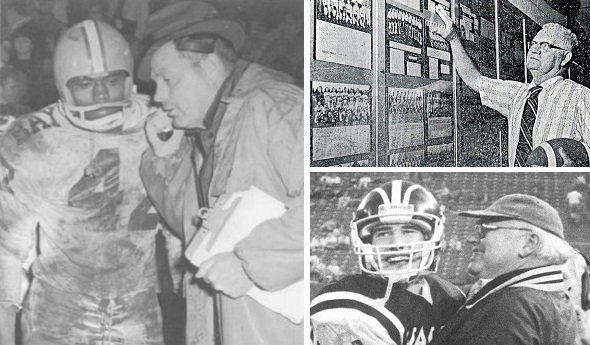
Ray Rynberg, a Grand Rapids Union and Central Michigan graduate, began his coaching career at Cedar Springs in 1939. After 12 years, he stepped away from the coaching ranks to pursue a degree in school administration from the University of Michigan. In the fall of 1955 he returned to the sidelines at Grant. He remained for 21 years, compiling a record of 189-62-9 (including seven unbeaten seasons) surpassing Sowle on the list upon retirement following the 1975 season.
Elmer Engel, who is honored in Bay City with his name attached to the city’s beautiful football stadium, also would appear on such a list. A three-year starter at the University of Illinois, Engel arrived in 1950 and installed the T-formation. He worked the sidelines for the Wolves through the 1972 season, compiling a 165-34-8 record and mythical Class A state titles in 1958, 1965, 1967, 1969 and 1972 according to the Associated Press polls ranking the state’s top teams.
Traverse City’s Jim Ooley led the Traverse City Trojans to a 164-56-4 regular season record (and a 179-60-4 record overall). Muskegon’s C. Leo Redmond led the Big Reds to a 156-29-13 record and six mythical Class A state titles between 1923 and 1946.
Certainly, there are others, many long-forgotten by most to the sands of time, who would qualify for the list. But who are they?
Incredibly successful coaches, like Flint Northern’s Guy Houston, would still fall shy. Playing in the incredibly tough Saginaw Valley Conference, Houston’s teams posted a remarkable 148-41-13 mark in 24 seasons as head coach of the Vikings. Nick Annese, who rolled up a 55-29-2 mark (including 38 straight victories) in 10 seasons at New Lothrop, then led Corunna to a 91-32-3 mark over 14 seasons but falls several games short.
So will many other of the state’s more well-known names, like Lloyd Carr, best known for his years at the University of Michigan, (who served as an assistant at Detroit Nativity and Belleville, before becoming head coach at Westland John Glenn for a few years), University of Nebraska’s Bob Devaney (who spent years 14 years coaching in Birmingham, Keego Harbor, Saginaw, and Alpena) and Colorado’s Bill McCartney (who assisted under his brother Tom at Detroit Holy Redeemer, then served as varsity football and basketball coach at Dearborn Divine Child). All moved on to the college game as assistants before reaching 150 high school wins.
Nick Annese’s son, Tony, who coached at Montrose, Ann Arbor Pioneer, Jenison and Muskegon tallied 169 regular season wins (and 195 victories overall) at the prep level before moving on to the college ranks at Grand Rapids Community College, then Ferris State University.
Can you name others, missing from the list of 200-game winners, with 150 varsity victories in the regular season? If so, contact me at the e-mail address below.
 Ron Pesch has taken an active role in researching the history of MHSAA events since 1985 and began writing for MHSAA Finals programs in 1986, adding additional features and "flashbacks" in 1992. He inherited the title of MHSAA historian from the late Dick Kishpaugh following the 1993-94 school year, and resides in Muskegon. Contact him at [email protected] with ideas for historical articles.
PHOTOS: (From left) Longtime Bay City coach Elmer Engel with a player from the 1968 Bay City Central yearbook, legendary Grant coach Ray Rynberg from the Muskegon Chronicle and championship-winning coach Jim Ooley of Traverse City.
1st & Goal: Week 7 in Review
October 12, 2020
By Geoff Kimmerly
Second Half editor
Yes, it’s true. We’re days from mid-October, with only two regular-season football games remaining, celebrating league champions and starting to look forward to the MHSAA Playoffs.
All of that has seemed to come on quickly this fall, but Week 7 provided us even more of what we’re used to enjoying every year.
In front of larger crowds at many stadiums, we watched the most unusual fall in a century continue to take shape – starting with a major southwestern matchup Thursday night and concluding Saturday with a few more indicators of what might be on the way as this season’s best contenders continue to rise.
Bay & Thumb
HEADLINER Port Huron 20, Port Huron Northern 7 The Big Reds (4-0) added on to last year’s playoff-opener win over Northern by breaking a three-game regular-season losing streak versus the Huskies (2-1). In doing so, Port Huron clinched a share of the Macomb Area Conference Blue championship and can finish an outright run this week against winless Sterling Heights. Click for more from the Port Huron Times Herald.
Watch list North Branch 56, Richmond 7 This is two weeks straight for the Broncos (4-0), who have avenged both of their regular-season losses from last year and sit alone atop the Blue Water Area Conference standings.
Remember this one Freeland 21, Saginaw Swan Valley 14 The Falcons (3-1) broke a four-game losing streak against the Vikings (2-2) and in doing so clinched a share of the Tri-Valley Conference Central title.
More shoutouts Reese 23, Elkton-Pigeon-Bay Port 20 The Rockets (1-3) made their first win count, upsetting Laker (3-1) and toppling it from a first-place tie in the Greater Thumb Conference West. Cass City 28, Unionville-Sebewaing 24 The Red Hawks, who don’t play Laker during this abbreviated season, were beneficiaries of that Reese upset and now sit atop the West together with only Bad Axe thanks also to this close win over USA (2-2).
Greater Detroit
HEADLINER Grosse Pointe South 21, Clinton Township Chippewa Valley 17 Joining one of the toughest leagues in the state hasn’t fazed newcomer Grosse Pointe South (3-1) this fall, as it showed against reigning champ Chippewa Valley (2-2). The Blue Devils find themselves tied with Macomb Dakota and Sterling Heights Stevenson for first place, and with Stevenson up next. Click for more from MLive-Detroit and see highlights below from State Champs Sports Network.
VIDEO: Check out the highlights of the Grosse Pointe South (@gpsouthfb) vs. Chippewa Valley football game from tonight. @SOUTHBLUEDEVILS @MHSAA pic.twitter.com/7b9wqEckvp
— STATE CHAMPS! Michigan (@statechampsmich) October 10, 2020
Watch list Clarkston 31, Lake Orion 7 The Wolves (4-0) continued their bounce back this fall by clinching a share of the Oakland Activities Association Red title while dealing the Dragons (2-1) their first defeat.
Remember this one Birmingham Seaholm 35, Birmingham Groves 28 Make that two in a row in this rivalry for Seaholm (3-1) after breaking a former seven-game losing streak to Groves (2-2) during last season’s playoffs.
More shoutouts Detroit Catholic Central 27, Orchard Lake St. Mary's 10 The Shamrocks (4-0) capped a perfect run through the Detroit Catholic League Central, holding their three league opponents to a combined 32 points. Rochester Hills Stoney Creek 23, Rochester Adams 10 The Cougars (4-0) defeated Adams (1-3) for the first time since 2014 and in doing so clinched a share of the OAA White championship.
Mid-Michigan
HEADLINER Mason 42, Fowlerville 14 The Bulldogs (4-0) ran their regular-season winning streak to 15 and set up a Week 9 winner-takes-all with also-undefeated Williamston for the Capital Area Activities Conference Red championship. Mason put up its most points in a game this season and has now held its four opponents to a combined 43. Click for more from the Lansing State Journal.
Watch list Olivet 30, Lake Odessa Lakewood 6 The Eagles (4-0) extended their Greater Lansing Activities Conference winning streak to 18 while clinching a share of the league title – and with unbeaten Williamston up next for an intriguing nonleague matchup.
Remember this one DeWitt 43, Warren De La Salle Collegiate 3 The Panthers (4-0) already were off to another strong local start, but defeating the Pilots (1-3) on the road no doubt drew plenty of statewide eyes.
More shoutouts Breckenridge 29, Carson City-Crystal 7 The Huskies (3-1) are 5-for-5 in the Mid-State Activities Conference, this win clinching their fifth title in five seasons playing in the league. Durand 20, Chesaning 14 The Railroaders (4-0) not only are off to their best start since 2016, but this was their first margin of victory smaller than 21 this fall.
Northern Lower Peninsula
HEADLINER Traverse City Central 57, Alpena 0 The Trojans (4-0) earned a share of a repeat championship in the Big North Conference, and how they’ve rumbled through league competition the last few years has been exceptional. Central has won 13 straight league games, going back nearly three full league seasons, and with the last 11 consecutive wins all by at least 24 points. Click for more from MI Sports Now.
Watch list Evart 34, Lake City 21 After opening 0-2, Evart (2-2) has won two weeks over opponents that last season outscored the Wildcats by a combined 64-12.
Remember this one Harbor Springs 57, Frankfort 22 The Rams (3-1) set themselves up to play Johannesburg-Lewiston in Week 9 for the Northern Michigan Football Conference Legacy title.
More shoutouts Oscoda 58, Blanchard Montabella 0 That the Owls are 4-0 isn’t super stunning coming off last year’s league title, but that they’ve yet to give up a point is impressive no matter the circumstances. East Jordan 48, Alcona 22 The Red Devils (3-1), counting the end of 2019, have won six of their last eight games.
Southeast & Border
HEADLINER Milan 24, New Boston Huron 7 A Week 5 loss to current leader Riverview has Milan (3-1) still trailing in the Huron League by a game with one to play. But the Big Reds hung on to a shared title hope by handing New Boston Huron (3-1) its first defeat. Click for more from the Monroe News.
VIDEO: Check out the highlights of the Milan (@MilanBRFootball) at New Boston Huron football game from tonight. @MilanBigRedsAD @ColeMcelvany
Presented by @LawrenceTechU. For more information go to https://t.co/Uq6Fmk66eG pic.twitter.com/MSI75OtuSQ— STATE CHAMPS! Michigan (@statechampsmich) October 10, 2020
Watch list Hillsdale 22, Brooklyn Columbia Central 21 Blissfield leads the Lenawee County Athletic Association, but Hillsdale (3-1) is tied with Week 9 opponent Clinton for second place as both hope for a Royals stumble.
Remember this one Michigan Center 36, Grass Lake 28 After two weeks off, Michigan Center (1-1) shook up the Cascades Conference standings, pulling Grass Lake (3-1) out of a tie for first place.
More shoutouts Adrian Madison 39, Morenci 22 The Trojans’ next two opponents are a combined 1-7, and if Madison gets to 5-1 it would guarantee its winningest season since 2009. Erie Mason 52, Britton Deerfield 12 The Eagles (4-0) won to set up a Tri-County Conference title match for this week with also-undefeated Sand Creek.
Southwest Corridor
HEADLINER Centreville 36, Mendon 0 The Bulldogs are well into a third season of impressive football after struggles through most of the last decade, and this might be one of the biggest wins in recent memory. Centreville traveled to Mendon and emerged in the matchup of unbeatens with a share of the Southwest 10 Conference championship and a second shutout in four games this fall. Click for more from the Sturgis Journal.
VIDEO: Check out the highlights of the Centreville at Mendon football game from Thursday night. Courtesy: WXMI-TV
Brought to you by @hungryhowies pic.twitter.com/9R4bUHctWS— STATE CHAMPS! Michigan (@statechampsmich) October 9, 2020
Watch list Battle Creek Harper Creek 28, Coldwater 7 This puts Harper Creek at only 1-2 in the Interstate 8 Athletic Conference, but dropped Coldwater into a mix of six teams that has one or two league defeats.
Remember this one Marshall 41, Parma Western 27 Having lost to two other league contenders close, Marshall (2-2) caused some I8AC juggling as well with this win over former lone league leader Western (3-1).
More shoutouts Buchanan 42, Comstock 7 The Bucks (4-0) inched closer to a possible Berrien-Cass-St. Joseph Conference title, now needing to win one of their final two regular-season games to clinch a share. Battle Creek Pennfield 28, Jackson Lumen Christi 20 The Panthers (2-2) hadn’t gotten within 15 points of Lumen Christi (2-2) during their first six meetings as part of the I8AC together.
Upper Peninsula
HEADLINER Kingsford 30, Gladstone 28 Getting a read on the Upper Peninsula pecking order is getting pretty difficult this fall, as Marquette, Sault Ste. Marie and Gladstone all have taken turns as the possible leader. Kingsford (3-1) is at least in the growing mix now coming off this close win – which also gave the Braves (2-1) three two-point games in three tries this season. Click for more from RRN Sports.
Watch list Sault Ste. Marie 34, Benzie Central 13 The Blue Devils (3-1) bounced back from their two-point Week 6 loss to Gladstone by sending Benzie Central to 2-2.
Remember this one Marquette 44, Menominee 26 That’s two Marquette wins over the rival Maroons (2-2) over four weeks, this one giving Marquette (3-1) a share of the Great Northern Conference title.
More shoutouts Gwinn 14, Norway 12 The Modeltowners (2-2) avenged a 28-20 loss from a year ago. Ishpeming Westwood 55, L'Anse 15 The Patriots (3-1) gave up a forfeit to open the season but haven’t lost since.
West Michigan
HEADLINER Byron Center 36, Lowell 22 The Bulldogs (4-0) became the lone leaders atop a strong Ottawa-Kent Conference White, adding a pair of fourth-quarter touchdowns to hold off the Red Arrows in another matchup of previously-undefeated teams. Lowell (3-1) pulled within seven late before Byron Center added one more score. See highlights below from WZZM.
13 On Your Sidelines: Lowell vs. Byron Center https://t.co/cjxExC0yIb
— 13 On Your Side (@wzzm13) October 11, 2020
Watch list Muskegon Catholic Central 40, Manistee 0 The Crusaders (4-0) clinched a share of the Lakes 8 Athletic Conference championship in dominating fashion, shutting out Manistee (3-1) for the second-straight season.
Remember this one Reed City 70, Newaygo 40 This one will reach the record book as offense reigned and Reed City (4-0) held on to its lead in the Central State Activities Association Gold.
More shoutouts Grand Rapids South Christian 32, Cedar Springs 14 The Sailors (4-0) join Week 9 opponent Grand Rapids Catholic Central alone atop the O-K Gold as both have claimed wins over Cedar Springs (2-2). Hopkins 34, Belding 28 The Vikings (4-0) are leaders alone in the O-K White after handing Belding (3-1) its lone defeat.
8-Player
HEADLINER Mayville 58, Deckerville 54 As noted in Friday’s preview, Mayville has seemed like a program on the verge of this level of win. The Wildcats (4-0) not only avenged last season’s 44-12 loss to the Eagles (3-1) but they ended Deckerville’s 18-game regular-season winning streak while staying tied for first in the North Central Thumb League Stars. Click for more from the Huron Daily Tribune.
Watch list Pellston 34, Gaylord St. Mary 28 While the Ski Valley Conference standings will be unbalanced because of the abbreviated schedule, Pellston (4-0) absolutely has earned its status as at least a co-champion by finishing its league slate with an impressive win over the Snowbirds (3-1).
Remember this one Bridgman 34, New Buffalo 20 Five teams in the Southwestern Michigan 8-man Football League have one conference loss, with Bridgman (3-1) handing New Buffalo (3-1) its first.
More shoutouts Morrice 56, Genesee 14 As the NCTL Stars reshuffled in part because of Mayville/Deckerville over the weekend, the Orioles (4-0) joined Mayville among undefeated teams in the league by handing Genesee (3-1) its first defeat. Munising 28, Stephenson 14 The Eagles (3-1) don’t lose a step in their Great Lakes Eight West race, but Munising (4-0) impressed again in remaining undefeated.
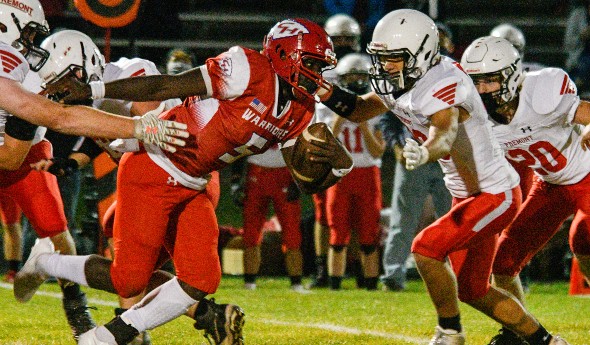
PHOTO: Fremont earned its first win this season in Week 6, defeating Remus Chippewa Hills 42-26. (Click to see more from HighSchoolSportsScene.com.)