

Let's Not Forget These Winning Coaches
December 15, 2015
By Ron Pesch
Special for Second Half
Buried deep within the MHSAA’s list of coaches with 200 career football wins is the name Oscar Johnson. Sharp eyes will note that Johnson began his coaching career in 1925 – 90 years ago.
Following graduation from Western State Normal School (today, Western Michigan University) in Kalamazoo, Oscar E. Johnson coached two seasons at Mount Pleasant High School before moving on to Muskegon Heights in 1927. Known by his nickname, like most from the time period, “Okie” coached multiple sports including football, basketball and baseball. After 37 years (1927 to 1963) and six mythical gridiron championships (as well as three Class A basketball titles), he retired and moved to Baldwin.
During a teacher’s strike in 1979, Johnson, now in his 70’s, came out of retirement to coach Baldwin’s football team for four contests, earning three wins against a single loss. In 40 seasons, Johnson’s teams posted 209 victories against 106 defeats and 28 ties.
In 1975, his was the lone name that would have appeared on the MHSAA’s list of coaches with 200 football wins.
In 1980, Bill Maskill, a graduate of Michigan State University and head coach for six seasons at Sheridan, then Galesburg-Augusta for 29 years, was the second to join the list. Jack Castignola, who started his coaching career in Ohio before becoming varsity coach at Monroe Catholic Central and then Trenton, was added to the list in 1981.
They were followed by Dick Mettlach, long of Crystal Falls and that school’s successor, Crystal Falls Forest Park, Jack Streidl who led Plainwell for 37 seasons, and Dick Soisson, who coached for a combined 41 seasons at Owosso St. Paul, Kalamazoo St. Augustine and Kalamazoo Hackett. Each posted his 200th win in 1984. Leo “Smokey” Boyd, who coached 40 years at Standish-Sterling, Saginaw Sts. Peter and Paul and Saginaw Nouvel, notched his 200th win in 1985, becoming only the seventh coach to accomplish the task in 90-plus years of high school football in Michigan.
Only two additional names were added over the next five years. Walt Braun, long of Marysville, joined the exclusive group in 1986. Al Fracassa, who spent a combined 46 seasons coaching at Royal Oak Shrine and Birmingham Brother Rice and turned down the chance to join Muddy Waters’ coaching staff at MSU in 1980, picked up his 200th win in 1988. That brought the list to nine total.
Twenty five years later, the list totals 58 names. So what changed?
Of course, it was the addition of the MHSAA football playoffs, which debuted in 1975.
A look at two coaches helps illustrate the issue.
Fracassa, the list’s current leader in all-time wins with 430, took 29 seasons to tally his first 200 victories. It took only 23 more seasons for him to gain the next 200. Farmington Hills Harrison’s John Harrington took 24 years to total 200 wins, but picked up his 400th after only 20 more.
Between 1960, Fracassa’s first season, and 1988, Fracassa’s teams played an average of 8.30 games a season. Between 1970, Herrington’s first year and 1993, the year of his 200th, his teams averaged 9.64 games per season.
Between 1988 and 2011, when Fracassa won his 400th game, his teams played an average of 11.61 games a season. Between 1994 and 2013, Herrington’s 400th, his teams played an average of 11.09 games per year. Fracassa’s teams compiled 68 victories in the MHSAA postseason. Herrington’s teams lead the state with 87 victories in the state playoffs.
Simply put, with the arrival of the postseason, it became easier to get to 200.
While no one would debate the accomplishments of any of the 58 gentlemen on the list, all but a few benefit from a baseline that few others who coached only 40 years before them were unlikely to reach.
Of course, those previous years included an amazing array of mentors. In hindsight, perhaps the list should include a mark for coaches from who assemble 150 varsity wins during the regular season only.
Johnson, and many others on the current list, certainly fall within such a category. But so would people like Ted Sowle, who, according to extensive research by former state historian Dick Kishpaugh, compiled a combined 171-47-10 mark between 1937 and 1963 as varsity coach at Grant, Algonac, Cathedral Prep in Erie, Pa., and Grand Rapids Catholic Central. At the time of his retirement from coaching in 1963, he ranked second in the state on the career wins list, behind only Johnson.
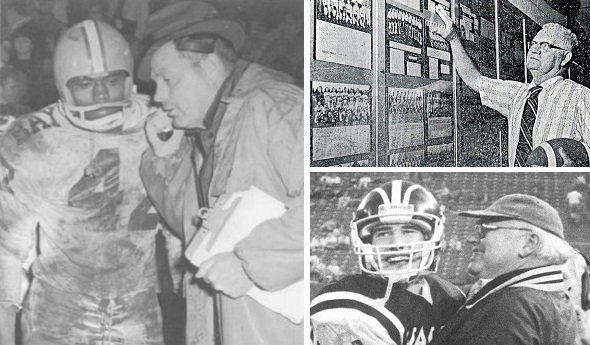
Ray Rynberg, a Grand Rapids Union and Central Michigan graduate, began his coaching career at Cedar Springs in 1939. After 12 years, he stepped away from the coaching ranks to pursue a degree in school administration from the University of Michigan. In the fall of 1955 he returned to the sidelines at Grant. He remained for 21 years, compiling a record of 189-62-9 (including seven unbeaten seasons) surpassing Sowle on the list upon retirement following the 1975 season.
Elmer Engel, who is honored in Bay City with his name attached to the city’s beautiful football stadium, also would appear on such a list. A three-year starter at the University of Illinois, Engel arrived in 1950 and installed the T-formation. He worked the sidelines for the Wolves through the 1972 season, compiling a 165-34-8 record and mythical Class A state titles in 1958, 1965, 1967, 1969 and 1972 according to the Associated Press polls ranking the state’s top teams.
Traverse City’s Jim Ooley led the Traverse City Trojans to a 164-56-4 regular season record (and a 179-60-4 record overall). Muskegon’s C. Leo Redmond led the Big Reds to a 156-29-13 record and six mythical Class A state titles between 1923 and 1946.
Certainly, there are others, many long-forgotten by most to the sands of time, who would qualify for the list. But who are they?
Incredibly successful coaches, like Flint Northern’s Guy Houston, would still fall shy. Playing in the incredibly tough Saginaw Valley Conference, Houston’s teams posted a remarkable 148-41-13 mark in 24 seasons as head coach of the Vikings. Nick Annese, who rolled up a 55-29-2 mark (including 38 straight victories) in 10 seasons at New Lothrop, then led Corunna to a 91-32-3 mark over 14 seasons but falls several games short.
So will many other of the state’s more well-known names, like Lloyd Carr, best known for his years at the University of Michigan, (who served as an assistant at Detroit Nativity and Belleville, before becoming head coach at Westland John Glenn for a few years), University of Nebraska’s Bob Devaney (who spent years 14 years coaching in Birmingham, Keego Harbor, Saginaw, and Alpena) and Colorado’s Bill McCartney (who assisted under his brother Tom at Detroit Holy Redeemer, then served as varsity football and basketball coach at Dearborn Divine Child). All moved on to the college game as assistants before reaching 150 high school wins.
Nick Annese’s son, Tony, who coached at Montrose, Ann Arbor Pioneer, Jenison and Muskegon tallied 169 regular season wins (and 195 victories overall) at the prep level before moving on to the college ranks at Grand Rapids Community College, then Ferris State University.
Can you name others, missing from the list of 200-game winners, with 150 varsity victories in the regular season? If so, contact me at the e-mail address below.
 Ron Pesch has taken an active role in researching the history of MHSAA events since 1985 and began writing for MHSAA Finals programs in 1986, adding additional features and "flashbacks" in 1992. He inherited the title of MHSAA historian from the late Dick Kishpaugh following the 1993-94 school year, and resides in Muskegon. Contact him at [email protected] with ideas for historical articles.
PHOTOS: (From left) Longtime Bay City coach Elmer Engel with a player from the 1968 Bay City Central yearbook, legendary Grant coach Ray Rynberg from the Muskegon Chronicle and championship-winning coach Jim Ooley of Traverse City.
Drive for Detroit: Semifinals Preview
November 18, 2016
By Geoff Kimmerly
Second Half editor
Ford Field is only one more win away for 32 teams playing in MHSAA Semifinals on Saturday.
 Five of eight reigning champions are playing to get back. Twice as many teams are playing to reach the final round for the first time.
Below is a look at all 16 Semifinal games, powered by MI Student Aid. All games will be broadcast, four on FoxSportsDetroit.com and 12 on MHSAA.tv; click for the schedule. And stay connected all Saturday for scores as they come in on MHSAA.com.
Division 1
Romeo (9-3) vs. Detroit Catholic Central (12-0) at Howell Parker Middle School
Reigning Division 1 champion Romeo seemed out of the running for a return run with two losses over the first five weeks (although by just a combined three points) and then a big one in Week 8 to Macomb Dakota. But a defense that has given up more than 16 points only once since opening night has given up just 17 total over three playoff games. Leading rusher and receiver Kade Messner (617 yards/6 TDs rushing, 229 yards/1 TD receiving) averages 10 yards per carry. DCC fell to Romeo in a Regional Final last year, 40-29, but has churned out a perfect season to earn a rematch, with senior Nick Capatina (996 yards/13 TDs rushing) and junior Cameron Ryan (748/14) carrying a good chunk of the load.
Utica Eisenhower (12-0) vs. Detroit Cass Tech (12-0) at Troy Athens
The Eagles are making their first Semifinal appearance since 2011, when they fell to Cass Tech 6-3, and already have secured their winningest season since 2003. Junior quarterback Max Wittwer (1,574 yards/19 TDs passing, 768 yards/8 TDs rushing) and senior running back Jack Provencher (1,434 yards/24 TDs rushing) make it impossible for defenses to stack in trying to stop an offense that has scored at least 42 points in every playoff game. Cass Tech is more familiar with this round than most; this will be its seventh straight Semifinal. The Technicians feature some of the best-known playmakers in the state, including senior quarterback Rodney Hall (2,125 yards/22 TDs passing) and senior receiver Donovan People-Jones (889 yards/15 TDs receiving).
Division 2
Walled Lake Western (11-1) vs. Lowell (12-0) at Brighton
This is a rematch of a 2015 Semifinal won by Lowell 49-34 – and the Red Arrows also beat Western 42-35 in a 2011 Semifinal. The Warriors reaching their first MHSAA championship game since 1999 likely will rest in part on the arm of senior quarterback Johnny Tracy (2,050 yards/23 TDs passing) and senior receivers Kameron Ford (1,013 yards/12 TDs receiving) and Cody White (669 yards/9 TDs receiving, 443 yards/6 TDs rushing). Lowell also follows a talented quarterback, junior David Kruse (1,573 yards/8 TDs passing, 1,438 yards/23 TDs rushing), and his leading running back, senior Nate Stephens (1,402 yards/21 TDs.). And trust the Red Arrows are extra motivated to get back to Ford Field after watching last season’s title slip away to Detroit Martin Luther King on the final play of the game.
Birmingham Groves (11-1) vs. Detroit Martin Luther King (10-2) at Dearborn
The reigning champion Crusaders have lost only to Division 1 semifinalist Detroit Cass Tech, twice, and are playing in their fourth Semifinal in six seasons. After the sudden death of coach Dale Harvel in July, King has rallied behind new coach Ty Spencer and followed sophomore quarterback Dequan Finn (1,986 yards/33 TDs passing) with major contributions by senior running back Kevin Willis (1,003 yards/13 TDs rushing) and senior receiver Ambry Thomas (766 yards/13 TDs receiving) among many others. After making its first Regional Final since 2004, Groves is playing in its first Semifinal ever. The Falcons have given up more than 15 points only once since opening night and 25 total over three playoff games while getting balanced offensive power from senior quarterback Beau Kewley (909 yards/12 TDs passing) and senior running back Ernest Allen (924 yards/11 TDs rushing).
Division 3
Edwardsburg (12-0) vs. Muskegon (11-1) at East Kentwood
Edwardsburg will play its third Semifinal in seven seasons seeking its first championship game berth and coming off a two-point win over Chelsea, last season’s Division 3 runner-up. And this might be the most impressive team of the Eddies’ recent run. Edwardsburg gave up only 38 points over the first 10 weeks of the season before allowing 60 total over the last two; the Eddies also have run for 4,473 yards, led by juniors Nick Bradley (1,363 yards/18 TDs) and Kyle Shrider (843 yards/15 TDs). After making only the Regional Final last season, Muskegon is back in its fourth Semifinal over the last five years. The Big Reds already have set a program record with 634 points (52.8 per game) keyed by their dual quarterbacks – senior Kalil Pimpleton (714 yards/14 TDs passing, 1,314 yards/21 TDs rushing) and junior La’darius Jefferson (863 yards/9 TDs passing, 709 yards/15 TDs rushing).
Dearborn Divine Child (10-2) vs. Orchard Lake St. Mary’s (8-4) at West Bloomfield
This is the first meeting between these Detroit Catholic League contenders since 2008. The Falcons have built their strongest effort since 1985 with a six-game winning streak after suffering back-to-back losses in Weeks 5 and 6. Divine Child avenged one of those, to Division 7 semifinalist Detroit Loyola, in Week 9, and last week handed Allen Park its only loss of the season. Junior quarterback Theo Day has thrown for 1,508 yards and 21 touchdowns to lead the way. Reigning Division 3 champion St. Mary’s advanced to its seventh Semifinal in eight seasons with a comeback win at DeWitt last week. The Eaglets move the ball with junior running backs RaShawn Allen (1,833 yards/21 TDs rushing) and Ky’ren Cunningham (860 yards/13 TDs), who both average at least eight yards a carry.
Division 4
Hudsonville Unity Christian (10-2) vs. Grand Rapids Catholic Central (11-1) at Greenville
Unity Christian’s best season ever moves on to its first Semifinal, thanks to an overtime win over previously undefeated Benton Harbor last week. The Crusaders won’t be intimidated by the annually successful Cougars after navigating the Ottawa-Kent Conference Green, one of the most competitive leagues in the state this season. They cover a lot of ground with senior running back Parker Scholten (1,353 yards/14 TDs rushing) and senior quarterback Mitchell Dykstra (924/15). GRCC is making its first Semifinal appearance since winning Division 4 in 2010. But the Cougars have a chance to do some great things next year too with juniors the top playmakers this fall. Quarterback Jack Bowen has thrown for 2,329 yards and 24 touchdowns and running back Nolan Fugate is the leading rusher with 1,359 yards and 11 scores on the ground.
River Rouge (11-1) vs. Detroit Country Day (12-0) at Hazel Park
River Rouge just missed its first MHSAA championship a year ago, falling to Grand Rapids West Catholic by six in the Final, and hasn’t really been slowed this fall. The Panthers at one point shut out seven straight opponents and eight over nine games including the first of the playoffs, and they’ve gone over 600 points for the second season in a row led by senior quarterback Jairus Grissom (1,369 yards/18 TDs rushing, 1,967 yards/23 TDs passing). Country Day is playing its fourth Semifinal in five seasons seeking its first championship game berth since 2012. The Yellowjackets are incredibly balanced on offense, with a pair of quarterbacks (senior Steven Mann and sophomore Jalen Graham) both having success. But the defense stands out most; led by senior linebacker Kolin Demens, Country Day is giving up only 8.6 points per game and has allowed more than 14 only twice.
Division 5
Frankenmuth (11-1) vs. Menominee (11-1) at Northern Michigan’s Superior Dome
The Eagles have had only four sub-.500 finishes over the last 32 seasons, and 22 playoff appearances during that time. But they broke through again for their first Semifinal berth since 1997, handing Ithaca last week its first loss not in an MHSAA Final since 2008. Senior running back Kris Roche (1,005 yards/16 TDs rushing) and senior quarterback Jared Davis (922 yards/16 TDs rushing, 1,169 yards/11 TDs passing) give Frankenmuth multiple threats. As it has done for decades, Menominee is again trampling opponents, although lead back Keifer Rasner (1,372 yards/20 TDs rushing, 410 yards/3 TDs passing) was reportedly hurt two weeks ago and isn’t expected to play. Ethan Mileski (584 yards/5 TDs rushing, 1,066 yards/14 TDs passing) is another offensive standout to watch.
Algonac (11-1) vs. Grand Rapids West Catholic (10-2) at Battle Creek Harper Creek
Algonac’s best two seasons in program history have been this one and last, and they’ve taken the next step with their first Semifinal appearance. Senior quarterback Brendan Piper is a two-way threat, throwing for 1,086 yards and 13 touchdowns this fall and running for a team-high 903 yards and 14 scores. Three-time reigning champion West Catholic has had to play three road games this playoff run, but outscored those opponents by a combined 78-20. Veteran duo David Fox and Gaetano Vallone are again big reasons why; the senior running back sometimes quarterback Fox had thrown for 1,286 yards and 17 touchdowns and run for 689 yards and eight scores, while junior quarterback Vallone has thrown for 889 yards and seven TDs.
Division 6
Leroy Pine River (9-2) vs. Maple City Glen Lake (10-2) at Traverse City Thirlby Field
Pine River’s first run to a Semifinal has included a ninth win for the second time ever and first time since 1999. Senior quarterback Mason Powell has had quite a final campaign, bringing the Bucks back from 4-5 last season by throwing for 1,047 yards and 15 touchdowns and running for 1,259 yards and 17 scores. The Lakers have had a little more recent success but still are making their first Semifinal appearance since 1996. Junior running back Nick Apsey carries a lot of the load offensively and has scored 22 times. But the defense also has been outstanding, giving up more than 14 points only twice and 112 points total this fall.
Jackson Lumen Christi (10-2) vs. Millington (11-1) at Lansing Catholic
Lumen Christi is back in the Semifinals for the first time since winning Division 5 in 2009; the Titans have won nine straight games to get here. Running back Bo Bell was the star in last week’s Regional Final win over Napoleon, and all season as well; he’s run for 2,200 yards and 29 touchdowns. Quarterback Troy Kutcha has added 1,313 yards and 10 scores through the air and run for six touchdowns. Millington is playing in its fifth Semifinal and seeking to reach the championship round for the first time. Junior quarterback Bryce Bearss (2,212 yards/25 TDs passing) and senior running back Brady Payne (1,196 yards/14 TDs rushing) give the Cardinals a strong 1-2 punch as well.
Division 7
Ubly (12-0) vs. Pewamo-Westphalia (12-0) at Mount Pleasant
Reigning Division 7 runner-up Pewamo-Westphalia will face its third straight undefeated opponent after handing first and only losses to Saugatuck and Traverse City St. Francis the last two weeks. Senior running back Jared Smith fell short of 100 yards rushing last week for the first time since his sophomore year, but continues to inch toward the MHSAA career rushing record and now has 2,403 yards and 36 touchdowns on the ground this season and more than 8,000 yards rushing for his career. Ubly also is a recent visitor to the Finals, its last trip coming in 2008. The Bearcats have controlled the ball with a rumbling ground game as well; senior Derek Brown has run for 1,226 yards and 19 touchdowns and senior Jonathan Brandel has gained 980 yards and 15 scores rushing.
Detroit Loyola (10-2) vs. Cassopolis (11-1) at Jackson
Loyola is another regular in this round, playing in its fifth straight Semifinal. The Bulldogs have beaten a league champion every week of the playoffs this time, and Cassopolis would be the fourth. Loyola averages 34 running plays per game and brings three 1,000-yard rushers – Malcolm Mayes (1,240 yards/14 TDs), D’Anthony Robinson (1,208 yards/18 TDs) and quarterback Price Watkins (1,010 yards/8 TDs rushing, 659 yards/7 TDs passing). Cassopolis is playing in his first Semifinal after setting a program record for wins last week. The Rangers roll with a loaded backfield; senior quarterback Shane Los has thrown for 1,320 yards and 17 touchdowns, while junior Brandon Anderson has run for 956 yards and 11 touchdowns and scored six more receiving. Sophomore Tyrese Hunt-Thompson has run for 811 yards and 10 scores and is the leading receiver with 533 yards and five TDs.
Division 8
Muskegon Catholic Central (12-0) vs. St. Ignace (11-1) at Petoskey
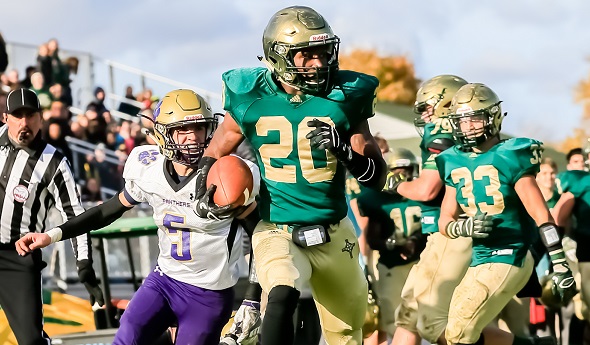
This is a rematch both of last season’s Semifinal (33-20 MCC win) and Week 2 of this fall (Crusaders 21-6), as St. Ignace gave MCC easily its closest game this season. The Crusaders have won three straight Division 8 titles and after facing mostly bigger schools during the regular season have given up only seven points over three playoff games. Senior LaTommy Scott (820 yards/8 TDs rushing) has starred for a few seasons and is one of five who have rushed for at least 370 yards. The Saints attack in multiple ways; senior running back Mitchell Peterson has run for 1,275 yards and senior quarterback Steve Seccia has thrown for 1,530 and 23 touchdowns.
Ottawa Lake Whiteford (12-0) vs. Saginaw Michigan Lutheran Seminary (10-2) at Dearborn Edsel Ford
Whiteford’s best two seasons also were the last two, with the Bobcats winning 10 games for the first time in 2015 and this their second straight Semifinal. Whiteford has set school records with 545 points, 222 first downs, 552 carries and 3,729 rushing yards this fall. Leading the way are running back Jessie Kiefer (1,057 yards, 27 touchdowns rushing, 287 yards/5 TDs receiving) and freshman Conner Hoogendoorn (811 yards/15 TDs). Michigan Lutheran Seminary is playing in its second Semifinal in three seasons to reach its first championship game since 1986. The Cardinals have given up only 13 points over three playoff games and force an average of two turnovers per game. Senior Casey Williams is the main scorer with 24 touchdowns, with 19 on the ground (and 1,226 yards).
Second Half’s weekly “Drive for Detroit” previews are powered by MI Student Aid, a part of the Student Financial Services Bureau located within the Michigan Department of Treasury. MI Student Aid encourages students to pursue postsecondary education by providing access to student financial resources and information, including various student financial assistance programs to help make college more affordable for Michigan students. MI Student Aid administers the state’s 529 savings programs (MET/MESP) and eight additional aid programs within its Student Scholarships and Grants division. Click for more information and connect with MI Student Aid on Facebook and Twitter @mistudentaid.
PHOTO: Muskegon Catholic Central's LaTommy Scott (20) breaks away for a touchdown against Frankfort in last week's Regional Final. (Photo by Tim Reilly.)