

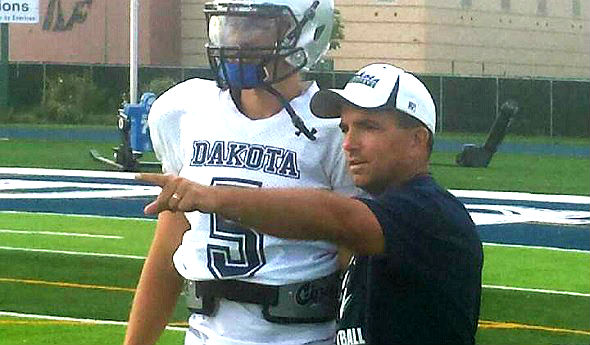
Longtime Assistant Set to Lead Dakota
By
Tom Markowski
Special for Second Half
August 17, 2016
MACOMB TOWNSHIP – Greg Baur was content to continue coaching in the background, much like a supporting actor in a movie.
 Baur, 46, had been an assistant football coach for 26 years at four different schools, most recently at Macomb Dakota. For 21 seasons he was a defensive coordinator, including the last 12 for the Cougars.
And he was good at it. In 2001, under then-head coach Mike Carr, Bauer was instrumental in guiding Clinton Township Chippewa Valley to its only MHSAA title, in Division 2. Chippewa Valley held Jenison to 139 yards in its 26-13 victory in the Final. In 2006 and 2007, Baur was with head coach Mike Giannone when Dakota won its two MHSAA Division 1 titles. That gives him the distinction of being the only Macomb County coach to play a big part in three MHSAA championships.
Last January, Giannone left Dakota to take the head coaching position at Warren DeLaSalle. The move took Baur by surprise – but it also started the wheels turning in his head.
Just once had Baur sought to be a head coach. When Carr left Chippewa Valley after the 2004 season, Baur applied to take over. When he didn’t get the job, Giannone quickly hired him at Dakota.
With Giannone gone, Baur made another bid at a head coaching gig. This time, he got it.
“I don’t remember the date,” Baur said. “I just remember it was a snow day. They called me and told me I had it. The first thing I did was make sure the staff would stay, and they did. Next I met with the players, and the kids were really excited about it.”
At most programs, going from a coordinator position to take over as head coach is akin to jumping into a pool after sitting an hour with just your feet in. Baur said it isn’t like that for him.
 Sure there’s more paper work, and yes, the fundraising becomes more of his responsibility. But as far as the workload, it’s not as daunting for Baur as it might be for others. Baur has always been a workaholic.
“I’ve always worked extra hard,” he said. “I told my wife, this will amp things up. It’s 24/7. The good thing is the kids have grown up a bit. And it’s not work for me. It’s fun. I’m really excited to get things going. When you wait 25 years you look at what you can tweak here and there. Offensively, I’ll tweak it a little. Defense is the same. I’m still running it. I can’t see myself not coaching (the defense).”
In a sense, Baur has already experienced success. He convinced Carr to come out of retirement and serve as his offensive coordinator.
It’s come full circle.
There are a number of reasons why Baur hadn’t looked elsewhere for a head coaching job. He and his wife, Renee, live in the area, and their three children attend schools in the Chippewa Valley school district, of which Dakota is a part. Their eldest child, Jason, played football at Dakota and graduated this spring. He’s now attending Wayne State University and helping out with Dakota’s freshmen team.
Professionally, there isn’t a program in Macomb County that can match Dakota. It is the only school in the county with more than one MHSAA title, and the Cougars are consistently one of the state’s top teams. They’ve made the playoffs 15 consecutive seasons, and just once since 2003 have they failed to win a playoff game. Last season Dakota lost to Detroit Cass Tech, 16-10, in a Regional Final.
Given that, there’s a certain amount of pressure that comes with being the head coach of such a program. It’s similar to the pressure that’s on coaches like Ralph Munger at Rockford and Kurt Richardson at Clarkston. Those in the community not only expect them to win every year, but expect their teams to be a factor in the playoffs every year. A first-round loss is not only disappointing – it can also raise a few eyebrows.
Baur’s attitude? Bring it on.
“To me, it’s not pressure,” he said. “I love to compete. If all goes well, great. If not, then we move on. I might not be the smartest coach around, but no one is going to outwork me.”
During this time of year, time is scarce. Double sessions start at 9 a.m. and end at 3 p.m. There’s time for dinner, then its film sessions followed by an hour or two of quality time with his children.
“That hasn’t changed,” he said. “That was always the schedule. But now there’s paperwork, putting out fires.
“I love this. There isn’t a part of the job I don’t like. There’s no complaining. You get an opportunity, you make the best of it. I know there’ll be tougher times.
“Being a head coach, it never really crossed my mind. (Giannone) is relatively young. I thought he’d retire (as a head coach) here. It wasn’t something I was campaigning for.”
Baur owes much of his success and where he’s at to those who mentored him. A graduate of Sterling Heights Stevenson, he played and coached under one of Macomb County’s legendary coaches, Rick Bye. After four years, Baur went to Romeo and coached under Greg Ganfield. Ganfield was gave Baur his first shot as a coordinator. Four years later, Baur went to Chippewa Valley.
Carr showed Baur how to run a program, not just coach. He lectured him on how to deal with parents and their concerns. A bit overwhelming then, Baur has gained the experience where such responsibilities are more easily managed.
“(Giannone) wasn’t that much different,” Baur said. “Heck, he coached under Carr, too. But (Giannone) took the program to another level.”
As good as Dakota has been recently, expectations are even higher this season. The senior and junior classes did not lose a game on the freshman or junior varsity levels. Many outside the program, including Utica Eisenhower coach Chris Smith, have said this senior class at Dakota is one of the best they’ve seen.
Baur said one of his biggest tasks is to make sure this group doesn’t become complacent.
“I’m a players’ coach,” he said. “When it got real hot recently, I dialed back. They don’t even call me Coach. It’s like, hey Baur.”
Baur is just like one of the guys – except this time he’s playing the leading role.
 Tom Markowski is a columnist and directs website coverage for the State Champs! Sports Network. He previously covered primarily high school sports for the The Detroit News from 1984-2014, focusing on the Detroit area and contributing to statewide coverage of football and basketball. Contact him at [email protected] with story ideas for Oakland, Macomb and Wayne counties.
PHOTO: Greg Baur (right), the new head coach at Macomb Dakota, directs one of his players. (Photo by Tom Markowski.)
1st & Goal: 2025 Week 1 Review
By
Geoff Kimmerly
MHSAA.com senior editor
September 2, 2025
The 51st season of MHSAA playoff-era football kicked off over the weekend with multiple matchups of teams that finished last season at Ford Field and nearly 600 teams total bringing championship dreams into this fall.
 Every one of them remains in the hunt after the first week. But below we have 45 first impressions as we begin our search for the next contenders.
Bay & Thumb
HEADLINER Goodrich 17, Frankenmuth 14 The reigning Division 4 champion Martians ran their record to 2-3 against the Eagles during this recent opening-day series, going ahead for good on Jacob Daggett’s 30-yard field goal. Goodrich’s only defeat last season was 22-0 to Frankenmuth, which went on to finish Division 5 runner-up. Click for more from the Flint Journal.
TANNER MAZICH WAS BIG WHEN THE MARTIANS NEEDED HIM MOST🏈 💪
Goodrich defeated Frankenmuth 17-14
Powered by @CAM_Association @Tanner_Mazich | @MartianFB pic.twitter.com/9ERNnu9kbq— STATE CHAMPS! Michigan (@statechampsmich) August 31, 2025
Watch list Grand Blanc 35, Muskegon Mona Shores 20 The Bobcats didn’t let a two-point loss to Mona Shores last year slow them down on the way to league and District titles, so this win could provide significant momentum as they look to build on that success.
On the move Armada 21, Marine City 14 The Tigers ran their season-opener win streak over Marine City to four with a third win by seven points or fewer during that stretch. Saginaw Swan Valley 55, Croswell-Lexington 35 After starting 2024 with three straight losses – including a third in a row to Croswell-Lexington – the Vikings broke through this weekend with their second highest-scoring game over the last four seasons. Midland Dow 38, Fenton 6 The Chargers broke a streak of three straight season-opening losses to the Tigers in another matchup of annual playoff teams.
Greater Detroit
HEADLINER Clarkston 38, Belleville 7 These two met for a second-straight year in an opener at Wayne State, this time as part of the Amazon Prep Kickoff Classic, and this time with Clarkston coming up big after the Tigers won 35-28 in 2024. The loss was only the third regular-season defeat for Belleville over the last nine years. Click for more from the Oakland Press.
TOUCHDOWN CLARKSTON!
Lukas Boman takes it 60 yards to the house for his 2nd of the day!
Clarkston: 37
Belleville: 0
Late in the 3Q
Delivered by @hungryhowies
Catch the game live on the SC YouTube & Local 4+ pic.twitter.com/je7gVKzRyE— STATE CHAMPS! Michigan (@statechampsmich) August 28, 2025
Watch list Detroit Cass Tech 28, Toledo Central Catholic (Ohio) 27 The reigning Division 1 champion Technicians held off a 2024 Ohio state runner-up that also should be among favorites again in the Catholic High School League Central this fall.
On the move Warren Michigan Collegiate 32, Clarkston Everest Collegiate 6 Michigan Collegiate avenged its only regular-season loss of the last two years. Northville 14, Lake Orion 13 The Mustangs also rebounded from a 2024 defeat, having opened last year with a 21-13 loss to the Dragons. Walled Lake Western 51, Milford 26 This matchup determined the Lakes Valley Conference championship last season and could end up key again this fall as Western attempts to win a fourth-straight title.
Mid-Michigan
HEADLINER DeWitt 21, Haslett 3 This was a much different game than when the teams combined to score 111 points a year ago. This time, the Panthers held Haslett to its first single-digit output since midway through the 2023 season, while Haslett’s defense also proved tougher than most against the often high-scoring Panthers. Click for more from the Lansing State Journal.
Watch list Williamston 46, Lansing Catholic 14 After reaching the playoffs last year at 3-6, the Hornets got off to a stronger start by avenging last season’s loss to Lansing Catholic, which went on to finish as Division 6 runner-up in 2024.
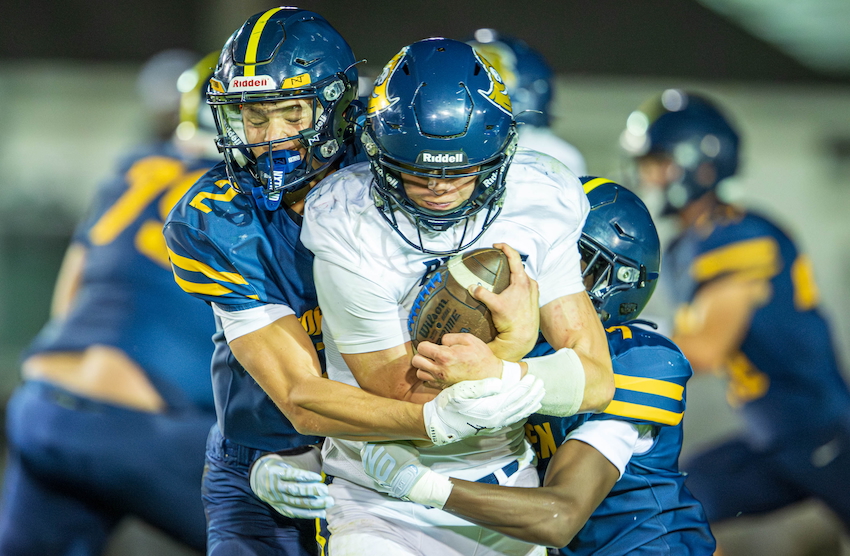
On the move Pewamo-Westphalia 35, North Muskegon 6 P-W got a solid jump on the season with a second-straight win over North Muskegon, which made the Semifinals for the second-straight season last fall. Mount Pleasant 35, Saginaw Heritage 13 The Oilers broke a two-game losing streak against the Hawks as they look to build on a seven-year playoff streak. Howell 23, Traverse City West 13 The Highlanders made the long drive north but ran their regular-season winning streak to 10 after finishing last year’s without a loss.
Northern Lower Peninsula
HEADLINER Kingsley 24, Reed City 6 The Stags got off to an impressive start, avenging last season’s 24-22 loss to Reed City, which went on to win a District title in 2024. The pair have met in the playoffs three of the last five seasons and will both play in Division 6 again if they qualify in two months. Click for more from the Cadillac News.
Watch list Traverse City St. Francis 30, Maple City Glen Lake 6 These are two more potential playoff teams after both won league titles a year ago, with this their first meeting since 2021.
On the move Cheboygan 19, Sault Ste. Marie 7 After at one point losing nine straight to Sault Ste. Marie, Cheboygan has now won two in a row and is 1-0 for the first time since 2022. Harbor Springs 18, Morley Stanwood 16 Harbor Springs won for the first time since Week 9 of the 2021 season, breaking a 26-game losing streak. Petoskey 21, Greenville 13 Petoskey also ran its regular-season winning streak to 10 to build on last year’s perfect pre-playoff run.
Southeast & Border
HEADLINER Saline 37, Rockford 28 These Division 1 titans hadn’t met since the 2020 playoffs, and Saline took a massive opening step with an impressive comeback to kick off this season. After Rockford took a 28-21 third-quarter lead on a blocked punt return, Saline rallied to re-tie the score, move ahead with a safety on a Rams miscue and then score one more time to pull away. Click for more from the Ann Arbor News.
Watch list Adrian Madison 56, Grass Lake 0 A 4-1 start turned into a 4-5 finish for Madison last fall, but excitement should be renewed after this win over a Grass Lake team coming off two straight six-win seasons.
On the move Dexter 50, Brighton 27 Add the Dreadnaughts to the short list of teams that finished 9-0 during the 2024 regular season and are off to the right start again. Hudson 44, Fowler 8 The Tigers made a loud statement by avenging last season’s opening 20-6 loss to Fowler, which like Hudson is annually one of the top small-school teams in the state. Monroe St. Mary Catholic Central 42, Clinton 6 The reigning Division 7 runner-up Falcons actually have won 13 straight regular-season games going back to 2023 – and three matchups with Clinton since falling to the Redwolves in the District Final that fall.
Southwest Corridor
HEADLINER Niles 28, St. Joseph 18 Niles picked up just about where it left off last season when the Vikings finished Division 4 runners-up. Their only loss before Ford Field was 30-7 to St. Joseph, but this time Niles pulled away to avenge and add a second win over the Bears over the last three seasons. Click for more from the Niles Daily Star.
Niles. Is. Still. Here.
Fresh off a State Final appearance, the Vikings beat rival St. Joseph, 28-18.@NilesAthletics @scot_shawNHSfb @w_cheney5 @WilliamT2029 pic.twitter.com/WPUXjolfDs— Bennett Wise WSBT (@BennettWiseWSBT) August 30, 2025
Watch list Berrien Springs 20, Kalamazoo Hackett Catholic Prep 13 These two combined to win 16 games last season, and Berrien Springs had lost its last two openers to Hackett by a combined five points – and also last season’s Division 5 District Final to the Fighting Irish by 17.
On the move Edwardsburg 28, McBain 21 The Eddies opened with a close win over the reigning Highland Conference champion Ramblers. Portage Central 45, East Lansing 0 These two now have split their last four meetings, but East Lansing had won last year’s 31-7. Union City 16, Parchment 14 The reigning Big 8 Conference champion Chargers won this matchup of 2024 playoff teams.
Upper Peninsula
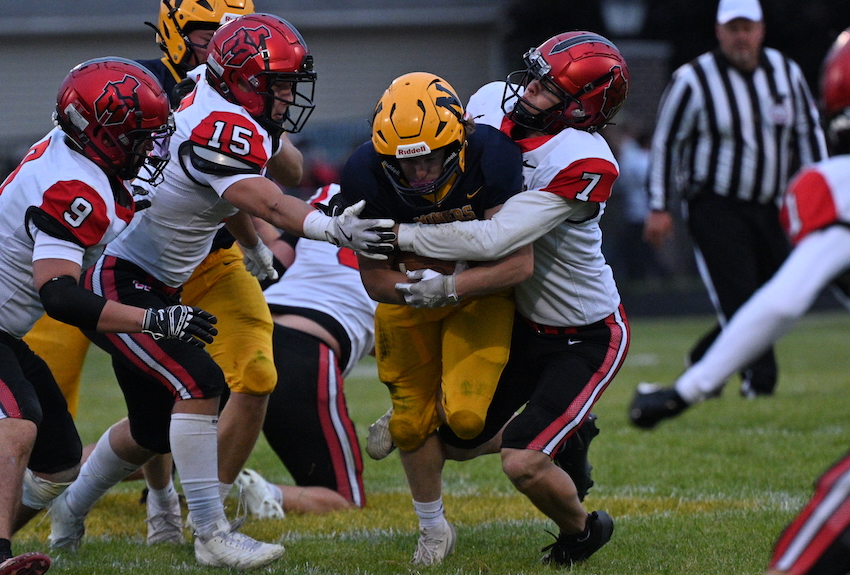
HEADLINER Negaunee 30, Marquette 22 Meeting 142 between these neighbors went to the Miners, who improved to 71-60-11 in the series by winning their first matchup against each other since 2017. Click for more from the Marquette Mining Journal.
Watch list Escanaba 21, Kingsford 18 Escanaba came into this fall off its first winning season since 2019, and the good times are still rolling after this first win over the Flivvers since 2019 as well. Kingsford had won last year’s matchup 21-0.
On the move L’Anse 26, Hancock 6 The Purple Hornets won just once over the last two seasons, but started 1-0 with their first win over Hancock since 2022. Bark River-Harris 52, Ishpeming Westwood 8 The Broncos bounced back big from last year’s 24-point loss to Westwood. Iron Mountain 41, Houghton 22 The Mountaineers will roll into this week’s matchup with Bark River-Harris carrying a 27-game regular-season winning streak.
West Michigan
HEADLINER Hudsonville 27, Byron Center 21 In another matchup of teams that finished at Ford Field last November, reigning Division 1 runner-up Hudsonville held off Division 2 runner-up Byron Center, handing the Bulldogs just their third regular-season loss in three years. Click for more from the Grand Rapids Press.
Watch list Grand Rapids Northview 32, Grand Rapids West Catholic 21 Northview is showing no signs of slowing down coming off arguably its best season in at least recent program history. The Wildcats followed up last year’s perfect regular season by starting a new one downing an annual championship contender.
On the move Grandville 44, Muskegon 40 The Big Reds might be coming off their first sub-.500 season since 1999, but Muskegon is still Muskegon – which means a memorable start for Grandville, with Cass Tech up next. Hudsonville Unity Christian 55, Whitehall 14 The Crusaders’ only loss last season came in their District Final, and an offense that averaged 43 points per game during that run looks ready to roll again. Lowell 40, East Grand Rapids 7 After three straight losses to EGR, including last season by 19 points, the Red Arrows served some early notice.
8-Player
HEADLINER Newberry 22, Crystal Falls Forest Park 20 Newberry ended last season with two straight wins to come in at 2-7 overall and ran its winning streak to three over the weekend by edging last season’s Division 2 champion. The victory also avenged a 37-6 loss to the Trojans from a year ago and gave Forest Park its first season-opening defeat since 2019. Click for more from the NFHS Network.
Watch list Central Lake 44, Marion 38 The Trojans – also 2-7 in 2024 – provided a strong indication that this could be a turnaround season by avenging last year’s 64-6 loss to Marion, which at a combined 40-6 has been one of the state’s top 8-player programs the last four years.
On the move Britton Deerfield 60, Pittsford 22 The Patriots made it three wins in three tries over the last two years against Pittsford in claiming this rematch of last season’s Division 2 Regional championship matchup. Gobles 54, Climax-Scotts 32 The Tigers are posted a perfect regular season a year ago and started this one with a notable win over a Climax-Scotts team that is coming off an 8-2 overall finish. Ontonagon 21, Ishpeming 14 Ontonagon claimed its fifth-straight opening-night win, this time downing an Ishpeming team that reached the Division 1 Regional Finals last year in its first playing 8-player.
MHSAA.com's weekly “1st & Goal” previews and reviews are powered by MI Student Aid, a division within the Department of Lifelong Education, Advancement, and Potential (MiLEAP). MI Student Aid encourages students to pursue postsecondary education by providing access to student financial resources and information. MI Student Aid administers the state’s scholarship and grant programs that help make college Accessible, Affordable and Attainable for you. Click to connect with MI Student Aid and find more information on Facebook and Twitter @mistudentaid.
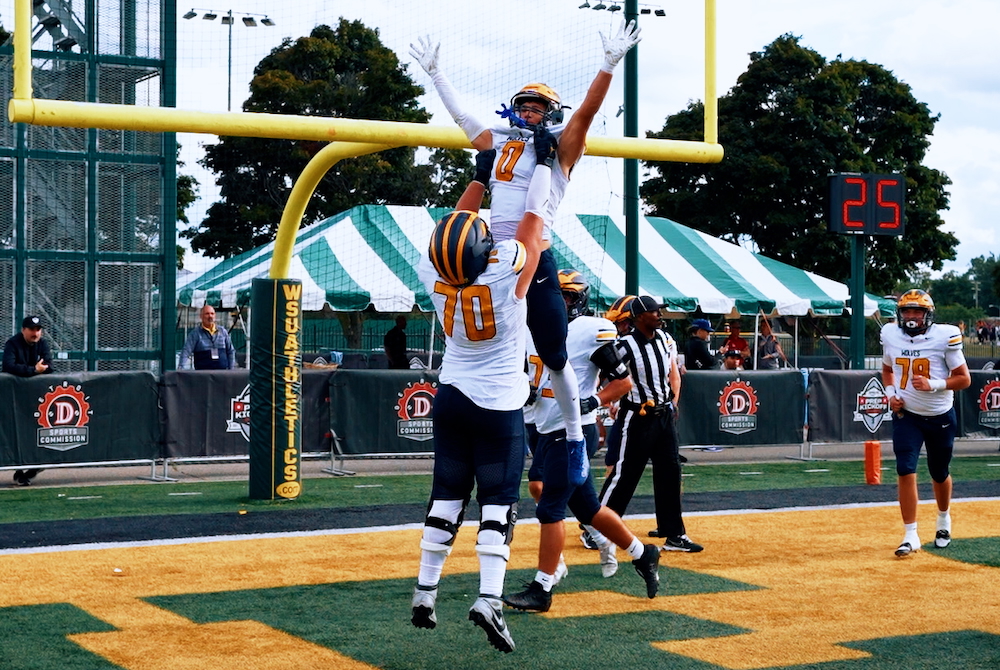
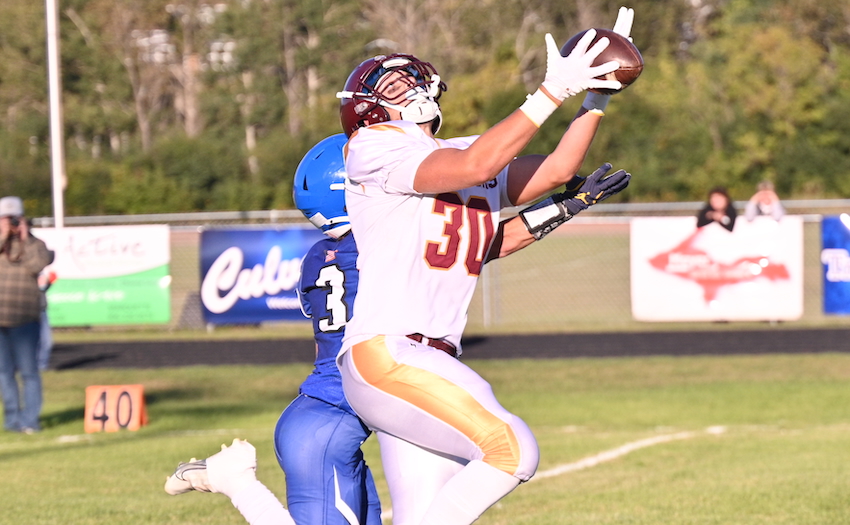
PHOTOS (Top) Clarkston players celebrate in the Wayne State end zone during their win over Belleville. (2) A pair of North Muskegon defenders wrap up a Pewamo-Westphalia ball carrier. (3) Negaunee's Marshall Peters carries the ball before getting tackled by Marquette's Ben Rayhorn (7), Bodi Bennett (15), and Alex Brennen (9). (4) On Ontonagon's first possession, Jack Nelson (30) catches a pass from Brody Bobula while being defended by Ishpeming's Grady Gauthier (3), and runs it in for a touchdown. (Top photo courtesy of State Champs! Sports Network. P-W/North Muskegon photo by Jim Pivarnik. Negaunee/Marquette and Ontonagon/Ishpeming photos by Cara Kamps.)