

Lumen Repeat 'Club' Inducts Newest Class
November 24, 2017
By Geoff Kimmerly
Second Half editor
DETROIT – The challenge came one more time over text Thursday night, from a pair of assistant coaches who had something their players desperately wanted.
 Tony Panici and Tyler Aldridge were part of Jackson Lumen Christi’s repeat Division 5 champions in 2003 and 2004, and they had one question for today’s Titans: “Do you have what it takes to join the back-to-back club?”
“That really stuck with us,” Lumen Christi junior linebacker Nick Thomas said. “And I think it gave us that little edge to be able to come out and leave everything on the field, and just join that club.”
Panici and Aldridge – who also were part of the 2005 runner-up team – sent along photos of their championship rings as well. And now the program will need to mint another 80 or so more.
Indeed the Titans won their 10th championship Friday at Ford Field, for the second straight season in Division 6, completing their first repeat since Panici and Aldridge’s sophomore and junior years more than a decade ago. And Lumen Christi did it by holding off arguably the state’s most successful program of the last decade – five-time champion Ithaca – by holding on for a 40-34 win.
The Titans led by 20 midway through the fourth quarter before the Yellowjackets pulled to within six with 2:27 to play. Lumen Christi (12-1) was able to run off those final minutes but needed every last yard – securing the victory by getting two on a 4-and-1 dive by senior Kyle Minder with under a minute to play.
It was a symbolic way to end the final rally. The Yellowjackets (12-1) have won their five titles over the last eight seasons with offenses led by dynamic dual-threat quarterbacks, and made this run led by senior signal-caller Joey Bentley – who ended the fall with 2,144 yards and 31 touchdowns passing and 1,656 yards and 27 scores rushing.
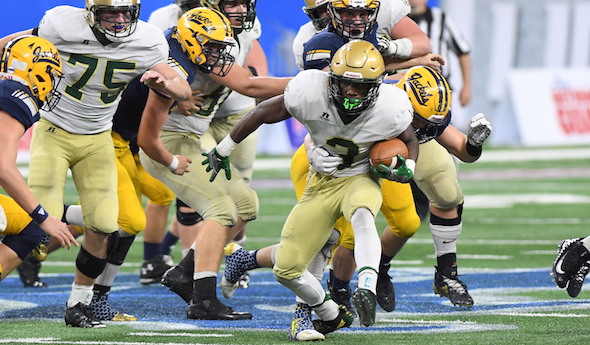
Lumen Christi’s attack is far more old school, a grind-it-out style that this season headlined senior Sebastion Toland with Minder mostly blocking in front of him and behind a powerful offensive line. The Titans didn’t throw a pass during the second half Friday, aside from a two-point conversion try, mostly because they were able to follow up Ithaca’s defensive stops with long runs – Minder ripped off scoring sprints of four, 43 and 63 yards over the final two quarters, and Toland had an 80-yarder to make the lead 19 points just more than a minute into the fourth.
“The offensive line really came off the ball in the second half,” said longtime Lumen Christi coach Herb Brogan, who finished his 38th season running the program. “We felt all year long that offensive line was the strength of our team, and we’ve got some pretty good people to run behind them. I really thought they asserted themselves in the second half and took control of the line of scrimmage.”
The Titans ran for 514 yards on 67 carries, averaging 7.7 yards per attempt. The carries were the second most by one team in an MHSAA championship game.
Toland finished with 244 yards on 33 carries, and Minder had 206 on 23 attempts. Both made the MHSAA record book list for rushing yards in a Final, Toland’s total tying for seventh highest. He had 176 of those yards during the second half. Thomas also scored his team’s first touchdown on a 72-yard reverse.
 “They’re a fantastic team offensively, and we knew that. Our challenge was getting off the field,” Ithaca coach Terry Hessbrook said.
“Our defense is fast, but obviously we’re not very big. They asked me at halftime on TV what (Lumen’s) adjustment was going to be. And I said I expected a lot more power running game from them in the second half, and unfortunately that’s exactly what we got.”
A 51-yard touchdown run by Bentley gave Ithaca a 13-8 lead it carried into halftime. Lumen Christi swung the score 24 points to take a 31-12 advantage into the fourth quarter, but the Yellowjackets remained dangerous. Three of Bentley’s four touchdown passes came over the final 9:36.
He finished 11 of 21 passing for 240 yards and those four scores, and ran for 89 yards and one touchdown. Senior Adam Culp caught five passes for 70 yards and two of those scores.
“I’m glad the clock ran out when it did,” said Brogan, also the fifth winningest coach in MHSAA history with a 343-83 record. “They’re really explosive.”
Senior linebacker Ethan McCormick led Ithaca with 15 tackles, while senior nose guard Nathan Bellinger had 11 and senior linebacker Zach Hessbrook had 10.
The Yellowjackets have won 118 of their last 123 games.
“All I can say is this: When you coach a team, all you ask from them is that they play as hard as they can possibly play,” Terry Hessbrook said. “My kids do that. They do that for me, for my coaching staff.
“I told those guys at halftime, Jackson Lumen Christi has never a team like Ithaca High School, because we have no quitters. These kids, I’m so proud of them for it.”
Minder and Thomas both had six tackles to pace the Titans.
The MHSAA Playoffs are sponsored by the Michigan Army National Guard.
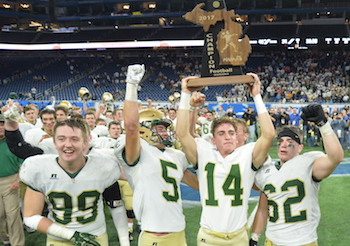
PHOTOS: (Top) Lumen Christi’s Sebastion Toland works to break away from a tackler during the Titans’ Division 6 Final win Friday. (Middle) From left: Cameron White, Joe Barrett, Luke Stanton and Hunter Richmond celebrate with the championship trophy.
Many-Sport Standout Gash Closing High School Career with Repeat Title Pursuit
By
Keith Dunlap
Special for MHSAA.com
September 3, 2026
Gideon Gash said this fall is marking the end of an era for him athletically.
 Throughout his life, it didn’t seem to matter what the sport was, because Gash was playing it.
Whether it was soccer, basketball, lacrosse, football, or track & field, Gash sampled them all, and it didn’t stop when his high school career began.
Last year as a junior at Detroit Catholic Central, Gash continued to play several sports after being named all-state for football in the fall.
During the winter, he played on Catholic Central’s basketball team. In the spring, he decided to go out for track and thrived, finishing second in the 100-meter dash and winning the long jump at the Catholic High School League meet, and then taking third in the long jump at the Lower Peninsula Division 1 Finals.
Following that championship meet, Gash returned to the lacrosse team and suited up for the Shamrocks during the final week of the season, which culminated in a DCC Division 1 title. Gash had played lacrosse the previous spring as a sophomore, but decided to focus more on track as a junior.
“I worked out different muscles and different skills and just having that versatility helped me a lot throughout life,” Gash said. “Being able to do different things and learn faster and having to keep up with everyone in terms of basketball, lacrosse, in terms of just raw skills. That helped me a lot in terms of just being able to add to my bag and be the best I can.”
But now, Gash said his multi-sport playing days are all but over.
One of the premier college football recruits in the nation, the 6-foot-4, 210-pound Gash has committed to play at Texas Tech for now, although he recently said his recruitment is “not closed down,” according to an article on Rivals.com.
 Regardless of where he ends up, Gash said he plans on enrolling early and starting college in January, adding he made sure to accumulate enough class credits to be able to do so.
That means it’s football from here on out, and odds are he’s going to have a monster senior year for reigning Division 1 champion Catholic Central.
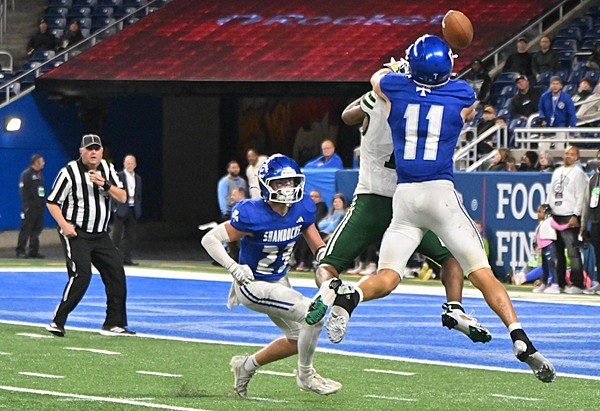
Last year, Gash was all-state in Division 1-2 as a lockdown defensive back, collecting 74 tackles and nine pass breakups. He also was a big-play threat as a wideout, catching three long touchdown passes for Catholic Central in a championship game win over Detroit Cass Tech at Ford Field.
There are times this season where Gash may never leave the field, given he will see lots of time as a dangerous punt returner. In a season-opening win over Clinton Township Chippewa Valley, Gash returned a punt 48 yards for a touchdown.
Playing so many sports throughout his life has shaped him into an all-around force on the football field and helped turn him into a dominating physical specimen.
Gash gained 10 pounds of muscle since last fall and going into his senior year is more chiseled and faster than he has ever been.
“He just loves competing,” Catholic Central football head coach Justin Cessante said. “When we compete and he works the way he does when nobody is watching, and he’s got his agility, his strength and his size, he’s a 10 times better player and athlete than he was last year. I think that attributes to doing all those different things.”
This is the first year Gash is not playing alongside his older brother, Samson, the 2025 Finals champion in the 100-meter dash and all-state wide receiver last fall who is a freshman at Michigan State.
Gideon Gash will certainly be counted on for veteran leadership since Catholic Central entered this season with only two returning starters, although there are several talented underclassmen already with Division I college scholarship offers who are expected to soon make names for themselves on the high school level.
While the next wave of great players is already coming for Catholic Central, it certainly will be hard to replace Gash and how he was able to excel at more than just football.
“I’m going to miss it,” Gash said. “I’ve been playing three sports my whole life, so I’m going to miss it a lot.”
 Keith Dunlap has served in Detroit-area sports media for more than two decades, including as a sportswriter at the Oakland Press from 2001-16 primarily covering high school sports but also college and professional teams. His bylines also have appeared in USA Today, the Washington Post, the Detroit Free Press, the Houston Chronicle and the Boston Globe. He served as the administrator for the Oakland Activities Association’s website from 2017-2020. Contact him at [email protected] with story ideas for Oakland, Macomb and Wayne counties.
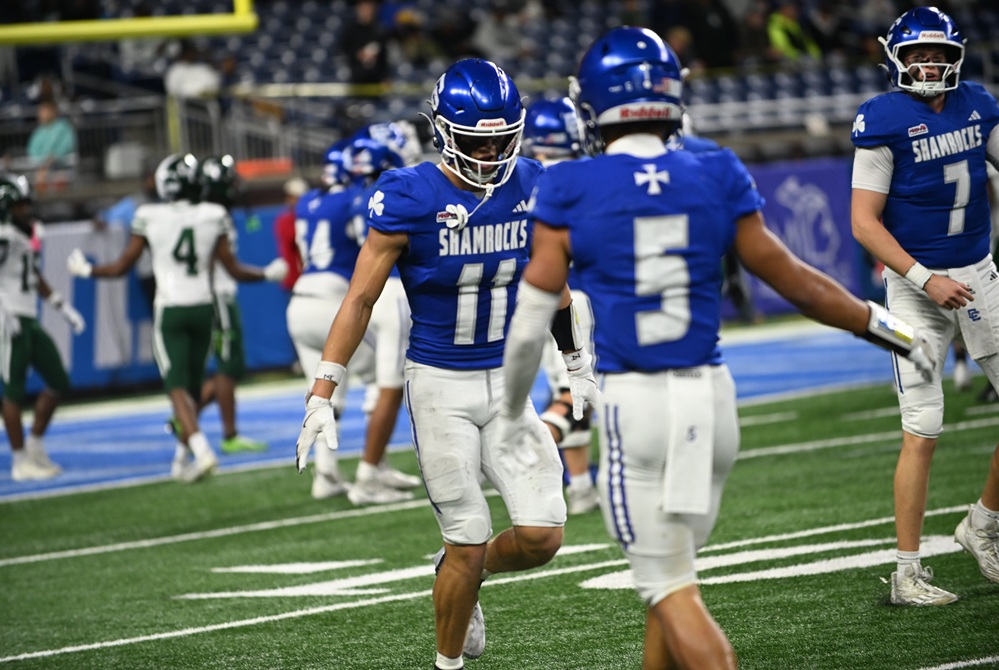
PHOTOS (Top) Detroit Catholic Central’s Gideon Gash (11) is congratulated by brother Samson Gash after scoring during last season’s Division 1 Final. (Middle) Gash breaks up a pass during the win over Detroit Cass Tech.