

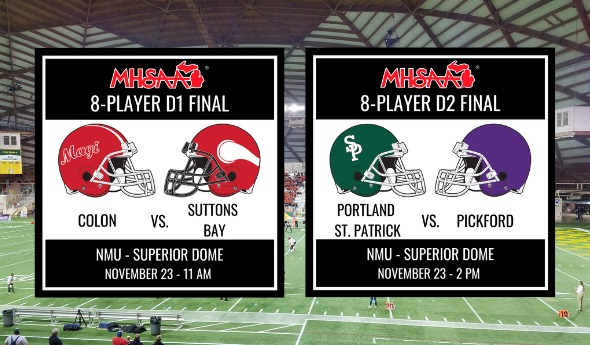
March to Marquette: 8-Player Preview
November 22, 2019
By Geoff Kimmerly
Second Half editor
For the second straight season, the majority of teams making the trip to the 8-Player Finals at Northern Michigan University’s Superior Dome will come seeking their first MHSAA football championship.
Colon, Suttons Bay and Pickford will be first-time title hopefuls Saturday. Portland St. Patrick is seeking its first football title since 1992, long before any of these current players was born.
Kickoff for the Division 1 game is 11 a.m., with the Division 2 game following at 2 p.m. Tickets cost $10 and one is good for admittance to both games. Both games also will be broadcast live on FOXSportsDetroit.com and the FOX Sports app, and replayed on FOX Sports Detroit’s primary channel on Nov. 26 – Division 1 at 8 p.m. and Division 2 at 11 p.m. Audio of both games will be streamed live on MHSAANetwork.com.
Below is a look at all four finalists. Team “rankings” are based on their playoff-point averages heading into the postseason.
 Division 1
COLON
Record/rank: 12-0, No. 2
Coach: Robbie Hattan, fourth season (28-13)
League finish: First in Southern Central Athletic Association A
Championship history: Has never played in an MHSAA Final.
Best wins: 27-8 over No. 6 Morrice in Semifinal, 56-12 over No. 3 Martin in Regional Final, 60-12 (Pre-Regional) and 55-0 over No. 13 Camden-Frontier, 43-8 over No. 11 Bellevue, 42-0 over Division 2 No. 5 Climax-Scotts.
Players to watch: RB/DL Brandon Crawford, 6-2/240, jr. (1,491 yards/22 TDs rushing); SL/DB/P Jonathan West, 6-2/160, sr. (653 yards/7 TDs rushing, 498 yards/12 TDs receiving); QB/DB Phillip Alva, 5-9/140, sr. (954 yards/19 TDs passing, 903 yards/17 TDs rushing).
Outlook: Colon moved to 8-player before the 2018 season after a nice recent run in 11-player that had included eight playoff appearances over the previous 14 seasons. But the Magi have succeeded at a higher level since making the switch, putting up double-digit wins last season for the first time and again this fall. Last season’s champion Morrice was the first opponent to hold Colon to under 34 points and also the first to come within 34 of catching the Magi this fall. Crawford and West both earned all-state honorable mentions in 2018, and 6-4 junior Brayden Ireland gives Alva another big target in the passing game. West also has scored off interceptions and punt and kickoff returns this season.
SUTTONS BAY
Record/rank: 12-0, No. 4
Coach: Garrick Opie, second season (21-2)
League finish: First in Midwest Central Michigan Conference West
Championship history: Division 6 runner-up 2004 (11-player).
Best wins: 45-14 over No. 8 Kingston in Semifinal, 36-30 over No. 14 Gaylord St. Mary in Regional Final, 36-14 over No. 16 Brimley in Pre-Regional, 20-14 and 29-18 over Division 2 No. 9 Onekama.
Players to watch: RB/DB Lucas Mikesell, 5-11/175, sr. (1,259 yards/29 TDs rushing, 501 yards/9 TDs receiving), QB/DB Bryce Opie, 6-4/194, sr. (1,167 yards/15 TDs passing, 692 yards/13 TDs rushing); OG/DT Gavyn Shananaquet, 6-0/230, sr.
Outlook: Suttons Bay has run its record over three seasons of 8-player to a combined 28-6 after being forced to end its final 11-player season early in 2016. The Norsemen had only three games decided by single digits this fall. The first was a six-point win over Onekama, and Suttons Bay won the rematch by 11, and the other two were against Gaylord St. Mary – a one-point loss on the field that became a forfeit win and a six-point win in the Regional Final. The defense has been especially impressive, giving up 16.7 points per game on the season but more than 18 only twice (both times to St. Mary). Bryce Opie also has five interceptions, and the team had a 23-14 turnover advantage heading into last week’s Semifinal.
 Division 2
PORTLAND ST. PATRICK
Record/rank: 12-0, No. 3
Coach: Patrick Russman, 13th season (88-48)
League finish: Does not play in a league.
Championship history: Division 2 runner-up 2017 (8-player), Class D champion 1992, runner-up 1991 and 1997 (11-player).
Best wins: 49-6 over No. 5 Climax-Scotts in Semifinal, 51-16 over No. 11 Kinde North Huron in Regional Final, 45-0 over No. 16 Bay City All-Saints in Pre-Regional, 42-24 over No. 9 Onekama.
Players to watch: RB/DL Ned Smith, 5-10/195, sr. (1,510 yards/24 TDs rushing); QB/DB Connor Cross, 6-2/175, jr. (1,688 yards/36 TDs passing); WR/DB Zach Spitzley, 6-2/180, sr. (1,133 yards/19 TDs receiving).
Outlook: The Shamrocks have made at least the Semifinals the last three seasons and four times since switching to 8-player in 2012, and this has been their most successful run of all four. St. Patrick has won all of its games by at least 18 points (not counting a 2-0 forfeit in Week 3) and by an average score of 52-10. Senior linebacker Alex Kissane, sophomore linebacker Derec Fedewa, senior defensive back Riley Kissane and senior lineman Jeff Davlin are among leaders of a defense that has given up more than 16 points only twice and a combined 22 points over three playoff games.
PICKFORD
Record/rank: 11-1, T-No. 1
Coach: Josh Rader, 16th season (110-55)
League finish: First in Great Lakes Eight Conference East
Championship history: Division 1 runner-up 2018 (8-player).
Best wins: 22-14 over T-No. 1 Powers North Central in Regional Finals, 40-8 over No. 4 Hillman in Semifinal, 57-12 (Pre-Regional) and 58-15 over No. 6 Engadine, 48-16 over No. 7 Crystal Falls Forest Park, 64-20 over No. 12 Cedarville, 46-23 over Division 1 No. 14 Gaylord St. Mary.
Players to watch: QB/LB Jimmy Storey, 6-0/185, sr. (1,400 yards/19 TDs passing, 1,809 yards/24 TDs rushing); TE/DE Nick Edington, 6-7/220, sr. (307 yards/3 TDs receiving); RB/DB Stephen Lamothe, 5-10/175, sr. (752 yards/11 TDs rushing, 813 yards/11 TDs receiving).
Outlook: After reaching last season’s Division 1 championship game with a junior-heavy roster, Pickford is back playing for its first Finals championship with many of the same standouts. Edington, Storey and senior lineman Isaiah May all made the all-state team last season, and Storey was the statewide Player of the Year for 8-player by The Associated Press. The team’s only loss this fall came in Week 3, by six points, to Powers North Central – and the Panthers avenged the defeat in the Regional Final. The Jets also were the only team able to hold Pickford under 40 points this fall. Senior running back Isaac Brown provides another valuable option on offense with 613 yards and 12 touchdowns rushing.

All Eyes on Ithaca's Winning Streak
November 1, 2012
By Geoff Kimmerly
Second Half editor
Terry Hessbrook has sensed this level of buzz around Ithaca's football program once before.
He was a senior running back during the 1984 "dream season" when the team finished the regular season 9-0 and made the playoffs for the first time. The Yellowjackets' postseason run lasted only a week – Ithaca fell to Grand Rapids South Christian 20-0 in the first round, which in those days of shorter playoffs was the Regional Final – but the excitement was reminiscent of the attention his program is getting heading into Friday's Division 6 District Final against Hemlock.
Except this hype extends far outside the city limits of his 2,900-resident hometown. Ithaca has won 38 straight games, the fifth-longest streak in MHSAA football history, and is only three more wins from a third straight trip to the Finals at Ford Field.
“It’s been really neat to have people take a look at what we’re doing in Ithaca,” Hessbrook said. “We’re not doing anything different. We’re not reinventing the wheel. We’re not a bunch of geniuses or anything like that. We just have a coaching staff that works really hard and supports each other, and we don’t care who gets the credit. And the players don’t care who gets the credit.”
How much the ninth-year coach is beaming comes through the phone as he talks of his players' handling of the growing expectations or how fortunate he is to be surrounded by assistants he's been close with, in at least a few cases, for decades.
And winning makes everything more fun. The Yellowjackets get a Second Half High 5 this week as they work toward becoming just the fifth school to win three straight MHSAA titles since the first playoffs were held in 1975. The winning streak is the third-longest among those that included at least one season since the postseason was added.
Ahead of Ithaca on that consecutive wins list are Hudson (72), Morenci (44), Cheboygan (43) and New Lothrop (39). But only Cheboygan accomplished its streak completely within the playoff era, with Hudson’s coming to an end in the first MHSAA Class C Final.
Making this run more special is that half the team has been together for nearly all of it.
Hessbrook brought his players into a huddle at the start of practice this August, and as he started looking at their faces, a thought crossed his mind.
“Wow, you guys have been around for a long time,” he told them.
Ithaca’s football players haven’t been around any longer than those on any other team in Michigan. But it sure feels that way. The Yellowjackets have played in 12 playoff games over the last three years, and five seniors who moved to varsity at the start of 2010 – receiver Markes Gadlen, linebackers Tyler Gibson and Jacob Barnes and linemen Bradley Martyn and Josh Capen – have played in 38 varsity games. That’s the equivalent of more than four regular seasons. And the team's other 12 seniors all came up for the playoffs in 2010, giving them more postseason experience than perhaps any group currently playing in this state.
During that 2010 run, they felt like they were along for the ride. Last season’s championship was about seniors like Garrett Miniard and David Brown showing they could win one too after following all-state quarterback Alex Niznak’s lead the year before. Now, these seniors similarly want to be the leaders of another title run.
But Hessbrook is sure to credit one more group – the 2009 team that played in the team's first MHSAA Semifinal.
“In 2009, that group of players raised the bar, and they made it possible, although they didn’t win,” Hessbrook said. “They didn’t get to the big game. But in 2009, for one quarter (in the Semifinal), we played with Montague (which went on to finish 14-0).
“The bar has been raised. I don’t know that the goal now is to (just) get into the playoffs. I think the kids are hungry enough that they don’t want to just get in. They want to get in and make noise.”
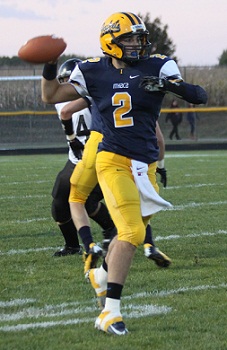
The name statewide observers are coming to know is that of junior quarterback Travis Smith. He took over in the 2011 opener and quarterbacked the team through the 42-14 championship game win over Constantine, throwing for 299 yards – fifth-best all-time for an MHSAA championship game.
His numbers this fall say plenty – 107 completions in 175 attempts for 1,696 yards and 30 touchdowns, with only four interceptions. Smith also leads the team with 610 rushing yards and 12 touchdowns on the ground. He’s 6-foot-2 and 200 pounds and already getting the college looks that came to Niznak during his senior season after he’d already committed to Central Michigan.
Total, the team is outscoring opponents on average 53-6. The defense is a little smaller but faster this fall, and is averaging exactly three turnovers per game.
Another stat helps it all make more sense. Teams submit the grade-point average for their top 11 players for academic all-state – and Ithaca’s group comes in at 3.85.
And visitors to Ithaca don’t get the feel they’re in a small town once they enter the stadium. Recent renovations included the addition of viewing platforms 15 feet above the track that put fans closer to the field than the first row of bleachers. There are new bathrooms and a larger concessions area, but the biggest blast comes from the 13 by 24-foot Jumbotron scoreboard that’s made the stadium feel more like the home of a Division II college team.
Hessbrook estimates at least 2,000 fans are showing up for home games, and similarly large crowds have followed his team on the road.
To Ithaca’s credit, the team is taking all of this in stride. It’s not that the streak isn’t a big deal – “It is what it is,” Hessbrook said – but the players just don’t talk about it too much.
“They’re really a mature group of seniors, really grounded, from great families with great parents who are very supportive of what we’re doing and just keep their kids grounded. The coaching staff does a good job keeping the kids grounded," Hessbrook said. "You’re only as good as your last game. Nobody’s going to care what you did last week or last month. And I think the players believe that.”
PHOTOS: (Top) Ithaca's Caden Kipp and Zach Allen (12) celebrate after a touchdown during last week's win over Grandville Calvin Christian. (Middle) Quarterback Travis Smith already is in the MHSAA record book for his performance during last season's Division 6 Final. (Click to see more from HighSchoolSportsScene.com).