

Marine City Focused on Comeback Quest
By
Paul Costanzo
Special for MHSAA.com
October 11, 2016
Ryan Alexander was in a familiar place this past Thursday.
 The Marine City senior running back was at East China Stadium, the junior varsity team on the field in front of him playing against Warren Woods-Tower and a group of junior program football players behind him, preparing to get onto the big field and play at halftime.
He and his Mariners teammates were coming off a win against archrival St. Clair, and had just finished their last practice in preparation for a Week 7 game against Warren Woods-Tower, one they would also win.
All of that is familiar for Alexander and the Mariners. The start of the season, however, was far from it.
“It was different than anything I’ve ever experienced,” Alexander said of Marine City’s first 0-4 start since 1971. “I’ve been on varsity for three years now, and to start 0-4, it was the first time I’ve ever felt anything like that since I’ve been in the program, since I’ve been in Marine City.
“It was a new feeling, but it was also a sense of motivation. It pushed me harder knowing that we had something to prove and that everyone was doubting us because we were 0-4. It’s hard to go through, but I think it made us a better team.”
Alexander and his teammates are on the road back, sitting at 3-4 and eyeing two more wins which could possibly preserve the school’s streak of qualifying for the postseason, which started in 1998. He said getting there would show those junior program players that by coming together as a team, you can accomplish anything.
The Mariners have already shown their coach plenty.
“I wondered, because our program has had so much success, what would happen if we had a bad start like this, how would that team be and how difficult would it be to coach,” Marine City coach Ron Glodich, who is in his fifth season as head coach after serving as a longtime assistant in the program. “What I found is these kids are incredible. Their perseverance and their work ethic has not changed. Nobody has quit, even though I challenge them week in and week out, nobody has quit. The bigger the challenge I give them, the bigger they step up.”
‘We live football’
Football in Marine City has a bit of a “Friday Night Lights” feel to it.
The town with a population of a little more than 4,000 essentially shuts down on game nights to support its team. Not long ago, it moved trick-or-treating because it conflicted with a Friday night playoff game. When the team went to Ford Field for MHSAA championship games in 2007, 2011 and 2013, it filled its entire side of the lower bowl with fans clad in orange and black.
“It’s a football crazy town,” Alexander said. “We live football.”
Kids grow up wanting to be Mariners as much as they grow up wanting to be Wolverines or Spartans, and you can’t even go to a JV game without seeing groups of them playing a side game of touch – or tackle – at East China Stadium.
“They were always winning, ever since I’ve been a kid and ever since my parents have been around,” senior lineman Andrew Steinmetz said. “It’s a great feeling to grow up here, live here and then play here.”
Always winning isn’t hyperbole, especially for someone Steinmetz’s age. The playoff streak is only scratching the surface of the Mariners’ success in the past few decades.
The program won MHSAA championships in 2007 and 2013, and – prior to this year – had lost more than two games in a season only three times since 1992.
From 2006 through 2009, Marine City had three undefeated regular seasons, and in the only exception, it went 13-1 with a Division 4 championship. The Mariners’ last losing season came in 1982.
There have been stars who went onto play Division I college football – Brendon Kay, a 2008 graduate went to Cincinnati and was the Most Valuable Player of the Belk Bowl, and Anthony Scarcelli, who was the Associated Press Division 3-4 Player of the Year in 2011 and is currently a senior on Central Michigan University’s football team – but most of Marine City’s success has come thanks to players who don’t have a recruiting site ranking.
“When you mention the name Marine City outside the area, it’s common for someone to say, ‘Oh, you’ve got a great football program,’” Glodich said. “And we’re proud of that. It’s been a long time since we built it, and a lot of people are proud of it in the area and they come out to support it. It’s nice that that’s linked to the town, and that people believe we have a great football program. And I believe we do.”
 In Marine City, even 8-1 teams catch flack. At 0-4, the loud minority of the fan base gets more vocal.
“As any coach who doesn’t win, there are critics out there,” Glodich said. “I happened to get a letter and I shared it with the kids. I told them, ‘We’re all in this together. You’re being criticized in the stands, I’m being criticized, so understand that we’re all in this together and it’s all about getting better.’
“The good news is, I’m at the point in my career where I know that this staff does a great job. So when you get letters like that, you chuckle and say, ‘OK, this person is venting, but they don’t know what the hell they’re talking about.’ And I would tell that person if they ever had the guts to look me in the eye, I would tell them, ‘You don’t know what the hell you’re talking about.’”
Glodich’s players said they were able to shut out the outside noise, for the most part, and anything that did enter their brains was used as motivation. Alexander said it went in one ear and out the other, because practicing with a clear mind was much more necessary than reacting to insults.
Even better, however, was the fact there was much more support than derision. Marine City may be football crazy and unaccustomed to waking up on a Saturday after a loss, but its love for football goes beyond a stunning win-loss record.
“The parents and the past players, they really had our backs,” senior lineman Tom Kaminski said. “(Former player) Ethan Cleve made a nice Facebook message on the Marine City football fans page, and (former player) Jarrett Mathison was saying, ‘Don’t worry about it, it will get better.’”
Writing the final chapter
The message within the team was similar to Mathison’s, but the players knew they were the ones who would have to make things better.
“A lot of it came from themselves,” Glodich said. “After that fourth loss, we challenged them and said you guys make a decision of how you want to move forward. That’s where your senior leadership and the guys that really care about the program, they kind of step forward and they rally the troops. We challenged them come Monday, and they responded to the challenge.”
The change could be seen in practice, and it translated into a 37-29 win against Madison Heights Madison in Week 5. That was followed by a 27-6 win against St. Clair in Week 6 and most recently a 49-31 win against Warren Woods-Tower in Week 7.
“We just had to put our heads down and keep fighting for it, because we knew we were better than what we were,” Kaminski said. “It’s big on your shoulders, because everyone’s used to 9-0 teams here, so that was a big wake-up call, but I think we’ve got it.”
As stated above, while this is a position Glodich never wanted to be in, he said he’s always wondered what would happen if a Marine City team had a start like this one. He’s wondered how the players would react. He’s wondered how difficult it would be to coach a team that no longer held its playoff destiny in its own hands before the midpoint of the season.
“I’m amazed that these kids are working this hard – I don’t know if any other team that was 0-4 is working as hard as we do,” Glodich said. “It’s just a credit to these kids and their background; they’re not afraid to work. The kids that come to school here in this community are not afraid to work, and that’s why I’m one of the luckiest guys in the state to be able to coach in this community.”
The 0-4 start may have put the Mariners on the brink of playoff extinction, but their opponents in weeks 1-4 could wind up helping push them over the top when it comes to playoff selection, should Marine City get to 5-4.
Algonac, Port Huron Northern, Detroit Loyola and Marysville were a combined 25-3 through seven weeks, with one of those losses a Northern defeat against Marysville.
The Mariners are taking the one-game-at-a-time approach to the end of the season, but they know that can help. They know they can do something special to close it out, and accomplish something no Marine City team has done before – rebound from a start that could cause some to pack it in.
Glodich said he can’t look past the next game, but admits he and his coaches have talked to the players about writing the final chapter in their book, and how they want their story to end.
Alexander has already started writing in his head.
“It would mean the world (to finish 5-4) especially because it’s my senior year and I’d love to end on a high note,” he said. “I’d love to be the team that started 0-4, won the last five games and then proved what we have in the playoffs. We have a good team, we have a good shot.
“We just want to get to 5-4. We don’t really focus on anything else (in terms of playoff points). If we get there, it doesn’t matter, we’ll be happy.”
 Paul Costanzo served as a sportswriter at The Port Huron Times Herald from 2006-15, including three years as lead sportswriter, and prior to that as sports editor at the Hillsdale Daily News from 2005-06. He can be reached at [email protected] with story ideas for Genesee, Lapeer, St. Clair, Sanilac, Huron, Tuscola, Saginaw, Bay, Arenac, Midland and Gladwin counties.
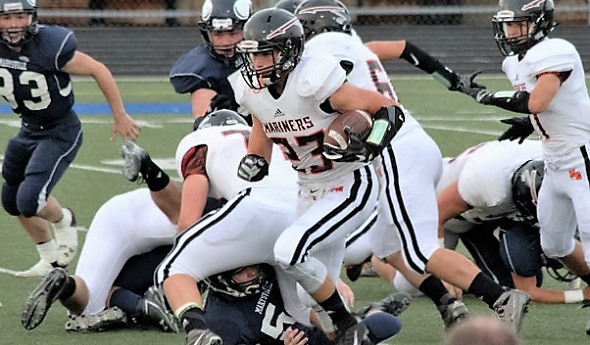
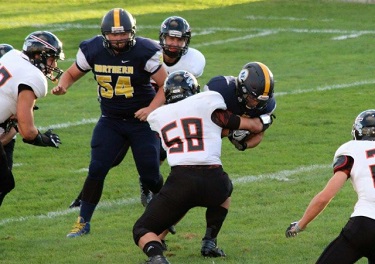
PHOTOS: (Top) Marine City's MJ Frank cuts through an opening against Marysville this season. (Middle) A group of Mariners surround and take down a Port Huron Northern ball carrier. (Photos courtesy of the Marine City football program.)

Parking, Entrance Protocols Announced for 2025 11-Player Football Finals
By
Geoff Kimmerly
MHSAA.com senior editor
November 24, 2025
To provide for the convenience and safety of spectators attending the Michigan High School Athletic Association 11-Player Football Finals on Nov. 28 and 30 at Ford Field in Detroit, attendees are being advised of a variety of items related to transportation and security – including policies regarding parking, seating and types of bags allowed into the stadium.
Parking will be available in Ford Field facilities and lots to the east and north of the stadium and costs $8. A map identifying the designated Ford Field lots (4, 5 and 6) and parking deck can be found on the Football page under “2025 Road to the Finals.” (There also are a number of privately-operated parking facilities close to Ford Field, but their pricing may differ.)
Fans also are advised that the consumption of alcohol is prohibited in Ford Field parking facilities and lots, and smoking – including use of electronic cigarettes and vaporizers – is prohibited inside the stadium. Tailgating, including the setting up and use of grilling equipment, also is not allowed.
Tickets are priced at $20 and allow a fan to see all four games in a single day. Tickets are available for purchase at the door (cash or credit accepted), or online from Ford Field via Ticketmaster – links to order tickets both days also are on the MHSAA Website football page. Spectators leaving the stadium will be required to purchase another ticket for re-entry. Babes in arms will be admitted without charge for this event.
Spectators may enter Ford Field at Gates A, D & G. Upon arrival in the building, fans will find their designated seating areas on the South side of the field if their team is the designated home team for their contest and on the North side for the designated visiting team. Home teams this weekend are Detroit Catholic Central, Dexter, DeWitt, Hudsonville Unity Christian, Pontiac Notre Dame Prep, Jackson Lumen Christi, Menominee and Hudson. Brightly-lit video boards above the seating areas will display the names of the participating teams each day, and fans should sit on the side of the stadium where they see their school’s name. For general fans, the entire lower bowl of Ford Field will be open for the event.
Security measures also will be in place to help assure spectator safety. Fans will be subject to metal detector screening, and Ford Field personnel reserve the right to request patrons open their coats, bags and other item-carrying vessels for visual inspection and deny entrance to individuals who do not cooperate. Spectators should remove cell phones, cameras, keys and other large metal objects before passing through the metal detectors.
Items which fans will be prohibited from bringing into the building include, but are not limited to, the following:
* Purses larger than a clutch bag, coolers, briefcases, backpacks, book bags, diaper bags, fanny packs, cinch bags, grocery & paper bags; duffle bags, computer bags or luggage of any kind.
* Aerosol cans (hairspray, mace, pepper spray, etc.)
* Animals (except service animals to aid guests with disabilities)
* Balloons (air or helium)
* Balls (beach balls, footballs, etc.)
* Banners or large flags
* Cameras with lenses longer than five inches or any detachable lens. Selfie Sticks also are prohibited.
* Chairs including folding chairs or stools
* Decals, stickers, confetti or glitter
* Drones and/or remote-controlled aircraft
* Electronic equipment including laptop computers, video recorders (hand-held video cameras are allowed), tripods and wearable video cameras including Go Pros.
* Fireworks
* Flashlights
* Food, beverages – including water – or liquids (cans, bottles, boxes, flasks, etc.)
* Illegal substances
* Knives, pocketknives, box cutters, scissors, etc.
* Laser pointers
* Marijuana including medically prescribed electronic accessories or paraphernalia associated with marijuana or illegal narcotics use.
* Markers (permanent) and/or paint
* Noisemaking devices (bells, horns, kazoos, whistles, etc.)
* Objects that can be used as missiles or projectiles (sticks, poles, bats, clubs, Frisbees, etc.)
* Strollers and infant car seats or carriers
* Umbrellas (large size)
* Weapons
* Wrapped gifts
The following items may be permitted after inspection:
* Bags that are clear plastic, vinyl or PVC and do not exceed 12 inches by 6 inches by 12 inches, or a one-gallon clear plastic freezer bag (Ziploc or similar). An exception will be made for medically necessary items after proper inspection at the Gate.
* Infant items in a clear bag (bottles and formula) only if accompanied by a child
* Binoculars and binoculars cases not exceeding 4½ inches by 6½ inches may be brought in via one of the clear plastic bag options.
* Cameras (lenses may not measure longer than five inches or be detachable, and no tripods or extension cords)
* Small radios (no larger than the size of a football and used with an earpiece)
* Small, compact umbrellas (must be placed securely under seat)
* Posters and signs without poles or sticks, or larger than what one person can hold.
* Tablets (iPads, Kindles, etc.)
* Seat cushions not exceeding 15 inches by 15 inches. Seat cushions also must not contain arm rests, zippers, pockets, flaps or metal backs.
The complete list of prohibited items can be found on the Detroit Lions Website. Prohibited items that are discovered during security inspections at stadium entrances must be returned to the owner's vehicle or discarded. Items will not be held for later pickup.
Fans are reminded that all image taking (still and video) may be only for personal, non-commercial use.