

Marine City, Mathison Make Right Moves
November 29, 2013
By Bill Khan
Special to Second Half
DETROIT — When Jarrett Mathison was told he wouldn't be Marine City's quarterback this season, he could've taken the news the wrong way.
He could've been selfish about losing the marquee position on the football team. He could've sulked, becoming a disruptive force on the team. He could've complained to his parents, who in turn could've made life miserable for coach Ron Glodich and his staff.
Instead, Mathison handled the change with a team-first attitude, even though he had no clue what his role would be with the Mariners.
"There wasn't really a decision until about a week before our first game," Mathison said. "They told me I was going to play fullback. I said, 'OK. I don't care. I'm playing. I've got to do what I've got to do to help the team out.'"
As it turned out, Mathison got even more action this season than he did a year ago when he was the sophomore quarterback for an 8-2 team.
He starred in all three phases of the game, leading Marine City to a 49-35 victory over defending-champion Grand Rapids South Christian in the MHSAA Division 4 championship game Friday at Ford Field.
Mathison intercepted two passes, returned the opening kickoff of the second half 91 yards for a touchdown, and ran 18 times for 103 yards and two touchdowns.
"We had to tell him he could be a benefit on both sides of the ball," Glodich said. "That gamble paid off tonight. He's a warrior. He was better at the end of the game than the beginning of the game."
Mathison never expected to have such an active role in Marine City's success after the quarterback position was turned over to junior Alex Merchant, who was 10 for 12 for 208 yards and three touchdowns against South Christian.
"I thought I was just going to be a person filling in," said Mathison, who scored 32 touchdowns this season. "It just came out for the better. Everything happens for a reason."
Senior Pete Patsalis caught all three touchdown passes for the Mariners, grabbing five passes for 142 yards. Marine City scored on seven straight full possessions, not including a one-play series in which it ran out the clock following a South Christian touchdown with 12 seconds left in the first half.
 The score was tied 21-21 at halftime when Mathison gave Marine City a huge lift to start the second half. A series of fake handoffs on a kick return that fooled nobody the first time the Mariners tried it worked wonders this time around. Mathison received the kick, turned his back toward the Sailors and faked the ball to three teammates before taking off and getting in the clear.
"The big kickoff return took the wind out of us a bit," South Christian coach Mark Tamminga said. "That was a huge momentum swing there. Give all the credit to them. That's a heck of a football team. We got beat by a better football team."
Still, South Christian was in the game when quarterback Jon Wassink scored from one yard out on fourth-and-goal to tie the game 28-28 with 6:04 left in the third quarter.
The Sailors couldn't stop the Mariners' offense, however. A 65-yard touchdown pass from Merchant to Patsalis with 5:11 left in the third quarter put Marine City ahead to stay. A 1-yard run by Mathison made it a 14-point game.
South Christian got within 42-35 with plenty of time left when Wassink hit Eric VanVoorst with a 19-yard touchdown pass with 10:04 remaining, but Marine City ground out a 12-play, 75-yard drive that consumed 6:15 to get some breathing room. A 20-yard pass from Merchant to Patsalis capped the drive with 3:45 left.
"We told the kids, 'You stay with them until the fourth quarter, then I guarantee you you'll have more in your tank than they do,'" Glodich said.
History was made in this game, as Marine City junior Olivia Viney became the first girl to play in an MHSAA Final. Viney did more than just play, going 7 for 7 on extra points to tie a Finals record for most extra points in a game. Paul Gross of Jackson Lumen Christi also was 7 for 7 in the 2001 Division 5 Final against Livonia Clarenceville.
"I really wasn't as nervous as I thought I would be," Viney said. "My team did a really good job of keeping everyone calm, keeping their heads on their shoulders. I was totally prepared mentally and physically."
Viney finished the season 61 for 65 on extra points, breaking the Marine City mark of 59 extra points in a season. She also had a 30-yard field goal.
"I couldn't do it without my team," she said. "I couldn't score an extra point unless we get touchdowns. Our snapper, our holder, our offensive line — I couldn't do it without them."
The tone for the high-scoring game was set just 58 seconds in, as Wassink hit VanVoorst with a 52-yard touchdown pass to give South Christian a 7-0 lead.
That was the only score of the first quarter, but the pace picked up in the second quarter, with the teams combining for five touchdowns to go into halftime tied at 21-21.
Mathison's 1-yard run put Marine City on the board with 10:28 left in the second quarter.
A 39-yard pass from Merchant to Patsalis with 7:12 left in the second quarter gave the Mariners a 14-7 lead.
Wassink's 50-yard option keeper with 5:36 left in the second quarter tied it 14-14. Tait Sapienza answered for Marine City with an 18-yard touchdown run with 2:05 to go in the half.
South Christian tied it 12 seconds before halftime when Wassink threw a low 8-yard touchdown pass to Kyle Haan, who was able to trap the ball between his legs as he fell across the goal line.
Wassink, a junior two-year starter who missed last year's championship game after breaking his collarbone in the Semifinal, was 18-for-38 for 240 yards, three touchdowns and two interceptions.
Sapienza ran 17 times for 123 yards and a touchdown for Marine City (13-1), which won its other MHSAA title in 2007.
"They were more physical than us," Tamminga said. "When you control both sides of the line of scrimmage, you're going to win a lot of football games."
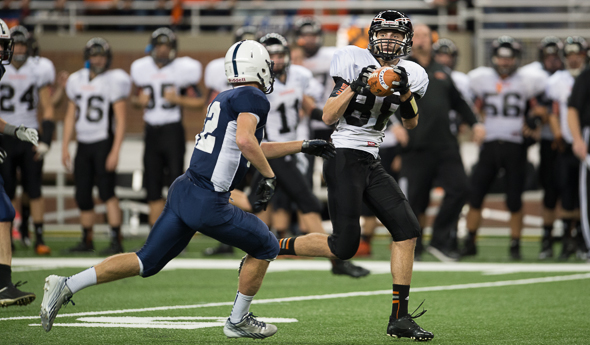
PHOTOS: (Top) Marine City's Joe Mazure (88) hauls in a pass during Friday's Final. (Middle) Grand Rapids South Christian quarterback Jon Wassink breaks away for a gain. (Click to see more from Terry McNamara Photography.)
Dock Putting Dad's Coaching Lessons to Work as Middleville TK Continues Climb
By
Steve Vedder
Special for MHSAA.com
November 3, 2025
MIDDLEVILLE – Denny Dock can't pinpoint the exact moment he thought his football-loving son would follow him into coaching, but the signs were there all along.
 For starters, there were the countless hours spent tossing a football around the backyard. Or when his young son, Jeff – not even old enough for middle school at the time – eagerly joined other Stevensville Lakeshore coaches watching film on weekends.
Maybe it was all those Friday nights spent trekking along the sideline as a ball boy for Lancers teams. Another clue might have been the Saturday afternoons the two spent together watching college football, or taking in the NFL on Sundays.
When Jeff got older, it may have been how he readily absorbed tips that helped him become a better quarterback in high school and then at Grand Valley State. It could have even been an early, uncanny ability to grasp the importance of fundamentals.
Put it all together, and it seemed inevitable coaching football loomed in Jeff Dock's future.
"That's very fair to say," said Denny Dock, who is 19th on the state's list of all-time winningest football coaches while also the winningest high school softball coach in the country. "The younger years in football were really positive for Jeff, and that doesn't happen all the time. There are negative things that can happen."
While there might have been multiple signs the younger Dock would one day join the coaching ranks, he admits it was far from a done deal. There were thoughts of becoming a biology teacher, a pastor or maybe even an orthopedic surgeon.
But coaching? Even with his father as a classic example of the positive impact a good coach could spread, Dock said it took years for him to eventually land in coaching.
"It dawned on me that there were a lot of all three of those things in being a coach," he said. "Growing up in sports is what I knew, and I ended up developing a passion for it."
That passion is actually the highest it's been in years as his Middleville Thornapple Kellogg football team this past weekend improved to 7-3, continuing the program's first winning season since 2020 and the best fall since the Trojans went 7-3 in 2018. The Trojans defeated Hastings 28-20 in a Division 2 playoff opener, and a win this Friday at Lowell would give Middleville its first District championship since 2001.
Denny Dock coached football at Hartford from 1981-83, Dowagiac from 1984-87, and then Lakeshore from 1988-2013, returning to lead the Lancers for one more season in 2020 and all together totaling a 270-79 career record, 15 league titles and five runner-up MHSAA Finals finishes.
He has kept his hand in football in aiding his son's Trojans program. He's at all the games to add support, critique, advice, strategy, tips on how practices can best be organized and long talks discussing how continual improvement can be furthered.
It's a two-way street as an old football coach who never had a losing season, and is a member of the Michigan High School Football Coaches Association Hall of Fame, can remain invested in the game while his son benefits from three decades worth of experience.
Jeff Dock said his father's real value is his ability to spot from the stands the little things that less experienced coaches may miss.
 "Play calling, how players are used, maybe a little bit about strategy," Dock said.
After playing for his father, Dock said there's no doubt he's transferred the best of what he learned into his own coaching. The older Dock was not only a highly successful football coach, he's compiled a 1,319-345-2 record in softball with eight Finals titles.
Whether it's about football or the philosophy Dock stresses in his softball program, the advice accepted from his father – who still attends softball clinics for tips on improving the Lakeshore program – is virtually across the board. It begins, however, with how a coach should treat his players.
"I was a manager growing up, and I saw his intensity and a love of his players," Dock said. "He never pushed me in any direction, but he told me about education. He always let me figure it out. One of the coolest things my parents did in raising me was to allow me to figure things out."
As far as the Xs and Os of coaching, Dock said his father prizes an organized practice. In fact, it could even be argued that both Docks enjoy a spirited and productive practice session over the microscope of Friday Night Lights.
"He never had a losing season, and it was ingrained in us just to go back to work and that that work never stops," he said. "He loves practices and being organized. Rule No. 1 with him was to make sure the players are prepared, and that you have to communicate with them. Dad would never belittle us or cuss us out.
"I saw the work he put in, how he'd wake up every Saturday thinking about the game. I saw the nitty gritty of coaching and how it was going to take work."
It was that seemingly endless work, in fact, that Denny Dock made sure his young son understood. Denny had no illusions over the pitfalls of coaching, and the pros and the cons. But before he could teach that to his son the coach, he made sure his son the quarterback understood how athletics worked.
There were challenges as a player and now for his son as a coach.
"He was always a quarterback because I think he liked the ball in his hands," Denny Dock said. "I think he liked the leadership part of the game, understanding the team part, and knowing what he had to do. That always challenged him."
While the challenge of playing is long gone for the younger Dock, the next challenge is building a program which is annually competitive. To do that, Jeff Dock said he accepts what his father knew 30 years ago.
"I'm willing to learn anything from anyone at any time," he said. "I know my dad has always thought about what he can do to become a little better every year. I'm always looking for ways to communicate and do things better. It can always be done better, but how can you get there? How can we do the little things better. That's what I learned."
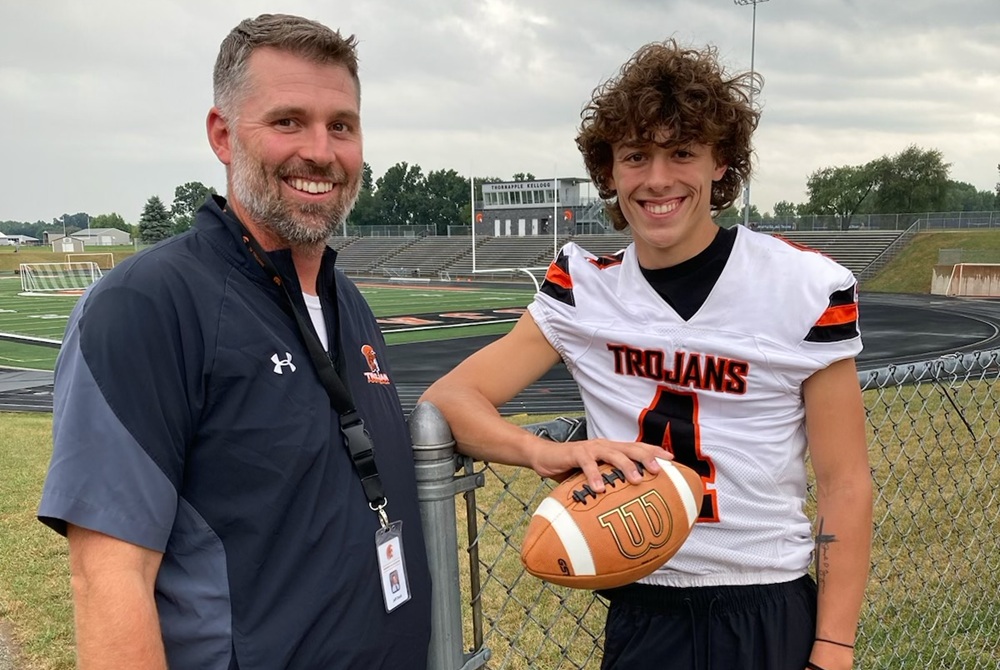
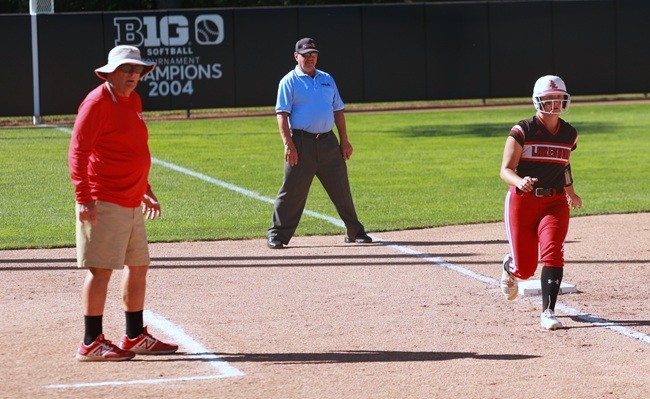
PHOTOS (Top) Jeff Dock, left, and son Micah – Middleville Thornapple Kellogg’s quarterback this season – stand for a photo at their home field. (Middle) Denny Dock, far left, coaches a base runner during Stevensville Lakeshore’s 2022 Semifinal win. (Top photo by Steve Vedder.)