

Memorable Wakefield Run Won't Be Forgotten
October 2, 2019
By Ron Pesch
Special for Second Half
When it comes to football, Russ Maki wears his heart on his sleeve. A 1971 graduate of Wakefield High School, he’s on a mission.
As a 7-year-old, he fell in love with the sport and, in particular, with a team.
“My Dad brought me to every (Wakefield) game,” he recalled. “We lived four blocks from the football field, and I watched every morning and afternoon practice.”
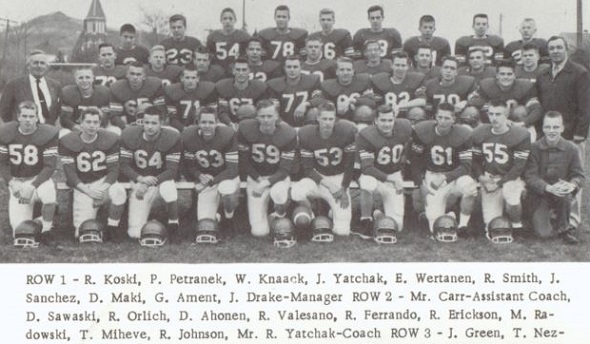
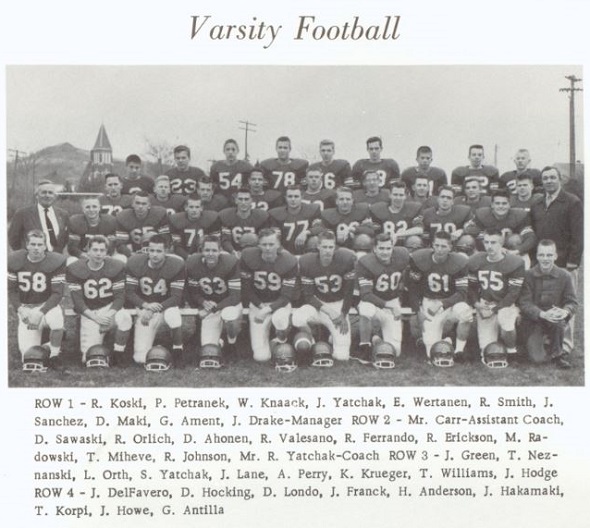
Maki’s memories are of the 1960 Cardinals, and he’s on a quest to honor the team.
Football began in 1920 at Wakefield. Interrupted briefly for a national crisis, it returned to the gridiron stronger than ever – but then, until recently, disappeared from the landscape of this Upper Peninsula town. Like in other cities across the nation, shrinking enrollments have impacted the sport.
“(That 1960) team just kicked everybody's butt,” added Maki. “The players on this team were my heroes then and still are to this day. Hardly anybody in town knows they were State Champs.”
Football state championships in Michigan are decided on the playing field via a tournament these days. But that wasn’t the case when Maki was a kid.
Hence, his challenge. He would like the school district to honor the team with recognition such as a pennant to hang in the gym. So he needs proof.
Big Iron
The City of Wakefield proudly notes that it is located in the heart of Big Snow country. Indeed, nearby are three of the finest ski hills in the Midwest. Located in the center of town is Sunday Lake. Porcupine Mountains State Park and Lake Superior are a little north. It is beautiful country.
 But it wasn’t snow, scenic waterways or quality of life that initially attracted folks to the Gogebic Range area of Michigan. Rather, it was the discovery of iron ore in 1881. The find inspired a mad rush to capitalize, and that led to the founding of the village of Wakefield in 1887. The city was incorporated in 1919.
Hop on highway US-2, head west, and around 10 minutes later, you’ll be in Wisconsin. Stay on US-2, jog a bit to the north, and in two hours you’ll find yourself in Duluth, Minnesota. A trip from Wakefield to Fargo, ND, is six and a half hours. For comparison, a visit to Detroit, with traffic cooperating, would require a commitment of at least nine hours.
So it’s completely understandable that, from the beginning, Hurley High School – located a mere 13 miles away in the Badger State – became a rival.
“The Wakefield high school football team will meet Hurley on the local grounds Saturday afternoon,” announced the Ironwood Daily Globe on October 20, 1920. According to Coach (Fred) Hackett, who has charge of the team, the boys are light and newly organized and have only a fair chance of winning the game with Hurley.”
Indeed, it was a mismatch, with Hurley trouncing the “green but willing youngsters” from Wakefield, 46-6.
“In the two weeks that the Wakefield team has been out in uniform, Coach Hackett had little time to even drill some of the youngsters in ordinary tactics of the game, much less develop a strong team.”
The schools met again in 1921 with similar result, but continued to play each other sporadically in the coming years. A field goal by Pat O’Brien with eight seconds left to play in the 1929 contest gave Wakefield a 23-20 victory over its natural rival, sealing the school’s first ever unbeaten (but once tied) season.
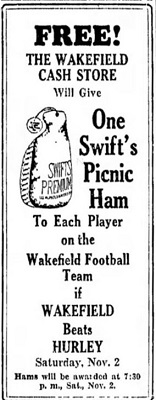
“A local grocery store offered a free ham to each player on the team if they beat Hurley in that season-ending game,” said Maki, laughing. “Can you imagine that?”
They became league rivals when both teams, along with Bessemer and Ironwood from Michigan and Ashland from Wisconsin, became charter members of the Michigan-Wisconsin Conference in 1937.
Hopes for a different moniker, “for brevity’s sake,” were tossed around by the press at the time. The ‘Big Five’ was pitched by the Iron Mountain News. The Ironwood Daily Globe suggested ‘Michwico’, a juxtaposition of the words Michigan, Wisconsin and Conference. Another thought was the ‘WHABI’, a combination or first letters from each member town.
Instead, as time wore on, the league simply became known as the “M-W.”
Alumnus comes home
Wakefield discontinued football for two years – some say three – due to World War II. The team returned in the fall of 1945. Ansel Anderson, a graduate of league rival Ashland and Stout Institute in Menomonie, Wis. – where he took part in basketball, track and captained the football team – guided the athletic squads at Wakefield for two seasons.
In 1947, the school hired one of its own.
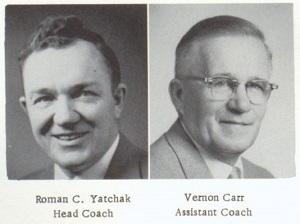 Roman Charles Yatchak had starred in both football and basketball at Wakefield, earning all-U.P. honors in the early 1930s, then lettered in football, basketball and baseball at Iowa State Teachers College. He coached prep ball in Iowa, then at Highland Park in metro Detroit before returning to Wakefield. A year earlier, the Cardinals became members of the newly formed Western Upper Peninsula Football Conference, comprised of Class ‘C’ schools from Houghton, Hancock, L’Anse, Ontonagon, Lake Linden and Crystal Falls. The 1947 season would be the first during which each member played one game against all the other members.
“The squad has responded magnificently to his tutoring,” wrote the News near the end of Yatchak’s first gridiron season at the helm. Wakefield had posted a 5-2 mark heading into the season-ending contest with Bessemer, now a nonleague game. The Cardinals had faced the Speedboys on 17 occasions with minimal luck, winning only four contests since 1924 when the teams first met.
Bessemer again came out on top, 13-0. Still, the season featured a third-place finish in conference play and was deemed a success. Ten juniors were expected back for the 1948 season.
The Cardinals, under Yatchak and assistant Vern Carr, won the Western Upper Peninsula Conference title in the fall of 1948 and posted a 7-1 mark overall. The loss was 6-0 to Ironwood, an old M-W conference rival, in the season opener and was played on the road. At season’s end, eight Cardinals earned all-conference honors, with center Ed Kuivinen receiving first-team all-U.P. accolades and Bob Novack appearing on the second team honor roll.
It was Wakefield’s best mark since 1929. Yatchak’s squad finished the 1949 season with another league title and a 7-1 mark. Again, the loss was to Ironwood.
Good times
After a nine-year absence, in 1951 Wakefield and Hurley renewed their cross-border rivalry. It would continue uninterrupted until 1993.
The game was played beneath the lights at the new home of the Hurley Midgets before a crowd of 2,000.
“The Cards opened the season with a thriller but a heart-breaker,” wrote the sports editor of the school’s yearbook, The Echo.
Both teams opened scoring in the first quarter. Trailing 7-6, Wakefield grabbed a single point advantage with a safety secured late in the third by downing a Hurley back behind his own goal line. The 8-7 lead held until late in the fourth, when Hurley halfback Louis Grandelis “tossed a perfect pass to end Tony Cornolo,” who rumbled to the Wakefield 6-yard line. The play covered 51 yards. Fullback Bob Johnson plowed over his left tackle on the ensuing play for the touchdown with just over a minute to play. Johnson then “drove through center to tally the extra point” and a 14-8 victory.
 The Cardinals romped over the Midgets 27-0 in 1952 on their way to their first 8-0 season. There were only three undefeated U.P. teams that year, and the Floyd Barber Trophy – symbolic of gridiron supremacy above the straits – was awarded by the U.P. Sportswriters Association to Menominee, which finished 7-0 and had won its last 15 games.
Wakefield fell to Hurley, 14-0, in 1953 and 38-14 in 1954. A 32-13 victory by the Cards in 1955 cemented the annual battle as a highlight of the schedule.
Attendance issues and stellar success
“Wakefield football teams seem to be a drawing card in every football stadium except their own,” wrote the Wakefield News in mid-September 1954. “The local populace has never really supported football as other range towns have. … This fact is surprising, especially since local teams have been extremely successful.”
In an attempt to improve local support, in 1957, Hurley and Wakefield again became conference rivals when the Cards returned to the Michigan-Wisconsin league from the Western Upper Peninsula Football Conference.
“The recommendation of the change of conferences was made by Coach Roman Yatchak to draw a larger attendance at football games,” stated the Globe. Contests with foes from the Western U.P. Conference, all 50 to 110 miles in distance from Wakefield, simply didn’t capture the attention of local fans. With the change, league contests would be no more than 50 miles away – the longest when they needed to travel to Ashland.
The Cardinals finished 3-1 in the M-W Conference in 1957 and 6-2 overall that first year. In the fall of 1958, Wakefield ran the table, ending the year with the M-W crown and a flawless 8-0 record on the season, the best in school history. Wakefield outscored its opponents 234-26.
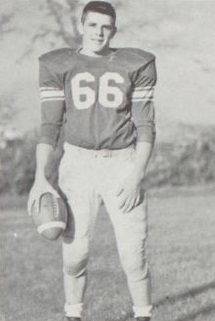
Yatchak’s team had included 13 returning lettermen including four regulars. Dick Koski, winner of 12 varsity letters at Wakefield, was much of the reason for the success. At season’s end, he was named to the Detroit Free Press’ Class C all-state team backfield. He netted 943 yards from scrimmage and finished as the third-highest scorer in the U.P. with 106 points. Teammate Jerry Bugni earned honorable mention recognition.
(Koski would go on to star at Northern Michigan College, then coach high school ball, guiding Ontonagon for three seasons and then Negaunee for 31 more. He retired following the 1999 season with a 211-113-1 record).
Despite the perfect mark, Wakefield finished the season ranked No. 7 in Class C-D by United Press International in its 1958 season-ending prep ratings. Charlevoix was the leading vote getter in the classification according to UPI’s panel of 21 top high school coaches. The Barber Trophy again went to Menominee. Wakefield, which finished second in the voting, was one of five undefeated U.P. teams that year.
A loss in the final 60 seconds of play, again to Ironwood, was the single flaw on the Cardinals’ 1959 slate. The team ended the year ranked 10th in the final UPI Class C-D rankings.
State Champs
Maki’s favorite, the 1960 squad, included 12 seniors. Ontonagon, winner of one game in 1959, dropped from the schedule, leaving Wakefield with only seven games as the season opened. About a dozen schools in Michigan and Wisconsin had been contacted in an effort to secure an opponent for the early October date. Despite Yatchak’s best efforts, he couldn’t find a replacement.
A Friday night blockbuster kicked off the season. At Longyear Field in Ironwood, a crowd of 3,000 lined the grounds on a warm, humid night for the rematch between the ’59 Michigan-Wisconsin Conference co-champs. Tied at 7-7 at the end of the first quarter, Wakefield opened a 21-7 lead as the teams headed to the locker room for halftime. Ironwood took the opening kick of the second half 11 yards to its 28, and then mounted a 10-play, 72-yard drive for a touchdown. A low kick kept the margin at eight. 21-13.
“Shortly after that the Red Devils were unable to capitalize on two golden opportunities to score following the recovery of Wakefield fumbles,” stated the Globe in its coverage the following day.
Ironwood snagged the first bobble on the Cardinals’ 32-yard line, but Wakefield held firm, allowing only seven yards on four plays: “Ironwood lost a certain touchdown when an end dropped a pass just a few steps from the goal line.”
The Red Devils grabbed the second fumble at the Wakefield 13, but the Cardinals’ unrelenting defense drove Ironwood back to the 17-yard line. An attempted field goal on fourth down sailed beneath the crossbar. From there, “neither team made a serious threat.”
For Wakefield, there were really no other major threats for the remainder of the season.
The Cards topped a strong Houghton 11 on a beautiful sunny Saturday by a score of 20-7 before a home crowd of 1,000. Again, an inopportune fumble by the hosts at their own 21 was snuffed out in four downs by the staunch Wakefield defense.
Next came conference victories over Bessemer, 40-0, Ashland, 20-6, and Hurley, 46-6. The win at Hurley was highlighted by a 50-yard interception return by Bob Orlich and an 81-yard kickoff return for a touchdown by Dewey Maki that opened the second half. Dave O’Leary, Hurley’s signal caller, picked up a Wakefield fumble and streaked 90 yards for the Midgets’ only points in the contest.
With the wins, the Cardinals secured the M-W championship and jumped from third place to first place in UPI’s weekly ratings, replacing Imlay City as the state’s top team in the Class C-D listings.
Despite continued efforts, no opponent could be found for the open date. When the team returned to action in mid-October, it squared off against Iron River. A 61-yard touchdown run by Tom Miheve on the second play of the game opened the scoring. Bob Erickson’s 31-yard TD dash followed. Then Dewey Maki “streaked 58 yards up the middle” in tallying the Redbirds’ third score. Miheve capped the scoring in the fourth quarter, whizzing 57-yards for his second TD as Wakefield grabbed a 27-0 road win before 2,500 at Nelson Field.
“Roman had the same personality traits as Coach Vince Lombardi of the Green Bay Packers. They were clones of one another,” said Russ Maki, describing the coach based on observation and conversations with former players in the years to come. “Yatchak was such a perfectionist. He’d have the players run a play, say an end sweep, over and over, six, seven times, maybe more, until it was perfect.”
The coach yelled and instructed and blew his whistle at afternoon practices audible to residents of the surrounding neighborhood.
“Mothers quickly learned to recognize signs to when practice was wrapping up, and the players were headed for the showers. It was time to cook the roast beef,” added Maki. “Their sons would be home in an hour.”
The season-ending contest with Calumet was a track meet, with the Cardinals steamrolling the Copper Kings 61-7 at Agassiz Field in Calumet on Friday, October 21.
According to the Globe:
 “Shifty Tom Miheve registered three markers, Bob Erickson, power-driving fullback added three more, followed by Dewey Maki, Bob Koski and Tom Neznanski each with a TD apiece. Bob Orlich added three extra points and Miheve, Erickson, Bob Smith and Pete Petramek each posted one.”
Still topping the UPI rankings after the game, now all Wakefield could do was wait for the rest of the state to finish the schedule.
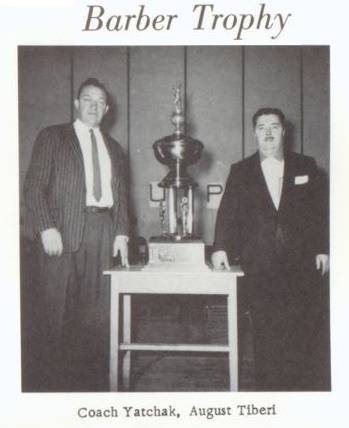
On Saturday, November 5, the Upper Peninsula Sportswriters Association gathered in Iron Mountain and awarded the Barber Trophy to Wakefield. The trophy was presented to Coach Yatchak and captain Bob Erickson at a special assembly at the high school on Monday.
The Cardinals had ranked No. 35 in Hal Schram’s Top 50 teams in the state, regardless of size, published in November in the Detroit Free Press. It was an impressive accomplishment for the little U.P. squad, especially when one considered 675 schools in Michigan sported prep football teams.
It would take until after Thanksgiving weekend – more than a month – before the UPI coaches panel would announce its final poll.
Word finally appeared in print in the SHORTS IN SPORTS column in the December 1 edition of the Wakefield News, which was published weekly.
“Congratulations this week go to: Wakefield Cardinal football team for being named top Class ‘C’ team in Michigan by United Press International.”
The city with a population of 3,231 celebrated its first (and only) mythical state football championship.
The annual Fourth of July parade included a red flatbed truck, adorned with an ornamental goal post and a large banner that read “State Class C Champs.” Four players, dressed in their uniforms, stood on the bed, carrying footballs.
Yatchak’s 1961 team extended the win streak to 14 games (and 25 wins in 26 dating back to 1957) with victories in its first two games before falling to Bessemer in a heartbreaker, 13-7. It would be the only loss of Wakefield’s seven-game season.
Following the 1961-62 school year, Yatchak departed Wakefield to help develop the athletic program at newly-opened Lansing Waverly High School. His Cardinals teams had posted 90 wins and two ties over his 15 years in charge, against only 25 losses.
Changing landscape
The coming years saw plenty of regular-season success, but no team would match the accomplishment of the 1960 squad. Mythical state titles, where state championships were determined by press polls and media input, were replaced in 1975 by MHSAA championships decided by postseason play.
“The Sunday Lake mine closed in 1961. They employed 225 guys. It was a big deal,” recalled Maki. Between the mine’s first shipment in 1885 and closing, Sunday Lake had raised an estimated 17 million tons of ore. Between 1960 and 1970, Wakefield’s population plunged by nearly 15 percent to 2,757. “A lot of people left for mining work elsewhere in Michigan, Wisconsin, Minnesota, Arizona.”
Maki himself made honorable mention all-state in 1970 as a senior when the Cards went 6-2 with losses to Hancock and Hurley.
“Dick Koski had a brother who was the same age as me. He was as good as Dick, maybe better. The Koski family left. There’s no doubt in my mind that we would have won some basketball state titles, maybe another Barber Trophy if they stayed. You just don’t know.”
The Gogebic area did see its fortunes improve, but the reprieve wouldn’t last.
“White Pine, a little town about 35 miles northeast of Wakefield, had a small copper mine. Digging deeper they found new veins of copper. All of sudden, they (needed workers). I remember five charter busses would line up near the football field each morning to take people to work there. That was happening all around the area.”
“Of the more than 3,000 workers at White Pine Copper Mine, less than 1,000 live here,” noted the Ironwood Daily Globe in September 1971. “Many workers commute great distances – some up to 90 miles each day.”
 However, uncertainty and layoffs began in 1975 and 1976. Employment dropped in half or more. In 1995, the mine shut down completely.
Wakefield’s 1991 football team was the first to qualify for the MHSAA postseason and won its opening-round contest with Central Lake before falling to Lake Linden-Hubbell in Class DD. The 1998 and 2000 teams also qualified.
Dropping student enrollment was impacting athletic programs at schools across upper and lower Michigan, including at Wakefield. Between 1985 and 2003, enrollment had fallen from 225 to 100. Following the 2003-04 school year, Wakefield consolidated with Marenisco, a district located 15 miles southeast. Still, for a variety of reasons, enrollment continued to drop. In 2009, Wakefield-Marenisco entered a co-op with Bessemer for football, and that fall, the Gogebic Miners were formed. Past rivals became teammates.
The rivalry with Hurley had been resurrected in 2000 and continued through the 2017 season. That school year, Ironwood joined the co-op, supplied the football schedule and its home field for the games.
In 2018, games were played at Bessemer. With enrollment now determined by combined school totals, the Wisconsin schools on the Gogebic schedule were replaced with games against Negaunee, Ishpeming Westwood and Iron Mountain, each with similar-sized enrollments.
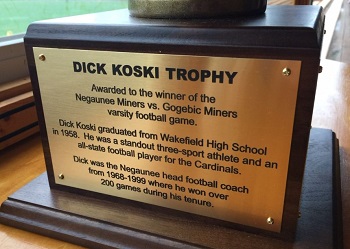
The Dick Koski Trophy, a new entry in the state’s collection of rivalry hardware, also was created in 2018. Awarded annually to the winner of the Negaunee-Gogebic game, it celebrates Koski’s connection to Wakefield and Negaunee.
This season, home contests are staged at Ironwood. In 2020, the games are scheduled to move to Wakefield.
Celebration
Maki hopes a lesson in history may help inspire future kids, so he’s been doing his homework.
“They have banners honoring conference champions,” he said.
If all goes as hoped, a new banner could be unfurled in time to celebrate the 60th anniversary of the 1960 championship.
“I am scheduled to speak at the next Wakefield school board meeting in late October to try to get this team some recognition such as a pennant to hang in the gym,” added Maki, also noting a desire for a public dedication, perhaps during Wakefield’s annual Independence Day celebration. “A lot of people come back to watch the fireworks.”
Now, wouldn’t that be a blast!
 Ron Pesch has taken an active role in researching the history of MHSAA events since 1985 and began writing for MHSAA Finals programs in 1986, adding additional features and "flashbacks" in 1992. He inherited the title of MHSAA historian from the late Dick Kishpaugh following the 1993-94 school year, and resides in Muskegon. Contact him at [email protected] with ideas for historical articles.
PHOTOS: (Top & 5) The 1960 Wakefield team is celebrated in the school’s yearbook for the 1960-61 school year. (2) An Ironwood Daily Globe advertisement announced a local store would guarantee a ham to every Wakefield player for a win over Hurley in 1929. (3) Roman Yatchak and Vernon Carr led Wakefield to its greatest football glories. (4) Dick Koski starred on the field for Wakefield before becoming a legendary coach. (6) Wakefield earned the Barber Trophy as the Upper Peninsula’s best team of 1960. (7) The Dick Koski Trophy is awarded annually to the winner of the Negaunee/Gogebic football game. (Photos gathered by Ron Pesch.)
Drive for Detroit: 11-Player Semis Preview
November 22, 2019
By Geoff Kimmerly
Second Half editor
The "Drive for Detroit" will take one last turn this weekend on the way to the final destination for 16 teams fortunate enough to finish this fall at Ford Field.
 This season's Semifinal field is a mix of teams that have made this trip plenty of times in the past – along with a few traveling this path for the first time, or the first time in a long while.
We're expecting great weather across most of the state, so find a seat in the bleachers and root on your favorite team. But if you’d rather watch from the comforts of home, this weekend we again will have all 16 Semifinals available, either on FOXSportsDetroit.com or MHSAA.tv. (Click for the full schedule.)
All games are 1 p.m. Saturday unless noted. “Drive for Detroit” is powered by MI Student Aid
Division 1
Belleville (12-0) vs. Brighton (10-2) at Howell High School
For the second straight season, Belleville is one more win from reaching the Finals for the first time. Junior quarterback Christian Dhue-Reid (2,706 yards/33 TDs passing) has led a return Semifinal march that’s seen the Tigers go unbeaten since falling in last year’s Semifinal to eventual champion Clinton Township Chippewa Valley. Brighton also is playing to reach its first championship game in this sport and also follows a dynamic quarterback in senior Colby Newburg (1,140 yards/17 TDs rushing, 1,319 yards/17 TDs passing).
Davison (10-2) vs. Sterling Heights Stevenson (8-4) at Troy Athens
The Cardinals are playing in their fifth Semifinal and for their first trip to a championship game. Davison is riding the arm of another quarterback getting a lot of attention – junior Brendan Sullivan has thrown for 2,635 yards and 31 touchdowns and run for eight more scores. Stevenson will be the third team from the vaunted Macomb Area Conference Red to see Davison this playoffs. The Titans are one of the state’s best comeback stories coming off three straight sub-.500 seasons. They have a number of versatile weapons, among them senior running back Nick Wingfield (1,018 yards/15 TDs rushing), as they seek their first Finals trip since 2009.
Division 2
Walled Lake Western (11-1) vs. Muskegon Mona Shores (10-2) at Okemos
The Warriors are a Week 3 three-point loss to Orchard Lake St. Mary’s from undefeated this fall as they seek their second trip to Ford Field in four seasons. Quarterback Zach Trainor (2,685 yards/32 TDs passing) to receiver Abdur-Rahmaan Yaseen (1,443 yards/18 TDs receiving) has been one of the state’s top scoring combinations. Mona Shores will need to slow Western down to return to Ford Field after finishing Division 2 runner-up a year ago. The Sailors will counter with an attack led by running back Tre Hatcher (1,257 yards/12 TDs rushing) and veteran quarterback Caden Broersma (406 yards/10 TDs rushing, 908 yards/11 TDs passing).
Detroit Martin Luther King (10-2) vs. Birmingham Seaholm (9-3) at Novi, 3 p.m.
Despite moving back to Division 2 after winning Division 3 a year ago, King will play in its fifth straight Semifinal and is riding a 10-game winning streak after early losses to Detroit Catholic Central and Muskegon. Freshman Dante Moore (2,240 yards/30 TDs) has more than fulfilled preseason media build-up, and senior Peny Boone (903 yards/15 touchdowns) is regarded as one of the top backs in the state. Seaholm is seeking its first championship game berth and playing its first Semifinal since 1997. Chaz Strecker has carried the load with 1,493 yards and 20 touchdowns for a Maples team approaching nearly 4,000 yards on the ground.
Division 3
Muskegon (12-0) vs. DeWitt (10-2) at East Kentwood
Muskegon has appeared on a mission since falling to King in last season’s Division 3 Final, and senior quarterback Cameron Martinez (1,735 yards/32 TDs rushing, 1,122 yards/10 TDs passing) again has led the charge. The only team to come within 20 points of the Big Reds this season was East Grand Rapids in Week 3, and Muskegon won the rematch last week 49-10. But DeWitt as a program has more experience at this level of the playoffs than most in the state, and the Panthers are coming off a 35-14 win over Edwardsburg that ended the reigning Division 4 champion’s winning streak at 25. The Panthers haven’t given up more than 15 points in a game since Week 5, and senior quarterback Andrew Schorfaar leads the team both in passing (1,458 yards/18 TDs) and rushing (1,058/14).
Chelsea (12-0) vs. River Rouge (11-1) at Dearborn
Chelsea has advanced to MHSAA Finals in both Divisions 3 and 4 over the last five years. The Bulldogs have won three games by seven points or fewer this playoffs to come within another victory of a second-straight trip to Ford Field after finishing Division 4 runners-up a year ago. A steady defense gives up just more than 12 points per game, while running back Brennan Van Riper (952 yards/13 TDs rushing) is among a number of offensive options. Rouge has won 11 straight since falling by three in its opener to Division 4 contender Grand Rapids Catholic Central and will play in its fourth Semifinal in five years. Running back Deandre Bulley (1,820 yards/20 TDs) has been tough to bring down at 6-foot-2, 245 pounds, and quarterback Mareyohn Hrabowski has reached 1,000 yards both rushing and passing. Meanwhile, the defense is giving up just 8.3 points per game.
Division 4
Grand Rapids Catholic Central (11-1) vs. Hudsonville Unity Christian (9-3) at Jenison
The Cougars are playing in their fourth-straight Semifinal and seeking their third championship game trip during this string after missing out last year with a two-point loss to Edwardsburg. GRCC is unbeaten in-state this fall, with its lone loss to a team from Illinois. Quarterback Joey Silveri drives the offense, throwing for 2,491 yards and 31 touchdowns and running for 704 yards and 13 scores. But Unity Christian has plenty of experience at this level too coming off last season’s Division 5 championship. Running back Malekhi Obande is averaging nearly 10 yards per carry (1,311 total, with 14 TDs rushing), and like GRCC the Crusaders won their first three playoff games all by at least three touchdowns.
Detroit Country Day (12-0) vs. Flint Powers Catholic (10-2) at Howell Parker Middle School
The Yellowjackets are playing in their fourth Semifinal in six seasons and advanced after handing Milan its only loss this season last week. The defense shined again, giving up just six points, which actually upped its average to 5.6 points given up per game. On the other side of the ball, running back Anthony Ammori (822 yards/14 TDs) leads a rushing attack that’s gained more than 2,200 yards. Powers’ defense during the regular season against much larger opponents in the Saginaw Valley League Blue didn’t stand out, but during the playoffs the Chargers have given up only 28 points over three games. Quarterback Luke Phillpotts has run and passed both for more than 700 yards to lead the team in both categories.
Division 5
Kingsley (12-0) vs. Lansing Catholic (11-1) at Greenville
Kingsley has won all of its games by double digits including in Week 7 against Division 6 semifinalist Maple City Glen Lake, and eliminated unbeaten Muskegon Oakridge in a 17-point win two weeks ago. Running backs Ayden Mullin (1,451 yards/21 TDs rushing) and Owen Graves (713 yards/12 TDs) are both averaging more than nine yards per carry as the team works toward making the Finals for the first time since 2005. But Lansing Catholic, now free of rival Portland after falling to the Raiders the last two District Finals, is aiming for its first Ford Field trip since 2014 with its most productive offense since that season. Quarterback Zach Gillespie has thrown for 2,247 yards and 24 touchdowns and run for another 18 scores.
Almont (12-0) vs. Detroit Denby (10-2) at Walled Lake Central
The Raiders have put together a 22-1 run over the last two seasons as they seek their first trip to the Finals. Almont long has been known for defense, and this year’s unit is giving up just 10 points per game. But the offense has reached 500 points for the first time since 2014 with four rushers gaining at least 500 yards and quarterback Josh Hellebuyck providing a nice complement with 1,194 yards and 22 TDs through the air. Denby also is seeking its first Finals berth, while playing in its first Semifinal, and has lost this season to only King, twice. The Tars have given up only 97 points this season – and subtract the King losses, they are allowing only 3.8 points per game.
Division 6
Maple City Glen Lake (11-1) vs. Montague (10-2) at Clare
Glen Lake’s only defeat this season was to Kingsley, as noted above, and the Lakers are seeking their second trip to Ford Field in four years. After dominating most of the regular season, Glen Lake has won close the last three weeks – with that experience possibly paying off in what’s sure to be a challenging matchup with last season’s Division 6 runner-up. Quarterback Reece Hazelton towers over most defenders at 6-6 and has thrown for 1,012 yards and 14 touchdowns, with Jonathan Wright adding 1,112 yards and 17 scores on the ground for the Lakers. Montague quarterback Drew Collins started during last season’s run and is starring with 2,354 yards and 27 TDs passing and 663 yards and 14 scores rushing.
Monroe St. Mary Catholic Central (10-1) vs. Onsted (10-2) at Ypsilanti Lincoln
The Falcons opened this decade with three Semifinal appearances over the first five years, and will close with one more thanks in part to a defense that hasn’t given up more than 16 points since Week 3. St. Mary also has scored its most points since its championship season of 2014 despite playing one fewer game so far than the last two years (because of an open date). Alex Morgan leads that effort with 1,571 yards and 16 touchdowns rushing. Onsted has made its first Semifinal since 1993 by avenging losses to Blissfield and formerly-undefeated Hillsdale during the playoffs. The Wildcats finished only 3-6 a year ago but have rebounded in part because of a ground attack featuring two 1,000-yard rushers, Travis Hill (1,312 yards/14 TDs) and Rourke Barth (1,025/16).
Division 7
Iron Mountain (12-0) vs. Pewamo-Westphalia (12-0) at the Superior Dome, 7 p.m. Friday
Pewamo-Westphalia will see its second-straight undefeated opponent after handing the first and only loss of the season last week to reigning champion New Lothrop. Iron Mountain won a league that sent four teams total to the playoffs and also has won all of its playoff games by at least two scores. Caleb Evosivich-Hynes is the team’s leading rusher (1,289 yards/12 TDs) and receiver (435/8), catching passes from quarterback and also basketball standout Marcus Johnson (1,037 yards/14 TDs passing). The Pirates got up big on New Lothrop before holding off the Hornets down the stretch to win by a point 36-35, but otherwise P-W has locked down all of its opponents, giving up only 56 points on the season. Expect to see the ball often in running back Tanner Wirth’s hands, as he has run for nearly 10 yards per carry and 1,499 and 24 touchdowns overall.
Jackson Lumen Christi (11-0) vs. Cass City (11-1) at Novi, 11 a.m.
The Titans have won 24 straight games and the last three Division 6 championships, and they impressed in a major test last week holding off Schoolcraft 35-30. It’s hardly a surprise that Lumen Christi runs the ball well – the latest in its string of star runners is Walker Plate, who has rushed for 2,279 yards and 31 touchdowns. Cass City is playing in its first Semifinal boasting a defense that has given up only 52 points all year – and just two over three playoff games. The Red Hawks have given up more than eight points only once, in a two-point opening-night loss to Montrose.
Division 8
Beal City (11-1) vs. Ubly (10-2) at Mount Pleasant
Both of these teams have reached the Semifinals previously this decade, Beal City most recently in 2014 and Ubly in 2016. Both also bounced back from late losses this time to make their runs – Beal City against McBain and Ubly to Cass City (see Division 7 above). Beal City has gained more than 3,200 yards this season showing impressive balance with no one rushing for more than 750 or throwing for more than 450. Ubly has four backs with at least 600 yards rushing, but the main ball carrier for an offense with nearly 4,300 yards total is Carson Heleski (1,447 yards/19 TDs rushing).
Reading (11-1) vs. Fowler (11-1) at Battle Creek Harper Creek
There are a lot of similarities in how these two small-school powers conduct business on the field. Fowler, in its first Semifinal since reaching the Division 8 championship game in 2011, has for decades been known for its powerful running. This season that’s come in the forms of Kyle Snyder (1,481 yards/21 TDs rushing) and Caiden Pung (1,222 yards/21 TDs). Reading rode the same to last season’s Division 8 title and is back in the hunt led by Hunter Midtgard (1,212 yards/15 TDs) among others running behind 6-3, 307-pound Nick Affholter. The key may be who stops whom; the Rangers have given up only 79 points, and the Eagles only 137.
Second Half’s weekly “Drive for Detroit” previews are powered by MI Student Aid, a part of the Office of Postsecondary Financial Planning located within the Michigan Department of Treasury. MI Student Aid encourages students to pursue postsecondary education by providing access to student financial resources and information. MI Student Aid administers the state’s 529 college savings programs (MET/MESP), as well as scholarship and grant programs that help make college Accessible, Affordable and Attainable for you. Connect with MI Student Aid at www.michigan.gov/mistudentaid and find more information on Facebook and Twitter @mistudentaid.
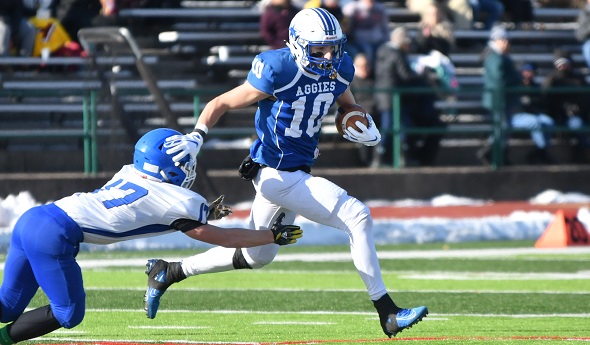
PHOTO: Beal City's Logan Chilman (10) breaks away from an Ishpeming's Dawson Delongchamp during last weekend's Division 8 Regional Final win. (Photo by Cara Kamps.)