

Memories Don't Fade for 1st MHSAA Class A Champion Franklin
By
Brad Emons
Special for MHSAA.com
November 8, 2024
Even after 50 years, Tim Hollandsworth recalls Livonia Franklin’s run to the first MHSAA Class A football playoff championship like it was yesterday.
Before 5,506 fans at Western Michigan University’s Waldo Stadium, the unranked Patriots capped a season for the ages by upending heavily favored Traverse City for the 1975 title, 21-7.
“It was a once in a lifetime event, and I guess it just brings back great feelings winning that game obviously,” said Hollandsworth, who went on to become an all-Mid-American Conference linebacker at Central Michigan. “What I remember most was carrying that trophy around on the field. Myself, Jim Casey and the whole team ... we paraded it out Stanley Cup-style in front of our fans, and everybody was going crazy. Just a happy time.”
The championship game was played on a frigid Nov. 22 afternoon in Kalamazoo, just 12 years following the assassination of President John F. Kennedy.
“When I think about that game, the first thing that comes to mind is that it was a cold, cloudy day before the game,” Hollandsworth said. “And as the game started, the sun came out; it was really bright. It turned out to be a bright, sunny day, and we didn’t feel the cold at all. The adrenalin was pumping.”
No. 2-ranked Traverse City, coached by Jim Ooley, entered with a high-powered offense averaging 34 points per game. The Trojans featured the running back tandem of Rick Waters (1,300 yards) and Bruce McLachlan, along with tight end Mark Brammer, a two-time All-American at Michigan State who later played five seasons for the Buffalo Bills in the NFL.
Franklin took a 7-0 lead in the first quarter when Dennis Smith, the holder on a 30-yard field goal attempt by Sam Williams, couldn’t secure the snap from center but alertly got up and tossed a 17-yard TD pass to Rick Lee.
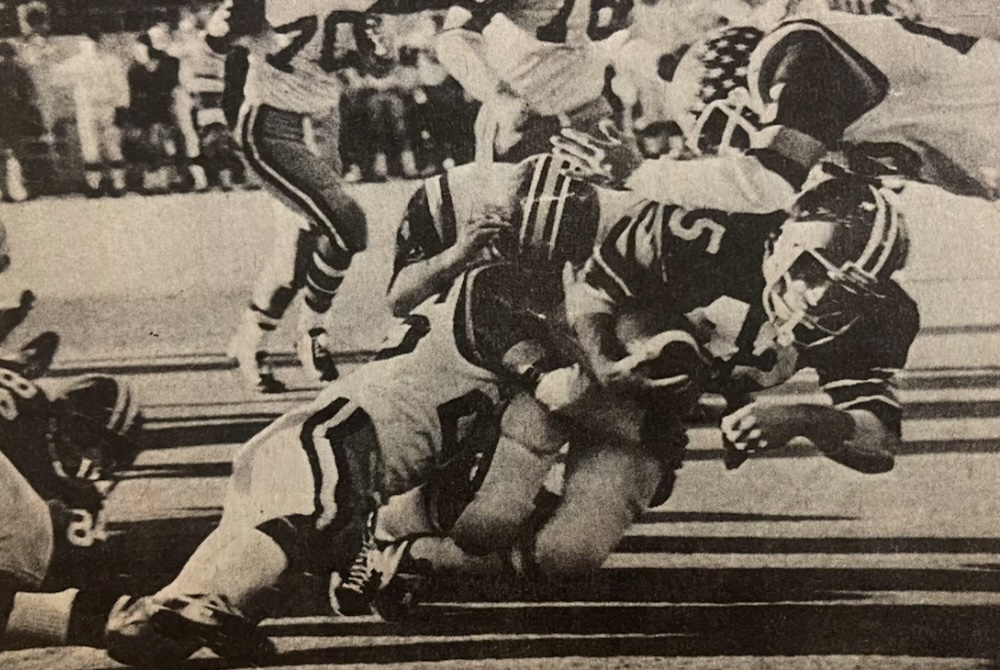
The Patriots then went up 14-0 in the second quarter on a 3-yard TD run by Casey, who went on to play four seasons at Ball State as a defensive back.
Traverse City cut the deficit to 14-7 before halftime on a 2-yard TD run by McLachlan, but the Patriots put it away in the final quarter on a 9-yard TD run by Casey, who finished the game with a hard-earned 105 yards on 24 carries.
Hollandsworth, who also starred in the backfield with Casey, severely twisted his ankle in the first half and was limited to playing only defense for the remainder of the game. Fortunately for Franklin, Tom Smith took his place and helped continue the offensive surge.
 “It was just the fact that everybody was just stepping up when they had to have them,” Casey said. “I think it kind of exemplified everything we did throughout the year to get there. That’s what was so cool about the whole deal.”
Meanwhile, Waters – who later became Hollandsworth’s friend and teammate at CMU – led the Trojans’ rushing attack with 85 yards rushing on 19 carries.
Franklin’s defense played a pivotal role in the win with four interceptions – one each by Hollandsworth, Chuck Hench, Jerry Pollard and Casey (his 10th of the season).
Williams, the Patriots’ star tight end and middle linebacker and the son of former Detroit Lions “Fearsome Foursome” defensive end Sam Williams Sr., also batted down a key fourth-down pass in the end zone to thwart a Traverse City scoring threat.
“It’s funny about the whole game ... you forget about the details, it’s crazy,” Casey said. “It was everybody coming together. There may have been some mistakes along the way. That just happens during the game and we hung in there, did what it took to score enough points to win.”
The game was played on artificial turf, not real grass, which was also a first for both teams.
“I think it had been raining the day before ... anyhow, the field was soaked,” Casey said. “And all it takes is to fall on a field that is soaked on an Astroturf field and everything, and all your clothes are soaked. I remember in the first half – I couldn’t wait for halftime to go inside and warm up.”
During the practice week prior to the title game, the Patriots were able to get acclimated when athletic director and assistant coach George Lovich made a deal to practice on the University of Michigan’s artificial surface.
“We had to get new shoes because nobody had played on artificial turf in high school back then,” Casey said. “They had a bunch of used shoes from the (U-M) team. They threw them in a big old box and they let us practice one night on their Astroturf. We went in and got our shoes and we were ready to play – excited about that. It was just different compared to regular grass. It felt super-fast.”
With only four spots per Class up for grabs in the inaugural MHSAA playoffs, five unbeaten Class A teams did not make the postseason including Warren Fitzgerald and Mount Clemens Chippewa Valley from Region 1, Trenton in Region 3, and Grand Rapids Union and Marquette from Region 4.
On the final Saturday of the regular season at Eastern Michigan’s Rynearson Stadium, No. 1-ranked Birmingham Brother Rice (Region 2) was upset in the Catholic League championship, 7-0, by Dearborn Divine Child, which went on to claim the Class B title.
That allowed the 8-1 Patriots, who had lost to rival Livonia Stevenson 13-9 in Week 2, to sneak into the playoffs just ahead of the previously-unbeaten Warriors.
“We were all in the stands watching that game,” Hollandsworth said. “And our coach, Armand Vigna, had all our points figured out right to the point where he said if Brother Rice were to lose, we were in. So, we’re sitting in the stands and Detroit Southwestern is off to our right a little bit higher in the stands. When Divine Child won that game, we were just going crazy and you could see Southwestern wondering who we were and what was going on.”
During the build-up to the Class A Semifinal game against Franklin, Southwestern coach Joe Hoskins was quoted in the Detroit newspapers as saying, “Livonia who?”
Southwestern was led by all-state QB Mike Marshall (MSU), along with junior tackle Luis Sharpe (UCLA), an eventual first-round NFL pick who played 13 seasons with the St. Louis, Phoenix and Arizona Cardinals.
And in that Semifinal at Pontiac’s Wisner Stadium before 5,000 fans, Franklin upended the No. 3-ranked Prospectors, 12-9, as Casey ran for 145 yards on 27 carries. Hollandsworth added a 1-yard TD to cap a nine-play, 72-yard drive and give his team the lead 9-7 at the half.
Southwestern got an 18-yard TD pass from Marshall to Andrew Williams and scored on a two-point safety when the Patriots fumbled the kickoff to start the second half.
Williams, however, booted a pair of field goals, including the game-winning 28-yarder to break a 9-9 deadlock for the Patriots after they were aided by a pass interference call followed by an unsportsmanlike conduct penalty, which took the ball to the Southwestern 18.
In protest, Hoskins took his team off the field and had to be coaxed by MHSAA officials to bring his players back to finish the game.
“I think we were excited about the playoffs because we were undefeated the year before, so were looking forward to getting into the playoffs,” Hollandsworth said. “It was deflating when we lost; it was low-scoring, tough battle versus Stevenson. All the Livonia games (vs. Churchill and Bentley) were tough battles. It was the first game that Sam Williams was out. He got hurt in the (Dearborn) Fordson game before that (the opener) and Sam was not only our tight end, and starting middle linebacker, but he was also our punter and kicker. I think we passed up some field goals in that Stevenson game because we were so unsure of our kicking game.”
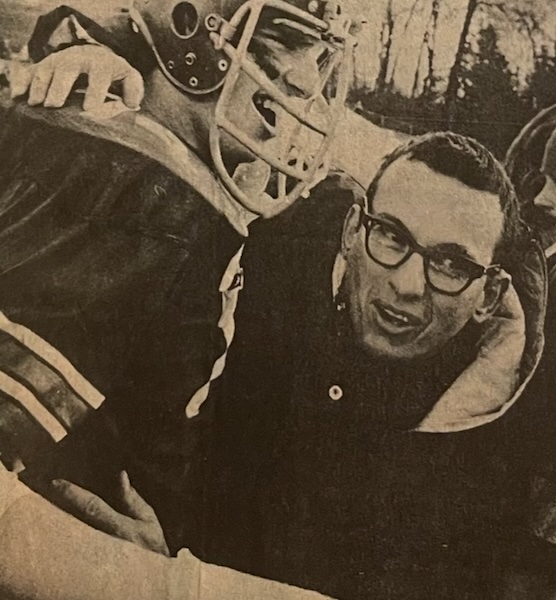
PHOTOS (Top) Livonia Franklin’s Jim Casey (45) plows ahead during the 1975 Class A Final as Traverse City tacklers converge. (Middle) Franklin coach Armand Vigna, right, shares an embrace with lineman Rick Kruger in the moments after their team’s championship victory. (Photos courtesy of Hometown Life, which includes the former Livonia Observer).
Grisdale to be Honored for 40 Seasons on Call for Cheboygan Football
By
Tom Spencer
Special for MHSAA.com
September 13, 2024
When Jason Friday was in high school, there were two types of football fans in Cheboygan.
 Folks either went to watch the Cheboygan Chiefs play under the lights, or they listened to the game on the radio called by play-by-play announcer Mike Grisdale.
Well, not much has changed. Friday, a 1992 Cheboygan grad, is now the school’s athletic director. And Grisdale is in the middle of his 40th season on the air.
What is changing tonight, though, is Cheboygan will officially dedicate the stadium press box to Grisdale in a special pregame ceremony before the Chiefs (1-1) take on Elk Rapids (1-1).
Former Cheboygan coaches, Grisdale’s family and people who have worked with him on the radio over the years will be on hand for the ceremony.
“We were able to get Dan Miller, George Blaha, Ken Kal and Dan Dickerson — radio broadcasters for all four Detroit sports — to record statements that we will play over the public address system,” said Friday. “Mike will be presented a smaller version of the plaque that we will be hanging in the press box, and he will have a chance to talk.”
Naming the press box after Grisdale has been in the works for more than a year, Friday noted. Grisdale first learned of the plan when he was interviewing Friday during halftime of a football game last year.
“Jason surprised me on the air,” Grisdale recalled. “I was shocked, but honored and thankful.”
 Grisdale, a 1979 Cheboygan grad, is humbled noting there are so many people who contribute to the radio broadcasts and football program. He remembers listening with his father to Jorden James and Bob Martin call Chiefs games when some of the older kids from the neighborhood were playing high school football.
“I have just been so fortunate to do it for this long and have become the go-to guy for historical information and perspective,” Grisdale said.
Grisdale, who has also done nearly 1,000 Chiefs basketball games on the air, along with some hockey and soccer, said his interest in sports goes back to his childhood.
Grisdale grew up in Cheboygan with three brothers in a neighborhood full of kids. Sports were a big part of their lives — collecting baseball cards, listening to the Detroit Tigers on the radio, and playing basketball, kickball and wiffle ball.
Grisdale, who also hosts a Saturday morning radio show from a local restaurant called “Coaches Corner,” vividly recalls trying to keep a scorebook while listening to high school basketball games on WCBY radio and dreaming of becoming the next Blaha, or Ernie Harrell, Bob Ufer, or Bruce Martin - four legendary broadcasters of Michigan professional and college sports.
While at Central Michigan University earning a broadcasting degree, Grisdale got extensive of on-air experience on student stations. He worked on Cheboygan radio stations during summers.
Some of his fondest memories of Chiefs broadcasts have come from the locations where they’ve played.
“I have enjoyed having the opportunity to cover games at places like the Pontiac Silverdome, Palace of Auburn Hills, Crisler Arena and the Breslin Center,” Grisdale said. “You remember the exciting moments and big games”
 The 40 years on the air, along with earlier turns covering Marshall and Albion football and basketball games, are really just a blur to the highly-revered radio personality.
“The seasons just seemed to run together,” Grisdale said. “There were many, many times when the weather and the long road trips took their toll.”
Grisdale played football at Cheboygan High School and was an offensive end and a defensive safety on a 9-0 squad his senior year in 1978. He caught three touchdown passes that season. He also held for extra points, collecting snaps from his brother Mark, the Chiefs’ long-snapper.
Mike Grisdale doesn’t hesitate to point out the best player he covered was fullback Shannon Scarborough from the 1991 team that reached the Silverdome – “The all-stater was strong and fast and played both ways,” he noted. But Grisdale has loved all the players and teams over the years. “I do it because I enjoy promoting the kids, keeping the traditions alive, seeing the community come together, good sportsmanship, and being part of a team.”
Friday, who also has broadcast multiple games alongside Grisdale over the years, has enjoyed Grisdale’s efforts to promote every player.
“Kids always love to hear their name on the radio,” Friday said. “What I think he does better than anyone is to make sure the offensive and defensive linemen are consistently mentioned — those boys in the trenches often get overlooked, but not with Mike on the call.”
When Cheboygan installed NFHS Network cameras, the athletic department sought to successfully connect Grisdale’s radio broadcast through the video feed.
“That has been a huge bonus and something that many community members have told me they appreciate,” Friday said.
Grisdale, who also works part-time for Black Diamond Broadcasting in its Cheboygan studios and serves Mackinaw Health System based in St. Ignace as its marketing director, has no plans to end his broadcasting career.
“As long as our local radio station can keep the tradition alive and I am still around, it would be my privilege to keep it going,” Grisdale said.
Cheboygan High School games are carried on WCBY (Cheboygan) 1240 AM, 100.7 FM and 98.1 FM, and streaming at BigCountryGold.com.
 Tom Spencer is a longtime MHSAA-registered basketball and soccer official, and former softball and baseball official, and he also has coached in the northern Lower Peninsula area. He previously has written for the Saginaw News, Bay County Sports Page and Midland Daily News. He can be reached at [email protected] with story ideas for Manistee, Wexford, Missaukee, Roscommon, Ogemaw, Iosco, Alcona, Oscoda, Crawford, Kalkaska, Grand Traverse, Benzie, Leelanau, Antrim, Otsego, Montmorency, Alpena, Presque Isle, Cheboygan, Charlevoix and Emmet counties.
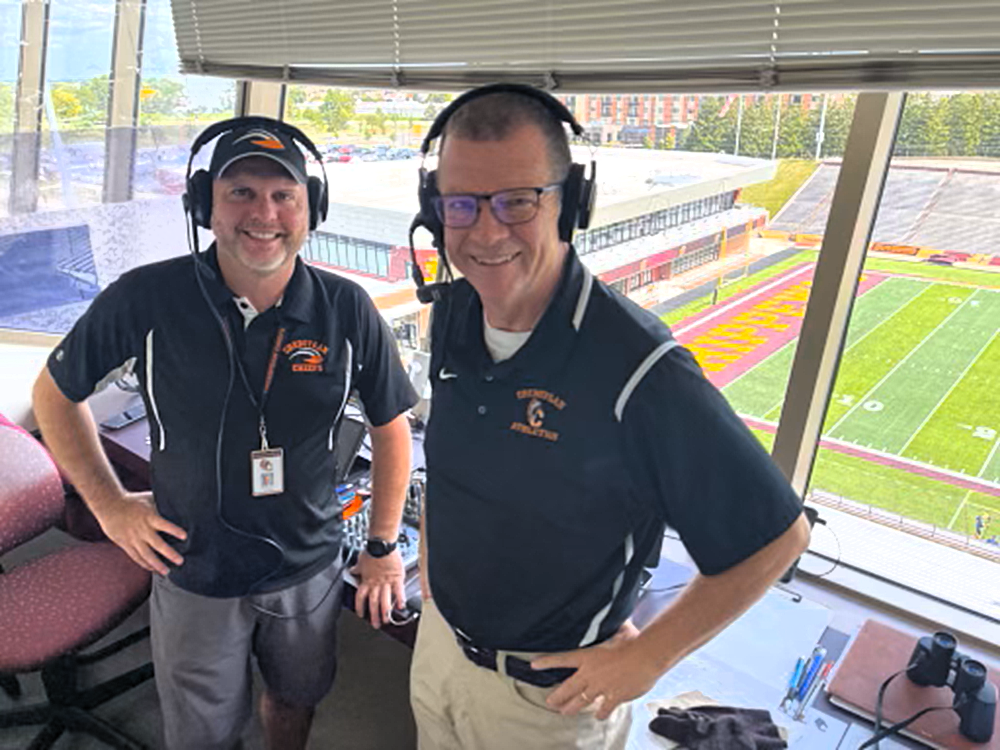
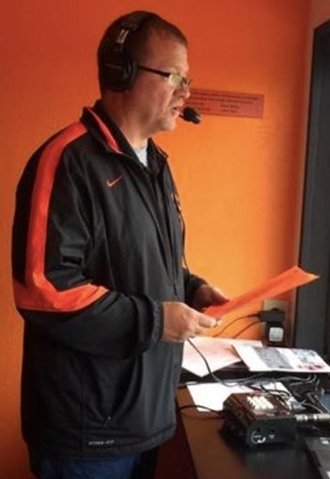
PHOTOS (Top) Mike Grisdale, right, and partner Nate King broadcast a Cheboygan game from Central Michigan University. (Middle) The Cheboygan stadium press box will be dedicated to the longtime broadcaster. (Below) Grisdale is on the call for another Chiefs game. (Photos provided by Grisdale and the Cheboygan athletic department.)