

Memphis Tastes Victory, Plays for More
By
Paul Costanzo
Special for MHSAA.com
September 12, 2018
Winning was such an unfamiliar feeling for the Memphis varsity football team that when the Yellowjackets picked up a victory in Week 1, coach Pat Connell had to give some of his players a push when it came to enjoying it.
 “We call (the victory formation), they take a knee and nobody knows what to do,” Connell said. “The kids on the field are starting to celebrate, and I looked at the kids behind me and said, ‘Hey, this is when you celebrate.’”
Memphis’ 14-12 win against Burton Bentley on Aug. 23 snapped a 26-game losing streak for the Yellowjackets, who hadn’t been victorious since Week 1 of the 2015 season. It was a cathartic moment for the players, coaching staff, school and community – one that won’t soon be forgotten.
“Honestly, I’d say it was the best feeling I’ve ever felt on that field,” senior wingback and defensive tackle Cole Myers said. “My entire time playing football at my school, we hadn’t gotten a win in the last two to three years. It felt like the turning point of our program.”
One win was great, and something Memphis desperately needed. But while everyone involved in the Memphis program knows things are looking up, they also know there is plenty of work still to be done to turn things completely around. That was evident in 44-0 and 42-0 losses to Ubly and Brown City, respectively, in the following weeks.
But it’s work the coaches and players are now willing to put in.
“I enjoyed it; it was nice to have my first Memphis football win,” senior quarterback and safety Cale Shivers said. “I’ve played football my whole life and been on winning teams my whole life, so I know that if we want to win more games, we have to keep working.”
When Connell and his staff took over, Memphis had just finished its first 0-9 season in 2016, which came on the heels of back-to-back 1-8 seasons.
During those struggles, numbers had gotten so low for the Yellowjackets that there were talks of prematurely ending a season -- not to end the losing, but to keep kids safe.
To build the program, Connell first needed players, and to get players, he needed to be recruiting in the hallways. Unfortunately for him, he teaches at Port Huron Northern, a good 30-minute drive from Memphis, as does his assistant Casey Kucsera. Assistant coach Pete Fox teaches at St. Clair, which is closer, but clearly not in the building.
“That first year when we took over in April or May, we were trying to get any kids, but it was a slow process,” Connell said. “We were taking personal days to set up in the school to go meet kids.”
The idea of simply playing a junior varsity schedule was brought up, but Connell said that if there was just one senior who wanted to play, the Yellowjackets would play as a varsity team so that player could have that experience. They wound up with 10, and while it was another 0-9 season, that fall was a building block.
“That first year was just about making it fun,” Connell said. “It isn’t us coming in to yell and scream at you; we want you to come out and enjoy football. It was opening the weight room, and sometimes kids would stumble in, and we were developing that trust. Then the word started getting out.”
 When comparing 0-9 seasons, it can be hard to find tangible improvement. But Memphis scored more points (60-39) and allowed fewer (427-538) while playing a similar schedule in 2017.
Most importantly, though, the players were noticing that things were different.
“Kids didn’t really see the progression until other coaches and players from teams were saying, ‘Even though you guys lost, we can tell you really look like a football team now,’’ Shivers said. “And we were hearing from the public that we actually looked good out there.”
Despite not winning a game, Memphis did pick up some momentum.
“When I first got out to Memphis, I would ask kids, ‘Are you interested in playing football?’ and it was, ‘I don’t know, maybe,’” said Connell, who is up to 28 players on his roster. “This offseason, it was, ‘Are you playing,’ and they were like, ‘Yes sir, I’m playing.’ We had like 20 kids who were all in on football. Now, that didn’t mean that they realized they had to be there three days a week in the winter lifting, but they were excited.”
The excitement grew after the opening win against Burton Bentley, a game that was filled with drama. After Memphis took a 14-12 lead on Shivers’ second touchdown pass of the evening and his ensuing 2-point conversion run, it had a chance to ice the game by running out the clock with a few first downs. Before that could happen, however, the lights -- which were set on a timer -- went out in the stadium.
When they came back on about 20 minutes later, Burton Bentley forced a Memphis punt to give itself one more chance.
Fortunately for the Yellowjackets, that drive ended with a turnover, and Memphis was able to run a play out of the victory formation for the first time in three years.
“I wouldn’t even call it remembering how to win,” Myers said. “Because I’ve never been on a winning team for football. It was something new.”
The feeling, Myers said, made him want to win more. And while Weeks 2 and 3 were a return to Earth for the Yellowjackets, those defeats haven’t dampened their spirits or their outlook. Connell knows there is still plenty of work to be done in the weight room and on the field to have his team competing with its Greater Thumb Conference East opponents.
But his players believe in what he and his staff are doing, and they are now starting to believe in themselves.
“It might take a couple more wins before people (in the school) start realizing this is a different program from past years,” Myers said. “(A successful season would be) to put in everything that we possibly can and have more wins than losses at this point. I would say five to six wins would be what I would hope out of this season.”
 Paul Costanzo served as a sportswriter at The Port Huron Times Herald from 2006-15, including three years as lead sportswriter, and prior to that as sports editor at the Hillsdale Daily News from 2005-06. He can be reached at [email protected] with story ideas for Genesee, Lapeer, St. Clair, Sanilac, Huron, Tuscola, Saginaw, Bay, Arenac, Midland and Gladwin counties.
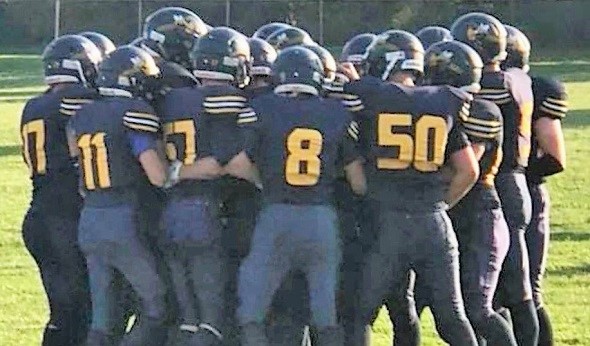
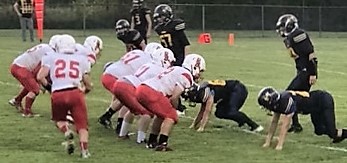
PHOTOS: (Top) Memphis players huddle up before a game this season. (Middle) The Yellowjackets defense held Burton Bentley to 12 points. (Photos courtesy of the Memphis football program.)

Friday Night Football
September 23, 2016
There continues to be among high school athletic administrators a great gnashing of teeth over encroachment of televised college football on the Friday night turf that long tradition reserves for high school football games. Little by little and year by year, college games drift to all times of the day and all days of the week, and Friday night is no longer hallowed ground for the high school game alone.
The Friday night intercollegiate fare remains mostly irrelevant games by second tier teams, but televised nonetheless because of the overabundance of production entities and networks seeking live sports events. But high school leadership is right to be on guard.
Known to very few people is a million dollar offer in the 1970s by then NCAA Executive Director Walter Byers to the National Federation of State High School Associations if it would not oppose televised college football games on Friday nights. Clifford Fagan, then executive director of the National Federation, declined the offer from his good friend; and the mutual respect these two men enjoyed brought an end to the negotiation.
Then, as now, the National Football League was prohibited by law (part of its anti-trust exception) from televising games on Friday nights and Saturdays from mid-September through mid-December where the broadcast would conflict with a live high school or college game. Under Byers, and until the NCAA lost control of intercollegiate football broadcasting as a result of a legal challenge by what was then called the College Football Association, college football leadership voluntarily gave high school football the same deference on Friday nights that the NFL did under federal law.
Today, major college football is such a ravenous revenue beast that it will schedule play at any time on any day in any location, televising every game – on college conference-controlled networks if the matchup is not attractive enough for national or even regional broadcasts. The Friday night high school football tradition can expect to be trampled as college football swarms and grunts around the feed trough like hungry hogs.