

Menominee Follows Winning Formula
October 29, 2015
By Dennis Grall
Special for Second Half
MENOMINEE – Explaining the continued success of football at Menominee High School is not difficult.
"Football is just work. The kids are willing to work," fourth-year coach Joe Noha said of a simple explanation of a premier program for decades.
 The Maroons (9-0) host Grayling (6-3) Friday at venerable Walton Blesch Stadium in a Division 5 opener. Noha, a former Menomninee player and assistant coach under legendary head coach Ken Hofer, is 45-4 since taking over the program.
Menominee was Division 5 runner-up under Noha in 2013 and reached the MHSAA Semifinals the other two seasons. Under Hofer, with Noha as the top assistant, the Maroons won Division 5 titles in 2006 and 2007 and Class BB in 1998.
There is more to this amazing success than simply hard work, something every successful program can also claim.
"We try to put our guys in the best position to have success," Noha said. "We can do a lot of different things."
Again, all successful teams can make that claim.
The Maroons also can point to stability in the coaching staff. Hofer, who retired after the 2011 season, is the all-time leader in victories among Upper Peninsula coaches with a 313-141-2 record. Noha, who graduated from Menominee in 1983 and then played football at Saginaw Valley State University, joined Hofer's staff in 1994.
Assistants like Ron "Satch" Englund, Jamie Schomer, Dave Mathieu, Nathan Linsmeier, Lucas Chouinard, Tyler Uecke, Bill Schwanz and Mark Klapp have also been part of the program for many years, providing stability to that success. Many of them also played for Hofer.
"After every practice we evaluate and look at ways to get better," said Noha, mentioning something else that of course is done across the sports universe.
Noha noted successful operations, referring to Fortune 500 companies, as he said, "everyone has core values. We put kids first, teach them hard work and responsibility (and discipline). Our teaching staff, our community; it is all part of what we do. We always have a support staff to lean on. Our kids know that. They know what the Menominee standard looks like."
He also pointed out, "There is a lot of pride there. We talk about giving back to what was given to you."
 Noha also notes a "family mantra" in Menominee. "There is definitely family here, there is definitely community support here, the school supports us. There is not a lot of turnover here. We stick together, we work well together. A lot of people maintain the standard.
"A lot of people have a vested interest."
Again, nothing different from other successful programs.
But here's what is different: The Menominee Maroons do all of those things, and most importantly, perhaps, is it has been like that for nearly half a century.
One other explanation could also be how the Maroons operate on the gridiron. They are one of the very few remaining teams who use a single-wing offense, which makes it difficult for potential playoff opponents to prepare for since it is tough to emulate in practice.
Familiar Upper Peninsula opponents such as Escanaba, Kingsford, Gladstone and Marquette get to see the single-wing every year, as well as at the freshmen and jayvee levels. Grand Rapids West Catholic, which beat the Maroons in the 2013 title game and the 2012 semis, also has a good idea of the single-wing intricacies.
"West Catholic has beaten us because they were better," admitted Noha. "Trying to replicate it in practice is very difficult. You have to execute. It comes down to putting kids in good spots."
The Maroons have obviously modified the single-wing through the years, from fullback spinners to jump passes to bubble screens and fly patterns for receivers. "We can spread it out and we can pound it, but the single-wing concepts are still there,” Noha added.
"Everybody puts their tweaks on everything. If you are defending us, you better know the top three plays in our formations. Everyone's film is your DNA, your template. It is not brain surgery by any means."
It still comes down to other areas. "You have to have the kids, the coaches, and the kids have to be resilient," Noha said. "You can have any system you want."
Talent also comes in handy, and the Maroons again are blessed in that department. Led by quarterback/running back Nathan Nowack, the Maroons fill six defensive positions and five offensive positions on the Great Northern Conference all-star team this fall.
Nowack, who scored seven touchdowns against Gladstone this year, is the GNC's offensive player of the year, and lineman Adam Beyersdorf is the GNC's defensive player of the year.
Noha said changes have been made throughout the 35 years he has been associated with the program, some mandated by the MHSAA such as the reduction of contact in practice and the emphasis on concussions.
"The practices and the schemes stay the same. We look at nutrition more and we don't hit nearly as much as we used to," said Noha, who also indicated weight training has been emphasized much more since he was a player.
 "The kids are bigger, stronger, faster and more physically fit. The game is faster, the kids are more skilled and get out in space more," Noha said.
While the Maroons usually boast good size in the line, Noha said the Maroons look more at body composition and how it best suits the players and positions. Many of the players go around the 180-190 pound area and are well-conditioned, solid athletes, he said.
Noha noted the first three playoff games are usually held outdoors, and then the Maroons usually play in the Superior Dome at Northern Michigan University and then hit Ford Field if they reach the title game. He said heavier kids may wilt under the indoor conditions. "We want kids that can run and move," he said.
Menominee's future may look even brighter. After not having a freshmen football team the past four years, Noha said that level will resume in 2016 as 30 freshmen players are anticipated. There were 22 freshmen on the 2015 junior varsity team.
Football is played to be fun for the Maroons, and it is always more fun when you can enjoy success like the Maroons experience. What it all comes down to in Menominee, Noha said, is "the scoreboard never defines us. We try to use football to get us to a better place."
 Denny Grall retired in 2012 after 39 years at the Escanaba Daily Press and four at the Green Bay Press-Gazette, plus 15 months for WLST radio in Escanaba; he served as the Daily Press sports editor from 1970-80 and again from 1984-2012. Grall was inducted into the Upper Peninsula Sports Hall of Fame in 2002 and serves as its executive secretary. E-mail him at [email protected] with story ideas for the Upper Peninsula.
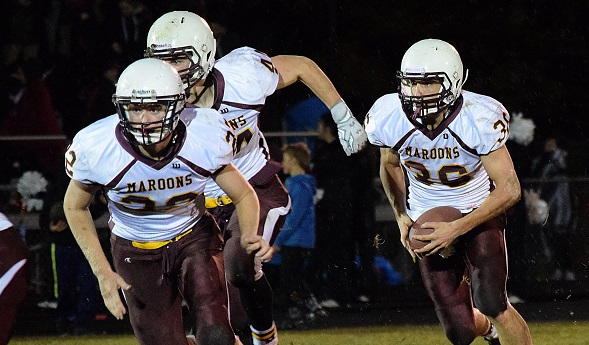
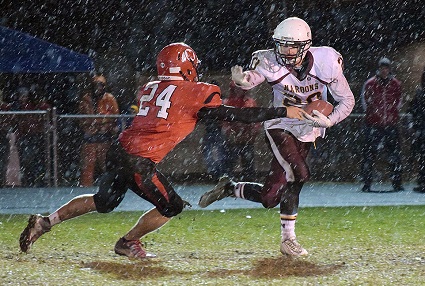
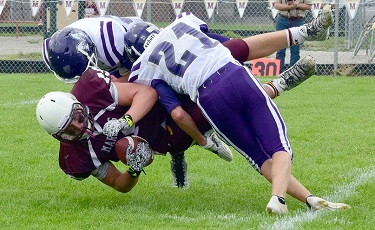
PHOTOS: (Top) Senior Nathan Nowack (36) follows two of his blockers during this season's game against Marquette. (Middle) Hunter Hass works to avoid a Marquette defender on a rainy night. (Below) A Menominee ball-carrier holds onto the ball as two Marinette, Wis., players tackle him. (Photos courtesy of Val Ihde.)

Longtime Crew Leader Harrelson Begins 32nd Season on Chains, Amid Cancer Fight
By
Tom Spencer
Special for MHSAA.com
September 11, 2026
First down! Move the chains.
 As a member of the Suttons Bay chain gang, Jim Harrelson doesn’t know how many more times he’ll follow the referee crew’s direction on the Norsemen sideline. Similarly, he has no idea how many times he’s already moved the chains.
But, in the meantime, every time he does, it will undoubtedly be a school record. An unofficial record of course, but a well-earned and appreciated achievement nonetheless.
Harrelson stepped on the field Wednesday night sporting a down marker for the 32nd straight year. This time, it was for the Norse’s middle school contest with Onekama. Harrelson was joined by Curt Murphy and Dave Faught. Mike Gordon, another regular member of the crew, was also on hand to celebrate Harrelson’s 32nd season.
Wednesday’s chain gang team was organized – no surprise – by Harrelson. It’s something he’s done on a volunteer basis for Suttons Bay the last 16 years.
Harrelson’s crews have staffed middle school, junior varsity and varsity football games, including the home contests during the Norsemen’s three straight seasons from 2019-21 that culminated in three trips to 8-Player Division 1 Finals. Harrelson, Faught, Murphy and Gordon are in their 10th season working together.
“The chain gang was always his baby, and he was always able to go find other people to help him out,” said Doug Periard, a long-time member of the Norse football coaching staff and former school athletic director. “Somehow he managed to get some of those who might not have done much in football, to suddenly come on board and enjoy doing it.”
Harrelson, who last spring retired from a coaching career spanning 35 years, has no intentions of letting anything get in the way of holding the down marker for the Norsemen.
 “I've always loved sports, and being a part of the chain gang was always big part of it,” Harrelson said. “The ADs didn’t have to worry about it, knowing it was taken care of.”
Jamie Hawkins, Suttons Bay’s principal and current athletic director, was on hand for Wednesday’s kickoff as well. Hawkins, one of the administrators who has relied on Harrelson, believes the community owes Harrelson a huge thank you, acknowledging he has marked more first downs than anyone could ever comprehend.
“Jim’s years as a coach and chain gang chief are an amazing commitment to our student-athletes, our football program, and the entire Suttons Bay community,” said Hawkins. “His time, energy, and passion have been a part of countless Friday nights and memories for generations of Norsemen.”
Harrelson, now 82, is battling cancer for the second time in his life. He was first diagnosed with colorectal cancer in 2010. Early this year, he was told cancer had returned.
Working with doctors and his wife of 53 years, Brenda, Harrelson picked a six-week treatment plan this summer timing it so he could return to the sidelines for the first football game. He’s awaiting word from his medical team on the outcome of the most recent treatment.
“I haven't let it dominate my life – everybody's going to have trials and tribulations no matter what,” Harrelson said of his cancer return. “Cancer is something that thousands of people find themselves having to deal with, and I'm pretty proud I've been able to function pretty much as normal as could be even though it’s obviously right there in front of me.”
Harrelson’s coaching journey began in 1991 with softball, drawn into the role as his children made their way through the Suttons Bay school system. He went on to serve as an assistant and head volleyball coach from 1996 through 2004.
Eventually he served as an assistant or head coach for Suttons Bay in golf, cross country and track.
 Among the highlights of his time on the volleyball bench was helping guide the 2001 squad all the way to the MHSAA Finals, where the team earned a runner-up finish in Class C.
A short while ago, Harrelson was honored with the Don Lukens Legacy Award at the Traverse City Record-Eagle John Lober Honor Roll Meet for his coaching of student-athletes from all four Leelanau County schools – Maple City Glen Lake, Leland, Lake Leelanau St. Mary’s and Northport (with some of that coaching was made possible through the schools becoming a part of a co-op with Suttons Bay).
Much of Harrelson’s coaching was on a purely volunteer basis – even while serving as a head coach responsible for running an entire program.
Now, Harrelson’s favorite thing is watching his grandchildren grow and compete in sports, while admiring his adult children’s great parenting.
Harrelson points to his first grandchild’s birth 15 years ago as a prime motivator during the first cancer round. The Harrelsons have seven grandchildren now, one of whom was playing volleyball Wednesday night for Suttons Bay’s middle school team – with Grandma in the stands.
And while he’s remembered fondly by Leelanau athletes and athletic directors for his coaching commitment and success, Harrelson has only one thought for his family legacy.
“I just hope if I’m remembered for anything by my grandchildren and my kids is that I handled cancer pretty well without letting it affect me in any way, shape, or form in how I behave, how I coach or whatever,” Harrelson said. “I am pretty doggone proud of the fact that I've been able to put that on the table and still be able to function.”
Periard already views Harrelson as a great student-athlete advocate and solution finder.
“It was an incredible amount of time he put in doing the stuff he did and how much he loved it,” recalled Periard. “Cross country, track, whatever he was called upon, he was there to help out. He's a jack of all trades, a great kids guy at heart.”
 Harrelson’s first paid coaching job was as an assistant for track in 2006. At the time he was hired by Cody Ingils, then the Suttons Bay athletic director and now a senior assistant director for the MHSAA.
Harrelson asked Inglis a decade ago to delivery his eulogy someday upon the veteran coach’s passing.
“Jim also always wanted the best for kids at every turn, and he wanted to be a positive force in kids’ lives – and I think Jim's ultimate takeaway is he met the kids where they were and tried to make sure that they got better,” Inglis said. “Jim was able to work with elite athletes, and he was able to work with kids that had never done that sport before. And that was the beauty of his coaching, is that it applied to anybody and everybody because of his positive way of dealing with kids.”
Harrelson, who points to track as his favorite sport to coach because of the camaraderie, is ready to keep moving the down marker as he battles the return of cancer.
“What I've been experiencing is part of who I am,” Harrelson said. “It’s just the cards I've been dealt. I just want to do it with class if I can.”
 Tom Spencer is a longtime MHSAA-registered basketball and soccer official, and former softball and baseball official, and he also has coached in the northern Lower Peninsula area. He previously has written for the Saginaw News, Bay County Sports Page and Midland Daily News. He can be reached at [email protected] with story ideas for Manistee, Wexford, Missaukee, Roscommon, Ogemaw, Iosco, Alcona, Oscoda, Crawford, Kalkaska, Grand Traverse, Benzie, Leelanau, Antrim, Otsego, Montmorency, Alpena, Presque Isle, Cheboygan, Charlevoix and Emmet counties.
PHOTOS (Top) Suttons Bay football chain gang leader Jim Harrelson plants his down marker on the sideline during Wednesday’s middle school game with Onekama. (2) Harrelson shakes hands with referee Ed Blough. (3) Harrelson stands for a photo with Suttons Bay principal and athletic director Jamie Hawkins, far left, past athletic director and longtime coach Doug Periard, far right, and his chain gang of (from left) Dave Faught, Curt Murphy and Mike Gordon. (4) Harrelson enjoys a break in the shade. (Top and sitting photos by Meredith McNabb Photography. Others by Tom Spencer.)