

Menominee's Man Among Maroons
June 28, 2012
Ken Hofer walked high school football sidelines as a head coach for nearly a half-century. That, in itself, is an incredible accomplishment.
But Menominee's recently-retired and legendary coach packed plenty of success into his 48 seasons, a tenure that began in his hometown of Stephenson.
- Hofer is retiring with a record of 342-136-3 and after three straight nine-win seasons.
- His teams have made the MHSAA playoffs at the ends of the last 16.
- The Maroons won 29 straight games from 2006-2008, with back-to-back 14-0 finishes in 2006 and 2007.
- His teams won three MHSAA championships, in those two perfect seasons and in 1998.
- In three of the last six seasons, his offense scored more than 500 points.
"His impact has been felt for generations, and his legacy will continue to inspire students into the future," Menominee superintendent Erik Bergh wrote when Hofer made his announcement.
Click to read our Q&A with the longtime Maroons coach, who stepped down earlier this month.
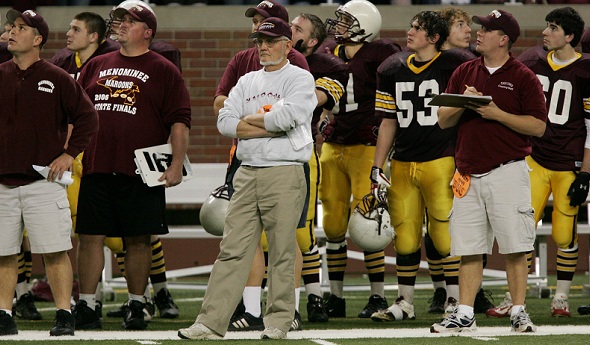
PHOTO: Ken Hofer, center in gray sweatshirt, coached Menominee to a 41-6 win over Madison Heights Madison in the 2006 Division 5 Final at Ford Field.

Summer Football Safety
June 23, 2017
Across the U.S. this summer, school-age football players are flocking to camps conducted by colleges and commercial interests. They get outfitted in full gear and launch themselves into drills and skills work.
Unlike the start of the interscholastic football season, the players usually do this without several days of acclimatization to avoid heat illness, and without limits on player-to-player contact to reduce head injuries.
Required precautions of the school season are generally ignored at non-school summer camps.
One notable exception to this foolish behavior is found in Michigan where the Michigan High School Athletic Association prohibits member schools’ student-athletes from using full equipment and participating in full-contact activities outside the high school football season. This is not a recent change; it’s been the MHSAA’s explicit policy for more than four decades.
And it’s a policy that has never been more in style and in favor than it is today.