

MHSAA Opposes Big Ten Friday Football
November 2, 2016
By Geoff Kimmerly
Second Half editor
The executive director of the Michigan High School Athletic Association said today that he is “disappointed and disheartened” by the Big Ten Conference announcement that it will play and televise football games on Friday nights beginning with the 2017 season.
Friday night football remains one of the strongest and longest-standing traditions in high school athletics, and the MHSAA has fought since the start of this century to keep Friday nights sacred against the overstepping of college football and the damage televised Big Ten games are now expected to cause to attendance and media coverage of the sport at the high school level.
MHSAA Executive Director John E. “Jack” Roberts was contacted by both Big Ten Conference commissioner Jim Delany and Michigan State University athletic director Mark Hollis before the decision was announced. Roberts said he is appreciative of Michigan State and University of Michigan’s low tolerance to be included in this venture – at most, both will host a Thursday or Friday night game during Labor Day weekend and play one Friday night away game during the remainder of a season – but remains frustrated that similar respect for high school football was not shown by the conference as a whole.
Michigan State has played Friday night games during Labor Day weekend the last six seasons, hosting five and playing at Western Michigan University in 2015. However, most Michigan high school games continue to be scheduled and played on the Thursday before Labor Day, relieving holiday travel conflicts in most communities. University of Michigan did play on the Thursday before Labor Day at University of Utah in 2015, but has not played on a Friday night of Labor Day weekend this decade. The Wolverines are one of five Big Ten schools without a Friday night game in 2017.
“We are saddened by this decision. We had hoped that the Big Ten Conference would stay above this. We think this cheapens the Big Ten brand,” Roberts said. “Fans won’t like this. Recruits won’t like this. And high school football coaches won’t like this.
“We are grateful that Michigan State University and the University of Michigan are trying to minimize the effects of this decision by the Big Ten. But overall, this is just the latest step by major college athletics in the pursuit of cash that is just crushing high school sports.”
The MHSAA has shown its opposition to the use of Friday nights for televised collegiate football games for more than 15 years, dating back to 2001 when the NCAA lifted its restrictions on Friday night telecasts, which at first led to the broadcasting of “mid-major conference” games on the same night traditionally reserved for high school athletes.
The MHSAA launched in 2001 its “Save Our Friday Nights” campaign to emphasize the role that Friday night high school athletic events play in communities and to rally MHSAA member schools to contact NCAA member school football coaches, athletic directors and conference commissioners to voice their concerns.
In addition to causing lower attendance at events going up against Big Ten football games, Roberts anticipates that Friday night college games also will leave high school football as a secondary priority in many media markets. More than 80 radio stations statewide cover high school games regularly, but many also carry Michigan State or University of Michigan football. High school football could lose significant time on local TV highlights shows and in print and online coverage as well, as resources are diverted to cover a college game – potentially quieting significantly the positive buzz that comes from the typical high school football Friday night.
“Everyone knows that football is struggling right now,” Roberts said. “It’s getting a lot of bad publicity. Participation is declining. And now this; there couldn’t be worse timing.”
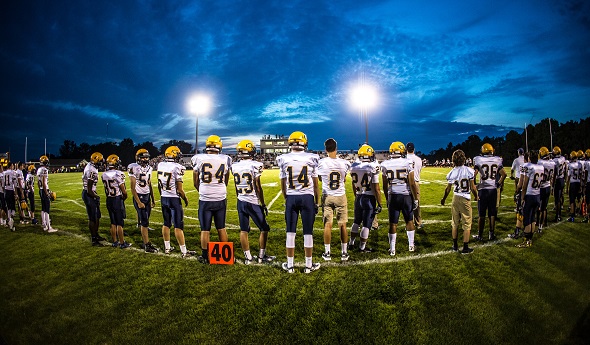
PHOTO: Grand Ledge takes on Okemos under the Friday night lights this season. (Click to see more from HighSchoolSportsScene.com.)
As Grayling Navigates Changes, Hunter Provides Reliable Impact in Return
By
Tom Spencer
Special for MHSAA.com
September 12, 2025
Changing.
 That may be the best description of the Grayling High School football team this year. Fairly big changes have already occurred, more are ahead, and at least one is already scheduled for next fall.
Grayling, off to a 1-1 start, has a new head coach – Michael Kososky, who served as an assistant for the Vikings the past 10 years, has taken over the helm. He started as a defensive backs assistant and became the defensive coordinator in his fourth year. Kososki replaced Eric Tunney, who stepped down after a 2-7 finish last year.
The latest change for the Vikings is losing junior running back Gregory Martin for the season with a neck injury. That happened during last week’s 36-6 win over Benzie Central. The game was stopped with 3:22 remaining after Martin was taken off the field by emergency medical staff. Kososky said he hopes Martin will return for track in the spring and next football season.
What didn’t change much this year is the Vikings’ schedule. They lost five games last year to playoff teams. One of those five is not on the schedule this year, but Maple City Glen Lake, another returning playoff qualifier, has been added. Grayling hopes to compete for the Northern Michigan Football League Legends title one more time, as the Vikings will be playing in the Northern Shores Conference beginning next season.
Perhaps the biggest change for the Vikings this year is senior Daniel Hunter lining up on both sides of the line of scrimmage. That was not the case last year as he battled a complication-riddled ankle injury suffered his during a basketball game as a sophomore center.
The injury, first diagnosed as an ankle sprain, kept him off the basketball court last winter as a junior.
“I ended up finishing that (2023-24) basketball season on it, and I got it checked out again because it was not getting better,” said Hunter, who plays wide receiver and defensive end. “They found out that there was a bone fracture, a talus bone.”
Even though it’s a very small bone, the talus plays a big role in one’s ability to stand and move. Injuries and damage to the talus can take longer to heal and have a higher risk of complications than those to other bones.
Doctors told Hunter he could either play on it and delay surgery or undergo an immediate procedure. Because he was advised he likely couldn’t damage it further, Hunter chose to play summer basketball and football last fall before scheduling surgery.
 “I decided to play on it throughout the summer and then into my junior year of football so I wouldn't miss out,” Hunter said. “I got surgery on it after football season and sat out my junior year of basketball.”
That football season was wrought with pain for the Hunter. He played in all but one of the Vikings’ games though.
“I only ended up playing one way — I only played on offense for the season,” he said. “It was pretty tough. Game day adrenaline helped.”
Kososky vividly recalls Hunter overcoming pain to play every down he could.
“He took it as far as he could take it,” Kososky said. “He was a kid that never missed a practice. Even if he decided to sit out that day because his ankle was throbbing, he wasn't taking the day off.”
So far this season, Hunter has six receptions for 71 yards. Now moving from linebacker to defensive end, he also has one tackle for a loss, a forced fumble, two assists and one sack.
“Daniel is an impact player on both sides of the line of scrimmage,” Kososky said. “He put a little bit of size on over the spring and summer. So it suits him real well at defensive end.”
Kososky, who played football for Mio High School and Northern Michigan University, points to Hunter as a shining example of the culture he’s trying to instill in the Grayling football program.
“There are a couple staples that I brought here to Grayling, and I kind of just refocused them this being my first year,” Kososky said. “We have a mantra we talk about each and every day: DEAD. It's dedication, effort, attitude and discipline, and Daniel holds those standards.”
Kososky has significantly reduced the size of the Vikings’ playbook this season.
“The way we do one thing is the way we do everything,” he said. “Instead of running as many plays as possible, we’re focused on being really efficient and perfect at what we have in front of us.”
Grayling has a couple of significant league road games coming up, and both Kososky and Hunter are really looking forward to them. Tonight the, Vikings will take on Kingsley, and next week Traverse City St. Francis.
Kingsley is 1-1 this season, and St. Francis is 2-0. Hunter hasn’t experienced a win over either conference foe during his high school career.
“I think a win over Kingsley would feel really good because I have lost to them every time we played them,” Hunter said. “I did end up sitting out a game last year, and that was St. Francis, and I have to get that win before I graduate.”
Regardless of the outcomes against the Stags and Gladiators, Kososky will keep focused on teaching life skills.
“Wins will help put you on the map and everything like that, but what my kids learn from the program I think is more important,” said Kososky, who also teaches special education and math at Grayling. “I can go back to many seasons that that I've coached and we were 3-6 and 4-5, and I'm going to be honest, the kids out of those groups probably are more successful in life than some of the teams that have gone undefeated. It’s how successful we are after the game of football, not during the game of football.”
 Tom Spencer is a longtime MHSAA-registered basketball and soccer official, and former softball and baseball official, and he also has coached in the northern Lower Peninsula area. He previously has written for the Saginaw News, Bay County Sports Page and Midland Daily News. He can be reached at [email protected] with story ideas for Manistee, Wexford, Missaukee, Roscommon, Ogemaw, Iosco, Alcona, Oscoda, Crawford, Kalkaska, Grand Traverse, Benzie, Leelanau, Antrim, Otsego, Montmorency, Alpena, Presque Isle, Cheboygan, Charlevoix and Emmet counties.
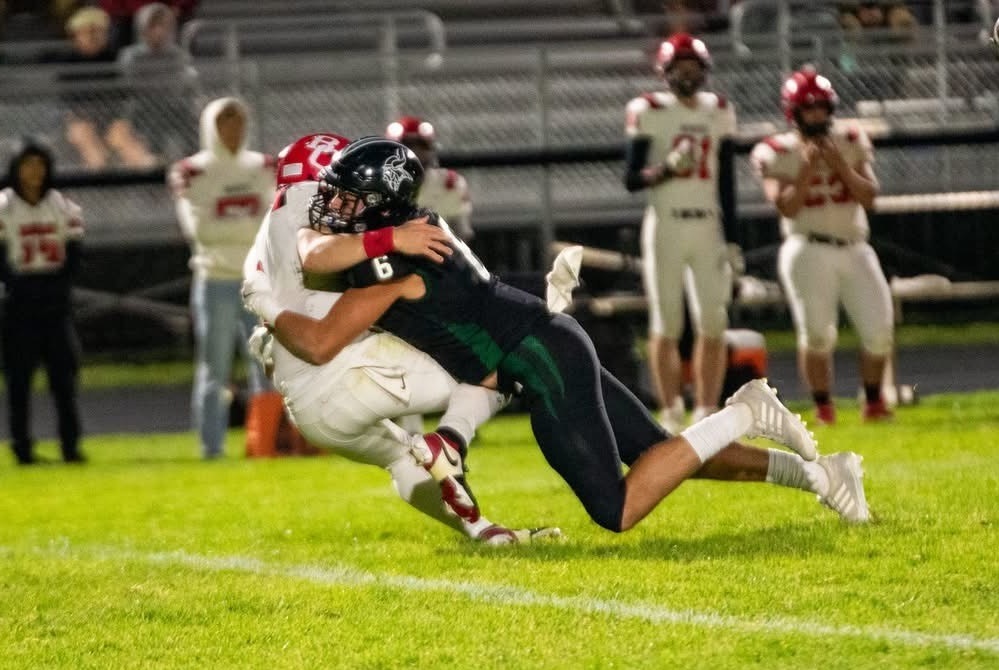
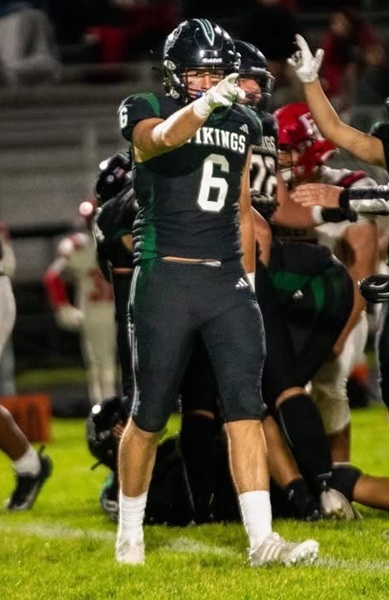
PHOTOS (Top) Grayling’s Daniel Hunter wraps up a Benzie Central player during an incompletion in Week 2. (Middle) Hunter points to his team’s sideline after the play. (Photos by Mylie D’Amour.)