


MHSA(Q&)A: Football Coaches Jim Ahern and Brad Weber
August 31, 2012
 Pewamo-Westphalia football coach Brad Weber and Lansing Catholic's Jim Ahern had experienced plenty of success long before the end of last season.
But this month marked the first time either had returned to the sideline after a trip to the MHSAA Finals.
Their teams faced off on opening night at Holt Junior High, the Cougars' home field. Gone were Lansing Catholic's all-state quarterback-receiver tandem that helped the Cougars finish Division 5 runner-up last fall, as well as the large group of standout se niors who guided the Pirates to the Division 7 Final.
 But the coaches are back for more, and we caught up briefly with both after Lansing Catholic's 45-21 win. (Lansing Catholic fell to 1-1 this week with a loss at Saginaw Nouvel, while P-W improved to 1-1 with a win over Potterville.)
This has to be the most unfamiliar group you've had at Lansing Catholic?
Ahern: They're a good group from the standpoint that they have a lot of team chemistry. They're a close-knit group, and they've worked extremely hard in the offseason. I know every coach says that. But this, probably of all the groups I've had, has really worked hard. We were a little nervous. We had a lot of kids playing in spots where they hadn't been there, but they settled down a little bit.
Have the players approached things differently because of how you ended up last year?
Weber: A little bit. But it's still football, and they've been playing football since sixth grade. It shouldn't be too different.
Are you (as a coach) approaching some things differently?
Weber: Yes and no. We're still getting down to business. Practices are the same. We still have a lot of energy at practice. But you do. You're looking for a little bit of the senior leadership to step up because it was so good last year. These guys kinda took it for granted, and they rode on their coat tails, and it's time for them to step up and be leaders of this team. It's 2012 now.
Ahern: Not really. Every year I tell everyone the same thing. Our goal is to win the league. If we do that, good things will happen. That's our goal -- to win the conference. ... We're still running the same stuff pretty much. We haven't changed a whole lot.
Do you have to say things to certain guys who are replacing (all-staters), like 'Do you know what you're stepping into?'"
Ahern: You don't have to remind them about it. They know it. They don't need to hear it. I think that's why they work so hard in the offseason. The bar's set pretty high for them, so they want to continue that.
Fund Helps Love for Comstock Live On
By
Pam Shebest
Special for MHSAA.com
August 21, 2018
COMSTOCK TOWNSHIP — Several years ago, Josh Whitfield and his sister, Mandy Hanson, were sitting around a bonfire just chatting when they touched on a subject that fired up the normally easy-going Comstock High School graduate.
 Whitfield had started helping coach the girls soccer team and realized that to be involved in sports, Comstock athletes had to “pay to play.”
“It takes a lot to get him riled up, to get him angry or upset,” Hanson said. “He was talking about, ‘Can you believe it? You have to pay to play sports at Comstock.’
“I was like, that’s crazy. He was getting so upset talking about it. Some of these girls paid to play but then couldn’t afford the right equipment.”
Whitfield, a 2000 grad and four-year multi-sport athlete at Comstock, said he wished he had enough money to help out.
That opportunity would come out of the saddest of circumstances. But as his loved ones continue to heal from Whitfield’s untimely death in 2015, they’ve created an opportunity for his memory to impact the Comstock athletic community for years to come.
That May, while playing golf with friends, including Hanson’s husband Mike, Whitfield said he did not feel well and left the group on the second hole.
“Of course, the guys razzed him about it because it wasn’t like Josh to leave in the middle of a round of golf,” his sister said.
When Whitfield’s mother, Becky, called him at home later, he told her he was having trouble breathing. He called 9-1-1 and his dad, Vic, drove to his son’s house just as the EMTs arrived.
Whitfield did not survive, dying from a double lung collapse. He was just 33 years old.
Two of his buddies, Eric Stewart and Chad Howard, wanted to do something to keep Whitfield’s memory alive.
“We were all struggling a lot,” Stewart said. “Josh had an extremely tight-knit group of friends. It was really hard for a lot of us. We were talking about ways to spin positive out of grief.
“We were like, ‘What can we do to honor his memory, to keep his name alive?’
We thought it would mean something to his family. We knew it would mean something to Comstock, because Comstock is in a tough place right now.”
The buddies had the idea for a fundraiser to help a few Comstock athletes pay to play. They were hoping to raise at least $1,500 through an alumni soccer game.
They were stunned to raise $5,000.
‘Spinning positive out of grief’
Over three years, the group – which has gone from the two friends to a committee of 14 – has raised more than $52,000 and so far donated more than $27,000 of it to various athletic causes in Comstock.
 “It started with Eric and Chad, who asked how they could help and wanted to set up an alumni soccer game to help offset the pay-to-play fees,” Comstock athletic director Justin Ansel said. “Initially, I wasn’t sure how big this would be or how sustainable this would be.
“Unfortunately, this entire thing was started by a tragedy. It’s a testament how, at Josh’s young age, how people rallied around him for this. It’s just special how the community comes together to remember Josh. We are thankful for what this organization does for our student-athletes.”
The fund has supplied about $5,000 for pay-to-play scholarships, helping more than 350 middle and high school athletes with activity fees and physical exam fees. But those have not been the group’s only focus.
“For example, someone might say I can’t pay the $75 for Rocket Football,” Stewart said. “We will approve that and send the check in to Rocket Football.
“We also do grants to teams and organizations focused on Comstock. We did Eastwood Little League through a $5,000 grant last year. We’re really excited to sponsor the First Day Shoe Fund. We bought all the kids in Comstock shoes. We know that a healthy lifestyle, teamwork, all are bred through athletics.”
This year, the group will have extra money available.
“As it happens, Comstock has a new superintendent this year in Jeff Thoenes,” Ansel said. “One of his first actions as superintendent was to remove our activity fee barrier so we no longer have this fee for the start of the 2018-19 school year.
“They still plan to fund things like athlete equipment, needs like shoes or shin guards along with a variety of other things.”
Without the pay-to-play expenditures, Stewart said, “Our goal now is to really push toward those youth athletic programs: AYSO, Little League, youth football, youth golf camps, soccer camps. We’re creating feeders to the high school that otherwise don’t really exist at Comstock.”
With Comstock’s entry a few years ago into the Berrien-Cass-St. Joseph Conference, teams travel more than 40 miles to many games. At first, the school transported athletes to the games, but parents took them home.
“Now the fund pays to bring kids home,” Stewart said. “Parents in poverty can’t drive that far to pick up their kids. That’s not OK, and we wanted to fix that.”
Continuing to grow
Once the original fund hit $5,000, Stewart and Howard did not want the sole responsibility of doling out the money.
“We said we need to vet this through a group of people,” Stewart said.
So they formed the non-profit Josh Whitfield Memorial Athletic Fund.
The board of directors is made up of Josh’s friends and family, and funds are distributed through the Comstock Community Center.
The committee sponsors three fundraisers each year: a golf outing, an alumni soccer game and a holiday party in December. It also accepts donations through its website (www.jwmaf.org).
The golf outing in June includes about “a quarter of the field with Whitfields,” Stewart said. “It’s always bittersweet when we get together for that reason, but I think it’s a good avenue to go through some of those things. Oftentimes it’s like a support group.”
 The soccer tournament is set for Sept. 21 at the school.
“It started out as an alumni soccer game, and then we had people who weren’t alumni that wanted to play,” Hanson said. “We said of course.
“It’s just getting out there and having fun. Last year, the oldest was mid-40s and the youngest just graduated.”
Said Stewart: “We usually get about 50 who sign up. It’s a hoot. It’s a good time. Everybody’s getting older, but it’s fun to relive the glory days.”
The holiday party last December was held at Kalamazoo’s Tibbs Brewing Company, which donated a portion of the sales to the fund.
Hanson and brother Matt Whitfield are members of the committee, which meets once a month to review applications.
“A couple committee members work in Comstock schools, so they see what’s going on and they see a need,” Hanson said. “The committee generally takes a vote. If the applicant meets what we’ve set forth in the guidelines, then we do grant them the money.”
Applicants also can apply through the website, but must be connected to Comstock athletics.
All committee members are volunteers, with 100 percent of any money raised going into the fund.
Besides Stewart, Howard, Hanson and Matt Whitfield, board members are
Sara Howard, Alyssa Stewart, Rolly Taylor, Travis and Marie Law, Tyler and Shannon Howard, Loreen Hospodar, Katy Seward and Mason Everett.
“It is amazing,” Hanson said. “It’s truly an honor. I think to myself, my gosh, Josh would be so humbled to know that this is happening because of him.
“I think secretly he’s laughin’ and lovin’ it up there.”
 Pam Shebest served as a sportswriter at the Kalamazoo Gazette from 1985-2009 after 11 years part-time with the Gazette while teaching French and English at White Pigeon High School. She can be reached at [email protected] with story ideas for Calhoun, Kalamazoo and Van Buren counties.
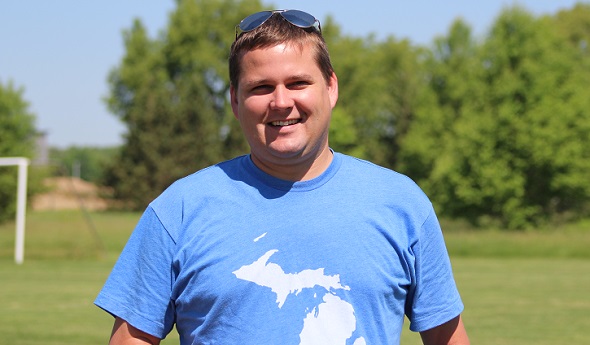
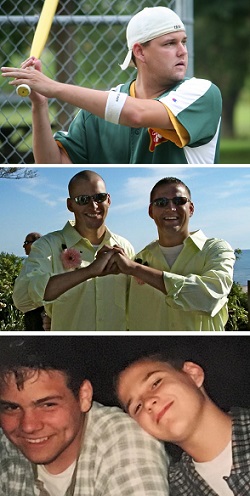
PHOTOS: (Top) Josh Whitfield in 2015, shortly before his death. (Top middle) Friend Eric Stewart, left, and Comstock athletic director Justin Ansel. (Middle) From top, Josh Whitfield playing wiffle ball, Josh and brother Matt Whitfield, and Josh and Stewart. (Below) Mandy Hanson, right, with daughter Madi. (Hanson photo by Pam Shebest; other photos submitted by Eric Stewart or Mandy Hanson.)